The Green Lantern/Green Arrow run by Denny O'Neil and Neal Adams (Green Lantern vol. 2 #76-89, 1970-1972) remains the defining Bronze Age arc: the first issue (GL #76, April 1970) carries an eBay blended median of €9 across 69 listings: though graded mid- and high-grade copies trade well above that. The Geoff Johns trilogy (Rebirth , Sinestro Corps War , Blackest Night, 2004-2010) anchors the modern-era market.
Green Lantern is the only DC franchise to span four comic-book eras with two entirely distinct heroes sharing the same mantle. Alan Scott: created by Martin Nodell and Bill Finger in All-American Comics #16 (July 1940): defines the Golden Age. Hal Jordan, conceived by John Broome and Gil Kane in Showcase #22 (October 1959), launched the Silver Age. John Stewart (first appearance: GL #87, December 1971, created by Denny O'Neil and Neal Adams) and Guy Gardner (first appearance: GL #59, 1968, created by John Broome and Gil Kane) broadened the Bronze Age roster. That depth makes Green Lantern an unusually rich hunting ground for collectors across every era.
This guide relies exclusively on verifiable data: eBay medians from our estimator (eBay.fr + eBay.com, June 2026) and auction records documented by Heritage Auctions and specialist press. The Golden Age and Silver Age grails (All-American Comics #16, Showcase #22) belong to separate series not covered by our tool: documented auction results are the only reliable price reference for those issues.
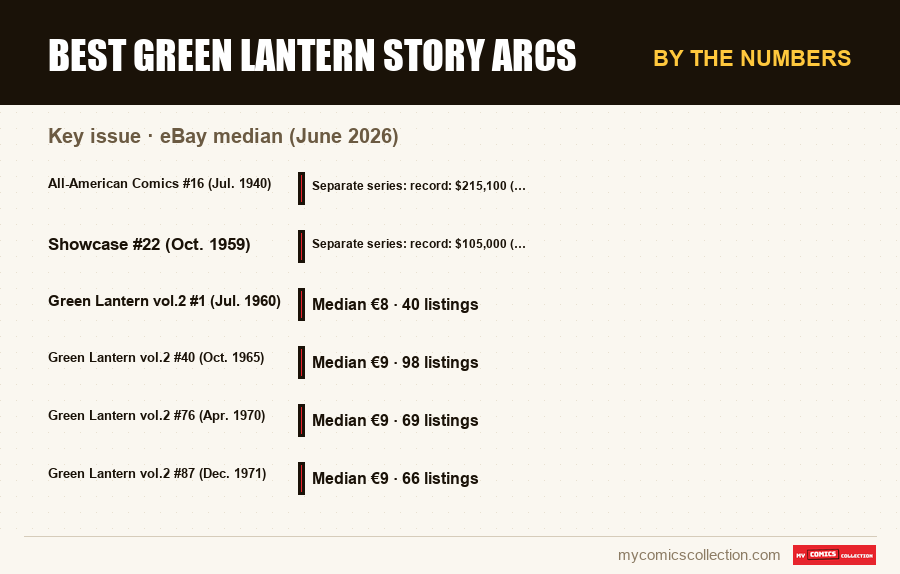
Key issue reference table (real data, June 2026)
The eBay medians below blend all grades and printings. For Bronze Age keys in particular, CGC mid- and high-grade copies can command several hundred to several thousand euros above the blended median.
| Key issue | Arc / significance | eBay median (June 2026) |
|---|---|---|
| All-American Comics #16 (Jul. 1940) | 1st appearance of Alan Scott (Golden Age) | Separate series: record: $215,100 (CGC 6.5, Heritage 2018) |
| Showcase #22 (Oct. 1959) | 1st appearance of Hal Jordan (Silver Age) | Separate series: record: $105,000 (CGC 9.2, ~2021) |
| Green Lantern vol.2 #1 (Jul. 1960) | Launch of Hal Jordan's solo series | Median €8 · 40 listings |
| Green Lantern vol.2 #40 (Oct. 1965) | 1st Krona, origin of the Guardians and multiverse | Median €9 · 98 listings |
| Green Lantern vol.2 #76 (Apr. 1970) | Start of O'Neil & Adams GL/Green Arrow run: Bronze Age landmark | Median €9 · 69 listings |
| Green Lantern vol.2 #87 (Dec. 1971) | 1st appearance of John Stewart | Median €9 · 66 listings |
Record sources: Heritage Auctions, GoCollect, sellmycomicbooks.com.
GL/Green Arrow #76-89 (1970-1972): the arc that launched the Bronze Age
In April 1970, Green Lantern #76 pivoted the franchise entirely. Writer Denny O'Neil and artist Neal Adams abandoned the space-opera format to engage with poverty, racism, drug abuse, and social injustice in contemporary America. The opening story, « No Evil Shall Escape My Sight, » won O'Neil the Shazam Award for best individual story of 1970. Green Arrow joined the title as co-star, the first sustained co-feature in DC history, and the run continued through #89 (1972). Along the way, issue #87 introduced John Stewart, a Black architect from an urban ghetto, as the first alternate Green Lantern: O'Neil and Adams brought the same social consciousness to his debut that permeated the entire run. Our eBay estimator returns a blended median of €9 across 69 listings for #76 and an identical median across 66 listings for #87. Those figures represent mostly ungraded reading copies; CGC 9.6 examples of #76 in CGC 9.8 reached $31,000 (Heritage 2014).
Emerald Twilight (1994): the fall of Hal Jordan
Green Lantern vol.3 #48-50 (January-March 1994) is one of the most controversial, and most consequential, arcs in the character's history. Written by Ron Marz and drawn by Darryl Banks, it follows Hal Jordan as he descends into madness after the destruction of his hometown Coast City. Hal rampages through the Corps, stripping ring after ring from fellow Lanterns, kills Sinestro and Kilowog on Oa, drains the Central Power Battery, and re-emerges as the supervillain Parallax. Guardian Ganthet bestows the last surviving ring on Kyle Rayner, a struggling illustrator who becomes the sole Green Lantern. The arc was fiercely debated on its release but is now essential reading: without Emerald Twilight, Geoff Johns's Rebirth has no foundation. Issues #48-50 remain affordable, typically below €15 for ungraded copies on eBay, making them an accessible entry point into the modern GL canon.
Green Lantern: Rebirth (2004): Hal Jordan returns
A decade after Emerald Twilight, Geoff Johns and Ethan Van Sciver delivered a meticulous six-issue comeback (Green Lantern: Rebirth #1-6, November 2004: July 2005). Johns reframes Parallax not as a synonym for Hal's insanity but as a Fear Entity that had possessed him: exonerating Hal and restoring him fully to the Corps. The arc reunites Hal Jordan, Guy Gardner, John Stewart, and Kyle Rayner in a single, coherent continuity and sets the template for everything that follows. It is one of the most structurally accomplished comeback stories in mainstream American comics. Rebirth #1 (2004) is a modern key: collectors should target first printings (no « 2nd printing » notation on the cover).
Sinestro Corps War (2007): war across the spectrum
Published across the summer and autumn of 2007 in Green Lantern vol.4 #21-25 and Green Lantern Corps #14-18, The Sinestro Corps War was co-written by Geoff Johns, Dave Gibbons, and Peter Tomasi. Sinestro builds a rival Corps fuelled by fear, recruits the Cyborg Superman and Superboy-Prime, and launches a galaxy-wide offensive. The arc's major narrative contribution is the expansion of the ring mythology to encompass the full emotional spectrum (seven Corps, one for each colour) which directly paves the way for Blackest Night. The first printings of #21-25 sold out immediately on release and went to second printings; first editions are the collector target. This is arguably the finest DC crossover event of the 2000s.
Blackest Night (2009-2010): the darkest night in the DCU
Blackest Night (2009-2010), written by Geoff Johns and drawn by Ivan Reis, is the culmination of the Johns trilogy. Nekron, the personification of death, reanimates deceased heroes and villains as Black Lanterns in an attempt to extinguish all life and emotion. Hal Jordan must forge unlikely alliances with Sinestro, Star Sapphire Carol Ferris, and the embodiments of every ring colour to counter the threat. The event spans more than 70 issues of tie-ins across the DC line. Issue zero was distributed free of charge; the eight core issues of the main miniseries are the key acquisitions. Blackest Night cemented Green Lantern as the most narratively ambitious DC franchise of the decade.
On-screen adaptations and their impact on the market
The 2011 Green Lantern film starring Ryan Reynolds underperformed at the box office and had limited lasting effect on collector demand. The HBO series Lanterns , set to premiere on August 16, 2026, takes a different approach: a detective thriller in which Hal Jordan (Kyle Chandler) and John Stewart (Aaron Pierre) investigate a brutal crime. Nathan Fillion appears as Guy Gardner, a role he had already played in the 2025 DC film Superman. The series announcement renewed collector interest in John Stewart's key issues: especially GL #87, and in the broader Geoff Johns catalogue. For any collector building a Green Lantern library, the O'Neil/Adams run and the Johns trilogy provide the essential framework, with entry-level raw copies affordable and high-grade CGC examples offering a premium tier for the serious investor.
Frequently asked questions
In April 1970, Denny O'Neil and Neal Adams leave space adventures behind to take on poverty, racism, drugs and social injustice in real America. Green Arrow joins the title as co-star, and the story "No Evil Shall Escape My Sight" earned O'Neil the 1970 Shazam Award.
In Green Lantern vol.3 #48-50 (1994), written by Ron Marz and drawn by Darryl Banks, Hal Jordan sinks into madness after the destruction of Coast City by Mongul and Cyborg Superman. He becomes Parallax, and Ganthet entrusts the last surviving ring to Kyle Rayner, the new Green Lantern.
Published in six issues (November 2004 to July 2005) by Geoff Johns and Ethan Van Sciver, it reveals that Hal Jordan's corruption was the work of Parallax, a cosmic entity of fear. Hal is cleared, resurrected and reinstated in the Corps. For Rebirth #1, look for first printings without a "2nd printing" sticker.
Released in summer 2007 in Green Lantern vol.4 #21-25 and Green Lantern Corps #14-18, the arc is co-written by Geoff Johns, Dave Gibbons and Peter Tomasi. First printings of #21-25 sold out on release, which forced second printings and drives collectors to aim for first editions.
The main issues #1-8 are the keys to own. Blackest Night #0 was given away free, and the event, written by Geoff Johns and drawn by Ivan Reis, mobilizes the whole DC universe across more than 70 tie-in issues.
Own a Green Lantern comic? Get a free valuation with our tool based on real eBay sales to find its low, median, and high value.