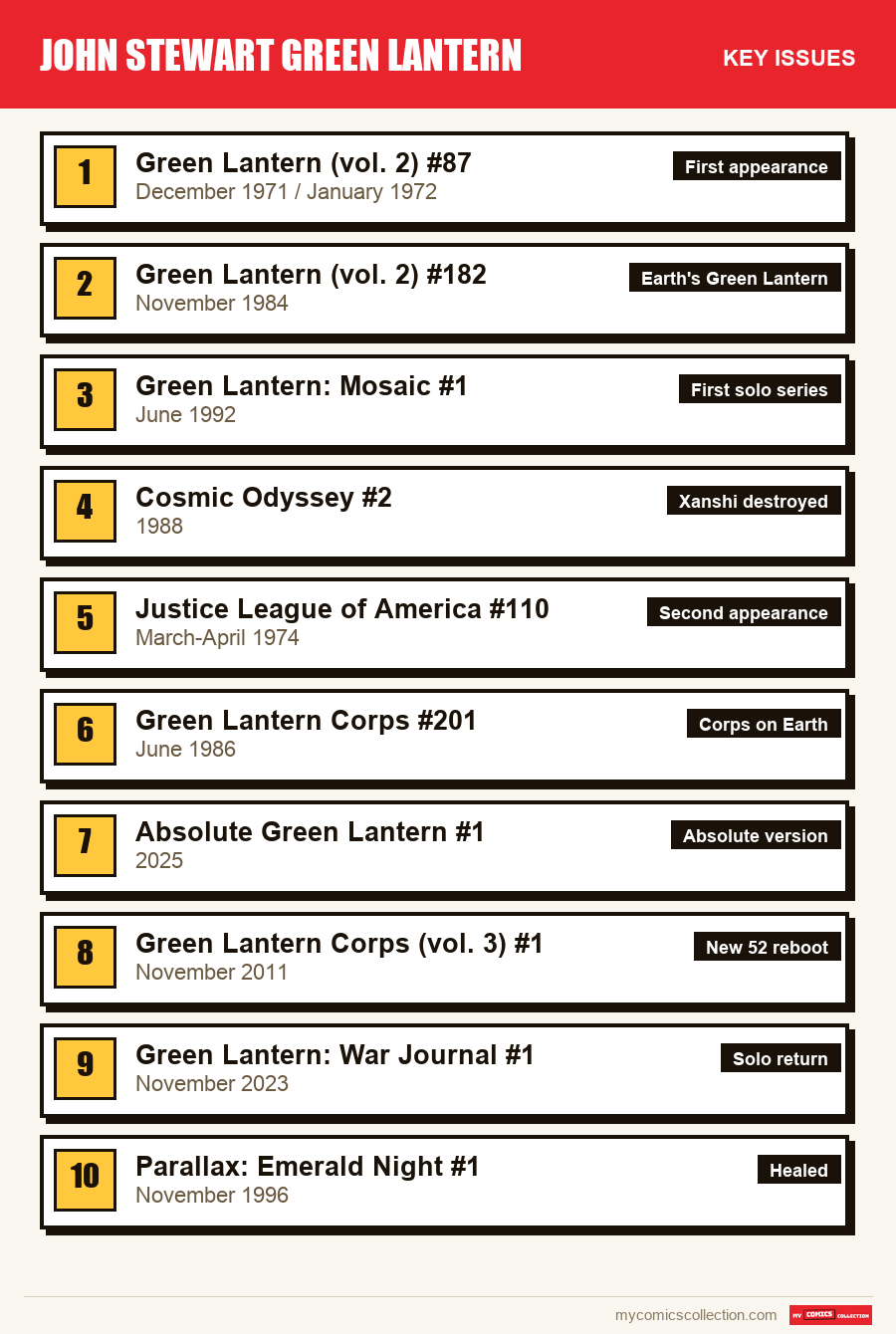
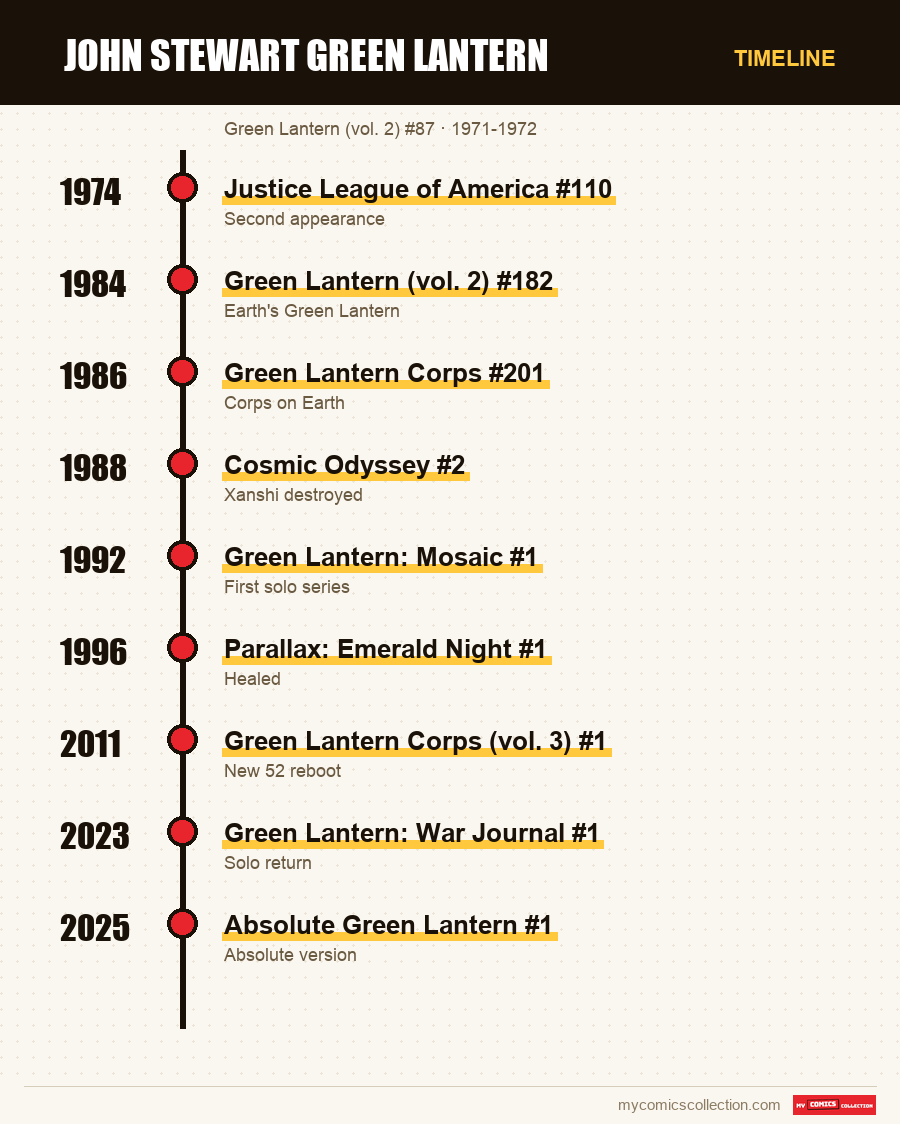
John Stewart first appears in Green Lantern (vol. 2) #87 (December 1971 / January 1972), created by Denny O'Neil and Neal Adams as the first black Green Lantern, replacing Hal Jordan. He became Earth's titular Green Lantern in Green Lantern #182 (1984), crossed over through the Mosaic and Darkstars eras, then exploded in popularity thanks to Justice League (2001) before returning as a headliner in Absolute Green Lantern (2025) and the HBO series Lanterns (2026). The key copy of the character, GL #87, commonly sells for several hundred to several thousand dollars depending on condition, with CGC 9.8 copies (34 listed out of nearly 1,950 graded copies) having reached several thousand dollars during recent sales.
There are few characters in the history of comics whose editorial trajectory so faithfully reflects the evolution of American society as that of John Stewart. Conceived in the early 1970s as a direct response to the civil rights movements, the Detroit architect turned wearer of the green ring was never a simple "second Green Lantern": he was thought of, from day one, as a life-size test of what the mainstream DC Comics readership could tolerate in terms of representation.
For collectors, John Stewart's interest is not limited to his first appearance. His editorial career spans more than fifty years and spans very different eras: the social run of Denny O'Neil and Neal Adams, his years as Earth's titular Green Lantern in the mid-1980s, the experimental series Mosaic, the Darkstars interlude, the consecration by the cartoon Justice League in the early 2000s, then a return to full light with Absolute Green Lantern and the series live-action Lanterns on HBO. Each of these periods generated its own collection keys, with very different levels of rarity and market dynamics.
This article retraces this story in detail, identifies the key issues to know and gives concrete guidelines for purchasing intelligently, whether you are starting a collection dedicated to the character or looking to complete a run of Green Lantern that is already well underway.
Green Lantern #87: the birth of John Stewart in 1971
John Stewart entered the DC universe in December 1971, in Green Lantern (volume 2) #87, in a story entitled "Beware My Power!" written by Denny O'Neil and drawn by Neal Adams. At that time, the O'Neil/Adams duo had already shaken up the codes of the superhero comic book with their socially engaged run on Green Lantern/Green Arrow, tackling drugs, poverty or institutional racism through the eyes of Oliver Queen and Hal Jordan. The arrival of John Stewart is part of this same approach: Neal Adams wanted a substitute Green Lantern who truly reflects the demographic composition of the United States, and not a simple background decoration.
The visual choice is deliberately strong for the time: Adams draws Stewart with a dark complexion, deliberately departing from the convention which consisted of lightening black characters in mainstream comics, and basing his design on the features of the actor Sidney Poitier, then an essential figure in African-American cinema. Editorially, Stewart is presented as a qualified architect, chosen by the Guardians of the Universe as Hal Jordan's official replacement with the Guardians, in the event of the latter's unavailability. The character also refuses to wear a mask, judging it unnecessary, which breaks head-on with the tradition of secret identity in the superhero genre.
From his first story, John Stewart is written as a frontal character, suspicious of Hal Jordan's white authority and aware of the racial issues of his time, a characterization directly inspired by Black Power speeches. It is this founding tension, rare for a mainstream comic from 1971, which makes Green Lantern #87 much more than a simple origin of a secondary character: it is a document of its time, today recognized as one of the first significant appearances of an African-American superhero at DC Comics.
In terms of rarity, Green Lantern #87 is a bronze age comic fairly widely distributed for the time but very high grade copies remain few in number. According to CGC census data, approximately 1,950 copies were submitted for grading, and only 34 of them received the maximum score of 9.8, or less than 2% of the total. It is this rarity at the top of the grid which explains the considerable price differences observed on the market: a 9.8 copy in white pages sold for $10,500 in a public auction, while other transactions at this same grade have been reported around $12,500 and up to $20,000 in previous periods, with strong variations depending on the context of sale and the interest of the moment for the character. Intermediate grades (6.0 to 8.0) remain much more accessible and constitute the natural entry point for most collectors who want to possess the origin of the character without aiming for the top of the census.
From simple replacement to Earth's titular Green Lantern (1974-1988)
After his founding appearance, John Stewart had a checkered career during the 1970s. His second appearance came in Justice League of America #110 (March-April 1974), where he replaced a temporarily out-of-service Hal Jordan within the Justice League. The character, however, remained a second knife for more than a decade, confined to the role of occasional understudy rather than that of the main character.
The major turning point came in 1984. In Green Lantern (vol. 2) #181, Hal Jordan resigned from his position as Earth's Green Lantern, and it was John Stewart who took up the torch in the following issue, Green Lantern #182 ("It's a Dirty Job, But...!", November 1984). For the first time, Stewart was no longer a mere occasional substitute: he became the main protagonist of the title, a position he held continuously until issue #200, before the series was renamed Green Lantern Corps (issues #201 to #224, 1986-1988). This period overlaps with the so-called "Justice League Detroit" era (1984-1986), but John Stewart was never a member of that Detroit-based Justice League (built around Vixen, Steel or Gypsy): it is in Green Lantern that he holds the lead role.
This 1984-1988 period is also marked by one of the darkest arcs in the character's career: the crossover Cosmic Odyssey (1988), written by Jim Starlin for the screenplay and Mike Mignola for the drawing, in which an error of judgment by John Stewart causes the destruction of the planet Xanshi and the death of its entire population. This traumatic event permanently redefines the psychology of the character in the following stories, turning him from a self-confident hero to a figure marked by guilt and doubt. For collectors building a thematic collection around John Stewart, this 1984-1988 sequence (GL #181-182, the Green Lantern Corps #201-224 run and Cosmic Odyssey) constitutes one of the densest and most sought-after narrative blocks in his editorial history, much more than the simple first appearance.
Mosaic, the Darkstars and the crossing of the desert (1990-1997)
The early 1990s offered John Stewart something that no other wearer of the green ring had obtained until then: a monthly series in his name alone. Green Lantern: Mosaic debuted in June 1992, written by Gerard Jones and drawn by Cully Hamner, with covers by Brian Stelfreeze. The concept is daring for the time: Stewart must administer "Mosaic", a version of Oa populated with fragments of worlds and civilizations torn from across the galaxy and forcibly brought together by the Guardians, a thinly veiled metaphor for community and racial tensions in major American cities. The series, more experimental and more mature than the average Green Lantern title of the time, concluded after 18 issues in November 1993 due to lack of sufficient audience, but it remains today hailed by critics as one of the publisher's most ambitious attempts to deepen a secondary character.
What follows is more difficult. From 1994, the "Emerald Twilight" arc saw Hal Jordan descend into madness and destroy the Green Lantern Corps as well as the planet Oa itself. John Stewart, forced to evacuate the cities of Mosaic before the destruction of Oa, is then recruited by the Controllers to lead the Darkstars, an interstellar police force rival to the Green Lanterns. He served there with distinction until being seriously injured by Grayven on the planet Rann, temporarily losing the use of his legs. It is only thanks to the sacrifice of Hal Jordan during the event "The Final Night" (1996), which stops the Sun-Eater threatening the sun, that Stewart regains his mobility, the final gift from his former mentor before his apparent death. He initially refuses a new ring, before finally accepting it and joining the Justice League to replace Kyle Rayner, then the main Green Lantern of the DC universe, during his prolonged absences from Earth.
This 1990 decade, less highlighted today than the founding period or the modern era of the character, nevertheless remains essential to understand the evolution of John Stewart: it is during this crossing of the editorial desert that he goes from the status of replacement to that of a hero in his own right, capable of bearing a title alone and surviving the disappearance of an entire intergalactic police force.
Back in the spotlight: Animated Justice League and the Geoff Johns era
The real turning point in popularity for John Stewart did not occur in comics but on television. In November 2001, the animated series Justice League landed on Cartoon Network, with Phil LaMarr lending his voice to John Stewart, chosen as THE Green Lantern of the series rather than Hal Jordan. The first episode established an audience record for the channel with more than 4.1 million spectators, and the series, extended by Justice League Unlimited until 2006, permanently established Stewart as the Green Lantern of reference for an entire generation of spectators who had, for many, never read the original comics. His love triangle with Hawkgirl, his disciplined military personality (a characterization added for the series and later repeated in the comics) and his natural authority within the team made him a character as popular, if not more, than Hal Jordan with the general public.
This television exposure directly influenced the comics of the 2000s. When Geoff Johns relaunched the Green Lantern franchise with Green Lantern: Rebirth (2004-2005), John Stewart found a place of choice alongside Hal Jordan, with whom he now shares sector 2814, carried by a notoriety that the character had never known in the comics themselves. He becomes a pillar of the great cosmic crossovers of the Johns era, notably Blackest Night (2009), where his status as veteran architect-soldier of the Corps is fully exploited.
John Stewart today: Absolute Green Lantern and the Lanterns series on HBO
The current period marks a new peak of exposure for the character, carried both by the comics and by a highly anticipated live-action adaptation. On the comics side, Absolute Green Lantern, launched in April 2025 under the pen of Al Ewing with drawings by Jahnoy Lindsay, reinvents John Stewart as part of the Absolute DC universe: an architect based in Evergreen, Nevada, he receives the Golden Flame of Illumination from the hands of Abin Sur and dons a unique yellow costume rather than the traditional green, alongside Sojourner "Jo" Mullein, Hal Jordan and Guy Gardner. This reinterpretation, deliberately distanced from classic continuity, aroused significant critical attention and revived readers' interest in the character from a completely new angle.
But it is above all the announcement of the Lanterns series, produced for HBO Max, which changes the situation for collectors. Developed by Chris Mundy, Damon Lindelof and Tom King, directed in particular by James Hawes, the series stars Aaron Pierre in the role of John Stewart, a young recruit of the Corps, alongside Kyle Chandler in that of Hal Jordan, a veteran responsible for training him. Notable fact and rarely highlighted: in this adaptation, John Stewart is explicitly presented by the production as the main character of the series, Hal Jordan occupying a role of mentor rather than central hero, a total reversal compared to the usual hierarchy of Green Lantern adaptations. Filming took place in Los Angeles between February and July 2025, for broadcast announced on HBO Max in 2026.
For the comic book market, this type of announcement always has a measurable effect, even if it remains difficult to quantify precisely before the actual release of a series. The experience of previous adaptations (whether for Hal Jordan with the 2011 film or for other DC characters brought to the screen) shows that collectors' interest in the origins and collectible keys of a character tends to be significantly revived in the months preceding a highly anticipated release. Green Lantern #87, as the character's undisputed origin, is naturally the most watched title in this context, followed by Green Lantern #182 (first time as the titular), Green Lantern: Mosaic #1 (first solo series), and, most recently, Absolute Green Lantern #1 for collectors oriented toward contemporary releases.
Collecting this series?
Track what you own, what you are missing and what your collection is worth. 7 day trial.
Start my trial →Buying Guide: How to Collect John Stewart Smartly
Building a coherent collection around John Stewart requires prioritizing according to your budget and your objectives, rather than immediately aiming for the highest grade of Green Lantern #87. Here are the points to keep in mind before buying.
- Prioritize the origin above everything else. Green Lantern #87 (1971) remains the essential founding piece. On a limited budget, a medium grade copy (VG to FN, i.e. 4.0 to 6.0) allows you to own the original story at a much lower cost than CGC 9.6-9.8 copies, the rarity of which (34 copies in 9.8 out of nearly 1,950 grades) explains significantly higher and more volatile prices.
- Don't overlook Green Lantern #182 (1984). This issue marks the point where John Stewart stops being a mere stand-in and becomes Earth's titular Green Lantern. Less sought after than #87 but historically just as central to understanding the character, it generally remains more affordable and constitutes an excellent second acquisition.
- Systematically check pages and restoration quality. For an aged bronze comic like GL #87, the difference in value between white, cream and yellowed pages can be significant at equal grade; Always require an accurate description or professional grading before any purchase above a certain budget.
- Explore Green Lantern: Mosaic (1992-1993) for background reading. The 18 issues of the series, today more confidential because they are rarely reprinted, offer one of the richest portraits of the character and generally remain accessible for a collector who wishes to complete a thematic collection without breaking the bank.
- Anticipate the effect of the Lanterns series. As the broadcast on HBO Max approaches in 2026, the prices of the character's historical keys (in particular GL #87 in high grade) are likely to move more. If you are aiming for a precise copy, it is better to follow the market upstream rather than buying in a hurry once the series is launched.
- Don't neglect contemporary releases. Absolute Green Lantern #1 (2025), as the first appearance of this alternative version of the character, deserves to be followed closely if the critical reception of the series is confirmed over time.
- Always compare several recent sales rather than a single price displayed. The key comics market is volatile; a list price or an isolated announcement does not necessarily reflect the real value at a given moment.
In any case, keep in mind that the value of a comic depends on a combination of factors: grade, quality of pages, relative rarity within the census, and editorial or cultural context of the moment. For reliable and up-to-date pricing based on actual sales rather than fixed estimates, the use of an estimator connected to sales data is always preferable to simply consulting a static price guide.
Key issues to know
Green Lantern (vol. 2) #87
Denny O'Neil and Neal Adams introduce John Stewart in the story Beware My Power!: after Guy Gardner's accident, the Guardians pick him as Hal Jordan's backup. An architect by training, he refuses the mask from the start, a rare move for the era. This is the character's origin and the centerpiece of any collection devoted to him.
Green Lantern (vol. 2) #182
With Hal Jordan having given up the ring in the previous issue, the Guardians hand his post to John Stewart. Len Wein and Dave Gibbons handle this changing of the guard: for the first time, Stewart is the lead of the title, a role he keeps until #200.
Green Lantern: Mosaic #1
Gerard Jones and Cully Hamner launch the first monthly series built around John Stewart. He oversees the Mosaic World on Oa, a patchwork of cities torn from their home planets. The series ran 18 issues, until November 1993.
Cosmic Odyssey #2
In this Jim Starlin and Mike Mignola miniseries, John Stewart sidelines J'onn J'onzz and faces the bomb threatening Xanshi alone. Painted yellow, it is beyond his ring's power, and the planet is wiped out. This failure haunts the character for years.
Justice League of America #110
The character's second appearance, written by Len Wein and drawn by Dick Dillin. John Stewart fills in for Hal Jordan with the Justice League in a Christmas story. It is his first mission alongside the team.
Green Lantern Corps #201
The title becomes Green Lantern Corps under writer Steve Englehart and penciler Joe Staton. John Stewart, Hal Jordan and Katma Tui lead a branch of the Corps based on Earth, joined by Kilowog in his first appearance.
Absolute Green Lantern #1
Al Ewing and Jahnoy Lindsay open the Green Lantern series of the Absolute universe. John Stewart makes his first appearance in this form: an architect in the small town of Evergreen, Nevada, and a friend of Hal Jordan and Jo Mullein.
Green Lantern Corps (vol. 3) #1
Peter Tomasi and Fernando Pasarin relaunch the series as part of the New 52, with John Stewart and Guy Gardner as co-leads. From 2013 Stewart becomes the book's sole lead, until it ends in 2015.
Green Lantern: War Journal #1
Launched as part of Dawn of DC, this series by Phillip Kennedy Johnson and Montos puts John Stewart back in the solo spotlight. He no longer needs a ring: his body acts as the ring and his heart as the battery.
Parallax: Emerald Night #1
Tied to The Final Night event, this issue by Ron Marz and Mike McKone follows Hal Jordan, now Parallax, as he visits those closest to him. He heals John Stewart, paralyzed since his fight with Grayven, who walks again.