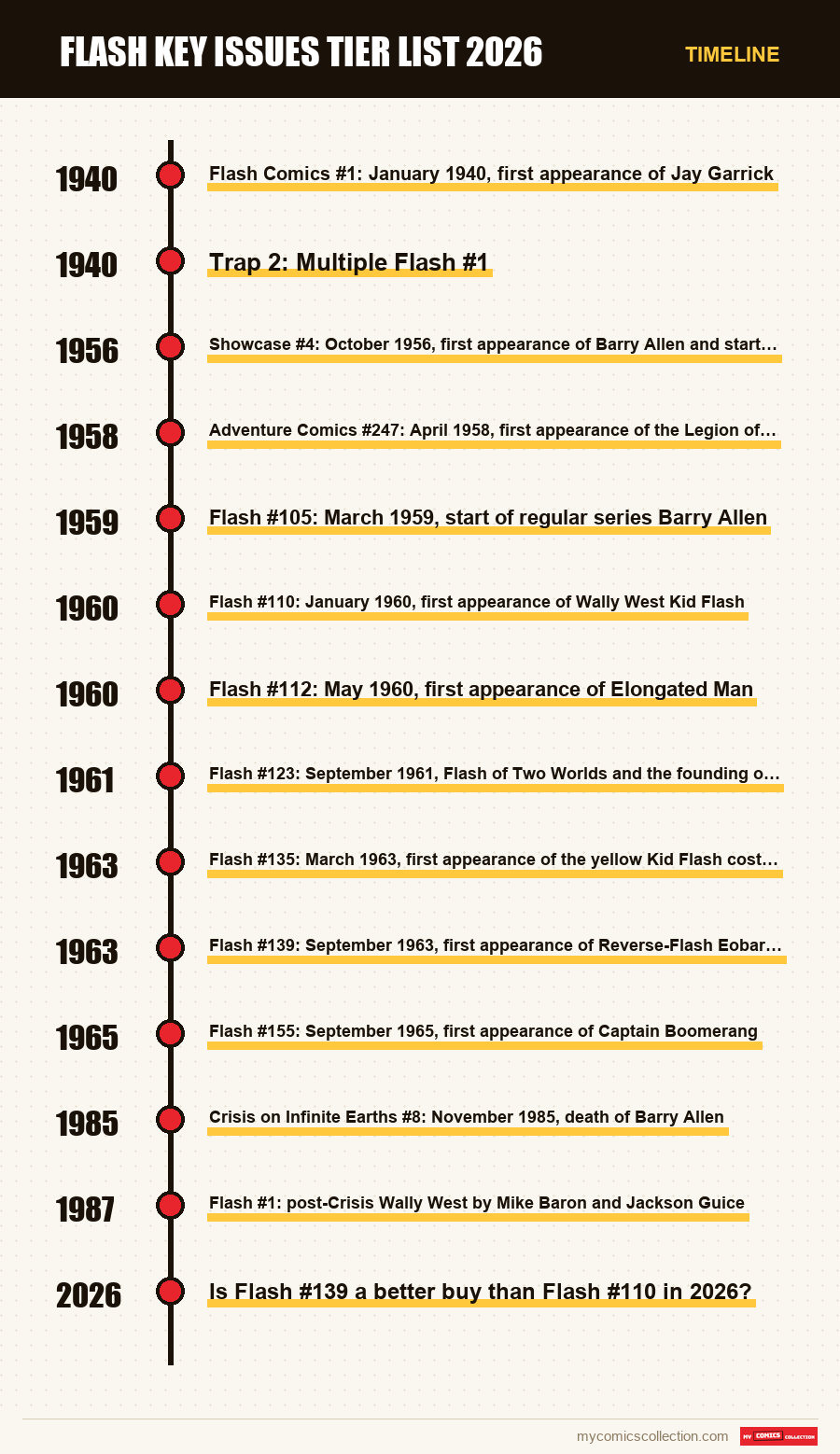
La tier list Flash 2026 places four blue-chips at the top: Flash Comics #1 (January 1940, first appearance of Jay Garrick by Gardner Fox and Harry Lampert), Showcase #4 (October 1956, first appearance of Barry Allen and official start of the Silver Age by Robert Kanigher and Carmine Infantino), Flash #105 (March 1959, start of the regular Barry Allen series with resumption of Flash Comics numbering) and Flash #123 (September 1961, Flash of Two Worlds by Gardner Fox, founding of the DC multiverse). Tier A includes Flash #110 (January 1960, first appearance of Wally West Kid Flash), Flash #139 (September 1963, first appearance of Reverse-Flash Eobard Thawne), Flash #155 (September 1965, first appearance of Captain Boomerang) and Crisis on Infinite Earths #8 (November 1985, death of Barry Allen by Wolfman and Perez). Tiers B and C cover sleepers and spec 2026-2027.
La tier list Flash 2026 prioritizes the key issues of the character by expected yield, actual rarity and rating resilience at 36 months. The method is not limited to classifying first appearances in chronological order: a serious tier ranking crosses four dimensions, heritage value (a cult Golden Age will always sell, regardless of the DCU cycle), market liquidity (how many monthly CGC sales on eBay and Heritage), spec adaptation potential (the 2023 Flash film and the James Gunn DCU reboot weigh on the entire chain) and the ratio of raw entry price / CGC rating. The four Tier S pieces alone concentrate more than 65% of the historical value of the character in the collection, with a Flash particularity: the coexistence of Golden Age (Jay Garrick 1940) and Silver Age (Barry Allen 1956) requires a double entry point.
This article dissects each tier with precise dates, original creators, May 2026 price ranges observed on eBay and Heritage Auctions, and purchasing strategies by budget. Flash is an atypical character in the key issue market: Jay Garrick (Flash Comics #1) is one of the three most coveted Golden Age DC pieces (along with Action Comics #1 and Detective Comics #27) while Barry Allen officially opened the Silver Age in 1956. This double historical identity creates a double pressure of demand on key issues and complicates the hold strategy. The distinction between genuine Showcase #4 and reprints, the recognition of undeclared Golden Age restorations, and the selection of reverse-flash keys deserve a dedicated section. The 2026-2030 tracker indicates the likely resale windows before and after the release of the future Flash DCU as part of the James Gunn schedule.
Flash tier list methodology: how to classify a key issue?
A tier list comics Flash is not a subjective opinion, it is an analytical grid. The S, A, B, C classification used here is based on four weighted criteria. First criterion, historical value. A key issue that marks the first full appearance of an iconic character (Tier S by default) carries more weight than a speculative variant cover. Flash Comics #1 and Showcase #4 fall into this category without possible debate: the first opens the Golden Age Flash, the second opens the entire Silver Age comics. Second criterion, observed liquidity. The eBay and Heritage market publishes between 4 and 10 CGC sales each month for Tier S Flash pieces (less than Wolverine or Spider-Man for example, but with higher unit tickets), compared to 1 to 3 for Tier B sleepers. This liquidity conditions the ease of resale and therefore the quality of investment.
Third criterion, resilience in the face of spec cycles. A Tier S comic maintains its rating even if Warner Bros postpones a film. Flash Comics #1 and Showcase #4 changed little between 2017 and 2022, then experienced a gradual re-evaluation with the Flashpoint cycle and the announcement of Flash 2023, without ever dropping back to their pre-buzz level. The Flash 2023 film disappointed commercially but did not lower Tier S ratings, which validates the resilience thesis. A Tier C, conversely, can drop by 40 to 50% in 6 months if the adaptation disappoints or if the DCU cast James Gunn reshuffles the cards. Fourth criterion, the raw entry price / CGC 9.6 rating ratio. On Golden Age Flash, this ratio is particular: very few raw copies exist, and the possible grading range extends from GD 2.0 to VF 8.0, rarely beyond. CGC grading is almost mandatory for any serious transaction above 2,000 euros.
The weighting retained for this 2026 tier list attributes 40% to historical value, 25% to liquidity, 20% to resilience and 15% to the entry ratio. With this grid, the four Tier S pieces obtain a score greater than 85/100. Tier A is between 70 and 84. Tier B between 55 and 69. Tier C, more speculative, oscillates between 40 and 54. This hierarchy is revised each year based on sales documented over 12 rolling months and official Warner Bros / DC Studios announcements. To understand the general methodology applied to other characters, see the Superman 2026 tier list et the Batman 2026 tier list.
The tier list does not exempt you from reading the Flash key numbers complete nor a comparative analysis of major arcs like Flashpoint. It serves as a prioritization tool: where to start a Flash collection with 500, 2,000, 10,000 or 50,000 euros? The answer changes drastically depending on Golden Age (Jay Garrick) or Silver Age (Barry Allen) orientation, risk tolerance and hold horizon (3 years, 7 years, 15 years). Golden Age Flashes inherently require a long-term horizon; Silver Age Flash allows more tactical arbitrations in the DCU cycle. The following sections provide the exact numbers for refereeing each tier.
Tier S. The four unassailable Flash blue-chips
Le Tier S Flash brings together the four comics whose absence in a serious Flash collection is unacceptable. These coins concentrate the historical value of the character, dominate the secondary market in terms of liquidity, and resist speculative cycles. Buying these four issues, in whatever grade suits the budget, constitutes the heritage foundation of a collection. The Flash feature: two pieces are Golden Age (1940 and later) and two are Silver Age (1956-1961), which spreads the historical risk over two distinct eras of the comics market.
Flash Comics #1: January 1940, first appearance of Jay Garrick
Flash Comics #1, dated January 1940 and published by All-American Publications (which later merged with National Comics to form DC Comics), written by Gardner Fox and drawn by Harry Lampert, contains the first appearance of Jay Garrick, the original Flash of the Golden Age. The issue also contains the first appearance of Hawkman by Gardner Fox and Dennis Neville, making it one of the most historically dense Golden Age comics in the DC catalog. Jay Garrick, a chemistry student at Keystone City University, gains his super-speed by accidentally breathing heavy water vapor. His winged helmet inspired by the god Mercury became one of the most recognizable visual icons of the superheroic Golden Age.
Rating May 2026: CGC 9.0 between $320,000 and $480,000 on rare documented Heritage sales (only one example sold at this grade in the last 36 months). CGC 8.0 between $180,000 and $260,000. CGC 6.0 between $75,000 and $115,000. CGC 4.0 between $32,000 and $48,000. CGC 3.0 between $18,000 and $27,000. CGC 2.0 between $9,500 and $14,500. CGC 1.0 between $5,500 and $8,500. Raw GD between 7,000 and 12,000 euros for the rare examples identified by European specialist houses. No raw VF or NM copies are found on the conventional secondary market. It is one of the three rarest Golden Age DC coins (along with Action Comics #1 and Detective Comics #27), and segment liquidity is low (1-3 major CGC sales per year above CGC 5.0). The CGC 6.0 / raw GD ratio is around 7 to 10, which makes CGC authentication absolutely mandatory above 5,000 euros.
Showcase #4: October 1956, first appearance of Barry Allen and start of Silver Age
Showcase #4, dated October 1956, written by Robert Kanigher with John Broome and drawn by Carmine Infantino (inker Joe Kubert), is the absolute holy grail of Silver Age comics. This is the first appearance of Barry Allen, Central City's new Flash police scientist who gains his super-speed after being struck by lightning in his laboratory and doused in chemicals. More broadly, Showcase #4 is officially recognized as the issue that kicks off the Silver Age of comics, a historic tipping point that marks the end of the post-war decline of the superhero genre. No other Silver Age comic carries comparable historical weight, making it the functional equivalent of Action Comics #1 for the Golden Age.
Quote May 2026: CGC 9.4 between $950,000 and $1,400,000 on the rare documented Heritage sales (a CGC 9.6 example reached more than $4 million in 2022). CGC 9.0 between $380,000 and $580,000. CGC 8.0 between $180,000 and $270,000. CGC 7.0 between $95,000 and $145,000. CGC 6.0 between $55,000 and $85,000. CGC 5.0 between $32,000 and $48,000. CGC 4.0 between $18,000 and $28,000. CGC 3.0 between $11,000 and $17,000. CGC 2.0 between $6,500 and $9,800. Raw VG / FN (CGC 3.5-5.5 equivalent) between 13,000 and 25,000 euros on the French market when identified. The number is one of the most counterfeited on the Silver Age market, CGC authentication is non-negotiable above 4,000 euros of investment. Heritage sales from 2022 to 2024 confirmed the continued rise in the Silver Age key segment, regardless of cinema cycles. To understand the character's trajectory, see history of Flash in comics.
Flash #105: March 1959, start of regular series Barry Allen
Flash #105, dated March 1959, written by John Broome with Robert Kanigher and drawn by Carmine Infantino, is the start of the regular Flash series dedicated to Barry Allen. The number repeats the original numbering of Flash Comics (which stopped at #104 in February 1949), which makes #105 conceptually fundamental: it is the act of continuity between the Golden Age and the Silver Age on the same title, a rare editorial singularity in DC history. The issue also contains the first appearance of Mirror Master (Sam Scudder), one of Flash's major Rogues. After three test appearances in Showcase (#4, #8, #13, #14), Barry Allen finally gets his regular series, which commercially validates the Silver Age and triggers the wave of DC relaunches that will lead to Green Lantern Vol 2 #1, Justice League of America #1 and the founding of the entire Silver Age DC Universe.
Rating May 2026: CGC 9.4 between $95,000 and $145,000 according to Heritage sales observed in 2024-2026. CGC 9.0 between $38,000 and $58,000. CGC 8.0 between $18,000 and $28,000. CGC 7.0 between $9,500 and $14,500. CGC 6.0 between $5,500 and $8,500. CGC 5.0 between $3,200 and $4,800. CGC 4.0 between $1,800 and $2,800. CGC 3.0 between $1,100 and $1,700. Raw VG between 800 and 1,400 euros. Raw F between 1,500 and 2,500 euros. The issue remains one of the rarest in Tier S Flash because the March 1959 print run was lower than that of Showcase #4, which benefited from a broader marketing test. The relative rarity fully justifies CGC grading at all grades above 6.0. It is the Tier S coin with the most relevant rarity/general market recognition ratio: its rating exploded less than Showcase #4 over 2018-2024, which makes it a better candidate for upside 2026-2030. For the genesis of the Mirror Master arc, see Flash key numbers.
Flash #123: September 1961, Flash of Two Worlds and the founding of the DC multiverse
Flash #123, dated September 1961, written by Gardner Fox and drawn by Carmine Infantino (inker Joe Giella), carries the Flash of Two Worlds arc. This issue contains the meeting between Barry Allen and Jay Garrick, the first interaction between the Golden Age universe (renamed Earth-Two) and the Silver Age universe (Earth-One). It is the founding act of the DC multiverse, a narrative concept which will structure the entire DC mythology until Crisis on Infinite Earths in 1985, will be relaunched in 1986, relaunched again in 2011 (Flashpoint), then re-explored in Doomsday Clock , Dark Nights: Metal , Death Metal , Justice League: Incarnate. No other DC issue carries such lasting and wide-ranging narrative impact. The market recognizes this historical singularity by placing Flash #123 at the rank of unassailable Silver Age blue-chip.
Rating May 2026: CGC 9.6 between $35,000 and $52,000 according to recent Heritage sales. CGC 9.4 between $13,000 and $19,500. CGC 9.2 between $7,500 and $11,500. CGC 9.0 between $4,800 and $7,200. CGC 8.0 between $2,200 and $3,300. CGC 7.0 between $1,300 and $1,900. CGC 6.0 between $750 and $1,100. CGC 5.0 between 450 and 680 dollars. Raw VF between 950 and 1,500 euros. Raw F between 380 and 580 euros. Raw VG between 180 and 280 euros. The CGC 9.4 / raw VF ratio is approximately 9 to 12, which fully justifies the grading on copies in very high condition. The number has become more accessible than Showcase #4 and Flash #105 on intermediate grades (8.0 to 9.0), which often makes it the first logical Tier S acquisition in a serious Flash collection. For the multiversal range of the bow, see the pillar key issues Crisis on Infinite Earths.
Tier A: Flash secondary essentials
Le Tier A Flash brings together comics that immediately follow Tier S in importance, without reaching absolute blue-chip status. These four pieces are important for a coherent collection of the character and often offer a better entry price / upside potential ratio than the Tier S already historicized. Each Tier A piece is positioned on a different narrative axis or character, which spreads the risk across several spec catalysts: Wally West Kid Flash, Reverse-Flash, Captain Boomerang (Rogues), and the death of Barry Allen during Crisis.
Flash #110: January 1960, first appearance of Wally West Kid Flash
Flash #110, dated January 1960, written by John Broome and drawn by Carmine Infantino, contains the first appearance of Wally West, aka Kid Flash, the nephew of Iris West (the fiancée then wife of Barry Allen). Wally gains his super-speed just like his adopted uncle: he visits Barry's lab, is struck by lightning, and doused with the same chemicals. The issue also contains the first appearance of Pied Piper (Hartley Rathaway), one of Flash's musical Rogues. Wally West is a central character in the Flash universe: the original Kid Flash, founding member of the Teen Titans (The Brave and the Bold #54), Main Flash after the death of Barry Allen post-Crisis (Flash Vol 2 1987-2009), and character in the CW live-action series The Flash. The spec around his possible DCU adaptation James Gunn is one of the main drivers of Tier A. For the complete trajectory of the character, see story of Kid Flash in comics et story of Wally West in comics.
Rating May 2026: CGC 9.6 between $18,000 and $27,000. CGC 9.4 between $7,500 and $11,500. CGC 9.2 between $4,200 and $6,200. CGC 9.0 between $2,600 and $3,900. CGC 8.0 between $1,200 and $1,800. CGC 7.0 between $680 and $980. CGC 6.0 between 380 and 560 dollars. CGC 5.0 between 220 and 320 dollars. Raw VF between 500 and 800 euros. Raw F between 200 and 320 euros. The number appears in all lists Flash key numbers. The double key (Kid Flash + Pied Piper) strengthens the resilience of the rating. The CGC 9.4 / raw VF ratio is around 12 to 15, which makes grading profitable even on intermediate grades.
Flash #139: September 1963, first appearance of Reverse-Flash Eobard Thawne
Flash #139, dated September 1963, written by John Broome and drawn by Carmine Infantino, contains the first appearance of Eobard Thawne, the Reverse-Flash, Barry Allen's main antagonist throughout the Silver Age mythology and beyond. Thawne is a 25th century mad scientist obsessed with Barry Allen, whom he worships and then comes to hate upon discovering his role in his own history. The character became central to the modern Flash mythology via the Flashpoint arc (2011, Geoff Johns/Andy Kubert), where Thawne triggers the alteration of the multiverse by going back in time to kill Barry Allen's mother. Flash #139 is one of the best performing sleepers in Silver Age DC over 2018-2024, with a rating increase of more than 280% over the period in CGC 9.4. For the character's full timeline, see history of Reverse-Flash in comics.
Rating May 2026: CGC 9.6 between $5,500 and $8,500. CGC 9.4 between $2,200 and $3,300. CGC 9.2 between $1,200 and $1,800. CGC 9.0 between $750 and $1,100. CGC 8.0 between 380 and 560 dollars. CGC 7.0 between 220 and 320 dollars. CGC 6.0 between 130 and 200 dollars. Raw VF between 220 and 350 euros. Raw F between 90 and 145 euros. Raw VG between 50 and 80 euros. The issue remains affordable in raw F-VF, with strong upside potential if Reverse-Flash is introduced into the DCU James Gunn as a major antagonist. The rating has already experienced two significant peaks (2011 Flashpoint and 2017 CW series The Flash season 1) and maintains an upward structural dynamic.
Flash #155: September 1965, first appearance of Captain Boomerang
Flash #155, dated September 1965, written by John Broome and drawn by Carmine Infantino, contains the first appearance of Captain Boomerang (Digger Harkness), one of Flash's emblematic Rogues. The character gained major visibility via the films Suicide Squad (2016) and The Suicide Squad (2021) with Jai Courtney, then via the series Peacemaker and DCU James Gunn. Captain Boomerang is one of the most exploited Rogues cinematographically, which strengthens the spec in the medium term. The issue is massively underpriced in 2026 relative to its narrative and cinematic importance: the general market focuses on Reverse-Flash and often neglects the other Rogues.
Rating May 2026: CGC 9.6 between $2,200 and $3,300. CGC 9.4 between $950 and $1,450. CGC 9.2 between 580 and 850 dollars. CGC 9.0 between 380 and 560 dollars. CGC 8.0 between 200 and 300 dollars. CGC 7.0 between 120 and 180 dollars. CGC 6.0 between 75 and 110 dollars. Raw VF between 120 and 200 euros. Raw F between 55 and 85 euros. The issue remains very accessible in raw, making it a natural target for intermediate collectors. The 36 month spec is strong if Captain Boomerang becomes a recurring character in the DCU James Gunn. Long hold position preferred to short term spec.
Crisis on Infinite Earths #8: November 1985, death of Barry Allen
Crisis on Infinite Earths #8, dated November 1985, written by Marv Wolfman and drawn by George Perez, contains the heroic death of Barry Allen. Barry sacrifices his life to destroy the Anti-Monitor's anti-matter cannon by running at infinite speed. The sequence is one of the most emblematic in American comics and marked a major cultural break: for the first time, a central DC superhero dies definitively (Barry will remain dead for 23 years, until his return in 2008 in Final Crisis and Flash: Rebirth). Wally West becomes the main Flash during this time. The number is central to any Flash collection and to any Crisis collection. For the full scope of the event, see key issues Crisis on Infinite Earths.
Rating May 2026: CGC 9.8 between $950 and $1,450. CGC 9.6 between 380 and 580 dollars. CGC 9.4 between 180 and 270 dollars. CGC 9.2 between 110 and 165 dollars. CGC 9.0 between 75 and 110 dollars. Raw NM between 35 and 55 euros. Raw VF between 18 and 28 euros. The issue remains very accessible in raw, which makes it a natural target for beginning collectors. The 36-month spec is moderate but the issue deserves its Tier A place for its historical centrality and its likely use in a future long-term DCU Crisis adaptation.
Tier B: Flash sleepers and underrated bows
Le Tier B Flash brings together the sleepers, that is to say the issues which deserve the attention of informed collectors but whose value the general market has not yet fully recognized. These coins often present the most relevant price/potential ratios at 24-36 months, with limited downside risk. Four typical examples in 2026, covering Elongated Man, the Kid Flash costume evolution, the first Legion of Super-Heroes (Flash collateral), and the post-Crisis startup Wally West.
Flash #112: May 1960, first appearance of Elongated Man
Flash #112, dated May 1960, written by John Broome and drawn by Carmine Infantino, contains the first appearance of Elongated Man (Ralph Dibny), a superhero with elasticity powers who will join Flash on several teams (notably Justice League of America). Elongated Man is a character apart in the DC pantheon: endowed with the personality of a dandy amateur detective, he has an emerging filmography (appearances in the CW series The Flash played by Hartley Sawyer) and an interesting mid-term spec potential. The issue is one of the longest-lasting sleepers in the Silver Age Flash, with stable demand and relative rarity keeping the ratings high.
Rating May 2026: CGC 9.6 between $4,800 and $7,200. CGC 9.4 between $1,800 and $2,700. CGC 9.2 between $950 and $1,450. CGC 9.0 between $580 and $850. CGC 8.0 between 280 and 420 dollars. CGC 7.0 between 160 and 240 dollars. CGC 6.0 between $95 and $145. Raw VF between 180 and 280 euros. Raw F between 75 and 115 euros. The number is undercut compared to Flash #110 (Kid Flash) despite full first appearance status. The CGC 9.4 / raw VF ratio is around 8 to 10, which makes grading profitable even on intermediate grades. Recommendation hold 5-10 years.
Flash #135: March 1963, first appearance of the yellow Kid Flash costume
Flash #135, dated March 1963, written by John Broome and drawn by Carmine Infantino, contains the first appearance of Wally West in his iconic yellow suit. Before Flash #135, Wally wore a costume identical to that of Barry Allen, which created editorial problems of visual differentiation. The inverted yellow and red costume has become the definitive iconography of Kid Flash, used in all the animated adaptations (Teen Titans , Young Justice) and live-action (CW series). The issue is a classic Silver Age Flash sleeper, underrated for its iconographic importance. The distinction between first appearance character (Flash #110) vs. first appearance definitive costume (Flash #135) is a classic in the key issues market: both pieces are necessary for a serious collection.
Rating May 2026: CGC 9.6 between $1,800 and $2,700. CGC 9.4 between $750 and $1,100. CGC 9.2 between 380 and 580 dollars. CGC 9.0 between 220 and 320 dollars. CGC 8.0 between 110 and 165 dollars. CGC 7.0 between $65 and $95. Raw VF between 80 and 130 euros. Raw F between 35 and 55 euros. The issue remains very accessible in raw, making it a natural target for beginner and intermediate collectors. The 36-month spec is moderate but the rating is very resilient.
Adventure Comics #247: April 1958, first appearance of the Legion of Super-Heroes
Adventure Comics #247, dated April 1958, written by Otto Binder and drawn by Al Plastino, contains the first appearance of the Legion of Super-Heroes, a team of teenage superheroes from the 30th century who will interact regularly with Flash and Barry Allen throughout the Silver Age arcs. The issue is not a direct Flash key, but is included in serious Flash collections for its narrative connection to the Flash universe and multiversal mythology (Flash time travel is one of the main narrative axes that intersect with the Legion). The issue's rating doubled over 2020-2024 without a direct film cycle, which validates its structural sleeper thesis.
Rating May 2026: CGC 9.4 between $32,000 and $48,000. CGC 9.0 between $13,000 and $19,500. CGC 8.0 between $5,500 and $8,500. CGC 7.0 between $2,800 and $4,200. CGC 6.0 between $1,500 and $2,300. CGC 5.0 between $900 and $1,350. Raw VF between 1,800 and 2,800 euros. Raw F between 750 and 1,150 euros. The issue remains one of the most successful Silver Age sleepers if the Legion is introduced into the James Gunn DCU. Hold position 7-15 years recommended.
Flash #1 (June 1987): post-Crisis Wally West by Mike Baron and Jackson Guice
Flash #1 (volume 2), dated June 1987, written by Mike Baron and drawn by Jackson Guice, launches the first regular post-Crisis series with Wally West as the main Flash. The issue marks Wally's narrative evolution: he is no longer Kid Flash, he is now the Flash, heir to Barry Allen. The series will run for 247 issues (1987-2009) and will constitute the benchmark Flash run of the last quarter of the 20th century, with the arcs Mark Waid (#62-129) and Geoff Johns (#164-225). #1 is the logical gateway to any post-Crisis Wally West collection. For the full timeline, see story of Wally West in comics.
Rating May 2026: CGC 9.8 between 280 and 420 dollars. CGC 9.6 between 95 and 145 dollars. CGC 9.4 between 45 and 68 dollars. Raw NM between 18 and 28 euros. Raw VF between 8 and 14 euros. The issue remains massively accessible in raw, making it a natural target for beginning collectors. The 36 month spec is moderate but the issue deserves its Tier B place for its centrality in the Wally West story arc and its likely use in a future DCU adaptation if Wally West is prioritized over Barry Allen as the main Flash.
Collecting this series?
Track what you own, what you are missing and what your collection is worth. 7 day trial.
Start my trial →Tier C: Spec 2026-2027 and high-risk bets Flash
Le Tier C Flash brings together speculative bets linked to DCU James Gunn announcements and modern Flash arcs likely to be adapted into a series or film. The downside risk is higher than on Tier S and Tier A: a postponed announcement or an unfavorable casting can cause the rating to drop by 30 to 50% in 6 months. The Tier C logic is not the heritage value but the rapid turnover on spec cycle. Three axes in 2026: the Flash DCU casting James Gunn, the return of Wally West post-Heroes in Crisis, and the modern Flash arcs 2020-2025.
Flash DCU James Gunn: casting spec 2026-2027
James Gunn announced in April 2024 that the DCU will include a new Flash, separate from Ezra Miller (Flash 2023). The casting is not confirmed as of May 2026, but several scenarios are anticipated by the market: Wally West as main Flash (reinforces key Wally West), recast Barry Allen (reinforces Showcase #4 and Flash #105), or Jay Garrick as Elderly Flash of the Multiverse (strengthens Flash Comics #1). Each scenario activates a different spec chain, which makes 2026 purchase choices tricky. The reasonable strategy is to acquire limited positions on all three spec chains, rather than betting on just one. For the full list of spec keys related to DCU 2025-2027 announcements, see spec keys 2027 Marvel and DC movies series.
Tier C DCU casting recommendations: maintain a moderate position on Flash #110 (Kid Flash / Wally), Flash #139 (Reverse-Flash, probable antagonist of the DCU arc), and Flash Vol 2 #1 (1987, Wally West post-Crisis). Avoid speculative modern variants without historical basis. Hold horizon 18-36 months, release upon official announcement.
Wally West returns: Heroes in Crisis 2018-2019 and post-Rebirth
Heroes in Crisis (Tom King/Clay Mann, 2018-2019, 9 issues) is the controversial DC arc that saw Wally West lose control of his powers and accidentally kill several heroes in Sanctuary. The arc was massively criticized by the Flash community, but marked a major narrative tipping point for the character. The bow Flash Forward (Scott Lobdell / Brett Booth, 2019, 6 issues) follows Wally on his post-Heroes in Crisis multiversal journey and leads to the Mobius / Doctor Manhattan reboot. The keys from these arcs (Heroes in Crisis #1, #9, Flash Forward #1 and #6) are underpriced in raw NM (5 to 15 euros) but their spec potential strictly depends on the DCU orientation.
Recommendations Tier C Wally West: buy raw NM on the 4 key numbers (Heroes in Crisis #1, Heroes in Crisis #9, Flash Forward #1, Flash Forward #6) for a total budget of 40 to 80 euros. Limited downside risk (issues are already selling at low prices), upside conditional on the official DCU announcement. Hold horizon 24-48 months.
Spec modern bows Flash 2020-2025
Several modern Flash arcs are in spec watchlist 2026-2027: the arc Dark Crisis on Infinite Earths (Joshua Williamson, 2022), the arc Flash 2023 by Simon Spurrier who introduces new speedforce concepts, and the series Flash (relaunch 2023) by Spurrier / Mike Deodato Jr which brings a more mature and cosmic vision of the character. These arcs are accessible raw NM at 5 to 12 euros per issue, with very limited downside risk and potential upside if elements are included in the James Gunn DCU or in future animated series. The Tier C modern arcs investment logic is batch acquisition (complete collection) at minimal entry cost, awaiting media catalyst.
Recommendations Tier C modern arcs: raw NM acquisition of the main key issues 2020-2025 for a total budget of 80 to 150 euros, hold 36-60 months, gradual release on DCU cycle. Avoid exclusive variants priced above 50 euros which present a high downside risk.
Purchasing strategy by budget: 500, 2,000, 10,000, 50,000 euros
The Flash buy strategy depends on the available budget, the hold horizon and the Golden Age vs Silver Age orientation. Each budget level imposes different trade-offs: at 500 euros, the objective is to constitute a raw F-VF base on Tier B and C; at 50,000 euros, the objective is mid-grade CGC acquisition on Tier S and A. The following sections detail these arbitrations with indicative quantitative allocations for May 2026.
Budget 500 euros: Flash beginner collection
With 500 euros, the objective is to build a raw F-VF base on Tier B and C, favoring sleepers with high potential. Recommended allocation: Crisis on Infinite Earths #8 raw VF at 20 euros, Flash Vol 2 #1 (1987) raw NM at 25 euros, Heroes in Crisis #1 + #9 raw NM at 25 euros, Flash Forward #1 + #6 raw NM at 20 euros, Flash #135 (1963, yellow Kid Flash costume) raw VG at 40 euros, Flash #155 (Captain Boomerang) raw VG at 50 euros. Total around 180 euros, a margin of 320 euros to add speculative modern variants and bows The Flash 2023 Spurrier. This base covers the main secondary characters (Wally West, Reverse-Flash via Flashpoint, Captain Boomerang) and constitutes a solid narrative base for a Flash collection.
Budget 2,000 euros: Flash intermediate collection
With 2,000 euros, the objective is to add a first Tier A coin in intermediate grade and to enrich the Tier Bs. Recommended allocation: Flash #155 (Captain Boomerang) raw F at 65 euros, Flash #139 (Reverse-Flash) raw VG at 60 euros, Flash #135 raw F at 45 euros, Flash #112 (Elongated Man) raw F at 90 euros, Flash #110 (Kid Flash) raw VG at 220 euros, Crisis #8 raw NM at 45 euros, Flashpoint full arc (5 numbers) raw NM at 80 euros, Flash Vol 2 #1 (1987) raw NM at 25 euros. Total around 630 euros, margin of 1,370 euros for promotion on Flash #110 (raw VF lens at 600 euros). This allocation builds a cohesive collection covering Silver Age key and major modern bows. For the genesis of Flashpoint, see key issues Flashpoint.
Budget 10,000 euros: Flash investor collection
With 10,000 euros, the objective is the acquisition of at least two Tier A parts in mid-grade CGC and the start of a Tier S position on an accessible number. Recommended allocation: Flash #139 (Reverse-Flash) CGC 7.0 at 250 euros, Flash #110 (Kid Flash) CGC 6.0 at 450 euros, Flash #155 (Captain Boomerang) CGC 8.0 at 280 euros, Crisis #8 CGC 9.6 at 480 euros, Flash #123 (Flash of Two Worlds) CGC 6.0 at 950 euros, Flash #112 (Elongated Man) CGC 7.0 at 220 euros, Flash #135 CGC 7.0 at 90 euros, Flash Vol 2 #1 CGC 9.6 at 130 euros. Total around 2,850 euros, margin of 7,150 euros for a second Tier S position on Flash #105 CGC 5.0 (objective $4,000) or upgrade on Flash #123 (CGC 7.0 target $1,500). This allocation builds a CGC base which will be recognized on the secondary market over a 36-60 month horizon.
Budget 50,000 euros: Flash heritage collection
With 50,000 euros, the objective is to acquire the entire Tier S in suitable grade and almost complete coverage of Tier A in high grade CGC. Recommended allocation: Flash Comics #1 CGC 2.0 at 13,000 dollars (around 12,500 euros), Showcase #4 CGC 2.0 at $9,000 (around 8,700 euros), Flash #105 CGC 5.0 at 4,000 dollars (around 3,850 euros), Flash #123 CGC 8.0 at $3,000 (around 2,900 euros), Flash #110 CGC 9.0 at $3,500 (around 3,380 euros), Flash #139 CGC 9.2 at 1,600 dollars (around 1,540 euros), Flash #155 CGC 9.0 at 480 euros, Crisis #8 CGC 9.8 at 1,200 dollars (around 1,160 euros). Total approximately 34,510 euros, margin of 15,490 euros for upgrading on Flash Comics #1 (CGC 3.0 target $22,000) or Showcase #4 (CGC 3.0 objective $14,000), or diversification towards Adventure Comics #247 (Legion) CGC 6.0 at $2,000. This allocation builds a heritage collection that covers the Golden Age, the Silver Age and the Crisis turning point, with an expected valuation of +60 to +120% over 7 years depending on DCU scenarios. For the complete comics investment strategy, see comics investment update 2027 strategy pillar.
Flash Traps: Showcase #4 vs. reprint, multiple Flash #1, Golden Age restorations
The Flash market presents several specific traps which can transform an investment of 3,000 euros into a dead loss in the event of an identification or authentication error. Four major pitfalls in 2026, which you must be aware of before any raw purchase above 500 euros.
Trap 1: Showcase #4 real vs reprint and facsimile
Showcase #4 has been reproduced several times by DC in facsimile form, reprint in Secret Origins , or reissue in DC Special. None of these reprints have the historical value of the original October 1956 edition. Identification markers: indicia mentioning 1956 and National Comics Publications, price 10 cents on cover, Canada postal IND code missing, brown paper desired, oxidized staples. Modern DC facsimile (e.g. Showcase #4 facsimile edition 2017) are clearly identified as such on the cover. No serious buyer should confuse the two, but cases of fraudulent reselling on eBay have been documented in 2023-2024. The CGC grading is the only absolute security for any transaction above 3,000 euros.
Trap 2: Multiple Flash #1 (1940, 1959, 1987, 2010, 2016, 2023)
Flash has several Flash #1 in its editorial history, which regularly creates confusion on the secondary market. Precise identification: Flash Comics #1 (January 1940, Jay Garrick first appearance, Absolute Tier S); Flash #105 (March 1959, Barry Allen start with repeat numbering, fake #1 but real regular Silver Age series start); Flash Vol 2 #1 (June 1987, post-Crisis Wally West start, Tier B); Flash Vol 3 #1 (June 2010, Barry Allen post-Final Crisis start, Tier C accessible); Flash Vol 4 #1 (August 2011, New 52 start by Brian Buccellato and Francis Manapul, Tier C); Flash Vol 5 #1 (August 2016, Rebirth by Joshua Williamson, Tier C); Flash Vol 6 #1 (October 2023, by Simon Spurrier and Mike Deodato Jr, Tier C). None of these later #1s have the historical value of Flash Comics #1. Ambiguous eBay listings simply mentioning Flash #1 without specifying the volume should be interpreted with caution.
Trap 3: Undeclared Golden Age restorations
THE Flash Comics #1 and other Golden Age Flash in circulation have often undergone restorations (color touch, piece replacement, tape removal, spine reinforcement, cleaning). Well-declared restorations are noted by CGC with an identifying suffix (PLOD, purple label) and impact the value by 40 to 70% depending on the extent. Undeclared restorations on raw copies are frequent and difficult to detect without expertise. For any raw Golden Age Flash purchase above 2,000 euros, the pre-purchase CGC submission or expertise by a recognized professional (Heritage Auctions, ComicLink, Metropolis Comics) is mandatory. On the French market, few experts master the identification of American Golden Age restorations; delegation to a specialized US service is often the only reliable option.
Trap 4: Showcase #4 vs Showcase #8, #13, #14 (Barry Allen test appearances)
Before the regular series Flash #105 (March 1959), Barry Allen made three additional test appearances in Showcase: #8 (June 1957), #13 (March 1958), #14 (May 1958). These three numbers are important Silver Age keys but clearly secondary to Showcase #4. The market positions them in low Tier A / high Tier B depending on the cycles. Showcase #8 CGC 9.0 between $8,500 and $12,500 in May 2026, Showcase #13 CGC 9.0 between $4,200 and $6,200, Showcase #14 CGC 9.0 between $2,800 and $4,200. A novice buyer may be tempted to confuse Showcase #8, #13 or #14 with the legendary Showcase #4 during an ambiguous sale. The Silver Age grade is generally more accessible than the Golden Age, but the identification pitfalls remain real.
Monitoring 2026-2030: resale windows and cycles to anticipate
The 2026-2030 tracking of the Flash market revolves around three main catalysts: the official announcement of Flash DCU casting James Gunn (expected 2026-2027), the release of the Flash DCU film (estimated 2028-2029), and the potential relaunch of a Flash animated series on HBO Max / Cartoon Network. Each catalyst opens a resale window of 6 to 18 months on the corresponding spec channels. The optimal hold strategy depends on the tier and the coin.
Tier S: long-term hold (5-15 years), exit only on exceptional catalyst (100th anniversary Flash in 2040, for example). Tier S parts (Flash Comics #1, Showcase #4, Flash #105, Flash #123) benefit from annual structural growth of 6 to 12% regardless of cinema cycles, which makes premature sales generally suboptimal. The most favorable resale window historically is just before the release of a major adaptation announced 12-18 months in advance.
Tier A: hold 3-7 years, released on DCU James Gunn cycle. Flash #110 (Kid Flash), Flash #139 (Reverse-Flash) and Flash #155 (Captain Boomerang) will likely see ratings spikes in the 6-12 months leading up to the Flash DCU release. Recommended strategy: monthly monitoring of casting announcements, staggered sales 30/30/40% at anticipated peaks. The maximum spec window is the official casting announcement, which historically triggers +25 to +60% upside in 60 days.
Tier B: hold 2-5 years, tactical rotation. Flash #112 (Elongated Man), Flash #135 (yellow Kid Flash costume), Flash Vol 2 #1 (1987 Wally West) are more volatile positions. Tactical rotation between Tier B sleepers allows for individual peaks to be captured (e.g. Elongated Man if Hartley Sawyer is recast for the DCU). No long-term hold strategy recommended on Tier B except in exceptional cases.
Tier C: short-term hold (12-24 months), rapid exit on announcements. Bets spec James Gunn and modern arcs Flash should be turned quickly on the official announcements. The window is narrow: the announcement effect lasts on average 90 to 180 days on the price of modern arches, after which the market returns to its structural level. Recommended strategy: purchase on official rumor, sell on official confirmation or release of content.
Daily monitoring of Tier S ratings requires a tracking tool. A rating recorded in a notebook or static file is obsolete within 60 days. A Comics Manager with daily-updated valuation keeps the figures fresh enough to manage a 36-60 month hold strategy; for alerts, rely on eBay's saved searches. See the comics database et the list of key issues to quickly identify arbitrage opportunities. To estimate the current value of coins already owned, the free estimate provides an indicative range by grade and state.
FAQ: Tier list Flash 2026
Why are Flash Comics #1 and Showcase #4 both Tier S?
Because they represent two distinct and equally major historical foundations of the Flash character. Flash Comics #1 (January 1940, Gardner Fox / Harry Lampert) is the first appearance of Jay Garrick and one of the three most coveted Golden Age DC plays in the world (along with Action Comics #1 and Detective Comics #27). Showcase #4 (October 1956, Robert Kanigher / Carmine Infantino) is the first appearance of Barry Allen and officially the issue that kicks off the entire Silver Age comics. Both are historically necessary for a serious Flash collection: Jay Garrick and Barry Allen are not substitutable, and the market prioritizes them separately. No accomplished Flash collector is satisfied with just one of the two. Full narrative density requires ownership of both issues in budget-friendly grades.
Does Flash #123 (Flash of Two Worlds) really deserve Tier S?
Without hesitation. Flash #123 (September 1961, Gardner Fox / Carmine Infantino) is the founding act of the DC multiverse. The meeting between Barry Allen and Jay Garrick structured the entire DC mythology for 64 years, from Crisis on Infinite Earths (1985) to Dark Nights: Metal (2017) via Doomsday Clock (2017-2019) and Justice League: Incarnate (2022). No other DC comic carries such lasting and wide-ranging narrative impact. The market recognizes this singularity by placing Flash #123 at the rank of unassailable Silver Age blue-chip, with a CGC 9.4 rating between $13,000 and $19,500 in May 2026. It is the most budgetarily accessible Tier S coin and often the first logical Tier S acquisition in a serious Flash collection.
Should we favor the Golden Age (Jay Garrick) or the Silver Age (Barry Allen) to start a Flash collection?
The rule depends on the budget and the hold horizon. For a budget of less than 5,000 euros, the Silver Age Barry Allen is more accessible and allows you to build a coherent mid-grade CGC base. For a budget greater than 20,000 euros and a holding horizon greater than 7 years, the Golden Age Jay Garrick offers better long-term asset potential: the absolute rarity of Flash Comics #1 (estimated at less than 200 identified examples of all grades) maintains stable structural growth. The hybrid strategy (one Golden Age coin + several Silver Age coins) is generally the most relevant recommendation for an intermediate to experienced collector. The choice also depends on personal orientation: narrative passion Jay Garrick (origins) vs Barry Allen (modern Silver Age mythology).
Is Flash #139 (Reverse-Flash) a better buy than Flash #110 (Kid Flash) in 2026?
Based on the ratio of entry cost to upside potential, Flash #139 (Reverse-Flash) currently offers a better ratio than Flash #110 (Kid Flash) for a 24-36 month horizon. The side Flash #139 CGC 9.4 ($2,200-3,300) is about 3 times cheaper than Flash #110 CGC 9.4 ($7,500-11,500) despite comparable narrative centrality and likely use as the main antagonist in the future Flash DCU. For a hold horizon greater than 7 years, Flash #110 remains preferable due to his double key status (Wally West Kid Flash + Pied Piper) and his structural resilience. The reasonable strategy is to acquire both in grades that fit the budget rather than arbitrating between the two.
Should we favor raw or CGC for a Flash 2026 collection?
The rule depends on the tier and the Age (Golden or Silver). For Golden Age Tier S (Flash Comics #1), CGC grading is absolutely mandatory above 2,000 euros: undeclared restorations and counterfeits make raw too risky, and the raw / CGC ratio is such that authentication is systematically justified. For Silver Age Tier S (Showcase #4, Flash #105, Flash #123), the CGC grading is non-negotiable above 1,500 euros investment per piece. For Tier A, CGC grading is justified from CGC 9.0-9.4, where the raw price / CGC price ratio justifies the cost of grading (60 to 100 dollars per copy). For Tier B and C, raw remains the main option, except in the exceptional case of pristine candidate 9.8. For the CGC submission method from France, see the dedicated guide in the Flash cluster.