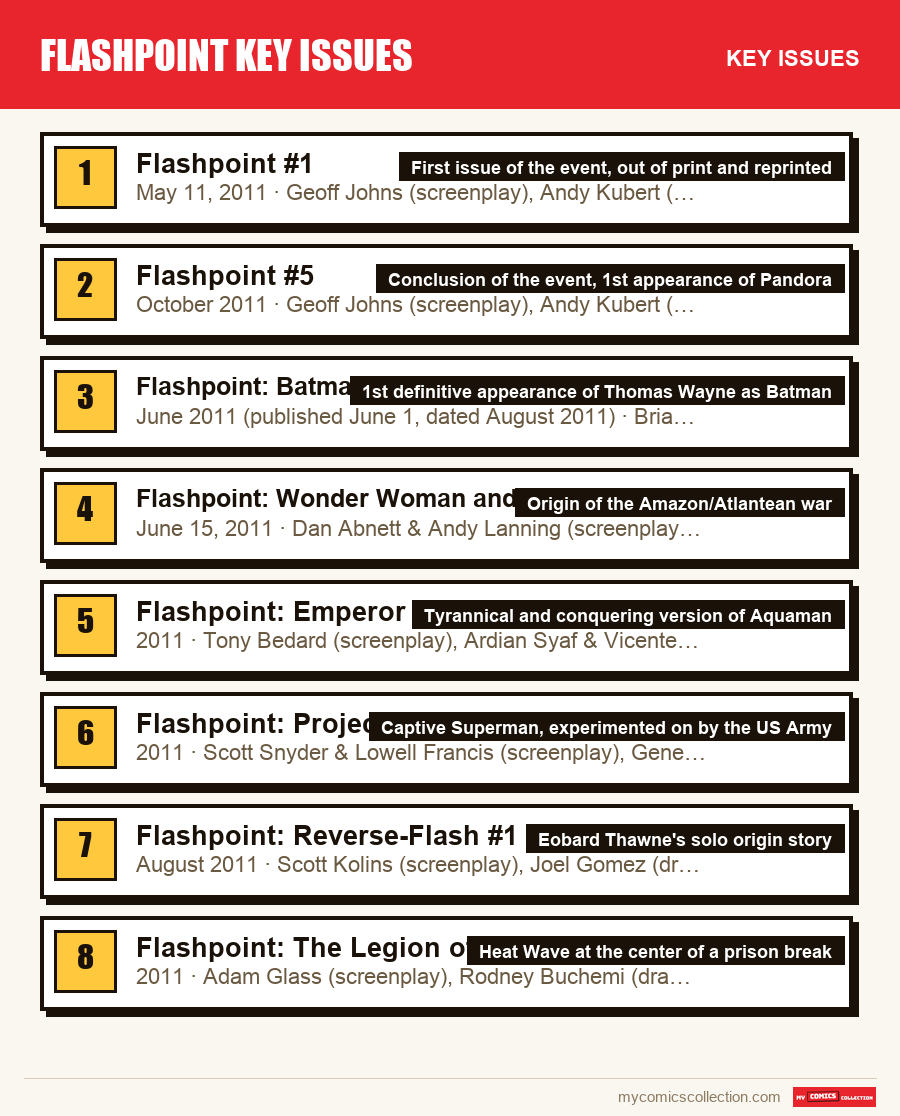
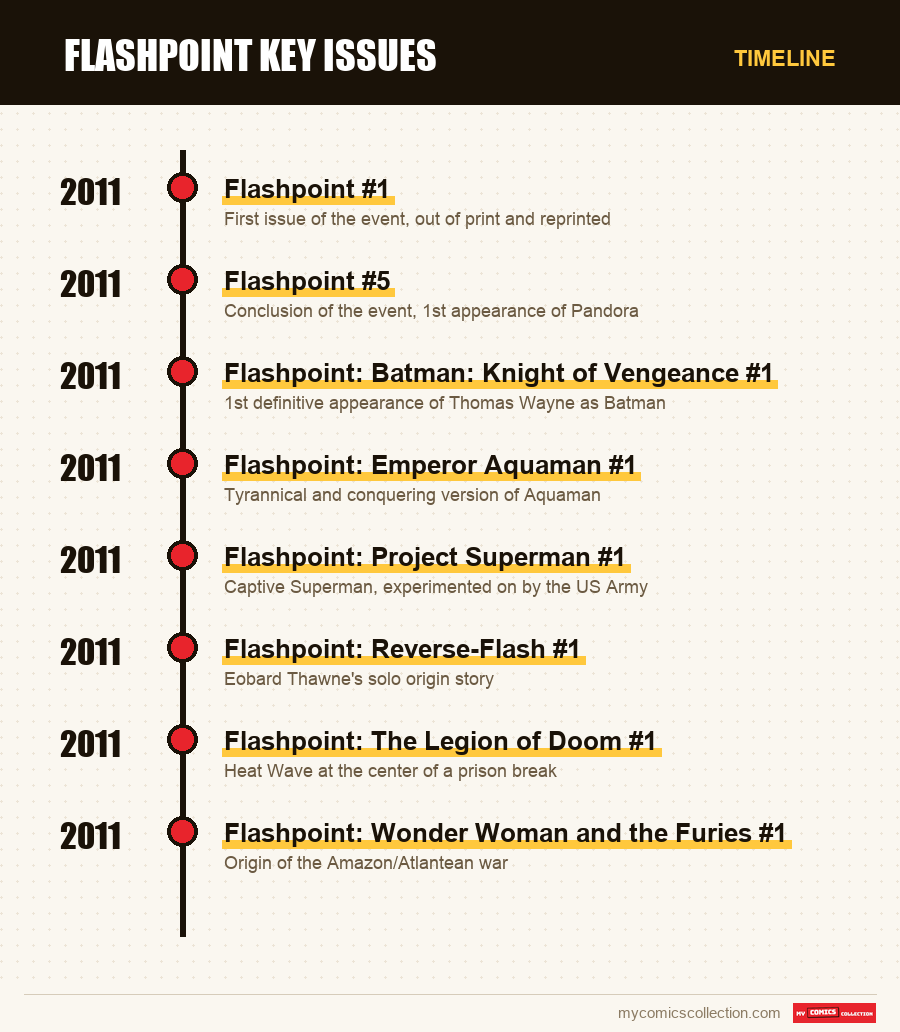
The essential key issues of Flashpoint (DC Comics, 2011) are Flashpoint #1 (May 11, 2011, Geoff Johns on screenplay, Andy Kubert on drawing, sold out in a few days and withdrawn in second printing) and Flashpoint #5, which closes the mini-series by introducing Pandora, a bridge character towards the launch of the New 52. The tie-in Flashpoint: Batman: Knight of Vengeance #1 (Brian Azzarello / Eduardo Risso) is the most sought-after of the spin-offs since it installs the definitive version of Thomas Wayne as Batman. The other derivative mini-series (Wonder Woman and the Furies, Emperor Aquaman, Project Superman, Reverse-Flash, Legion of Doom) complete a list of 56 issues which, ten years later, nourished the film The Flash with Ezra Miller.
Published between May and October 2011, Flashpoint remains one of the most structuring crossovers in the editorial history of DC Comics. It's not just another "event" in the publishing house's annual calendar: it's the pivot that put an end to the "New Earth" continuity and opened the door to the massive relaunch of the New 52 in the summer of 2011. For collectors, this makes it a pivotal series, comparable in its structural role to Crisis on Infinite Earths or to Infinite Crisis, but rooted in an era of well-documented digital prints and a still-young CGC population.
What makes Flashpoint particularly interesting for a collector today is the very structure of the event: a central mini-series in five issues by Geoff Johns and Andy Kubert, surrounded by an echo chamber of eighteen tie-in mini-series and one-shots which each explore a part of this altered reality where Bruce Wayne died in place of his parents, where Wonder Woman and Aquaman are at open war, and where Superman has never existed publicly. In total, there are 56 issues that make up the Flashpoint universe, brought together in 2021 in the tenth anniversary omnibus. This star architecture mechanically creates several layers of rarity and desirability: the main mini-series, highly ordered at the time, contrasts with tie-ins printed in much smaller volumes and today significantly more difficult to find in high grade.
In this guide, we review the issues that really matter to an investor or a comics collector: the editorial genesis of the event, the booklets which concentrate the first significant appearances, the effect of the film The Flash (2023) on demand, and a series of practical tips for buying intelligently on the second-hand market.
Flashpoint: an event thought of as a total reboot of the DC universe
Flashpoint #1 hits newsstands and comic shops on May 11, 2011, cover price $3.99, with a script by Geoff Johns and art by Andy Kubert. The story opens with Barry Allen waking up in an unrecognizable world: his mother is alive, those around him have changed faces, and the major figures of the DC universe occupy radically different roles. Cyborg takes the place of the central hero formerly reserved for Superman, who is held captive by the American government in an underground laboratory in Metropolis. Thomas Wayne, not Bruce, wears the Batman costume, while a war between Amazons and Atlanteans has ravaged Western Europe. Barry quickly understands that this reality is the consequence of a trip back in time that he himself undertook to save his mother from the Reverse-Flash, and that he must now repair the timeline before it becomes permanent.
The commercial success was immediate: the issue sold out of stock at distributors a few days after its release, which pushed DC to order a second printing, arriving in stores on June 15, 2011 with a new colorization of the original cover by Andy Kubert. For each batch of 25 copies of this second printing ordered, resellers could also obtain a copy of the black and white variant in 1:25 ratio, also signed Kubert: a detail which explains why this variant remains today significantly more difficult to locate than the standard print. Initial orders from North American distributors are estimated at just under 87,000 copies for the month of May 2011 alone, a comfortable figure for the time which places Flashpoint #1 among the most abundant modern key issues of the period: therefore accessible in high grade, but sought after for their narrative role rather than for their raw rarity.
The other singularity of Flashpoint lies in its fragmented narrative structure. Rather than telling everything in the parent mini-series, Johns and Kubert delegated the exploration of this alternate reality to a wave of eighteen tie-ins scripted by different authors: Brian Azzarello on Batman, Dan Abnett and Andy Lanning on Wonder Woman, Tony Bedard on Aquaman, Scott Snyder on Superman, Scott Kolins on the Reverse-Flash, Adam Glass on the Legion of Doom, among others. This way of doing things, borrowed from the major Marvel crossovers of the 2000s, had a direct effect on the collectible market: some of these one-shots, printed in much more modest quantities than the main series, became second-tier keys now sought after for their first appearances of characters who then made careers in the New 52 and then in the cinema.
Flashpoint #1
The starting point of the whole event: Barry Allen wakes up in a timeline where his mother is alive and where the whole world has shifted into a configuration that he does not recognize. It is in this issue that the reader first discovers Element Woman and the Outsider (Michael Desai), two characters created specifically for the Flashpoint continuity. The issue was such a success on newsstands that it was withdrawn as a second printing on June 15, 2011, with a black and white variant distributed at a 1:25 ratio for retailers who ordered a sufficient volume of this reprint.
Flashpoint #5
The final issue of the miniseries sees Barry Allen restoring a version of the timeline, but not exactly the one he left. It is in these pages that Pandora appears for the very first time, the mysterious figure imagined by Johns and Kubert who merges the DC universe, the Wildstorm universe and elements of Vertigo to give birth to the New 52. Pandora will then make an appearance in the first issue of each of the titles relaunched in the summer of 2011, which makes Flashpoint #5 the reference document of her creation.
Flashpoint: Batman: Knight of Vengeance #1
The most sought-after tie-in of the entire event. Azzarello and Risso, the duo behind 100 Bullets, deliver a complete origin story of Thomas Wayne who became a ruthless vigilante after the death of his son Bruce, killed by a thief in an alley in Gotham. This version of the character, a father consumed by mourning and revenge rather than an idealistic heir, left a lasting impression on the imagination of readers and was directly cited as a reference during the development of the film The Flash in 2023, which also explores a timeline where Bruce's absence changes things in Gotham.
Flashpoint: Wonder Woman and the Furies #1
This tie-in tells, via flashback, how the planned marriage between Diana and Arthur (Aquaman), supposed to unite Themyscira and Atlantis, degenerated into a conflict that devastated Western Europe in Flashpoint continuity. This is the issue which gives political meaning to the war mentioned in the background in the main mini-series, and which establishes New Themyscira as the central setting for several subsequent tie-ins.
Flashpoint: Emperor Aquaman #1
This one-shot develops the figure of Arthur Curry who becomes warlike emperor of an Atlantean kingdom in full military expansion, directly mirroring the story led on the Amazon side in Wonder Woman and the Furies. It completes the reading of the central conflict of the event from the Atlantean point of view and gives the character an authoritarian side rarely explored elsewhere in classic DC continuity.
Flashpoint: Project Superman #1
Written by Scott Snyder, then in full rise at DC (he was working on Detective Comics and American Vampire at the same time), this tie-in drawn by Gene Ha shows a Kal-El never revealed to the public, detained and studied as a potential weapon by the American government in a secret center located under Metropolis. The issue is particularly popular with collectors who follow Snyder's bibliography, whose author rating has increased significantly since 2011 thanks to Batman: The Court of Owls and American Vampire.
Flashpoint: Reverse-Flash #1
This one-shot looks at the origins of Eobard Thawne and the obsession that pushes him to become the Reverse-Flash: his failed admiration for Barry Allen, his inability to defeat him despite years of confrontations, and the way in which he ends up going back to Barry's past to strike at the root. A reference number for anyone who collects keys related to the character, since it is one of the rare stories entirely focused on him as narrator.
Flashpoint: The Legion of Doom #1
This tie-in features Heat Wave in a prison escape story at the heart of the Flashpoint reality, the polar opposite of the image of the relatively minor Rogue that he occupied until then in classic continuity. Less commercial than titles centered on Batman or Superman, this issue remains a relevant choice for collectors who specifically target the Flash's Rogues gallery.
Collecting this series?
Track what you own, what you are missing and what your collection is worth. 7 day trial.
Start my trial →The impact of adaptations on the rating
Flashpoint experienced a second major media life with the release, on June 16, 2023, of the feature film The Flash directed by Andy Muschietti, with Ezra Miller as Barry Allen. The film takes up the central mechanics of the comic (Barry who goes back in time to save his mother and, in doing so, triggers the collapse of an entire timeline) while adding the particularity of making two versions of Batman coexist on screen, those of Michael Keaton and Ben Affleck. On a strictly commercial level, the film was a failure: grossing $108.1 million in North America and $163.3 million internationally, for a worldwide total of $271.4 million, well below its production and marketing budget, with losses estimated at up to $200 million for Warner Bros.
This commercial failure, however, did not prevent the paper event from retaining its status as a historical reference: Flashpoint remains, independently of the film, the tipping point which led to the New 52, and it is this editorial reach, more than the performance of the feature film, which continues to support the demand for Flashpoint #1 and for Knight of Vengeance #1 in particular. For a buyer starting his collection, it is useful to keep in mind that the release of a film adaptation generally generates a one-off peak in search rather than a lasting revaluation, except when the film introduces a completely new character to the general public: which is not the case here, Thomas Wayne-Batman already being a regular in collectors' circles since 2011.
In terms of conservation, it should also be noted that the certified population of Flashpoint #1 and its tie-ins remains relatively young compared to the keys of the 1960s-1980s: the majority of CGC submissions date from the 2010-2020 decade, with a significant proportion of copies directly certified in 9.8 by buyers who had anticipated, from the release, the importance of the event. This effectively means that the gap in value between a 9.8 copy and a 9.6 copy can remain narrow as long as the pool of very high grade copies remains abundant: a different dynamic from that of older comics where the jump in grade often more than doubles the rating. To understand precisely how this jump in grade influences the value of a comic, our comparison CGC 9 vs. CGC 9.8 details the rating differences observed according to the grade brackets.
Buying guide
- Distinguish between the first and second impressions of Flashpoint #1: the cover is recolored on the second printing, and only the first printing corresponds to the real collection key sought by serious buyers; always check the "2nd printing" on the back or title page before purchasing.
- Don't neglect tie-ins in favor of just the main mini-series: Flashpoint: Batman: Knight of Vengeance #1 is, in equal circulation, often more sought-after than certain issues of the parent series due to the cult role of Thomas Wayne-Batman; don't limit your search to the #1 "official" number of the event.
- Systematically check the interior pages on ungraded copies: the paper used on the 2011 prints is aging correctly, but the corners and spine remain the most fragile areas; Always ask for photos of the four corners and the edge before making any remote purchase.
- Spot the ratio variants: the 1:25 black and white cover of Flashpoint #1 (second printing) is significantly more difficult to find than the standard print; make sure the seller clearly specifies whether it is the variant or the current edition.
- Favor a complete run rather than isolated numbers if your objective is medium-term resale: a coherent lot (main mini-series + Knight of Vengeance + Wonder Woman and the Furies) often trades better than an accumulation of disparate issues without a common thread.
- Use an estimation tool based on current eBay listings rather than on a fixed list price: the market for modern key issues like Flashpoint moves quickly, particularly around announcements of new DC projects; OUR free estimate is based on current eBay listings.
- If you accumulate several event numbers, consider cataloging your collection gradually rather than in a single session: the collection management application allows you to track the condition, grade and origin of each copy without re-entry.