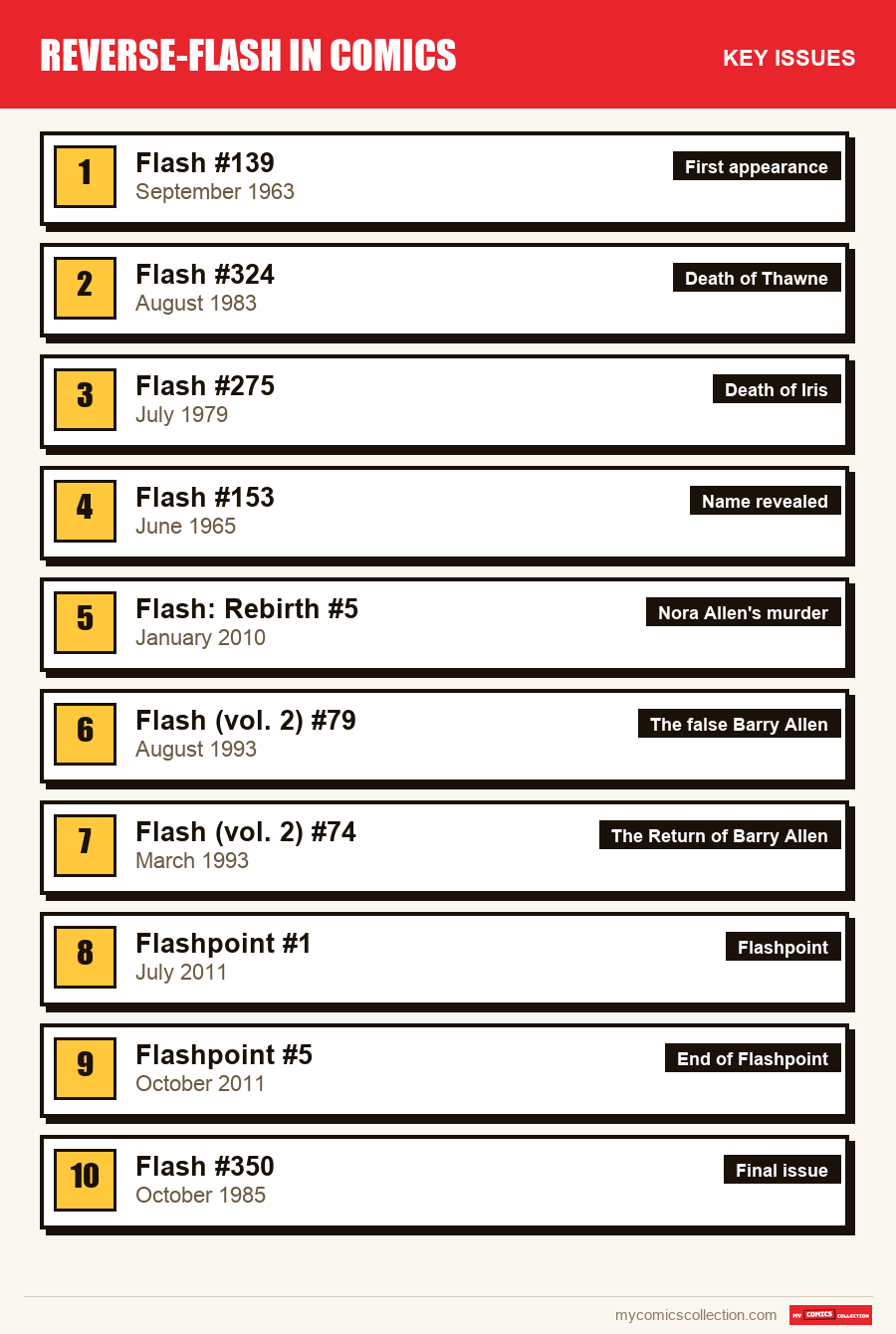
The Reverse-Flash (Eobard Thawne, aka Professor Zoom) first appears in Flash #139 (September 1963), created by John Broome and Carmine Infantino. His identity is revealed in Flash #153 (1965), Barry Allen kills it in Flash #324 (1983), and its mythology is completely rewritten by Geoff Johns in Flash: Rebirth (2009-2010), starting point of the event Flashpoint (2011). Flash #139 remains the key sought after by collectors, with a market structured around CGC graded examples.
There are recurring enemies, and there are character-defining enemies. The Reverse-Flash belongs to the second category: for more than sixty years, he has not only been the opposite of Flash in a reversed yellow and red costume, he is living proof that speed can turn against those who possess it. Eobard Thawne doesn't attack Barry Allen with punches or gadgets: he attacks his past, his family, his entire timeline, making him one of the few DC villains capable of rewriting a hero's story without ever winning the final fight.
For a collector, the editorial history of the Reverse-Flash is a textbook case: a first discreet Silver Age appearance which slowly climbs in value, an identity revealed two years later in an almost anecdotal issue, a spectacular death which becomes a narrative milestone, then a storyline resurrection forty-six years after its debut which revives all the collector's interest around the character. There are few DC villains whose key bibliography spans six decades with such consistency.
This article retraces, issue by issue and fact by fact, the history of the Reverse-Flash in comics: its creation in 1963, the stages which built its legend, its treatment in the Arrowverse television series, and the concrete benchmarks to approach this part of the collection without making a mistake.
Flash #139: the birth of anti-Flash in 1963
In September 1963, screenwriter John Broome and artist Carmine Infantino published Flash #139, an issue which did not announce any particular revolution on the cover. Yet this is where one of the most elegant concepts of Silver Age DC is born: a scientist from the 25th century, brilliant but disillusioned by the sanitized routine of his time, falls into an obsessive fascination with the exploits of the Flash that he studies in history books. This character, who already calls himself Professor Zoom in this first story, uses the technology of his time to reconstruct a costume inspired by that of Barry Allen, but with the colors reversed: yellow dominant, red as an accent, an exact visual mirror of the hero he admires and whom he will soon fight.
The editorial choice was remarkable for the time: rather than giving Flash an adversary with a gadget or brute force, Broome and Infantino created a rival who possessed exactly the same powers, obtained by the same scientific means, but directed toward crime rather than heroism. The reverse costume isn't just a convenient graphic choice to differentiate the two characters on a full page: it's a thematic statement. Reverse-Flash is what speed becomes when it is driven by ego and obsession rather than duty.
The character then remains referred to under the code name Professor Zoom in the editorial continuity of the time, without a specified civil identity. It was only a year and a half later, in Flash #153 (1965), still under the pen of John Broome, that the name Eobard Thawne was associated with the character, completing the origin sketched in issue 139 and definitively anchoring the villain in the distant future of Central City: a choice which would allow, decades later, the writers to indefinitely replay the temporality of the character without ever exhausting his narrative possibilities.
This editorial context of 1963 deserves to be placed in its time: the Silver Age DC had just relaunched Flash itself, a few years earlier, in the form of Barry Allen in Showcase #4 (1956), after the abandonment of the first Flash of the Golden Age, Jay Garrick. The creation of a mirror adversary in 1963 is therefore part of a period where the DC editorial team, led by Julius Schwartz as editor-in-chief of the title, systematically sought to deepen the mythology of its relaunched heroes rather than piling up one-off threats. The Reverse-Flash is not a simple product of this logic: it is the most successful outcome, to the point of becoming, much later, the archetype claimed by other publishers for their own hero-nemesis duos with symmetrical powers.
It is also this care given to conceptual coherence which explains the editorial longevity of the character: unlike many Silver Age villains who fell into oblivion after a few publications, the Reverse-Flash has never permanently left DC continuity since 1963, crossing Bronze Age, post-Crisis, New 52 and Rebirth with a consistency of characterization rare for such an old character.
The duel that turns into tragedy: Fiona Webb and the death of Thawne in Flash #324
The relationship between Flash and his inverted double changed its nature at the turn of the 1980s. Under the direction of screenwriter Cary Bates, once again associated with Carmine Infantino on the drawing, the antagonism ceased to be a game of cat and mouse to become a personal war. Thawne attacks Barry Allen's entourage directly, culminating in the murder of Iris West-Allen, the hero's wife (Flash #275, 1979), and then in his attempt to kill Fiona Webb, Barry's new fiancée, on their wedding day.
It was in this context that Flash #324 (August 1983), entitled “The Slayer and the Slain! ". Pushed to the limit, Barry Allen breaks for the first time the unwritten rule that prohibits DC heroes from killing: he causes the death of Thawne during a confrontation at extreme speed. The gesture has serious editorial consequences: it opens the narrative arc known as "Trial of the Flash", in which Barry Allen must answer for this homicide in court, a story which will occupy the title for almost two years and which will contribute, implicitly, to the subsequent decision to have Barry Allen die in Crisis on Infinite Earths #8 (1985) rather than prolong this trial indefinitely. Flash #324 thus marks a tipping point: the Reverse-Flash is no longer a recurring rival that we find issue after issue, he becomes the trigger for one of the darkest periods in Barry Allen's career.
The Impossible Return: Flash (vol. 2) #74-79 and the impersonation of Barry Allen
After the death of Barry Allen in 1985, the Flash title passed to Wally West, his nephew by marriage and former Kid Flash. In 1993, screenwriter Mark Waid, associated with artist Greg LaRocque, imagined one of the most twisted stories ever dedicated to the character: the arc "The Return of Barry Allen", published in Flash (vol. 2) #74 to #79. A man introducing himself as a resurrected Barry Allen bursts into Wally West's life one Christmas Eve. The reunion quickly turns into discomfort: this Barry shows himself to be more brutal, more expeditious in his way of treating criminals, a thousand miles from the model of moral rigor that Wally had known.
The final revelation is one of the most striking of the post-Crisis period: this false Barry Allen is none other than Eobard Thawne, who used the cosmetic surgery of his futuristic era to physically remodel himself identical to the hero he idolized to the point of obsession. Mark Waid constructed this story precisely to end, in a definitive and disturbing way, readers' hopes of seeing Barry Allen return: by transforming this fantasy into a nightmare embodied by his worst enemy. The arc is today considered one of the peaks of the Wally West era and a reference piece for understanding the obsessive psychology of Thawne's character, well beyond the simple reverse costume.
Flash: Rebirth (2009-2010): Geoff Johns redefines the mythology of the Reverse-Flash
The return of Barry Allen to active life, orchestrated by Geoff Johns in the Final Crisis event then confirmed in the mini-series Flash: Rebirth (six issues, April 2009 to February 2010), is accompanied by a profound rewriting of the origin of the Reverse-Flash. Johns reveals that Thawne is not only Barry's adult adversary: he is responsible, going back in time, for the murder of Nora Allen, Barry's mother, killed when Barry was just a child: a crime for which Barry's father, Henry Allen, was unjustly imprisoned for decades in pre-existing continuity.
This change retroactively transforms the entire mythology of the character: the rivalry between Flash and Reverse-Flash ceases to be a simple opposition of super-speed to become a family tragedy orchestrated since Barry's childhood. Flash: Rebirth is also the story that popularizes the Speed Force as the central narrative mechanism of the Flash universe, and establishes Thawne as the structural source of Barry Allen's founding trauma, much more than just a villain of the month.
Flashpoint and the post-2011 legacy
The direct consequence of this rewrite arrived in 2011 with Flashpoint, a five-issue event written by Geoff Johns and drawn by Andy Kubert. Barry Allen, unable to live with the memory of his mother's murder, goes back in time to stop Thawne from killing her. The seemingly life-saving gesture fractures the timeline and creates a disastrous alternate reality that Barry must then work to repair: the event that will serve as the gateway to the New 52 editorial launch at DC Comics.
With 2016's Rebirth, Thawne returned to a status quo closer to his pre-Flashpoint origin, with nuances of motivation reworked by the title's successive writers. This waltz of continuities (classic origin in 1963, revelation of the murder of Nora Allen in 2009, reset in 2011, restoration in 2016) is precisely what makes the Reverse-Flash bibliography so dense: each major editorial step corresponds to an identifiable issue, sought after for its narrative value as much as for its place in the character's history.
Do not confuse: Reverse-Flash and Zoom (Hunter Zolomon)
A point of vigilance often comes up among beginning collectors: the name “Zoom” is sometimes associated with Reverse-Flash, notably via the historical nickname “Professor Zoom” worn by Thawne. But DC Comics introduced in 2003, in Flash #197, a distinct character under the code name Zoom: Hunter Zolomon (who had first appeared in 2001 in Flash Secret Files and Origins #3), a former FBI profiler turned villain under the pen of Geoff Johns. Zolomon has a radically different relationship to speed than Thawne's, he perceives the world slowing down around him rather than speeding up himself, and his editorial career, although sometimes intertwined with Thawne's in the television adaptations, remains a separate lineage in the comics. For the search for purchase keys, it is therefore essential to distinguish the issues devoted to Eobard Thawne (Reverse-Flash / Professor Zoom) from those devoted to Hunter Zolomon (Zoom), which share neither the same first appearance nor the same collection bibliography.
Collecting this series?
Track what you own, what you are missing and what your collection is worth. 7 day trial.
Start my trial →The impact of adaptations on the rating
The Reverse-Flash benefited from particularly sustained television exposure thanks to The CW network's Arrowverse. Actor Matt Letscher played the original version of Eobard Thawne in 2014, first in the series Arrow, before reprising the role in The Flash and Legends of Tomorrow for versions of the character displaced in time. At the same time, Tom Cavanagh played Thawne hidden under the identity of Harrison Wells during the first season of The Flash (2014), a double incarnation which had a lasting impact on the popular perception of the character and which Cavanagh would continue over several subsequent seasons. During the crossover “Crisis on Earth-X” (2017), only Cavanagh will reprise the role, Letscher not having been requested for the occasion.
This television ubiquity has maintained a continuing interest in character-related collectible keys, particularly Flash #139, regularly cited by grading guides as one of the most sought-after early Silver Age appearances in Flash's villain gallery. As an indication, existing grading data lists around fifteen examples rated 9.0 or more by CGC, including only three examples at grade 9.6: a rarity which explains the premium granted to high grades on this specific number. A documented sale of a CGC 9.6 example reached $8,365 in 2006, while examples in intermediate grades (FN 6.0, GD-1.8) showed a significant increase in value over the period 2012-2018 according to the same grading databases. These figures are several years old and do not replace an updated estimate of recent sales.
Conversely, it is useful to note that the character of the Reverse-Flash does not appear in the feature film The Flash released in 2023 with Ezra Miller: the film replaces him with an antagonist named Dark Flash, a corrupted version of Barry Allen himself wearing a yellow costume in a visual nod to the Reverse-Flash, without Eobard Thawne appearing as a full character. This scriptwriting choice reminds us that the exposure of a comic book character to the cinema is never guaranteed, even for a villain as central to the comics as the Reverse-Flash: a factor to keep in mind for anyone speculating on the effect of a cinema release on the rating of an issue.
Buying guide: how to approach Reverse-Flash comics
Building a coherent collection around the Reverse-Flash requires knowing precisely the hierarchy of key issues and the classic pitfalls of the Silver Age and Bronze Age comics market. Here are the points to know before buying:
- Flash #139 (1963) is the absolute centerpiece: first appearance of the character, already named Professor Zoom, it is the number which structures the entire rating of the character and the one on which the demand for high grade (9.0 and above) greatly exceeds the supply available on the market.
- Systematically check the authenticity of the restoration on old copies of Flash #139: a comic over sixty years old in high grade ungraded deserves an inspection under raking light or, better, a passage by a professional grading company before any significant purchase.
- Don't confuse Flash #139 (first appearance) and Flash #153 (Thawne's identity revealed): These are two separate keys with different ratings and rarity levels, often mixed up in general ad descriptions.
- Flash #324 (1983) and "The Return of Barry Allen" arc (Flash vol. 2 #74-79, 1993) constitute solid secondary keys for those who want to trace the complete narrative history of the character rather than just his first appearance.
- Issues of Flash: Rebirth (2009-2010) are more accessible budgetarily and represent a relevant entry point to understand the modern origin of Thawne, while remaining recent comics with a higher circulation than the Silver Age.
- Always distinguish the keys of Reverse-Flash (Eobard Thawne) from those of Zoom (Hunter Zolomon), notably Flash #197 (2003), who belong to a different villain lineage despite names sometimes confused by the general public.
- Compare several recent completed sales rather than a single ad before setting a purchasing budget, as price volatility on Silver Age keys can be significant from one sale to another depending on the exact condition and origin.
To organize the monitoring of these acquisitions over time (targeted gradation, budget allocated to each key, history of copies already in the collection) the application comic collection management allows you to centralize this information rather than relying on scattered files.
Key issues to know
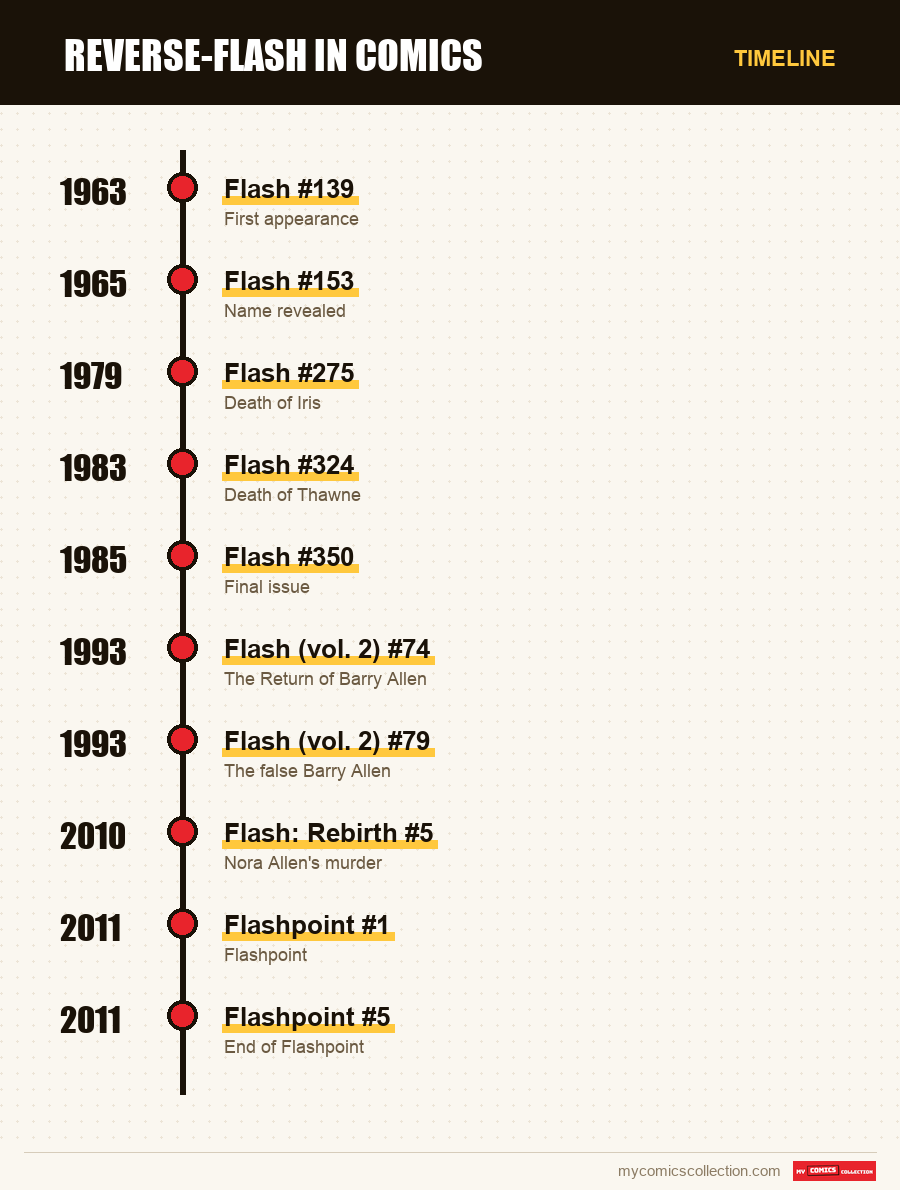
Flash #139
John Broome and Carmine Infantino create a 25th-century criminal who recreates the Flash's powers and adopts a costume with reversed colours. He calls himself Professor Zoom, the Reverse-Flash. His civilian name is only revealed in #153.
Flash #324
In The Slayer and the Slain!, by Cary Bates and Carmine Infantino, Barry Allen chases Professor Zoom around the world to stop him from killing his fiancée Fiona Webb, and snaps his neck. The act opens the long Trial of the Flash arc.
Flash #275
At a costume party, Iris West-Allen, Barry's wife, is killed. The murderer is Professor Zoom, who struck her by phasing his vibrating hand. The crime fuels the vendetta that leads to #324.
Flash #153
Again by John Broome and Carmine Infantino, this issue shows Professor Zoom released from prison in the 25th century and gives his real name for the first time: Eobard Thawne.
Flash: Rebirth #5
Geoff Johns and Ethan Van Sciver rewrite the mythology: Professor Zoom reveals he caused every misfortune of Barry's childhood, including the death of his mother Nora. The revelation sets up Flashpoint directly.
Flash (vol. 2) #79
Final chapter of The Return of Barry Allen, by Mark Waid and Greg LaRocque: Wally West realises that the Barry who came back at Christmas is Eobard Thawne, a Thawne who has not yet met Barry and has had surgery to look like him.
Flash (vol. 2) #74
Start of Mark Waid and Greg LaRocque's arc: a week after Christmas, Wally West still struggles to believe in the return of his mentor Barry Allen, gone since Crisis on Infinite Earths. The six-issue story plays on readers' hopes.
Flashpoint #1
Geoff Johns and Andy Kubert wake Barry Allen up in a transformed world, after he went back in time to save his mother. Professor Zoom makes a brief appearance. The five-issue event leads into DC's New 52 relaunch.
Flashpoint #5
After the final battle, the pre-Flashpoint Thawne dies and Barry goes back in time to let events run their course. The resulting timeline opens the New 52 universe.
Flash #350
The last issue of the first series, closing the Trial of the Flash: Barry and the Rogues must defeat Professor Zoom to restore the timeline, then Barry is reunited with Iris in the 30th century. The hero dies shortly after in Crisis on Infinite Earths.