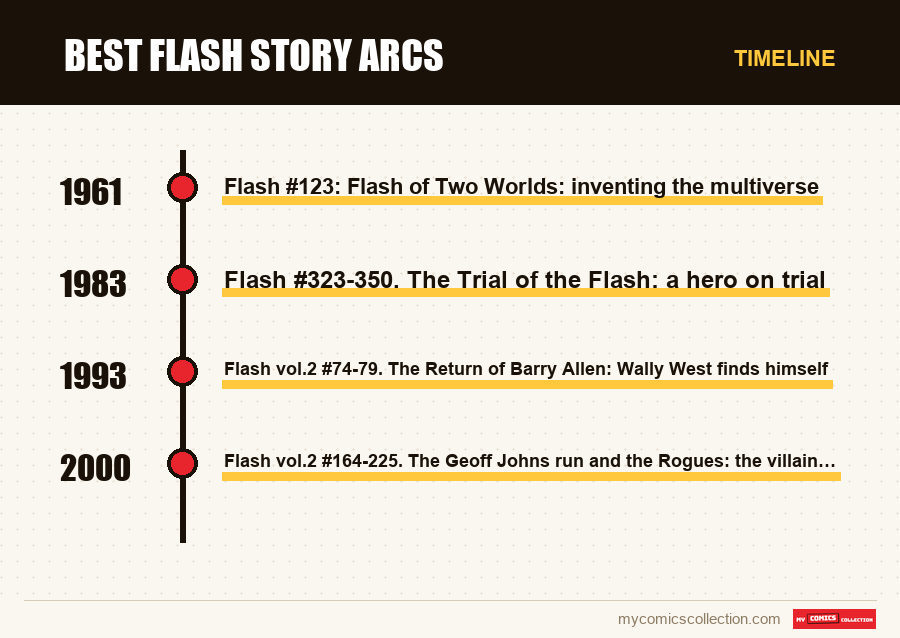
The Flash's publishing history spans three generations of speedsters: Jay Garrick, Barry Allen, and Wally West: and more than eighty years of continuous storytelling. Among the arcs that have defined the character, five stand as genuine landmarks: Flash of Two Worlds (#123, 1961), which invented the DC multiverse; The Trial of the Flash (#323-350, 1983-1985), which ended the Barry Allen era; The Return of Barry Allen (vol.2 #74-79, 1993), where Wally West stepped out of his mentor's shadow; Geoff Johns's Rogues-era run (2000-2005), a reinvention of the villains gallery; and Flashpoint (2011), which rewrote the entire DC Universe.
Flash first appeared in Flash Comics #1 (January 1940, created by Gardner Fox and Harry Lampert), but it was Showcase #4 (October 1956, Barry Allen by Robert Kanigher/John Broome and Carmine Infantino) that officially launched the Silver Age of American comics. A CGC NM+ 9.6 copy of that issue sold for $900,000 at Heritage Auctions in January 2024: the highest price ever recorded for a Silver Age DC comic. Yet what makes Flash genuinely unique in collector culture is not just its landmark first appearances but its succession of defining long-form stories.
This guide sticks to the verifiable: confirmed issue numbers, documented creators, and raw eBay data from our estimator (eBay.fr + eBay.com, June 2026) where listing volume is sufficient. One important caveat: Silver Age Flash (vol.1) issues are thinly covered on eBay: our tool returns 0 or 1 listing for most keys (e.g. #123: 0 listings, #323: 0 listings). For those issues, documented auction records are the reference; no eBay median will be cited.
The five essential arcs at a glance
| Arc | Issues | Creators | Narrative stakes |
|---|---|---|---|
| Flash of Two Worlds | Flash #123 (Sept. 1961) | Gardner Fox / Carmine Infantino | Birth of the DC multiverse (Earth-Two) |
| Trial of the Flash | Flash #323-350 (1983-1985) | Cary Bates / Carmine Infantino | Barry Allen on trial; close of vol.1 |
| Return of Barry Allen | Flash vol.2 #74-79 (1993) | Mark Waid / Greg LaRocque | Wally West steps out of Barry's shadow |
| Rogues (Johns run) | Flash vol.2 #164-225 (2000-2005) | Geoff Johns / Scott Kolins | Rogues reimagined; Wally at his peak |
| Flashpoint | 5-issue miniseries (2011) | Geoff Johns / Andy Kubert | Barry rewrites history; New 52 launches |
Flash #123: Flash of Two Worlds (1961): inventing the multiverse
No single issue in DC's history carries more structural weight. Flash #123 (September 1961), written by Gardner Fox, pencilled by Carmine Infantino and inked by Joe Giella, fits its entire concept into one story: Barry Allen, the Silver Age Flash, accidentally vibrates through a dimensional barrier and arrives on a parallel Earth where Jay Garrick, the Golden Age Flash, has been living quietly in retirement. It is the first meeting of a Silver Age hero with his Golden Age counterpart, and above all, the founding document of the DC multiverse (Earth-One / Earth-Two), shaped under the editorial vision of Julius Schwartz. The ripple effects are enormous: DC revived its entire roster of Golden Age characters, annual crossovers between the two Earths became a fixture, and the whole concept ran forward until Crisis on Infinite Earths (1985) collapsed the multiverse: only for later creators to rebuild it.
As a collectible, Flash #123 is a genuine Silver Age key. Our eBay estimator returns 0 active listings: no usable median exists. The only high-grade auction record found in public sources is a CGC 9.4 copy (Western Penn pedigree) that sold for $23,000 at Heritage Auctions in 2004. Mid- and low-grade copies trade privately for hundreds to low thousands of dollars depending on condition and grade.
Flash #323-350. The Trial of the Flash (1983-1985): a hero on trial
Launched in July 1983 and concluded with the final issue of volume 1 (#350, October 1985), The Trial of the Flash is one of the most ambitious, and most debated, extended stories in the title's history. Written by Cary Bates and drawn by Carmine Infantino in some of his last major work on the character, the arc grows out of the death of Iris West (Flash #275, 1979): Barry has found new happiness and is about to remarry when Reverse-Flash attempts to kill his fiancée Fiona Webb. In the struggle, Barry snaps the villain's neck, and faces a murder charge. For nearly two and a half years, every issue doubles as a courtroom chapter and an action story, culminating in a resolution that sends Barry into the future to be reunited with Iris, paving the way directly for his sacrifice in Crisis on Infinite Earths #8 (1985).
For the collector, this is a run to build gradually: our estimator returns 0 listings for #323 and a single listing for #350: both too thin to quote. Mid-series issues from 1983-1984 surface modestly on eBay at a few euros apiece in reading condition. The #323 in fine shape has attracted renewed interest from collectors revisiting the late Infantino era.
Flash vol.2 #74-79. The Return of Barry Allen (1993): Wally West finds himself
When Mark Waid took over Flash (vol.2, the Wally West series that launched in 1987) with issue #62, he inherited a character still perceived as Barry Allen's stand-in. The Return of Barry Allen (vol.2 #74-79, March-August 1993, art by Greg LaRocque) confronts that problem directly: someone claiming to be Barry Allen comes back from the dead, triggering an existential crisis in Wally. The revelation, that this figure is a delusional Eobard Thawne who has absorbed Barry's memories and believes himself to be the original Flash, forces Wally to interrogate his own worth and identity. The arc ends with Wally genuinely outrunning his mentor's ghost and embracing the Flash legacy as his own. It also features the modern debut of Max Mercury and is credited with establishing the broader Flash Family concept.
Our estimator returns a single listing at €4 for issue #74: too thin for a reliable median. These issues remain inexpensive in the secondary market (a few euros each in reading condition), making the complete six-issue arc an affordable entry point into Waid's celebrated run. The collected edition is widely available.
Flash vol.2 #164-225. The Geoff Johns run and the Rogues (2000-2005): the villains reimagined
Geoff Johns joined Flash with issue #164 (September 2000): initially as a fill-in with artist Angel Unzueta, then as the ongoing writer from #170, with Scott Kolins as his primary artistic partner. His five-year run through issue #225 is widely regarded as the definitive Wally West era. The core insight was to treat the Rogues (Captain Cold, Mirror Master, Heat Wave, Weather Wizard, the Trickster) not as colourful obstacles but as characters with psychology, codes of conduct, and genuine menace. The Rogues arc proper (#177-181, 2001-2002, art Kolins) is the clearest statement of that vision, but the full run functions as a single long narrative. The Iron Heights one-shot (2001, art by Ethan Van Sciver) is inseparable from this period: it establishes the Flash's version of Arkham, and introduces Hunter Zolomon, who becomes the second Zoom.
The complete run is available in two Flash by Geoff Johns Omnibus volumes, which is the most practical way to read it. Individual issues from 2000-2005 are inexpensive and plentiful on the secondary market; the omnibuses themselves can reach €80-100 in secondhand condition.
Flashpoint (2011): Barry rewrites history, DC reboots
Flashpoint is a five-issue miniseries written by Geoff Johns and drawn by Andy Kubert, published from May to September 2011. Barry Allen, in the regular DC timeline, travels back in time to prevent the murder of his mother Nora, and inadvertently creates an alternate reality orchestrated by Reverse-Flash (Eobard Thawne). In this warped world, Thomas Wayne is a brutal Batman, Aquaman and Wonder Woman have plunged Europe into war, Superman is a government prisoner, and Barry is powerless. The story is a meditation on grief, consequence, and the dangers of tampering with time, and it closes with a sacrifice that restores the timeline, and simultaneously launches The New 52, DC's 2011 continuity relaunch. The story also inspired the The Flash film (2023, directed by Andy Muschietti, starring Ezra Miller).
As a modern miniseries, Flashpoint is highly accessible: individual issues are found for a few euros in fine condition, and the collected TPB is easy to locate at cover price. For collectors interested in complete runs, the numerous tie-in miniseries expand the alternate-universe world in significant detail.
Own Flash comics? Get a free valuation with our tool based on real eBay sales to find the low, median, and high value of your copies.
Frequently Asked Questions
Flash of Two Worlds (#123, 1961), The Trial of the Flash (#323-350, 1983-1985), The Return of Barry Allen (vol.2 #74-79, 1993), Geoff Johns's Rogues run (2000-2005) and Flashpoint (2011). They span three generations of heroes: Jay Garrick, Barry Allen and Wally West.
Published in September 1961 with Gardner Fox writing and Carmine Infantino drawing, it sends Barry Allen sliding onto a parallel Earth where Jay Garrick, the Golden Age Flash, lives. It is the first meeting of these two heroes and the birth certificate of the DC multiverse, with Earth-One and Earth-Two.
Started in 1983 with #323 and concluded in #350, the last issue of volume 1, the arc sees Barry Allen tried for the murder of the Reverse-Flash. Written by Cary Bates and drawn by Carmine Infantino, it serves as a direct prologue to Crisis on Infinite Earths and Barry's death.
In Flash vol.2 #74-79 (1993), a man claiming to be Barry returns from the dead. Mark Waid reveals he is Eobard Thawne, the Reverse-Flash, which forces Wally West to assert his own legitimacy. The arc also introduces the first modern appearance of Max Mercury.
From #164 to #225 (2000-2005), Johns humanizes the Rogues by giving them psychology, motivations and a code of honor, with the Rogues arc in #177-181 and the 2001 Iron Heights one-shot. The run is available in collected form, The Flash by Geoff Johns Omnibus, in two volumes.