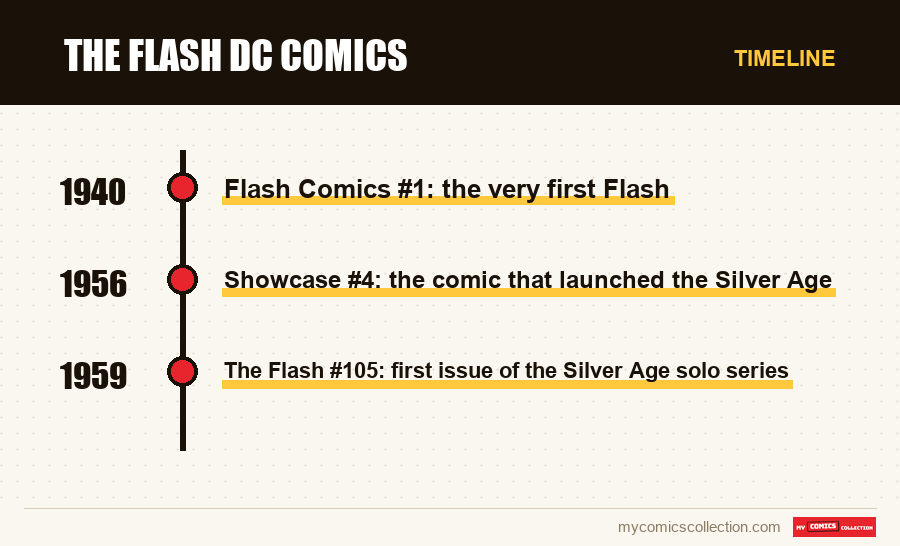
The ultimate Flash grail is Showcase #4 (October 1956), the first appearance of Barry Allen written by Robert Kanigher and drawn by Carmine Infantino: a documented record of $900,000 for a CGC 9.6 copy sold at Heritage Auctions in 2024. Next come Flash Comics #1 (1940, Jay Garrick, Golden Age) and the Silver Age solo series keys: The Flash #105, #110, #123, and #139: all with near-zero eBay volume, their values are established at specialist auctions.
The Flash is one of the rare comics characters to have spanned every major publishing era without interruption. Jay Garrick, the Golden Age Flash, debuted in January 1940 in Flash Comics #1, created by writer Gardner Fox and artist Harry Lampert. Sixteen years later, Barry Allen reinvented the character in Showcase #4 (1956) and launched the Silver Age of American comics: a distinction very few single issues can claim. Wally West carried the mantle from 1987, before Geoff Johns brought Barry back in Flash: Rebirth (2009) and rewrote DC continuity with Flashpoint (2011). The CW television series starring Grant Gustin (9 seasons, 2014-2023) and the 2023 film The Flash (Ezra Miller, $271.4 million worldwide gross) have recently cemented the character's place in popular culture.
This guide sticks to the verifiable: eBay medians from our estimator (eBay.fr + eBay.com, June 2026) and sale records documented by Heritage Auctions, CGC News, and GoCollect. A critical caveat: the major Flash keys (Showcase #4, Flash Comics #1, Flash #105, #110, #123, #139, #275) show zero to one active listing in our eBay tool: volume is too thin for a reliable median. These issues are valued exclusively through specialist auctions; the figures below are documented records, not current market medians.
Flash key issue ranking (real data, June 2026)
For Golden Age and Silver Age grails, auction records are the only reliable benchmark. Our eBay tool detects no usable listings for these issues; the figures below come from Heritage Auctions, ComicConnect, and GoCollect.
| Issue | Key significance | eBay (all grades) | Documented record |
|---|---|---|---|
| Showcase #4 (Oct. 1956) | 1st appearance of Barry Allen; launch of the Silver Age | Separate series: not available | $900,000 (CGC 9.6, Heritage 2024) |
| Flash Comics #1 (Jan. 1940) | 1st appearance of Jay Garrick (Golden Age) | Separate series: not available | ~$107,550 (CGC FN+ 6.5, Heritage) |
| The Flash #105 (Feb. 1959) | First issue of the Silver Age solo series; 1st Mirror Master | 1 listing: signal too thin | ~$39,000 (CGC 9.4, Heritage 2011) |
| The Flash #110 (Dec. 1959) | 1st appearance of Wally West (Kid Flash) + 1st Weather Wizard | 0 listings: not available | Several thousand dollars at CGC mid-grade |
| The Flash #123 (Sept. 1961) | "Flash of Two Worlds": 1st DC multiverse, Jay Garrick returns | 0 listings: not available | ~$83,000 (Heritage 2004, near-mint copy) |
| The Flash #139 (Sept. 1963) | 1st appearance of Professor Zoom / Reverse-Flash (Eobard Thawne) | 0 listings: not available | ~$8,365 (CGC 9.6, Heritage) |
| The Flash #275 (Jul. 1979) | Death of Iris West (Bronze Age landmark) | 0 listings: not available | Qualitative: thin market |
| The Flash vol.2 #1 (Jun. 1987) | Wally West's first issue as The Flash (Mike Baron / Jackson Guice) | ~14 mixed listings: median unreliable | Low intrinsic value in low grade (<€20) |
Record sources: Heritage Auctions, GoCollect, ComicConnect, CGC Census.
Showcase #4 (1956): the comic that launched the Silver Age
In October 1956, DC Comics published Showcase #4: not under the Flash title, but in its anthology try-out series. Robert Kanigher wrote the lead story ("Mystery of the Human Thunderbolt!"), John Broome the second tale, and Carmine Infantino drew both. Barry Allen, a police chemist struck by lightning in his lab, acquires super-speed in what would become the defining origin of the Silver Age. The issue is universally recognised as the trigger of the Silver Age of American comics. A CGC 9.6 copy, one of only two at that grade in the census, sold for $900,000 at Heritage Auctions in 2024, setting the all-time record for a Silver Age DC comic. Our eBay tool lists this series separately and returns no usable median; only specialist auctions can price this grail.
Flash Comics #1 (1940): the very first Flash
In January 1940, DC (then All-American Publications) released Flash Comics #1. Gardner Fox (writer) and Harry Lampert (artist) created Jay Garrick, a college student who inhales hard-water vapours and gains superhuman speed. The issue also contains the first appearance of Hawkman. A CGC FN+ 6.5 copy reached approximately $107,550 at Heritage Auctions: illustrating the value of mid-grade copies for scarce Golden Age books. High-grade copies are virtually absent from the open market.
The Flash #105 (1959): first issue of the Silver Age solo series
In February 1959, after successful try-outs in Showcase (#4, #8, #13, #14), Barry Allen earned his own series: picking up the numbering from Flash Comics, which had ended at #104 in 1949. The Flash #105 is both the first issue of the Silver Age solo series and the first appearance of the Mirror Master. It ranks in the top 15 Silver Age comics according to the Overstreet Price Guide. Only three copies have been graded CGC 9.4; the most recent reached approximately $39,000 at Heritage Auctions in 2011. Our eBay tool returns a single active listing: far too thin for a reliable median.
The Flash #110, #123, and #139: the Silver Age key trio
The Flash #110 (December 1959) introduces two major characters in a single issue: Wally West, Iris Allen's nephew, becomes Kid Flash after recreating his uncle's laboratory accident, and the Weather Wizard appears as a villain for the first time. Wally West would go on to become the Flash most beloved by a generation of readers. eBay listings for this issue are absent from our tool; CGC mid-grade copies trade for several thousand dollars based on documented sales.
The Flash #123 (September 1961) is one of the most-cited stories in comics history. "Flash of Two Worlds!", written by Gardner Fox and drawn by Carmine Infantino, sees Barry Allen accidentally vibrate through a dimensional barrier and meet Jay Garrick on Earth-Two: the first story to formalise the DC multiverse concept. It is the starting point of a cross-world crossover tradition that would shape DC continuity for decades. A near-mint copy reached approximately $83,000 at Heritage Auctions in 2004; current values for high-grade copies are considerably higher.
The Flash #139 (September 1963) presents the origin and first appearance of Professor Zoom (Eobard Thawne), Barry Allen's mirror-image antagonist from the 25th century. This Reverse-Flash became one of DC's defining villains, later popularised by the CW series. A CGC 9.6 copy, one of three at that grade, sold for approximately $8,365 at Heritage Auctions.
Bronze Age: The Flash #275 and the death of Iris West
The Flash #275 (July 1979) marks one of the darkest turning points of the series: Iris West-Allen, Barry's wife, is killed by Professor Zoom at a masquerade party. The storyline spanned several issues and culminated in a fictional murder trial, before the vol.1 series concluded with #350 in 1985. Our eBay tool returns no active listings for this issue; the market is thin and pricing qualitative.
Wally West and the modern era: vol.2 (1987) and the landmark runs
Following Barry Allen's death in Crisis on Infinite Earths #8 (1985), Wally West inherited the title. The Flash vol.2 #1 (June 1987), written by Mike Baron and drawn by Jackson Guice, launched a long-running series that continued to #247 (2009). The runs by Mark Waid (from #62, 1992) and Geoff Johns (from #164, 2001) are widely regarded as the finest in the title's history, and they remain extremely affordable and readily available on eBay and in back-issue bins. Our tool returns roughly 14 mixed listings for "Flash #1" with a median around €4, blending multiple volumes; at that price point, you are in the common vol.2 1987 range.
Flash: Rebirth (2009, Geoff Johns / Ethan Van Sciver) covers Barry Allen's resurrection and is the ideal modern entry point into the character. Flashpoint (2011, Johns / Andy Kubert) rewrites DC's timeline and leads into the New 52 relaunch. For collectors, first printings and trade paperbacks of both remain accessible at modest prices.
Own a Flash comic? Get a free valuation with our tool based on real eBay sales to find its low, median, and high value.
Frequently asked questions
Showcase #4 (October 1956), the first appearance of Barry Allen, written by Robert Kanigher and drawn by Carmine Infantino. It is considered the trigger of the Silver Age and holds the all-time record for a DC Silver Age comic.
This January 1940 issue introduces Jay Garrick, the Golden Age Flash, created by Gardner Fox and Harry Lampert. It also contains the first appearance of Hawkman.
The Flash #105 (first solo issue, first appearance of Mirror Master), #110 (Wally West as Kid Flash and Weather Wizard), #123 ("Flash of Two Worlds", the first DC multiverse) and #139 (Professor Zoom, a.k.a. Reverse-Flash). These are the four issues to know.
Because these issues show zero to a single active online listing: the volume is too low to produce a reliable median. They can therefore only be assessed through specialist auctions, based on documented records.
Through the Wally West era: The Flash vol. 2 #1 (1987) and the series up to #247 (2009), whose runs by Mark Waid (from #62) and Geoff Johns (from #164) remain very accessible. Flash: Rebirth (2009) and Flashpoint (2011) complete the path.