
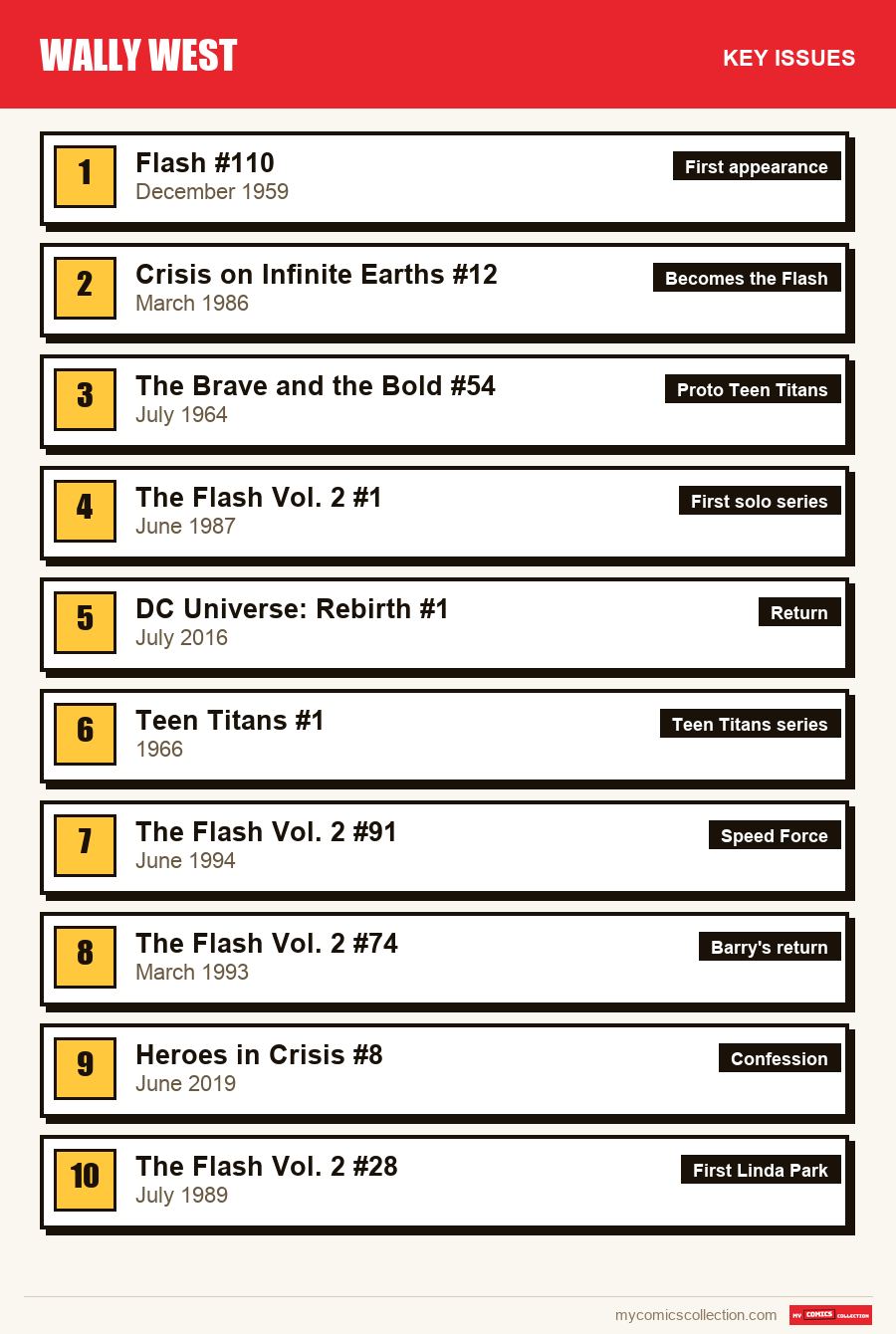
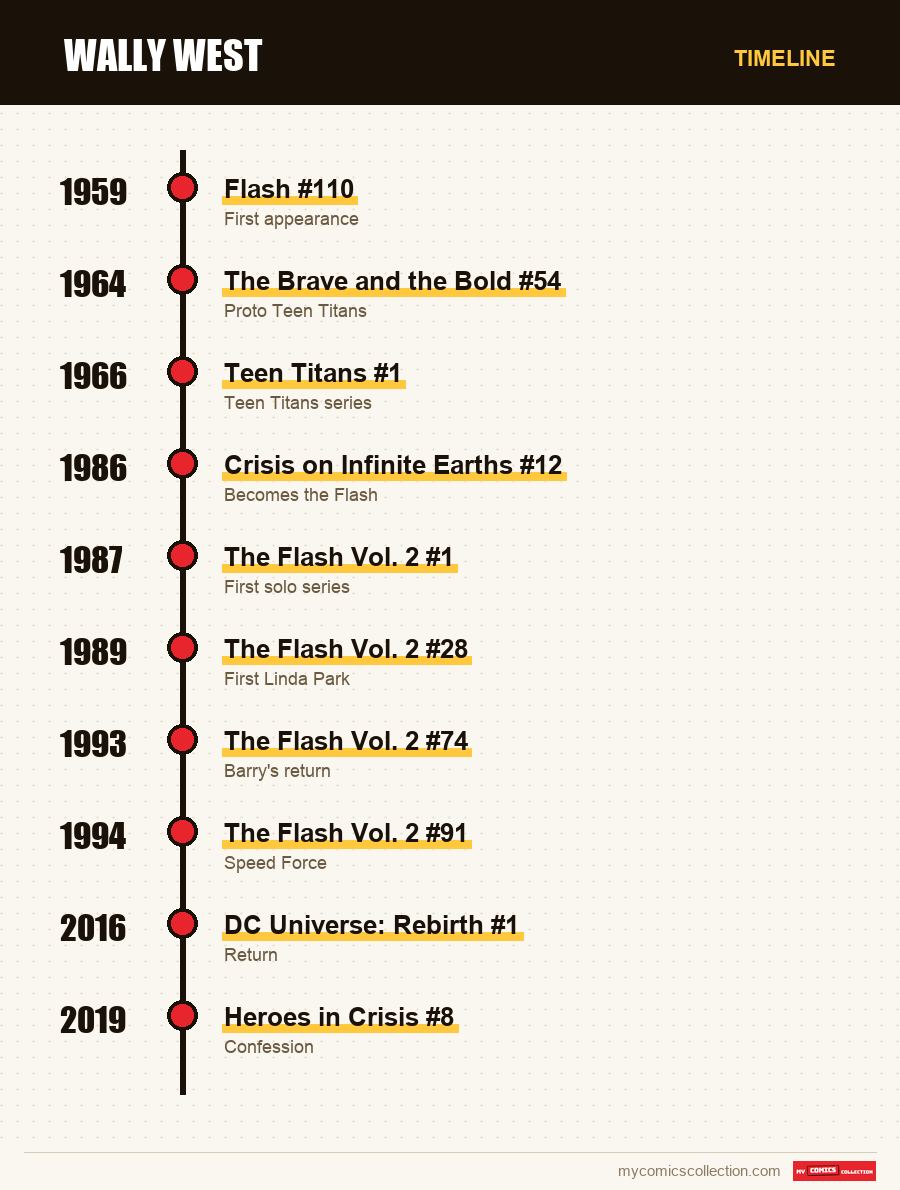
Wally West first appeared in December 1959 in Flash #110 (John Broome and Carmine Infantino), as Kid Flash, the nephew of Iris West and sidekick of Barry Allen. In March 1986, in Crisis on Infinite Earths #12, he inherits the costume and becomes the third Flash after Barry's sacrifice. He held the title for more than twenty years, disappeared with the Flashpoint/New 52 reboot in 2011, returned in 2016 with DC Rebirth, went through the controversy of Heroes in Crisis in 2018-2019, then becomes the official Flash of the DC universe since 2023-2024. Major collection keys remain Flash #110 and Crisis on Infinite Earths #12.
Few supporting characters of the Gilded and Silver Ages had as bumpy a publishing trajectory as Wally West. Created as a simple teenage foil for Barry Allen in 1959, it took him more than twenty-five years to emerge from the shadow of his mentor, before becoming, for an entire generation of readers in the 1990s, the most popular Flash in the character's entire history. Then DC almost completely erased him from the editorial landscape for five years, before bringing him back into the spotlight in an intrigue which remains one of the most debated of the 2010 decade.
This bumpy history largely explains why the rating of its key comics works in fits and starts: a peak when a film or series puts it back in the spotlight, another when a significant narrative arc emerges in trade paperback, and a solid and lasting base around the very first issues of 1959 and 1986, which remain indifferent to passing editorial fashions. For a collector, understanding this complex chronology is essential before embarking on the search for the right numbers.
This article traces, arc by arc and decade by decade, the complete history of Wally West in comics: his creation in 1959, his transition from sidekick to full-fledged hero in 1986, the golden age of the Mark Waid era in the 1990s, his post-Flashpoint disappearance, his return in Rebirth, the controversy of Heroes in Crisis, and his current status as the official Flash of the DC Universe since 2023-2024.
From the origins of Kid Flash to the birth of a DC Silver Age legend
Wally West was born in December 1959 in the pages of Flash #110, an issue signed by writer John Broome and artist Carmine Infantino, with inking by Murphy Anderson. At the time, the title was officially called the numbered continuation of Flash Comics, the Golden Age magazine relaunched in 1959 with issue #105 for Barry Allen, who had debuted three years earlier in Showcase #4 (1956). This issue 110 marks a double event: it introduces both the supervillain Weather Wizard and the character who will become, decades later, one of the pillars of the DC universe.
In the original story, Wally Rudolph West is the nephew of Iris West, the girlfriend and then wife of Barry Allen. During a visit to his uncle's laboratory, the young boy is struck by the same set of circumstances that gave Barry his powers: a discharge of chemicals combined with lightning. He becomes Kid Flash, decked out in a yellow and red costume distinct from that of his mentor, and quickly joins the universe of DC's teenage sidekicks alongside Robin and Aqualad.
This first decade of Kid Flash is part of the editorial logic of the Silver Age: the character serves above all as a gateway for young readers, a hero with whom adolescents can identify more easily than with the accomplished adult that is Barry Allen. Kid Flash then becomes a founding member of the Teen Titans, first united in The Brave and the Bold #54 (1964) alongside Robin and Aqualad, then in their own series Teen Titans #1 in 1966. This membership in the group of adolescent superheroes will structure Wally's identity for more than twenty years: he forms lasting friendships there, notably with Robin (Dick Grayson), which will last throughout the rest of his editorial career.
Kid Flash in Barry Allen's Shadow: The Formative Decades
Between 1959 and the mid-1980s, Wally West remained almost exclusively a supporting role. It appears regularly in the pages of Flash alongside Barry Allen, multiplies his participation in the different incarnations of the Teen Titans, and becomes a regular in DC crossovers of the time. But he never bears the title of a series alone, and his identity as a hero remains largely defined by his relationship with his uncle by marriage.
This position of permanent sidekick, which could have limited the character to a simple foil, nevertheless turned into a narrative asset when DC decided, in the mid-1980s, to fundamentally reorganize its editorial universe. The publishing house then prepares Crisis on Infinite Earths, the maxi-event series by Marv Wolfman and George Pérez which must merge the DC multiverse into a single continuum and, in the process, get rid of several historical characters deemed redundant. Barry Allen is part of the list of heroes whose death should have a lasting impact on readers. However, for such a sacrifice to have long-term editorial meaning, a credible successor was needed: Wally West, present since 1959 and already experienced in costume and speed powers, was the natural choice.
1985-1986: the death of Barry Allen and the birth of the third Flash
The decisive turning point occurs in Crisis on Infinite Earths #8, published in November 1985. Barry Allen sacrifices himself to save the multiverse by destroying the Anti-Monitor's machine, running faster than he ever has until he literally dissolves into the time frame. At the very end of #12, published in March 1986, Wally West, still wearing his yellow Kid Flash costume, puts on Barry's red uniform and utters the now famous phrase announcing that the Flash lives again. This shift makes him, at this precise moment, the third character to officially bear the name Flash in DC continuity, after Jay Garrick during the golden age and Barry Allen since 1956.
The editorial transition came to fruition the following year with the launch of The Flash volume 2 #1 in June 1987, which finally inaugurated a monthly series centered on Wally alone. The first years of this new title, however, remained marked by a form of hesitation: successive screenwriters struggled to define an identity specific to the character, stuck between readers' nostalgia for Barry Allen and the desire to make Wally something other than a simple copy of his deceased mentor. This editorial hesitation lasted until the arrival, in 1992, of a screenwriter who would permanently change the situation: Mark Waid.
The Mark Waid era: when Wally West finally becomes himself
Mark Waid's run on The Flash volume 2, associated in particular with the cartoonists Greg LaRocque then Salvador Larroca, is today considered by a large part of the reading community as the character's reference period. Two arcs in particular structure this era: The Return of Barry Allen , published in Flash #74 to 79 in 1993, and Terminal Velocity , published in Flash #95 to 100 in 1994-1995.
In The Return of Barry Allen, a man claiming to be a resurrected Barry Allen reappears in Wally's life on Christmas Day, calling into question the young hero's entire legitimacy to wear the costume. The final twist reveals that it is actually Eobard Thawne, the Reverse-Flash, manipulating Wally to destroy him psychologically. This direct confrontation with the ghost of his mentor pushes Wally to confront, once and for all, his own imposter syndrome: he no longer seeks to be a pale copy of Barry, but to become a Flash in his own right, with his own voice.
Two years later, Terminal Velocity deepens the founding concept of the Speed Force, which had appeared shortly before in Flash #91 (June 1994), this extra-dimensional energy field which explains and unifies the powers of all DC speedsters. Above all, the arc allows Wally to literally surpass the limits that Barry Allen had known in terms of speed, while consolidating his relationship with Linda Park, a journalist who becomes his companion then his wife and one of the emotional pillars of the character for the following twenty years. It was during this period, between the mid-1990s and the end of the 2000s, that Wally West established himself as THE Flash for an entire generation of readers who never knew Barry Allen other than as a memory.
A more human, more accessible Flash
What fundamentally distinguishes Wally West's writing from that of Barry Allen is a choice of characterization assumed by successive screenwriters: where Barry embodied the impeccable and almost too perfect scientist, Wally remains more impulsive, more joking, more subject to doubt. This more marked humanity, combined with a personal life developed over time with Linda Park and, later, their twin children Irey and Jai, helps to make Wally one of the most endearing DC characters of his generation, far ahead of many more prestigious solo heroes on paper.
Flashpoint, the New 52 and the year Wally West disappeared
In 2011, the event Flashpoint rewrites the entire DC continuity and leads to the launch of the New 52, a complete reboot of the entire catalog of the publishing house. In this new version of the universe, Barry Allen once again becomes the one and only Flash on the trail, and Wally West simply disappears from continuity for several years, an editorial choice which quickly arouses the frustration of a significant part of the historical readership of the character.
DC ends up reintroducing a character named Wally West in The Flash Annual #3 in 2014. But it is then a very different version: a mixed-race teenager, member of a new iteration of the Teen Titans, without any direct narrative link with the classic character created in 1959. This substitution, experienced by some fans as a pure and simple erasure of the original in favor of a homonymous character, fuels a controversy which weighs heavily in discussions around the New 52 during this period.
DC Rebirth: the long-awaited return of the original Wally West
The editorial response to this frustration comes in 2016 with the launch of DC Rebirth, the partial overhaul that aims to reintegrate the warmth and emotional story lost during the transition to the New 52. DC Universe: Rebirth #1, the original Wally West resurfaces, revealed to have been trapped in the Speed Force for what is, internally, an entire decade. His return serves as the centerpiece of the central mystery of Rebirth: an outside force has manipulated ten years of DC continuity, a mystery which will later be attached to the character of Doctor Manhattan from the universe of Watchmen.
To resolve the coexistence of the two characters with the same name, DC then carried out a retcon: the Wally West who appeared in 2014 officially became Wallace West, cousin of the original Wally and son of Daniel West, a version of the Reverse-Flash who appeared in the New 52. This clarification allows the two characters to coexist in continuity without stepping on each other, even if it remains, even today, a frequent source of confusion among readers who discover the franchise via audiovisual adaptations.
Heroes in Crisis: the controversy that divided Wally West fans
In 2018-2019, the event mini-series Heroes in Crisis, written by Tom King and drawn by Clay Mann, plunges Wally West into one of the darkest and most contested arcs in his entire publishing history. The story is presented as a police investigation surrounding a shooting that occurred within the Sanctuary, a care center for superheroes with psychological difficulties created by Batman, Superman and Wonder Woman. In Heroes in Crisis #8, the culprit is revealed: it is Wally himself, who lost control of his powers after consulting the confidential files of the other heroes, causing an explosion which kills several characters, including his long-time friend Roy Harper.
The reaction from the readership was immediate and largely negative. A large part of the historical fans of the character judge what to do with Wally West, the very incarnation of hope and loyalty within the DC universe, indirectly responsible for the death of his own friends, constitutes a betrayal of more than fifty years of characterization. Tom King himself subsequently admitted, during Comic-Con International 2019, that this choice represented a difficult mountain to get fans to accept, while specifying that the decision to make Wally the one responsible for the facts came from an editorial directive from DC and not from an initial script choice on his part.
Flash Forward and the path to redemption
Faced with the scale of the controversy, DC is launching the mini-series in 2019 Flash Forward, written by Scott Lobdell with Brett Booth drawing, explicitly designed to offer Wally West a path to redemption after the traumatic events of Heroes in Crisis. This six-part story marks the starting point of a progressive reconstruction of the character, which will continue over several years through different titles and mini-series, before Wally fully regains his central place in the DC universe in the early 2020s.
Wally West today: the official heir to the Flash name
Since September 2023, Wally West has once again taken center stage with the launch of The Flash volume 6, written by Simon Spurrier and drawn by Mike Deodato Jr. This new series shows him at a moment of strong personal development, surrounded by his wife Linda Park and their children Irey, Jai and the youngest, Wade. This characterization marks a deliberate contrast with the darkest years of Heroes in Crisis, by focusing on the family dimension which has always made Wally unique compared to other bearers of the Flash name.
Wally's status is further consolidated in 2024: in the event Absolute Power #4, Barry Allen voluntarily cuts his own connection to the Speed Force and passes the Flash's iconic ring to Wally, making him the sole official holder of the title. This major editorial transition concludes in The Flash #14, published in October 2024, which establishes Wally West as the central speedster of the DC universe for the rest of the decade. For collectors, this recent editorial news remains a factor to monitor: each relaunch or handover generally generates a one-off renewed interest in the founding issues of the character, notably Flash #110 and Crisis on Infinite Earths #12.
Collecting this series?
Track what you own, what you are missing and what your collection is worth. 7 day trial.
Start my trial →The impact of adaptations on the rating
Unlike characters like Spider-Man or Batman, Wally West has never had a live-action film adaptation focused on him alone. Its mainstream exposure comes almost exclusively through television and animation, which explains a more modest but nonetheless real and measurable market dynamic with each new appearance.
On television, Australian actor Keiynan Lonsdale plays Wally West in the series The Flash broadcast on the CW from 2015. Introduced in season 2 as the previously unknown son of Joe West, the character becomes Kid Flash from season 3, before joining the spin-off Legends of Tomorrow in 2017. Lonsdale announced his departure from both series in 2018. This television incarnation, watched by millions of viewers each week at the height of the Arrowverse's success, introduced the character of Kid Flash to a much wider audience than just comic book readers, generating occasional but real interest in the character's original issues on the secondary market.
On the animation side, Wally West benefits from a double vocal life well known to connoisseurs. Michael Rosenbaum voices him as the adult Flash in Justice League and Justice League Unlimited in the early 2000s, then as Kid Flash in the series Teen Titans from Cartoon Network. A decade later, Jason Spisak took over the role of Kid Flash in Young Justice from 2010, then in the animated film Justice League vs. Teen Titans in 2016. These multiple animated incarnations, broadcast over nearly two decades, have largely contributed to building the character's lasting notoriety among a younger audience, regardless of the sometimes complex twists and turns of the continuity of paper comics.
For a collector, this profile of media exposure, more diffuse and spread over time than a single blockbuster, results in a price which progresses more regularly than in spectacular spurts: the record sale of Flash #110 in June 2024 (a CGC NM+ 9.6 copy, sold far above a CBCS 9.0 copy sold at the end of 2018) above all illustrates the general rise in the market for Silver Age DC keys on high gradations, more than an isolated peak linked to a specific media release.
The key comics to know to collect Wally West
Three editorial moments concentrate most of the heritage value linked to Wally West. The first is obviously Flash #110 (December 1959), which marks his very first appearance as Kid Flash and remains, as such, the absolute Holy Grail for any collector seeking to trace the origins of the character from the beginning. Recent sales in very high grades, such as the CGC 9.6 copy sold in June 2024, confirm that this issue is now trading in the same category as other major Silver Age DC keys.
The second essential number is Crisis on Infinite Earths #12 (March 1986), which contains the very first appearance of Wally West as the adult Flash, four issues after the death of Barry Allen in #8. This issue benefits from a double demand: that of collectors of the maxi-series Crisis as a whole, the founding event of the entire modern DC shared universe, and that of collectors specifically focused on Wally West and his transition to the red suit.
The third important milestone is The Flash volume 2 #1 (June 1987), first issue of the first-ever solo series focused entirely on Wally West as the titular Flash. Less spectacular in terms of circulation and rarity than the two previous issues, published in the middle of a period of high production at DC at the end of the 1980s, it nevertheless remains a reference milestone for any complete collection retracing the history of the character from his creation to his status as a hero in his own right.
To organize a methodical research, the collection tracking app of the site allows these key issues to be cataloged as they are acquired, with details of the edition, condition and date of purchase, which proves particularly useful for a figure as rich in editorial twists and turns as Wally West.
Buying guide: how to collect Wally West
- Check the exact title of number 110. The magazine was called Flash Comics up to number 104, then resumed continuous numbering under the simple title Flash from issue 105 in 1959: make sure that the sales sheet corresponds to this second title and not to a confusion with the golden age series.
- Favor copies with white or off-white pages. On a 1959 issue, oxidation of the pulp paper quickly degrades the gradation grade; white page copies trade significantly above copies with yellowed pages, even with identical digital grading.
- Clearly distinguish the two Wally Wests from the New 52 era. If you are buying issues published between 2014 and 2016, check if it is the classic Wally West or the character later retconned into Wallace West: confusion between the two is common on general sales platforms and can distort your collection expectations.
- Target the full arc rather than isolated issues for the Mark Waid period. The Return of Barry Allen (Flash #74-79) and Terminal Velocity (Flash #95-100) are naturally read and collected in complete sets; an isolated issue of these arcs loses part of its narrative interest and therefore its appeal for buyers.
- Consult the CGC census before bidding on a high gradation. For a number like Flash #110, the price difference between a 9.0 rating and a 9.6 rating can be considerable; checking the exact number of copies recorded at each grade makes it possible to assess whether the requested premium is justified.
- Don't neglect Crisis on Infinite Earths #12 in single reading copy. Not all collectors aim for high grade: a copy in average condition remains an excellent entry point to complete a thematic collection on the origins of the character without an exorbitant budget.
- Always estimate before buying or selling. The prices of Wally West keys fluctuate with the editorial news of the character (series relaunches, handovers like that of 2024); use the estimator based on current eBay listings to position yourself in relation to the current market before any transaction.
Key issues to know
Flash #110
John Broome and Carmine Infantino introduce Wally West, Iris West's nephew, who gains the same powers as Barry Allen in a lab accident and becomes Kid Flash. The issue also introduces the villain Weather Wizard. It is the cornerstone of any collection devoted to the character.
Crisis on Infinite Earths #12
Final issue of the Marv Wolfman and George Pérez maxi-series. With Barry Allen dead since issue #8, Wally leaves the Kid Flash identity behind and takes up the Flash name: this is his first appearance as the Flash. He would carry the name for more than twenty years.
The Brave and the Bold #54
Bob Haney and Bruno Premiani team up Kid Flash, Robin and Aqualad against Mister Twister. The Teen Titans name is not used yet, but this issue is regarded as the first appearance of the team Wally would help anchor.
The Flash Vol. 2 #1
First issue of the monthly series built around Wally as the Flash, written by Mike Baron and drawn by Jackson Guice. This second volume would go on to host the character's major runs, including Mark Waid's.
DC Universe: Rebirth #1
In this special issue written by Geoff Johns, the pre-Flashpoint Wally West, lost in the Speed Force, tries to make his old allies remember him so he can return to reality. His comeback is the starting point of DC's entire Rebirth era.
Teen Titans #1
After their outings in The Brave and the Bold and Showcase, the Teen Titans get their own series by Bob Haney and Nick Cardy. Kid Flash teams up with Robin, Aqualad and Wonder Girl from this very first issue.
The Flash Vol. 2 #91
Mark Waid and Mike Wieringo introduce the Speed Force, the energy source that powers the DC Universe's speedsters. The issue also features a brief cameo by Bart Allen, the future Impulse, whose first full appearance follows in issue #92.
The Flash Vol. 2 #74
First chapter of The Return of Barry Allen by Mark Waid and Greg LaRocque. The man who turned up at Wally's door at the end of issue #73 presents himself as Barry Allen back from the dead. Issue #78 reveals him to be Eobard Thawne, and the arc wraps up in issue #79.
Heroes in Crisis #8
Penultimate issue of Tom King's mini-series. Wally records his confession: after breaking into Sanctuary's files, he lost control of the Speed Force and caused the blast that killed several heroes. It remains one of the most debated issues in the character's history.
The Flash Vol. 2 #28
William Messner-Loebs and Greg LaRocque introduce Linda Park, the journalist who would become Wally's partner and later his wife. The couple stays at the heart of the series through the 1990s and 2000s.