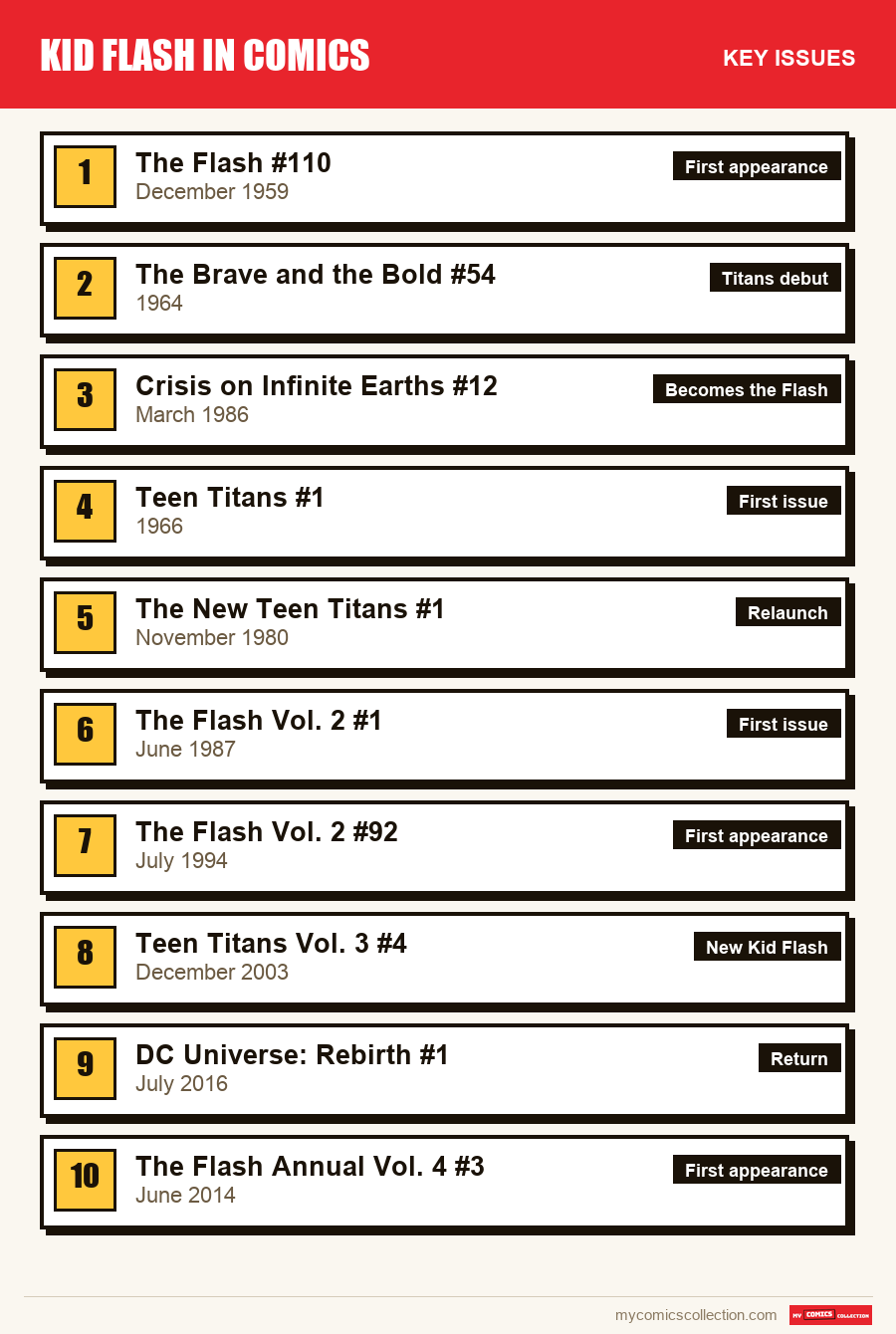
Kid Flash first appears in The Flash #110 (December 1959), created by screenwriter John Broome and artist Carmine Infantino. It was originally about Wally West, nephew of Iris West, who accidentally reproduced the laboratory experiment that gave Barry Allen his powers. The character then becomes a founding member of the Teen Titans (The Brave and the Bold #54, 1964), then takes the costume of the Flash in Crisis on Infinite Earths #12 (1986), after the death of Barry Allen in #8. The name "Kid Flash" was then carried by Bart Allen (2003) then by Wallace "Ace" West in post-New 52 continuity.
Few secondary characters in the DC Comics universe have had such a long and eventful editorial trajectory as Kid Flash. Born in the midst of the Silver Age explosion, thought of as a simple teenage foil for Barry Allen, the character ended up carrying single-handedly one of the greatest superhero transmission arcs in all of DC history: the one which sees a sidekick become, in his own right, the holder of the costume he admired as a child.
Retracing the story of Kid Flash in comics means telling three intertwined trajectories: that of Wally West, the original Kid Flash who became the third incarnation of the Flash; that of Bart Allen, grandson of Barry Allen from the future who takes up the mask in the early 2000s; and that, more recent, of Wallace "Ace" West, introduced after the New 52 reboot. Three characters, the same code name, and nearly seventy years of DC continuity to dissect to understand why certain issues bearing his first appearance are today among the most sought-after pieces of the Silver Age.
This article looks back at the editorial genesis of the character, the issues that mark his evolution, his transition from the status of sidekick to that of titular hero, as well as the television adaptations which continue to fuel collectors' interest in these founding comics.
Birth of a sidekick: the editorial context of 1959
To understand why Kid Flash exists, we must place ourselves in the context of the comics market at the very end of the 1950s. Since the post-war period, Robin has functioned as the commercial locomotive of Batman titles: the young partner in costume allows direct identification of young readers and boosts sales. DC then seeks to reproduce this recipe on its other flagship franchises. It is in this logic that Wonder Girl, Aqualad, a new version of Speedy... and Kid Flash were born, almost simultaneously at the turn of the 1960s.
Editor Julius Schwartz, who has already orchestrated the rebirth of the Flash in the guise of Barry Allen in Showcase #4 (1956), entrusted John Broome and Carmine Infantino with the task of writing and drawing the story which would introduce this new character. The script choice is clever: rather than an external partner, Kid Flash is integrated directly into the hero's family mythology. Wally West is presented as the nephew of Iris West, the girlfriend (then wife) of Barry Allen, which helps justify his proximity to the Flash without heavy narrative artifice.
The Flash #110: the birth of Wally West
It's in The Flash #110, dated December 1959, let it all begin. The story tells how young Wally, visiting Barry Allen's laboratory, witnesses an almost perfect reconstruction of the original accident that transformed Barry into the Flash: a lightning bolt strikes a shelf of chemicals, projecting their contents onto the teenager. Wally finds himself endowed with the same super-speed powers as his uncle by marriage. This issue has dual historical significance as it also marks the first appearance of Weather Wizard, one of the founding members of The Flash's Rogues Gallery, making it a dual-key issue sought after by hero collectors and fans of classic villains alike.
The following issues quickly deepen the relationship between the two heroes. In The Flash #120 (May 1961), Kid Flash joins his mentor on an expedition to South America, a milestone in the building of their duo. Then The Flash #125 (December 1961) takes him on a temporal adventure using the cosmic treadmill, a gadget that will become emblematic of the Flash mythology for the following decades. These episodes, although less sought after than number 110, remain interesting pieces for those who want to retrace the formation of the character on paper, run by run.
From Teen Titans to editorial maturity
If Kid Flash is born as a simple foil in the title of his mentor, it is his participation in the formation of the Teen Titans which will truly establish his own identity. The first unofficial meeting of the group took place in The Brave and the Bold #54 (June-July 1964), written by Bob Haney. In this story entitled "The Thousand-and-One Dooms of Mr. Twister", Kid Flash, Robin and Aqualad join forces for the first time against a common threat, without yet claiming a collective name. The principle works well enough for DC to immediately launch a dedicated title.
This dedicated arrives with Teen Titans #1, dated January-February 1966, still by Bob Haney on the screenplay, but this time with the drawings of Nick Cardy, whose elegant style will deeply mark the visual identity of the series for the following years. Robin, Wonder Girl, Aqualad and Kid Flash face the Beast-God Xochatan in what constitutes the first monthly series specific to the group. This is a strong editorial milestone: Kid Flash is no longer just the shadow of the Flash, he becomes a pillar of a set of juvenile heroes who will cross, with ups and downs, more than sixty years of DC continuity.
New Teen Titans #1: The 1980s Revival
After a first series which ended in the early 1970s, it was relaunched in November 1980, New Teen Titans #1, which gives a spectacular second wind to the group and, in turn, to Kid Flash. Written by Marv Wolfman and drawn by George Pérez, this issue, which sold for $0.50 upon release, sees Raven attempt to convince Robin, Wonder Girl, Kid Flash, Changeling, Cyborg and Starfire to form a new team. The series would become one of DC's greatest commercial and critical successes in the 1980s, injecting a dramatic and adult dimension unprecedented for the time in a title centered on adolescent characters. Kid Flash gains psychological depth, notably through a chronic illness which affects his abilities and which will become, a few years later, a determining plot point for the rest of his journey.
From Kid Flash to Flash: the post-Crisis transition
The major turning point in Wally West's publishing career came with Crisis on Infinite Earths, the maxi-event series which redesigns the entirety of DC continuity between 1985 and 1986. In Crisis on Infinite Earths #8, dated November 1985, Barry Allen sacrifices himself to destroy the Anti-Monitor's antimatter cannon and save the universe, ending the character's more than twenty-five year reign as the Flash. During the final confrontation, Wally West is struck by a discharge of antimatter energy which, through an unexpected side effect, cures him of the chronic illness which had limited his powers for several years in New Teen Titans.
The transition, however, is not immediate or triumphant. Wally first takes on the Barry costume out of necessity, intending to wear it only temporarily, before having to overcome public skepticism and his own apprehension about a role he deems too big for him. It is ultimately with The Flash vol. 2 #1, published in June 1987, that Wally West truly settled into the costume and became, in his own right, the third incarnation of the Flash in DC continuity. This launch inaugurates a run that will span nearly twenty years and which remains, for many readers of the post-Crisis generation, the very definition of the character of the Flash: even more than Barry Allen for those who grew up in the 1990s.
This shift is important to understand the special place that Kid Flash occupies in the history of superhero comics: it is one of the very first examples where a historical sidekick truly and lastingly inherits the costume of his mentor, without this change being canceled by a rapid editorial flashback, unlike other similar attempts by the competition at the same time.
Bart Allen and Wallace West: the heirs of the suit
The code name "Kid Flash" does not disappear with Wally West's promotion to Flash. It was taken over a few years later by Bart Allen, presented as the grandson of Barry Allen from the 30th century. Bart first appeared as Impulse in the mid-1990s, before formally donning the Kid Flash costume in Teen Titans vol. 3 #4 (December 2003), after being badly injured by Deathstroke. Bart would then briefly serve as the Flash himself before being killed by the Rogues and then resurrected in the 31st century by Brainiac 5 in later story arcs.
Wally West himself experienced a notable editorial slump during Infinite Crisis #4 (March 2006), where the character disappears in speed on the sidelines of his confrontation with Superboy-Prime, leaving the Flash costume temporarily vacant. It was only after the New 52 reboot of 2011, then its official return to classic continuity during DC Universe: Rebirth, that Wally fully regains his place in DC history. It is also in this post-New 52 period that a third figure bearing the name Kid Flash appears: Wallace "Ace" West, presented as the young cousin of Wally and the son of the villain Daniel West, introduced from 2014. This multiplication of bearers of the name "Kid Flash" sometimes complicates reading for new collectors, but it also testifies to the robustness of the initial editorial concept imagined by Broome and Infantino in 1959.
The impact of adaptations on the rating
As with many secondary characters that have become cult, the television adaptations have considerably broadened Kid Flash's notoriety well beyond the traditional comic book readership, with a measurable effect on interest in the founding issues. The first major mainstream exposure comes with the animated series Teen Titans (2003-2006), in which Kid Flash appears as a recurring character, voiced by Michael Rosenbaum: already known at the time for his role as Lex Luthor in Smallville: notably in the episode “Lightspeed” (2005) entirely focused on him.
The animated series Young Justice, launched in 2010, goes even further by making Wally West one of the founding members of the title team, voiced by Jason Spisak, alongside a later version played by Bart Allen, voiced by Jason Marsden. This series, praised for its relative fidelity to the comics and its careful continuity over several seasons, introduced an entire generation of viewers to the complete mythology of the character, from the Teen Titans to the mentoring dynamic with Barry Allen.
Finally, the most mainstream adaptation undoubtedly remains the arrival of Wally West in the series The Flash broadcast on The CW from 2014. Actor Keiynan Lonsdale was announced in the role in 2015 for season 2, first as the unknown son of Joe West, before becoming Kid Flash in his own right during season 3, in 2016-2017. The character then leaves the series to join the spin-off Legends of Tomorrow in 2017. This prolonged exposure on a mainstream channel had a notable effect on the secondary market: issues carrying first appearances linked to Kid Flash, starting with The Flash #110, saw their ratings rise significantly in the decade following the launch of the CW series, a classic pattern observed for many DC and Marvel characters successfully adapted for the screen.
Collecting this series?
Track what you own, what you are missing and what your collection is worth. 7 day trial.
Start my trial →Buying Guide to Collecting Kid Flash
Building a coherent collection around Kid Flash requires clearly distinguishing the three incarnations of the character and prioritizing the truly founding issues rather than multiplying secondary appearances. Here are the essential benchmarks to guide your research and purchases:
- Prioritize The Flash #110 (1959): it's the absolute centerpiece: first appearance of Wally West/Kid Flash and Weather Wizard in the same issue. A copy in Fine (6.0) or better condition remains the reference for any serious collector of the character, knowing that documented sales show a clear progression in the price in this grade bracket over the years.
- Don't neglect transition numbers: The Flash #120 and #125 (1961) document the rapid evolution of the Barry/Wally relationship and remain significantly more financially accessible than issue #110, making them good entry points to start a thematic collection.
- Check out The Brave and the Bold #54 (1964) for the origin of the Teen Titans: this is the first reunion of the Robin/Kid Flash/Aqualad trio, an issue in high demand among Silver Age collectors regardless of specific interest in Kid Flash.
- Complete with Teen Titans #1 (1966): the team's first solo title, drawn by Nick Cardy; look for copies with good cover quality, as paper from this period is particularly sensitive to yellowing.
- New Teen Titans #1 (1980) for the Wolfman/Pérez era: more affordable than the Silver Age issues while marking a major qualitative turning point for the character; a great choice for tight budgets who want a historically significant piece.
- Crisis on Infinite Earths #12 and The Flash vol. 2 #1: essential to retrace Wally West's transition to the Flash costume; these are modern issues (post-1985) so generally available in very high grade at reasonable prices.
- Systematically check the condition of the covers before purchasing: on Silver Age issues like Flash #110 or Brave and the Bold #54, spine creases, yellowing and cover delamination greatly affect the value; favor sharp, detailed scans rather than single, blurry photos.
- Clearly distinguish the three bearers of the name Kid Flash: Wally West, Bart Allen and Wallace West do not have the same demand on the market; be sure to identify which incarnation is involved before calling a number a "key".
- Use a collection tracking app: to organize your acquisitions around Kid Flash through its different incarnations and titles, a tool like the comic collection application allows you to keep a clear overview of what is missing from your run.
The key issues to know
The Flash #110
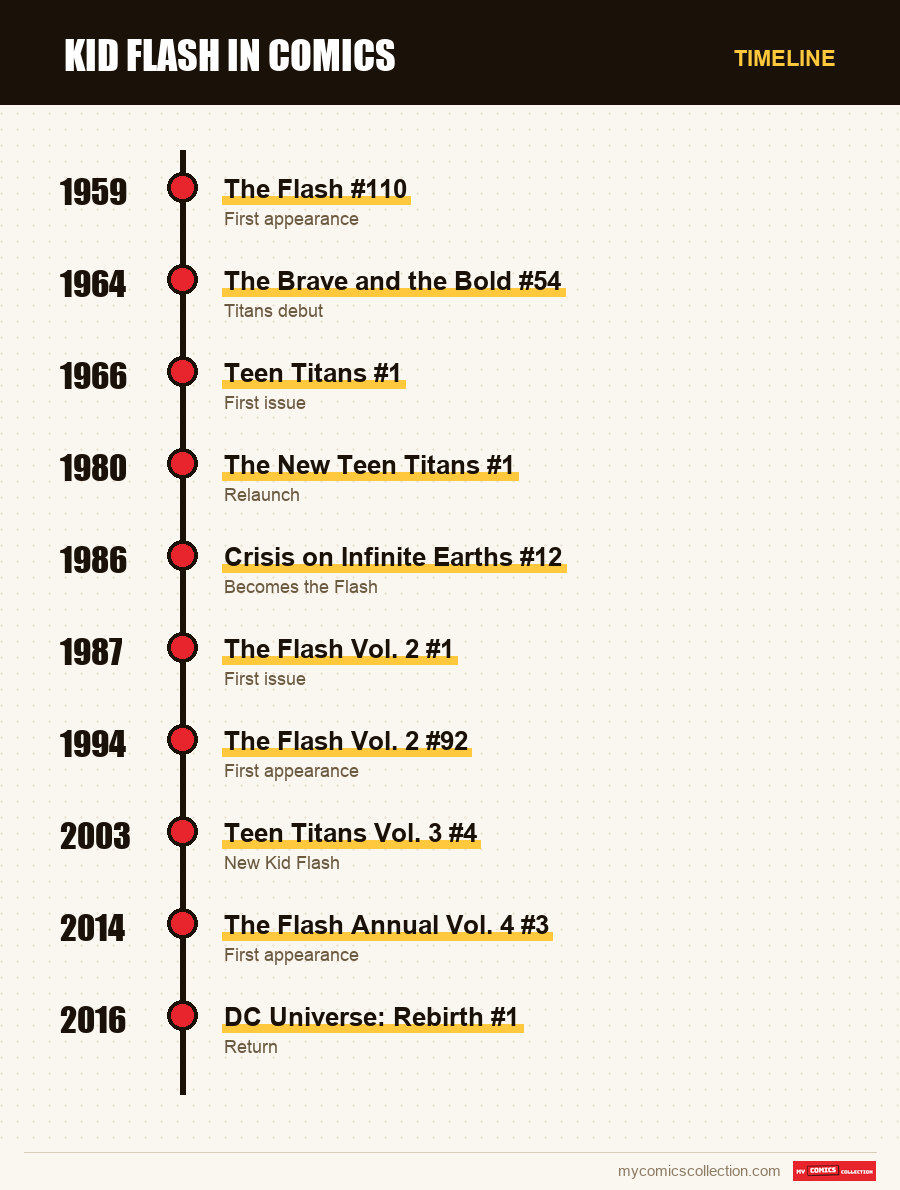
John Broome and Carmine Infantino introduce Wally West, Iris West's nephew, in the story "Meet Kid Flash!": he gains the same powers as Barry Allen in a similar lab accident. The same issue introduces the Weather Wizard. It is the cornerstone of any Kid Flash collection.
The Brave and the Bold #54
Kid Flash, Robin and Aqualad team up for the first time in "The Thousand-and-One Dooms of Mr. Twister", written by Bob Haney. The trio does not yet have a team name. This issue is classically regarded as the first appearance of the Teen Titans.
Crisis on Infinite Earths #12
The final issue of Marv Wolfman and George Pérez's maxiseries, and Wally West's last appearance as Kid Flash. After Barry Allen's loss, his nephew takes on the identity of the Flash here. It is the most famous handover in DC history.
Teen Titans #1
The team's first ongoing series, written by Bob Haney and drawn by Nick Cardy. Robin, Kid Flash, Aqualad and Wonder Girl face the Beast-God of Xochatan. Kid Flash becomes a pillar of the group, no longer just his mentor's shadow.
The New Teen Titans #1
Marv Wolfman and George Pérez relaunch the team: Raven gathers Robin, Kid Flash, Wonder Girl, Changeling, Cyborg and Starfire, who form the New Teen Titans together for the first time. The series became one of DC's big hits of the 1980s and gave Wally West real depth.
The Flash Vol. 2 #1
Wally West settles into the costume with his own series, launched by Mike Baron and Jackson Guice with the story "Happy Birthday Wally!". It marks the start of the former Kid Flash's long run as the main Flash. For a whole generation of readers, he becomes the definitive Flash.
The Flash Vol. 2 #92
Mark Waid and Mike Wieringo fully introduce Bart Allen, Barry Allen's grandson from the 30th century, in the first chapter of "Reckless Youth". Bart first becomes Impulse before taking the Kid Flash name years later. An unnamed cameo already appears in #91.
Teen Titans Vol. 3 #4
In Geoff Johns and Mike McKone's run, Bart Allen drops the Impulse identity after being badly injured by Deathstroke. He returns in a new costume under the Kid Flash name. It is the first official handover of the codename.
DC Universe: Rebirth #1
Geoff Johns and Ethan Van Sciver bring back the original Wally West, trapped in the Speed Force and trying to be remembered by those close to him. His return is the thread running through the whole Rebirth initiative. A must-have for readers who missed the original Kid Flash.
The Flash Annual Vol. 4 #3
First appearance of Wallace West, the new Wally introduced after the New 52 reboot, written by Van Jensen. This young cousin of the original Wally would later take up the Kid Flash name. It is the starting point of the name's third bearer.