Flash's three must-have runs are the revolutionary Infantino Silver Age (1956-1968), the definitive Mark Waid (1992-2000) and the monumental Geoff Johns (2000-2005, 2009-2011).
Flash is the character who launched the Silver Age of comics in 1956. From Barry Allen to Wally West, the Speed Force has generated some of the most beloved runs in the DC Universe. For the collector, the franchise offers a range of periods from the rare Golden Age to the accessible modern.
This ranking covers the best continuous series of the Scarlet Bolide, all incarnations combined. Each run has redefined the character and his universe, and represents a solid investment for any serious DC collection.
Top 1: Infantino Silver Age (1956-1968)
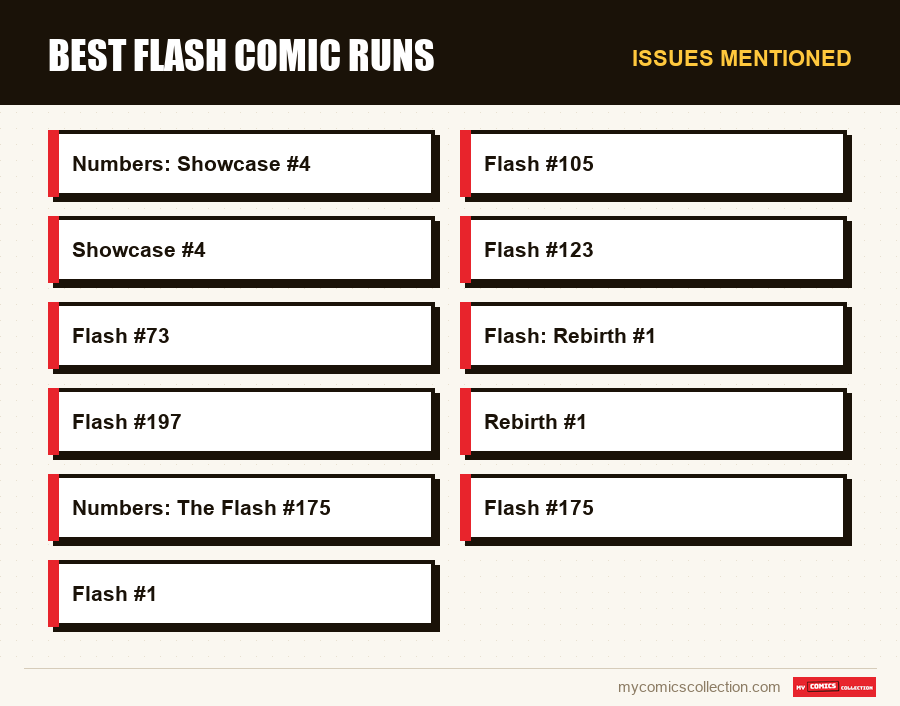
Screenwriter: John Broome, Robert Kanigher |Designer: Carmine Infantino | Numbers: Showcase #4, The Flash #105-174 |Period : 1956-1968
Showcase #4 revives the superheroic genre and ushers in the Silver Age. Infantino invents a visual language of speed that still defines the character today. The origins of the Reverse-Flash, Captain Cold, Mirror Master and Earth-2 are born here. A historic run in the literal sense.
Key numbers: Showcase #4 (1st Barry Allen), Flash #123 (Flash of Two Worlds), #139 (1st Reverse-Flash). Market value: Showcase #4 in VG: €15,000-30,000 | Flash #123 in VF: €1,500-3,000.
Top 2: Mark Waid (1992-2000)
Screenwriter: Mark Waid | Designers: Greg LaRocque, Mike Wieringo, Paul Pelletier |Numbers: The Flash vol.2 #62-129, 142-159 |Period : 1992-2000
Waid transforms Wally West from hesitant successor to definitive Flash. He invents the Speed Force, a concept that has become central to the entire DCU. “Terminal Velocity,” “Dead Heat,” and “The Return of Barry Allen” are legendary arcs that elevate the character to the DC pantheon.
Key numbers: Flash #73-79 (Return of Barry Allen), #95-100 (Terminal Velocity), #142 (Wally/Linda marriage). Market value: #73 in NM: €15-30 | Full run: €200-400.
Top 3: Geoff Johns (2000-2005, 2009-2011)
Screenwriter: Geoff Johns | Designers: Scott Kolins, Howard Porter, Francis Manapul |Numbers: Flash vol.2 #164-225, Flash: Rebirth #1-6 |Period : 2000-2005, 2009-2011
Johns enriches the Rogues' gallery like no one before him, humanizing Captain Cold and the Rogues into complex antagonists. “Rogue War” and “Blitz” (Zoom introduction) are peaks. Flash: Rebirth brings back Barry Allen and redefines the Speed Force mythology for the modern era.
Key numbers: Flash #197 (Blitz/Zoom), #220-225 (Rogue War), Rebirth #1. Market value: #197 in NM: €20-40 | Full run: €150-300.
Top 4: Bates & Novick (1969-1976)
Screenwriter: Cary Bates | Designer: Irv Novick | Numbers: The Flash #175-250 | Period : 1969-1976
Bates brings a thriller and detective dimension to the title, exploring the civilian life of Barry Allen forensic scientist. Reverse-Flash's storylines become more personal and threatening. An often overlooked but solid transitional run, with very affordable issues for the collector.
Key numbers: Flash #175 (Flash vs Superman race), #215-216. Market value: #175 in French: €60-120 | Full run: €150-300.
Top 5: Baron & Guice-Wally West (1987-1992)
Screenwriter: Mike Baron | Designer: Jackson Guice | Numbers: The Flash vol.2 #1-18 | Period : 1987-1988
Post-Crisis, Baron relaunches Flash with Wally West as an imperfect hero: broke, arrogant, limited in speed. This realistic, down-to-earth approach creates a stark contrast to Barry Allen. Guice brings a nervous visual dynamism. The founding run of the series vol.2 which leads to Waid.
Key numbers: Flash vol.2 #1 (1st Wally solo), #12 (Chunk). Market value: #1 in NM: €15-25 | Full run: €40-80.
Top 6: Joshua Williamson (2016-2020)
Screenwriter: Joshua Williamson | Designers: Carmine Di Giandomenico, Howard Porter |Numbers: The Flash vol.5 #1-88 | Period : 2016-2020
The longest continuous run on Flash, Williamson synthesizes the Waid/Johns legacy while creating new speedsters (Godspeed, Meena Dhawan). “Flash War” confronts Barry and Wally in a powerful emotional arc. An accessible and consistent run over 88 issues.
Key numbers: Flash #1 (Rebirth), #21-22 (The Button, Batman crossover), #47-50 (Flash War). Market value: #21 (lenticular) in NM: €20-35 | Full run: €180-350.
Discover our guide to Flash key numbers and the editorial history of the character to put these runs in context.
Collect Flash through all his eras with our app. Tracking by run, missing alerts and integrated value estimation.
Try the collection appFrequently asked questions
Infantino's Silver Age (1956-1968), Mark Waid's run (1992-2000) and Geoff Johns's (2000-2005, 2009-2011). Each redefined the character and his universe.
It relaunches the superhero genre and inaugurates the Silver Age with the first appearance of Barry Allen. Infantino invents there a visual language of speed that still defines the character. In the same period, Flash #123 (Flash of Two Worlds) and #139 (first appearance of the Reverse-Flash) are worth knowing.
He transforms Wally West from a hesitant successor into the definitive Flash and invents the Speed Force, which became central across the DCU. His arcs "The Return of Barry Allen" (#73-79), "Terminal Velocity" (#95-100) and the marriage of Wally and Linda (#142) are legendary.
The runs of Bates and Novick (1969-1976), Baron and Guice (vol. 2, #1-18) and Joshua Williamson (2016-2020, 88 issues) are described as accessible. Williamson's is consistent, and Baron and Guice's is the founding run that leads to Waid.
"Blitz" (#197), which introduces Zoom, and "Rogue War" (#220-225), which humanizes Captain Cold and the Rogues. Flash: Rebirth then brings back Barry Allen and redefines the Speed Force mythology.