Flash offers a collection structured by distinct eras: the Silver Age of Barry Allen (Showcase #4, 1956), the Wally West era by Mark Waid and Geoff Johns (1992-2005), then Barry's return with Flash: Rebirth (2009). The optimal strategy: target the Silver Age key issues in mid-grade, then build up the Waid and Johns runs: the most acclaimed and still affordable.
Collecting Flash is like traveling through the very history of American comics. The character ushered in the Silver Age with Showcase #4 (1956), defined the concept of the legacy hero with the transition from Barry Allen to Wally West, and produced some of DC Comics' most celebrated runs. For the collector, this historical wealth translates into a price range from the inaccessible Golden Age to the very affordable modern.
This guide supports you in building a coherent Flash collection, by identifying essential runs, key issues by era, and appropriate budgetary strategies. Whether you're aiming for Silver Age grails or a complete modern collection, here you'll find the method to move forward methodically without overspreading your budget.
Key issues by era: the roadmap
Golden Age (1940-1956)
Flash Comics #1 (January 1940): First appearance of Jay Garrick, the original Flash. Extremely rare and expensive issue, reserved for advanced collectors. All-Flash #1 (1941) is a more accessible Golden Age alternative. These pieces are historical grails whose value is only increasing.
Silver Age (1956-1985)
Showcase #4 (October 1956): first appearance of Barry Allen and official birth of the Silver Age. One of the most important comics in history: in CGC 4.0, it already represents a major investment. Flash #105 (1959): first issue of the regular Barry Allen series. Flash #123 (1961): "Flash of Two Worlds", introduction to the DC multiverse. Flash #139 (1963): First appearance of Reverse-Flash. These four numbers form the essential Silver Age quartet.
The Wally West era (1987-2009)
Flash vol.2 #1 (June 1987): Wally West takes over after Crisis on Infinite Earths. Accessible and symbolic number. Flash vol.2 #92 (1994): first appearance of Bart Allen (Impulse). Flash vol.2 #164 (2000): start of the Geoff Johns run. These modern numbers are still very affordable: now is the time to invest.
Barry Returns and the Modern Era (2009-present)
Flash: Rebirth #1 (2009, Geoff Johns and Ethan Van Sciver): the return of Barry Allen. Flash vol.4 #1 (2011, New 52, Francis Manapul): artistically sublime relaunch. Flash vol.5 #1 (2016, Rebirth, Joshua Williamson): start of an 88-issue run that redefines the Speed Force. All available at low prices.
The big runs to build
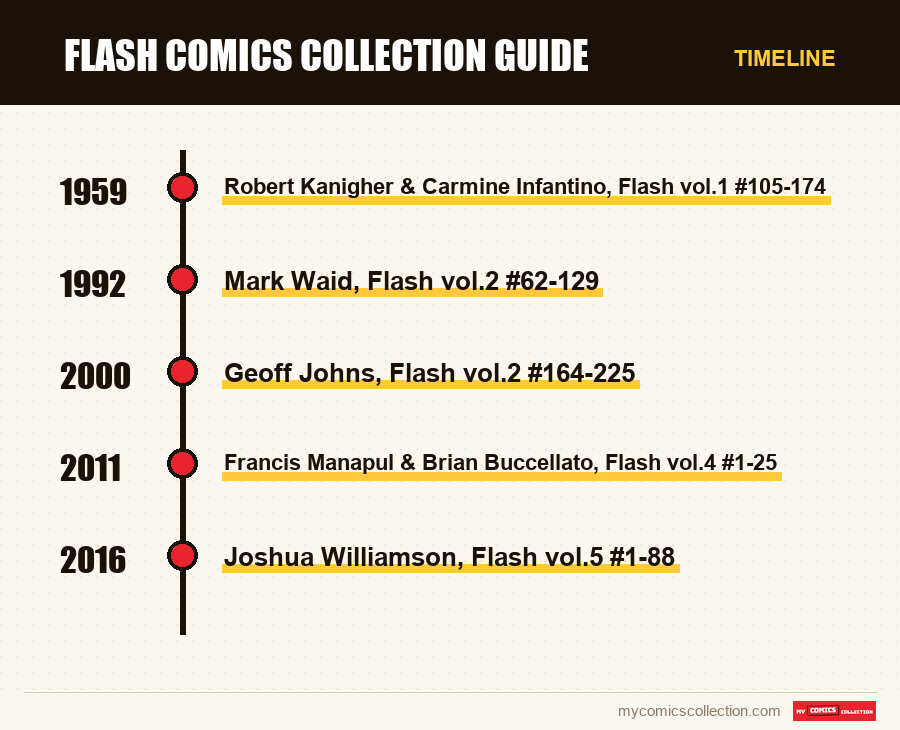
Mark Waid, Flash vol.2 #62-129 (1992-1997)
The run that transforms Wally West from hesitant heir to legitimate Flash. Waid invents the concept of Speed Force, explores the limits of speed, and creates arcs that have become classics ("Terminal Velocity", "Dead Heat", "Race Against Time"). These 67 issues are the beating heart of any modern Flash collection. Available in lots at a very reasonable price.
Geoff Johns, Flash vol.2 #164-225 (2000-2005)
Johns revitalizes the Rogues Gallery, introduces Hunter Zolomon (Zoom), and writes tense detective arcs mixing superheroism and thriller. “Blitz” (#197-200) and “Rogue War” (#220-225) are pinnacles of the genre. The complete run (61 issues) is affordable and constitutes an exceptional narrative investment.
Joshua Williamson, Flash vol.5 #1-88 (2016-2020)
The longest run of the modern era on Flash. Williamson reintroduces Wally West into the Rebirth continuity, explores new forces (Force Barrier, Strength Force, Sage Force) and orchestrates "Flash War" (#47-50): a highly sought-after culminating arc among collectors. He also develops new speedsters (Godspeed, first appearance in #1) and a new Reverse-Flash. 88 recent issues, easy to find and inexpensive: a complete and satisfying collecting project.
Francis Manapul & Brian Buccellato, Flash vol.4 #1-25 (2011-2013)
The New 52 Flash is a visual gem. Manapul reinvents the layout of superhero comics with dizzying double pages that graphically convey speed: each issue is a feat of design. Short run (25 issues), complete and artistically exceptional: a must for lovers of beautiful objects and innovative visual storytelling.
Robert Kanigher & Carmine Infantino, Flash vol.1 #105-174 (1959-1967)
The founding Silver Age run. Infantino defined Barry Allen's look and invented a visual vocabulary for speed that still influences the medium. These issues, excluding key issues, are surprisingly affordable at mid-grade and offer sublime Silver Age art. It's the ideal hunting ground for patient collectors who want to put together a historic run without breaking the bank.
Budget strategy: three levels
Essential budget (key issues only)
Showcase #4 (low-grade if the budget is tight: even a CGC 1.0 has immense symbolic value), Flash vol.2 #1, Flash: Rebirth #1, Flash vol.2 #92 (Impulse). These 4-5 issues chronicle the evolution of the character through his pivotal moments. Add Flash #123 in mid-grade if possible: this issue invented the DC multiverse and remains a pillar of the mythology.
Intermediate budget (priority runs)
Build the full Waid run (#62-129) and the full Johns run (#164-225). That's 128 issues covering the character's best creative period. In eBay lots, these runs can be found at very reasonable prices: often less than two euros per issue in lots of 20+. Complete with the Manapul run (#1-25 vol.4) for the artistic dimension.
Complete budget
Add the complete Flash vol.2 (#1-247, 1987-2009), the Williamson run (#1-88), the key mini-series (Flash: Rebirth, Flashpoint, Flash Forward), and the Impulse series (#1-89, 1995-2002) for Bart Allen. Aim for 500+ issues for a comprehensive Flash collection of the modern era.
Organization of the collection by era
Flash lends itself particularly well to a chronological organization by coat wearer:
- Jay Garrick Section: Flash Comics #1+ (Golden Age, rare parts) and modern JSA appearances
- Barry Allen Classic Section: Showcase #4, Flash vol.1 #105-350 (Silver/Bronze Age)
- Wally West Section: Flash vol.2 #1-247 (1987-2009), heart of the modern collection
- Barry's return section: Flash: Rebirth, vol.4 (New 52), vol.5 (Rebirth/Williamson)
- Enlarged Speed Force section: Impulse #1-89, Flash Forward, Speed Force one-shots
This legacy structure reflects the very philosophy of the character: Flash is a legacy that is passed on. In My Comics Collection, use the tags by coat wearer to visualize your progress in each era and quickly identify where you are missing.
Essential Flash crossovers
Crisis on Infinite Earths (1985-1986, 12 issues): Barry Allen's death in #8 is one of the most defining moments in DC history: a sacrifice that would define the character for 23 years. Flashpoint (2011, 5 issue, by Johns and Andy Kubert): Barry Allen alters the timeline and creates a dystopian alternate universe: this event leads directly to the New 52 reboot and inspired the film The Flash (2023). #1 is a modern key issue that is constantly increasing.
Flash War (Flash vol.5 #47-50, 2018): Wally vs. Barry, a Williamson arc that redefines the Speed Force and whose numbers are sought after. Heroes in Crisis (2018-2019, 9 issue, by Tom King) involves Wally West in a controversial drama that has divided fans but whose numbers have speculative value. These crossovers are essential complements to contextualize the main series.
Flash collection FAQ
Is Showcase #4 worth the investment?
Absolutely. It's the comic that ushered in the Silver Age: its place in the medium's history is comparable to Action Comics #1 for the Golden Age. Even in very low grade (CGC 0.5-1.5), an example has significant and historical value. It is a heritage investment that does not lose value in the long term.
Wally West or Barry Allen: which one to collect?
The two are complementary. Barry dominates the Silver Age and the modern era (post-2009), Wally is king over the period 1987-2009. The Waid and Johns (Wally era) runs are the most critically acclaimed, while the Barry Silver Age issues have the highest market value. A complete collector will want both eras: they complement each other and tell the story of the evolution of a unique legacy in American comics.
Are Flash numbers between key issues worth it?
Absolutely. Silver Age Flash filler issues often contain inventive stories with exceptional Infantino art. In mid-grade (VG to FN), these numbers can be found for a few euros each and make for an impressive historic run on a low budget. This is one of the best pleasure/price ratios on the Silver Age DC market.
Is the Impulse series worth it?
Impulse (#1-89, 1995-2002) is an underrated series that follows Bart Allen as a teenager in a light and fun tone. Largely drawn by Humberto Ramos and then Craig Rousseau, it offers a refreshing counterpoint to the main Flash series. All 89 issues can be found in bundles for next to nothing and are the perfect complement to an exhaustive Speed Force collection. #1 is the only coin with moderate value.
Secondary characters to collect
The Flash universe offers additional avenues: Impulse (#1-89, 1995-2002) follows the adventures of teenage Bart Allen in a fun and accessible series. Jay Garrick appears regularly in JSA titles: Flash Comics #1 (1940) is a Golden Age grail, but its modern appearances in JSA are affordable. Jesse Quick and Max Mercury enrich the mythology of the Speed Force in the Waid and Johns runs.
The Rogues also deserve attention: Captain Cold, Mirror Master, Heat Wave and Weather Wizard form one of the most cohesive groups of villains in DC Comics. Their early Silver Age appearances (Flash #105-140) are sought-after pieces that are a natural addition to a Flash collection.
Geoff Johns' "Rogues" run (#177-182, "Rogues War" #220-225) gives the villains new depth by transforming them from comical criminals into tragic and respectable antagonists. The miniseries Flash: Iron Heights (2001, one-shot by Johns) is an essential companion piece that introduces the Rogue Penitentiary.
The Flash market: trends and advice
The Flash market is influenced by TV series (2014-2023) and film appearances. Since the end of the TV series, prices have stabilized: this is an ideal buying window for mid-grade Silver Ages. The Waid and Johns runs are on a slow but steady rise, buoyed by their critical reputations. Showcase #4 remains a safe investment at any grade: this comic literally inaugurated an entire era of the medium.
Practical advice: the Flash Silver Age numbers (#105-350) between the key issues can be found at a very low price in mid-grade. Putting together a near-complete run of vol.1 is an ambitious but financially viable project for a patient collector. The Carmine Infantino issues (#105-174) offer sublime Silver Age art at often ridiculous prices outside of the key issues.
Professional pressing can transform a Silver Age copy: a Flash #123 going from VG to FN thanks to pressing gains significant value for a modest investment. For modern runs, buy in full batches: a Waid or Johns run in batches often costs less than the sum of its parts purchased by number.
Conventionally, dollar bins are often full of Flash vol.2 issues from the 90s-2000s in good condition. This is the ideal hunting ground to complete your Waid and Johns runs at a lower cost. The intermediate issues between the two runs (#130-163, by various authors) are often sold in bulk and complete the chronological collection.
Check out our complete editorial history of Flash and the guide to Flash universe for the secondary characters and their impact on the collection.
Manage your Flash collection efficiently
With My Comics Collection, import your Flash series from all volumes, track your progress by era and instantly identify your missing issues among the DC Comics speedsters.
Free trial 7 days, No obligation