Essential characters from the Flash universe: Reverse-Flash (Eobard Thawne), the Rogues (Captain Cold, Mirror Master, Heat Wave), Kid Flash (Wally West), Jay Garrick, Jesse Quick and the Speed Force itself: an ecosystem of speedsters and antagonists that greatly enriches the mythology of the Scarlet Bolide.
The Flash universe goes far beyond just Barry Allen. From the 1940s with Jay Garrick to the multiple heirs to the mantle, the speedster dynasty constitutes one of the richest heroic families in DC Comics. For the collector, that means dozens of sought-after first appearances and iconic runs to hunt down.
Between the Rogues Gallery, one of the most coherent groups of villains in American comics, and the various bearers of the title, the Flash universe offers narrative depth and remarkable collectible potential. Each era has produced its key issues, from Showcase #4 (1956) to Joshua Williamson's modern runs.
Major villains and their first appearances
Reverse-Flash (Eobard Thawne)
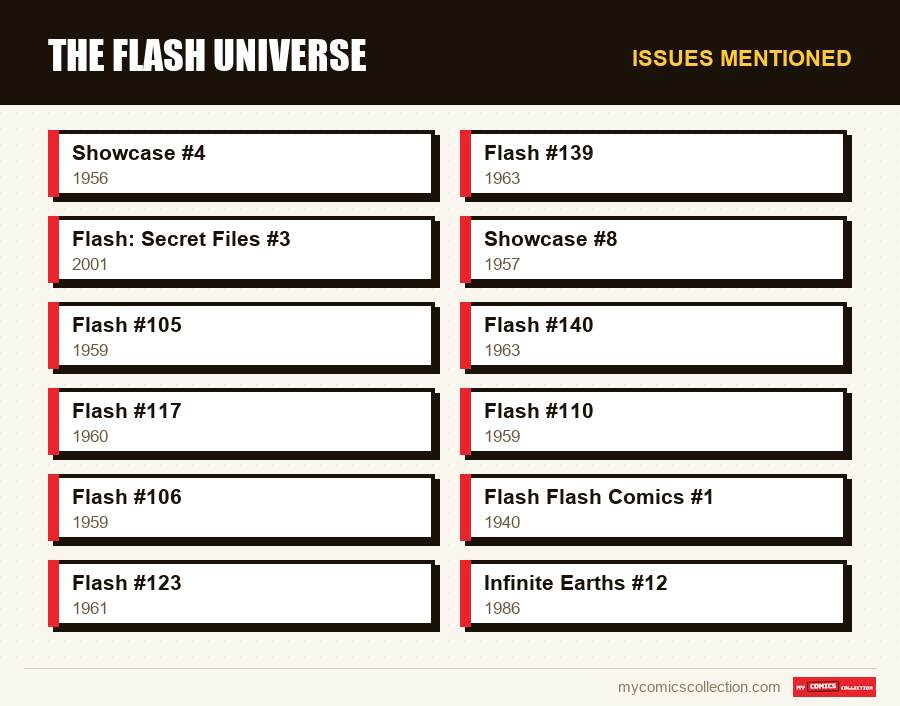
First appearing in Flash #139 (1963), Professor Zoom is Barry Allen's ultimate antagonist. This issue in high condition fetches considerable sums. Wally West's opponent Hunter Zolomon (Zoom) appears in Flash: Secret Files #3 (2001).
The Rogues Gallery
Captain Cold debuts in Showcase #8 (1957), Mirror Master in Flash #105 (1959), Heat Wave in Flash #140 (1963), Captain Boomerang in Flash #117 (1960), and Weather Wizard in Flash #110 (1959). These early Silver Age issues are very popular with DC collectors.
Gorilla Grodd
This simian genius appears in Flash #106 (1959). A recurring and popular villain, his first appearance remains a holy grail for collectors of the Silver Age era.
Speedsters and the supporting cast
Jay Garrick: the original Flash
Flash Comics #1 (1940) marks the birth of the concept. An extremely rare Golden Age issue, it represents the absolute Holy Grail for any Flash collector. Jay Garrick returns in Flash #123 (1961), the famous “Flash of Two Worlds”.
Kid Flash / Wally West
Wally appears in Flash #110 (1959) as Kid Flash, then takes up the mantle in Crisis on Infinite Earths #12 (1986). His run as the titular Flash (1987-2009) by Mark Waid and then Geoff Johns is considered the character's modern golden age.
Jesse Quick and Bart Allen
Jesse Quick (Jesse Chambers) appears in Justice Society of America #1 (1992). Bart Allen (Impulse) debuts in Flash #92 (1994): two early modern appearances that are still financially accessible.
Spin-off series and related titles
Beyond the main series, several titles explore the Flash universe: Impulse (1995-2002, 89 issues), The Flash: Fastest Man Alive (2006-2007), Speed Force (one-shot 1997), and Flash Forward (2019-2020) centered on Wally West. The crossover Flash War in Flash #47-50 (2018) has become a sought-after modern arc.
Essential runs include Flash vol.2 #62-129 (Mark Waid), Flash vol.2 #164-225 (Geoff Johns), and Flash vol.5 #1-88 (Joshua Williamson). Each has redefined the mythology of the Speed Force.
Collection strategy
To build a coherent Flash collection, prioritize the first Silver Age appearances of the Rogues (accessible in mid-grade), the Waid/Augustyn run for moderns, and the key issues of Geoff Johns (Flash: Rebirth #1, 2009). The Rebirth and Infinite Frontier series variant covers provide an affordable entry point. Consult our guides on Flash key numbers and the editorial history of the character to go deeper.
Ready to map your Flash collection? Use our app to track every issue, identify your missing Rogues and Speedsters, and don't miss any key first appearances in this ever-accelerating universe.
Chronological markers: four generations of Flash
The Flash universe is best understood as a chain of legacies. Each generation has its era, its writers and its key issues, and knowing where you stand avoids mixing continuities that have not always been compatible.
Jay Garrick and the Golden Age
It all begins in 1940 with Flash Comics #1 and Jay Garrick. That Flash then fades from the newsstands, before returning in Flash #123 (1961), "Flash of Two Worlds", where he meets Barry Allen. That story sets up the idea of parallel worlds that will durably structure the DC universe.
Barry Allen and the Silver Age
In 1956, Showcase #4 launches Barry Allen and opens the Silver Age of superheroes. His series is then born with its first recurring villains, the Rogues, and its supporting cast. That Flash dies in Crisis on Infinite Earths #8 (1985), an event that closes his era.
Wally West, from Kid Flash to headliner
Wally West, introduced as Kid Flash in 1959, takes up the mantle after the Crisis. The runs of Mark Waid and then Geoff Johns give him more than twenty years of editorial stability, a rare case in the character's history. It is the era in which the Speed Force becomes a true concept of the universe.
Barry's return and the modern era
Barry Allen returns with Flash: Rebirth (2009), by Geoff Johns. The Flashpoint story (2011), by Johns and Andy Kubert, leads to the New 52 relaunch. Joshua Williamson then takes the series with Flash vol. 5, through #88, and the Flash War crossover (2018) reopens the question of legacy between Barry and Wally.
Where to read and what to aim for
For efficient reading, three entry points stand out: Showcase #4 for the origin, Waid's run for Wally and the Speed Force, Flash: Rebirth for Barry's return. Johns's run highlights the Rogues and their group cohesion, which makes it a good choice for those who like villains.
On the collecting side, separate the three blocks: the Silver Age first appearances of the Rogues, often sought in mid grade, the pivotal issues of the 1980s and 1990s, and the recent relaunches, which are easier to complete. A good reflex is not to buy an entire series until you have chosen the generation that interests you.
Frequently asked questions
Eobard Thawne, Professor Zoom, appears in Flash #139 (1963). He is Barry Allen's ultimate antagonist. Hunter Zolomon, alias Zoom, Wally West's adversary, appears in Flash: Secret Files #3 (2001).
Captain Cold in Showcase #8 (1957), Weather Wizard in Flash #110, Mirror Master in Flash #105 (1959), Captain Boomerang in Flash #117 (1960) and Heat Wave in Flash #140 (1963). These Silver Age issues are highly prized.
Jay Garrick, in Flash Comics #1 (1940), an extremely rare Golden Age issue, the Holy Grail for Flash collectors. He returns in Flash #123 (1961), the famous "Flash of Two Worlds".
Wally West debuts as Kid Flash in Flash #110 (1959) and becomes Flash in Crisis on Infinite Earths #12 (1986). Jesse Quick appears in Justice Society of America #1 (1992) and Bart Allen, alias Impulse, in Flash #92 (1994).
Flash vol. 2 #62 to 129 (Mark Waid), Flash vol. 2 #164 to 225 (Geoff Johns) and Flash vol. 5 #1 to 88 (Joshua Williamson). Each redefined the mythology of the Speed Force.