
The best speedsters (super-fast characters) in comics are, at the top, Flash (Barry Allen) , Flash (Wally West) , Quicksilver and Reverse-Flash. This tier list classifies the cars of the comic book universe according to their importance, their stories and their cultural impact. Facts (publisher, creation) verified, no invented ratings; each character refers to its file.
Super-speed is one of the most spectacular powers in comics, and DC has made it a real dynasty with the “Speed Force”. This tier list classifies speedsters according to their narrative importance and their richness, from legend to second-rate. Criterion: the weight of the character, not their “quantified” speed.
Editorial Ranks, Facts verified. Each speedster refers to its file when it exists.
Collecting this series?
Track what you own, what you are missing and what your collection is worth. 7 day trial.
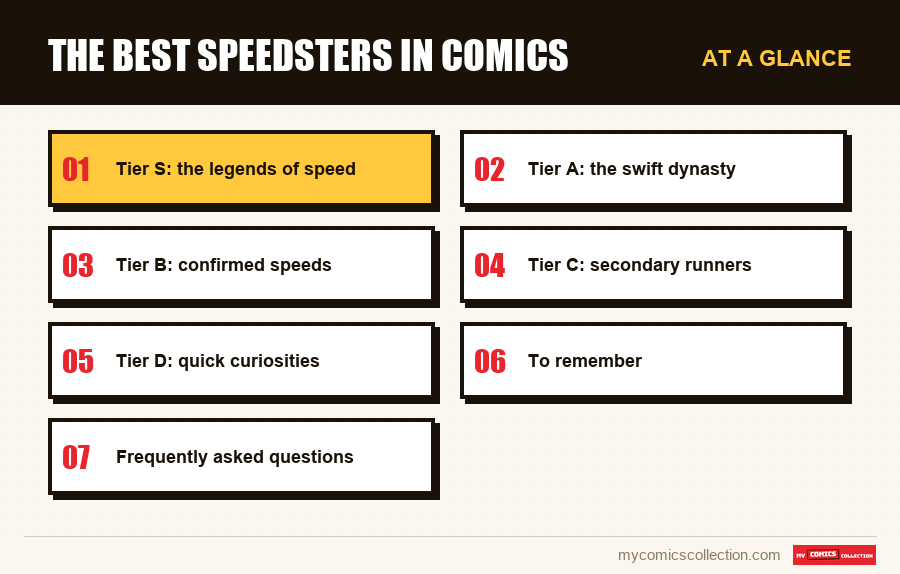
Start my trial →Tier S: the legends of speed
Barry Allen (1956) is the Flash who launched the Silver Age of comics and founded the mythology of the Speed Force. Wally West, long the "main" Flash, is a favorite of many readers for its emotional depth. Quicksilver is Marvel's flagship speedster, mutant and Avenger. And Reverse-Flash (Eobard Thawne) is the absolute nemesis, obsessed with destroying Barry.
Tier A: the swift dynasty
Jay Garrick (1940) is the very first Flash, a Golden Age figure. Kid Flash and Impulse embody the next generation, while Zoom (Hunter Zolomon) is one of the best modern villains of the character.
Tier B: confirmed speeds
Max Mercury , the “Zen of speed”, Jesse Quick , there Makkari of the Eternals at Marvel and Godspeed enrich the gallery of speedsters, each with their own identity.
Tier C: secondary runners
XS (Barry's granddaughter), Johnny Quick , Savitar and Wallace West complete the Veloce Force: solid characters, a notch below the major figures.
Tier D: quick curiosities
The Whizzer (Marvel, 1941), Speed Demon and Turbine close this selection: obscure but very real speedsters, for fans of deep cuts.
To remember
- DC largely dominates the concept of speedster via the Speed Force.
- Barry Allen (Flash #123, Showcase #4) concentrates the great key numbers of the genre.
- The Flash/Reverse-Flash rivalry is one of the great duels of comics.
- Each character refers to its file for its key numbers.
Speed in comics: chronological landmarks and where to start
The ranking sorts speedsters by importance. To find your way, it helps to place them in time: the genealogy of speed reads almost like a succession of generations.
From 1940 to 1966: the pioneers
It all begins in 1940 with Jay Garrick, the very first Flash (Flash Comics #1), who appears the same year as Max Mercury in his first version. Johnny Quick and The Whizzer follow in 1941. Then comes the 1956 relaunch: Barry Allen in Showcase #4 launches the Silver Age of comics. Kid Flash (1959) and Wally West (1960) establish the idea of a family of runners, while Reverse-Flash (1963) provides the nemesis that was missing. At Marvel, Quicksilver (1964) and Speed Demon (1966) answer DC.
From 1976 to 1995: the Speed Force expands
Makkari (Marvel, 1976) is a reminder that speed also exists among the Eternals. The 1990s bring Jesse Quick (1992), Impulse (1994), XS (1994) and Savitar (1995): the Speed Force becomes a true family tree, with its heroes, its successors and its villains.
Since 2003: modern rereadings
Zoom (2003), Turbine (2012), Wallace West (2014) and Godspeed (2016) show that the concept keeps renewing itself. Creators keep returning to the same question: what do you do with speed, other than chase time?
Where to start according to your taste
- The founding story: Showcase #4 and Flash #123 for Barry Allen, then Flash Comics #1 to go back to Jay Garrick.
- The rival: follow the rivalry between Flash and Reverse-Flash, one of the great duels of comics.
- The next generation: Kid Flash, Impulse and XS for stories of passing the torch between generations.
- The Marvel side: Quicksilver, as a mutant and Avenger, for a speedster outside the Speed Force.
Warning signs for collectors
Several characters carry or have carried the name Flash, and some entries mention two dates (Max Mercury, for example, is tied to 1940 and to 1993): always check which version it is before buying an issue supposed to contain a first appearance. The keys are mostly concentrated around Barry Allen, which explains why the supporting characters' issues remain far more accessible. In your tracking, group your purchases by character rather than by title: the same speedster appears in many series.
Frequently asked questions
Barry Allen and Wally West are competing for first place at DC. Barry for its historical importance, Wally for the richness of its stories. Quicksilver dominates on the Marvel side.
The debate is eternal and varies between authors, but Wally West is often presented as the fastest, capable of outpacing the Speed Force itself in some stories.
With Jay Garrick in Flash Comics #1 (1940), then especially Barry Allen in Showcase #4 (1956), a major key issue which launched the Silver Age of comics.
Do you have a Flash key number (Showcase #4, Flash #123, etc.)? Estimate its value for free with our tool based on current eBay listings.