The most powerful comic book characters, on a cosmic scale, are at the top Galactus , Superman , Thanos (with the Infinity Gauntlet) and Doomsday. This tier list ranks Marvel and DC characters by their raw power as established in the comics: not their popularity. It is a subject of eternal debate: the ranks are an argued bias, based on facts (editor, canonical feats of arms).
Classifying power is comic book readers' favorite debate, and it has no absolute answer, as the levels vary according to authors and artifacts (Infinity Gauntlet, Phoenix Force, etc.). This tier list offers a ranking on a cosmic scale, based on the most established canonical feats of arms, while assuming its share of subjectivity.
Ranks argued, facts verified. Each character refers to its file.
Collecting this series?
Track what you own, what you are missing and what your collection is worth. 7 day trial.
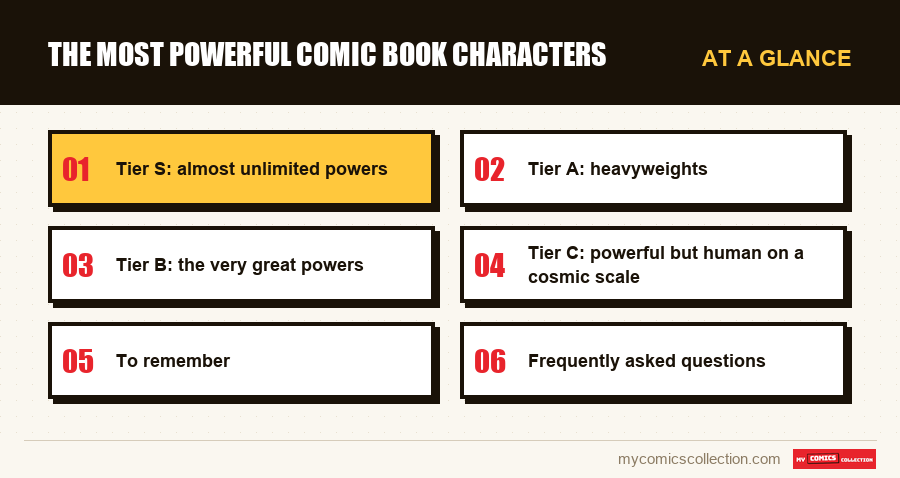
Start my trial →Tier S: almost unlimited powers
Galactus devours entire planets for food: it is a fundamental cosmic force of the Marvel universe, of a higher order than classic superheroes. Superman is DC's standard of power, capable of moving planets. Thanos, once the Infinity Gauntlet in hand, literally becomes omnipotent for the duration of an event. And Doomsday is the brute who killed Superman, designed to evolve and become unbeatable.
Tier A: heavyweights
Thor, god of thunder, plays in the court of deities. Hulk possesses a strength that grows without limit with his anger. Scarlet Witch rewrote reality with a snap of his fingers (“No More Mutants”). And Silver Surfer, herald of Galactus, wields Cosmic Power.
Tier B: the very great powers
Doctor Strange, Sorcerer Supreme, operates on the mystical plane. Apocalypse, a thousand-year-old mutant, has almost unlimited powers. Wonder Woman rivals Superman on the DC side, and Brainiac combines level 12 intelligence and devastating technology.
Tier C: powerful but human on a cosmic scale
Tornado controls the global climate, Vision manipulates its density to the point of intangibility, and Magneto bends terrestrial magnetism to its will. Formidable powers on a human scale, but a notch below the cosmic forces at the top.
To remember
- The power varies according to the authors: this classification reflects the most established feats of arms.
- Artifacts change everything: Thanos without the Gauntlet is much less powerful than with it.
- It's a never-ending debate: and that’s what makes it exciting.
- Each character refers to its file for its key numbers.
Frequently asked questions
On the scale of “playable” characters, Galactus Marvel side and Superman DC side dominate. Above exist abstract entities (Living Tribunal, Presence) which go beyond the framework of classic heroes.
Without the Infinity Gauntlet, the debate is open. With the Gauntlet, Thanos becomes temporarily omnipotent and surpasses everyone, but it's a power conditioned on an artifact.
No, no power ranking is “official”: levels fluctuate depending on the writers. This tier list is based on the most recurring feats of arms in the comics.
Do you collect the first appearances of these titans? Estimate their value for free with our tool based on current eBay listings.
Reading a power ranking: three criteria to keep in mind
A power ranking is never a verdict. Three criteria explain most disagreements between readers, and knowing them helps you read this tier list with perspective.
1. Own power or borrowed power
Some characters are powerful by nature, others through an object. Thanos is the example: with the Infinity Gauntlet he becomes omnipotent, but that power depends on an artifact. Without it, he sits much lower. When a ranking puts a character at the very top, ask under what conditions he is there. The same character can occupy two ranks depending on whether he is counted with or without his object.
2. The gap between writers
A character does not have the same power under every pen. One writer can make him nearly invincible, another can have him struggle in an ordinary fight. That is why this list relies on the best-established feats rather than on a single episode. When you read a story that contradicts a ranking, it is not necessarily a mistake: it is often the mark of a different author.
3. Entities that fall outside the frame
Above heroes and villains exist abstract entities, such as the Living Tribunal or the Presence, that can no longer be compared with the others. Rankings of this kind generally leave them aside, because including them would make the list impossible to read.
Where to read these titans' first steps
For those who want to go back to the source, Galactus and the Silver Surfer debut in Fantastic Four #48 (1966), while Thanos first appears in Iron Man #55 (1973). These issues are easy to read in collected form, and it is an excellent way to see how these powers were originally presented, long before the debates over their rank.
If you collect these characters
Always check which issue corresponds to the first appearance and distinguish it from later appearances, often wrongly presented as firsts. Keep in mind also that a character's power and the value of his issues are two distinct things: a character at the top of this ranking does not necessarily have the most sought-after issue, and the reverse is just as common. A tracking list per character will help you avoid mixing up roles and spot what is missing from your collection.