The best superhero teams in comics are, at the top, the X-Men , THE Avengers , there Justice League and the Fantastic Four. This tier list ranks the teams according to their importance, the quality of their stories and their cultural impact. Facts (editor, creation) verified; each team refers to a key number or a site file.
A great team is more than an addition of heroes: it is a dynamic, tensions, a substitute family. This tier list does not measure the combined power but the team success as a concept: richness of characters, great runs, imprint on pop culture.
Editorial Ranks, Facts verified. Each team points to a site resource.
Collecting this series?
Track what you own, what you are missing and what your collection is worth. 7 day trial.
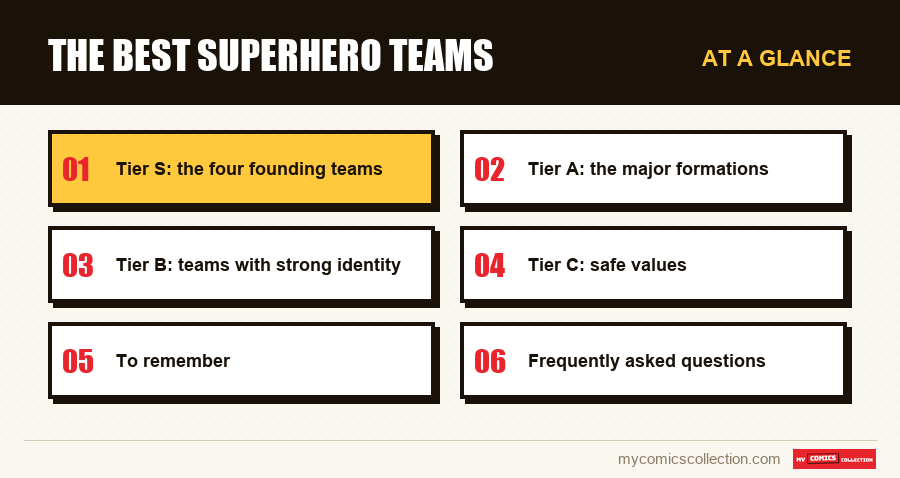
Start my trial →Tier S: the four founding teams
THE X-Men (1963) are undoubtedly the richest team: their allegory of difference has fueled decades of great stories. THE Avengers (1963) brings together the greatest Marvel heroes and carries the major events. There Justice League brings together the DC pantheon (Superman, Batman, Wonder Woman). And the Fantastic Four (1961), the first Marvel family, literally launched the publisher's modern universe.
Tier A: the major formations
THE Teen Titans, especially in their 1980 version of Wolfman and Pérez, rival the X-Men. THE Guardians of the Galaxy brought a cosmic and pop breath. There Justice Society is the very first superhero team in history (1940). And the Defenders form Marvel’s cult “non-team”.
Tier B: teams with strong identity
X-Force embodies the dark side of mutants. There Suicide Squad sends villains on suicide missions. There Doom Patrol, especially under the pen of Grant Morrison, is DC's strangest team. And the Birds of Prey imposed a sustainable women's team.
Tier C: safe values
THE Thunderbolts (villains pretending to be heroes) are based on a brilliant twist. THE Inhumans and Alpha Flight complete the selection: good teams, a notch below the formations which define their universe.
To remember
- The criterion is the success of the team concept, not the combined power.
- Marvel and DC dominate the top equally (two teams each).
- A strong team carries events: Avengers and X-Men structure entire sagas.
- Each team refers to a key number or site file.
Chronological landmarks and reading by team type
A tier list says who is at the top, but not in what order these teams were born. Yet the order of appearance changes the reading: the groups on the list span more than seventy years of publishing.
- 1940: the Justice Society, the first superhero team in history.
- 1960-1965: Justice League (1960), Fantastic Four (1961), then X-Men, Avengers and Doom Patrol (1963), Teen Titans (1964) and Inhumans (1965).
- 1971-1983: Defenders (1971), the Wolfman and Pérez version of the Teen Titans (1980) and Alpha Flight (1983).
- 1987-1997: Suicide Squad (1987), X-Force (1991), Birds of Prey (1996) and Thunderbolts (1997).
- 2008: the Guardians of the Galaxy, the most recent group in the selection.
The early 1960s concentrate almost the entire top: three of the four Tier S teams were born between 1961 and 1963, proof that the modern team concept settled within a few years.
Reading by team type
Rather than following the ranking, you can choose by what you look for in a team:
- The family: the Fantastic Four, Marvel's first family, for stories built on bonds more than on fights.
- The allegory: the X-Men, whose difference is the narrative engine of decades of sagas.
- The pantheon: the Avengers and the Justice League, which gather each publisher's major heroes and carry the big events.
- The non-team: the Defenders, a cult group unlike any other.
- Villains on a mission: the Suicide Squad and the Thunderbolts, two original concepts built on antiheroes or impostors.
- The strange: the Doom Patrol, especially under Grant Morrison.
Points of caution for collecting
Several names designate successive relaunches. The 1964 Teen Titans and the 1980 ones do not carry the same editorial interest, and the 2008 Guardians of the Galaxy have nothing to do with earlier versions of the name. Before buying, always check the date and the volume, then decide whether you collect the team as a whole or one specific version.
Finally, a strong team carries entire events, notably the Avengers and the X-Men: their issues therefore extend well beyond their own title. Issue-by-issue tracking in your collection app keeps you from missing crossovers slipping into other series.
Frequently asked questions
THE X-Men and the Avengers compete for first place at Marvel, the Justice League DC side. The choice depends on the criterion: thematic richness (X-Men) or scope (Avengers, JLA).
La Justice Society of America (JSA), appearing in All-Star Comics #3 in 1940, is the very first superhero team united in the same title.
Yes: the Suicide Squad and the Thunderbolts are based entirely on this principle, making them two of the most original team concepts.
Do you have a founding number of one of these teams? Estimate its value for free with our tool based on current eBay listings.