The best comic book villains, at the top, are the Joker , THE Doctor Doom , Thanos , Magneto and Lex Luthor. This tier list classifies supervillains according to their cultural and narrative significance: impact on their universe, richness of writing, iconic status. Each choice is based on verifiable facts (creation, publisher, role) without any invented data.
A great villain is often worth the hero he faces: without Joker, no Batman as we know him; without Magneto, the X-Men lose their mirror. This tier list does not classify the raw “power” but the quality of the antagonist: to what extent it defines its universe, inspires the best stories and leaves a lasting mark on popular culture.
Ranks are a bias; the facts (creators, first appearance, publisher) are verified. Each villain refers to his character sheet on the site.
Collecting this series?
Track what you own, what you are missing and what your collection is worth. 7 day trial.
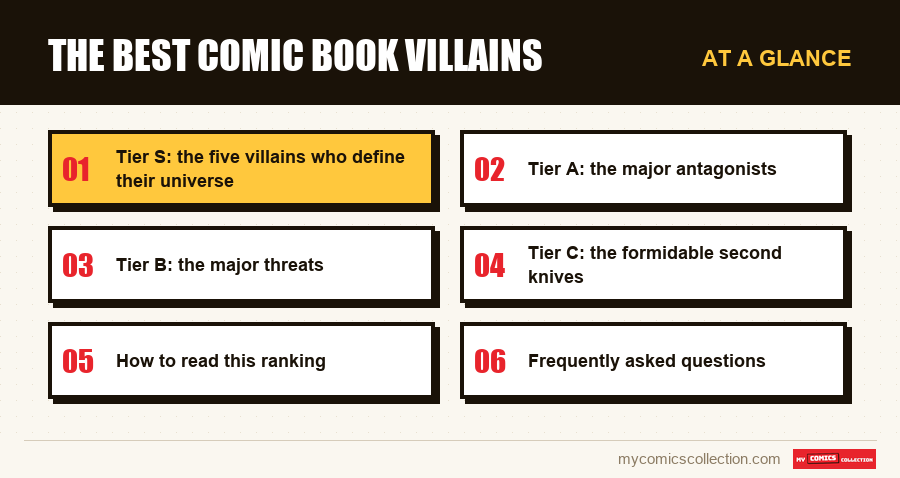
Start my trial →Tier S: the five villains who define their universe
Le Joker (DC, 1940) is the standard measure of the supervillain: chaos incarnate, he inspired some of the greatest Batman stories (The Killing Joke , The Dark Knight Returns). THE Doctor Doom (1962) is Marvel's most complete antagonist (monarch, genius, magician) to the point of carrying entire events. Thanos (1973) redefined the cosmic scale with the Infinity Gauntlet. Magneto (1963) is the rare villain whose cause is understandable, a tragic mirror of the X-Men. And Lex Luthor (1940) opposes Superman with the worst human weapon: unscrupulous intelligence.
Tier A: the major antagonists
Le Green Goblin (1964) remains Spider-Man's ultimate nemesis: it is he who kills Gwen Stacy, one of the turning points in the history of the medium. THE Red Skull (1941) embodies absolute evil against Captain America. THE Caid (1967) dominates New York crime and haunts Daredevil. Loki (1962), God of Mischief, became one of the most popular villains thanks to his complexity. Darkseid (1970) is the cosmic tyrant who founded Jack Kirby's Fourth World.
Tier B: the major threats
Ultron (1968), genocidal AI, keeps coming back to haunt the Avengers. Brainiac (1958) is the extraterrestrial intelligence that bottled Krypton. Apocalypse (1986) imposes its law of the strongest on mutants. And Venom (1988), born from a symbiote rejected by Spider-Man, experienced the rare trajectory of the villain who became a cult antihero.
Tier C: the formidable second knives
Carnage (1991) pushes the concept of the symbiote towards pure horror. Bulleye (1976) turns any object into a deadly weapon against Daredevil. Mystical (1978), manipulative shapeshifter, and Sabertooth (1977), Wolverine's mirror predator, complete this tier: excellent villains, a step below the figures who define an entire universe.
How to read this ranking
- The criterion is not power but the narrative and cultural importance.
- The S tier brings together villains without whom their hero would not exist as is.
- Marvel dominates in numbers, but DC places two founding figures at the top (Joker, Luthor).
- Each villain returns to his file to find his key numbers.
Frequently asked questions
Le Joker (DC, 1940) is the most consensual: its richness of writing and its iconic status make it the reference, alongside Doctor Doom at Marvel.
Yes : Venom is the most famous example, going from Spider-Man's nemesis to star antihero. Magneto and Loki also regularly alternate between the two camps.
Because his motivation-to protect mutants from a second genocide-is understandable, making him a tragic antagonist rather than just a "bad guy." This ambiguity fuels the best X-Men stories.
Do you have a key number of the first appearance of one of these villains? Estimate its value for free with our tool based on current eBay listings.
Collecting the great villains: first appearances and pitfalls
A villain ranking becomes useful to a collector once you know where to look for their debuts. The Joker appears in Batman #1 (1940) and Lex Luthor in Action Comics #23 (1940), two pillars of the DC Golden Age. At Marvel, Doctor Doom debuts in Fantastic Four #5 (1962), Magneto in X-Men #1 (1963) and Thanos in Iron Man #55 (1973), an issue that remains the ultimate key of the series. Darkseid was born in 1970 under Jack Kirby's pencil in Superman's Pal Jimmy Olsen #134, and that is where to look for him rather than in a Superman series.
First pitfall: the difference between an appearance and a full first appearance. Ultron is a good example. In Avengers #54 he hides under the identity of Crimson Cowl, and only in #55 does he reveal himself in his Ultron-5 form. Depending on the guide, one or the other is presented as the key: always check exactly what a first-appearance label covers before paying. The same reflex applies to Venom (Amazing Spider-Man #300, 1988) and Carnage (Amazing Spider-Man #344, 1991), whose first steps happen in issues of the main Spider-Man series rather than in a dedicated one.
Second pitfall: dependence on screens. The value of a villain issue often follows film and series news, with peaks at casting announcements and drops between projects. An S tier in this list does not guarantee stable value: it is the editorial status that lasts, not an issue's market price. The keys of historic villains (Joker, Luthor, Doom, Magneto) have the advantage of an importance that depends on no particular adaptation.
Third landmark: read before collecting. To understand why a villain matters, the stories that established them are worth the detour. The Killing Joke and The Dark Knight Returns show two facets of the Joker; the arcs around the Infinity Gauntlet set Thanos on a cosmic scale; X-Men stories nuance Magneto, whose motivation is understandable. These readings are easy in collected editions, without going through the original issues.
Finally, keep in mind that roles shift. Venom, born from a symbiote rejected by Spider-Man, became a popular antihero, and Loki or Magneto regularly switch sides. If you collect a character, follow their evolutions: a villain turned hero attracts new readers, and therefore new buyers for their founding issues. And for any piece of importance, check authenticity and favor a certified copy.