The best-written comics of all time are, at the top, Watchmen by Alan Moore and Dave Gibbons (1986-87), Sandman by Neil Gaiman (1989-96), Maus by Art Spiegelman (1992 Pulitzer Prize) and Daredevil: Born Again by Frank Miller and David Mazzucchelli (1986). This tier list classifies stories by the quality of writing alone (construction, dialogue, themes, ambition) regardless of their rating. Each choice is based on verifiable facts: authors, dates, awards.
“Well written” does not mean “expensive.” An issue can be worth a fortune for a first appearance without being a great text, and a masterpiece of writing can be found in a collection for twenty euros. This tier list focuses on scenario: the structure of the story, the density of the dialogues, the thematic scope and mastery of the medium. Ratings don't come into play here: it's a reading rank, not an investment.
The method is simple and straightforward: each title is judged on its writing, with the support of verifiable facts (creators, year, documented awards such as the Eisner Awards or the Pulitzer). The ranks are an editorial bias, but the factual information is verified.
Collecting this series?
Track what you own, what you are missing and what your collection is worth. 7 day trial.
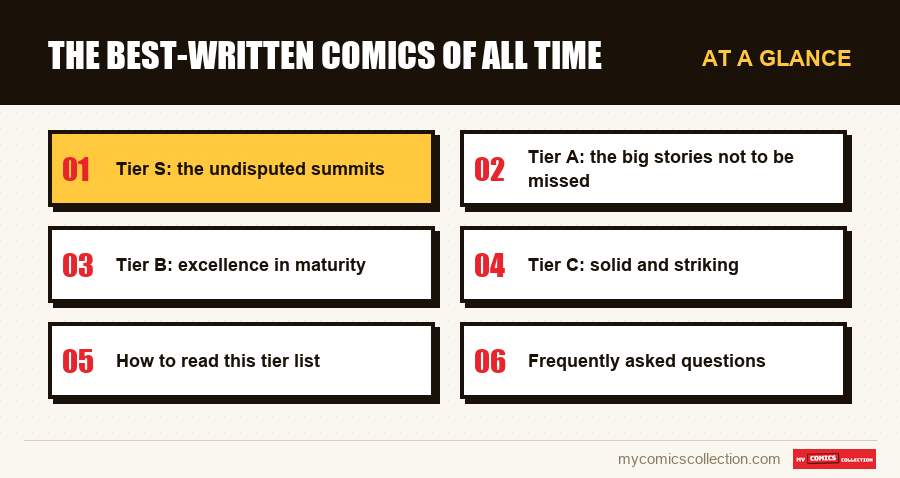
Start my trial →Tier S: the undisputed summits
Watchmen (DC, 1986-87) remains the reference. Alan Moore deconstructs the figure of the superhero through a deep detective intrigue, an obsessive formal symmetry (the central chapter “Fearful Symmetry” reads like a mirror) and a political subtext on the Cold War. It is the only comic to have won a Hugo Award (1988). No other miniseries has weighed so heavily on writing in the medium.
The Sandman by Neil Gaiman (Vertigo, 1989-96) transforms an obscure DC character into a 75-issue mythological fresco. Gaiman brings Shakespeare, the Underworld and the dream itself into dialogue; the episode A Midsummer Night's Dream (Sandman #19) is the only comic to have won a World Fantasy Award (1991), after which the regulations were amended to exclude comic books. Literary writing in the strict sense.
Maus by Art Spiegelman (1980-91) recounts the Holocaust experienced by his father, representing the Jews as mice and the Nazis as cats. This is the only graphic novel Pulitzer Prize winner (1992, special category). The memorial ambition and the presentation of the story (the author writing the story of his father) make it an essential milestone in writing.
Daredevil: Born Again (Marvel, 1986) is the pinnacle of “genre” superhero writing. Frank Miller methodically demolishes Matt Murdock's life, Kingpin learns his identity and destroys everything he owns, before a redemption of rare intensity. Miller's narrative density, served by Mazzucchelli's plates, serves as a model for three decades of urban stories on Daredevil.
Tier A: the big stories not to be missed
The Dark Knight Returns (1986) shows a Batman aging who returns to service in a decrepit America. Miller invents the dark and political tone that will dominate the character to this day. Batman: Year One (1987), by the same Miller with Mazzucchelli, is the counterpoint: a sober, realistic origin story, which has become the matrix of all modern rereadings.
Saga by Brian K. Vaughan and Fiona Staples (Image, since 2012) is the family space opera that won the most Eisner Awards of the decade. Writing full of humor and emotion, immediately endearing characters: it is the ideal modern gateway, available via the hub Saga. Preacher (Garth Ennis, 1995-2000) and Y: The Last Man (Vaughan, 2002-08) complete this tier with two long-term stories, one provocative and theological, the other post-apocalyptic and intimate.
Tier B: excellence in maturity
This tier brings together works of great writing finesse. All-Star Superman by Grant Morrison and Frank Quitely (2005-08) distills into twelve issues everything that Superman can embody kindness. The Vision by Tom King (2015-16) is a chilling suburban tragedy about an android who wants a family. Immortal Hulk by Al Ewing (2018-21) reinvents Hulk in metaphysical body horror. Transmetropolitan and Planetary by Warren Ellis show the extent of his writing, between journalistic satire and archeology of the fantastic.
Tier C: solid and striking
Kingdom Come (Mark Waid, 1996) is a twilight fable about the aging of DC heroes. East of West (Jonathan Hickman, 2013-19) unfolds a wildly ambitious apocalyptic western. Sin City (Miller, 1991-92) brings the noir thriller to its graphic incandescence. Mister Miracle (Tom King, 2017-18) closes this selection with an intimate meditation on depression and fatherhood. None are minor: they only give way, by a hair, to the titles above them.
How to read this tier list
- To discover the medium: start with the S tier: these are the four works that convince any reader that comics are an art in their own right.
- For long courses: Saga, Preacher and Y: The Last Man (tier A) offer dozens of hours of coherent reading.
- For formal audacity: Watchmen, The Vision and Mister Miracle play with the very structure of the page.
- Most are accessible in collection at a low price: this is a reading ranking, not speculation.
Frequently asked questions
The most consensual reference is Watchmen (Alan Moore & Dave Gibbons, 1986-87), only Hugo Award-winning comic. Sandman and Maus (Pulitzer Prize) are regularly associated with him at the top.
No. Writing quality and market value are two independent criteria. Most of the titles on this tier list can be found in collections for a modest price, while highly rated issues are for a first appearance, not for their storyline.
The autonomous works of tier S and A are ideal: Watchmen, Maus, Batman: Year One or Born Again can be read without knowing anything about the universe. Saga is the best entry point for a long-term modern series.
Do you own one of these original edition titles? Estimate its value for free with our tool based on current eBay listings: quality writing is priceless, but a first edition is.