
The best dystopian comics are, at the top, V for Vendetta by Alan Moore, The Dark Knight Returns by Frank Miller, Transmetropolitan by Warren Ellis and Judge Dredd. This tier list classifies stories of totalitarian or decadent societies according to their political strength and quality, from satire to authoritarian nightmare. Facts (authors, publishers, dates) checked, no invented ratings.
Dystopia is one of the most powerful registers of comics: it projects our fears into dark futures. This tier list brings together the stories that best carry this charge: political vision, chilling universe, characters in resistance. Criterion: the strength of the dystopian vision combined with the quality of the story.
Editorial Ranks, Facts verified. Each entry refers to a site file when it exists.
Collecting this series?
Track what you own, what you are missing and what your collection is worth. 7 day trial.
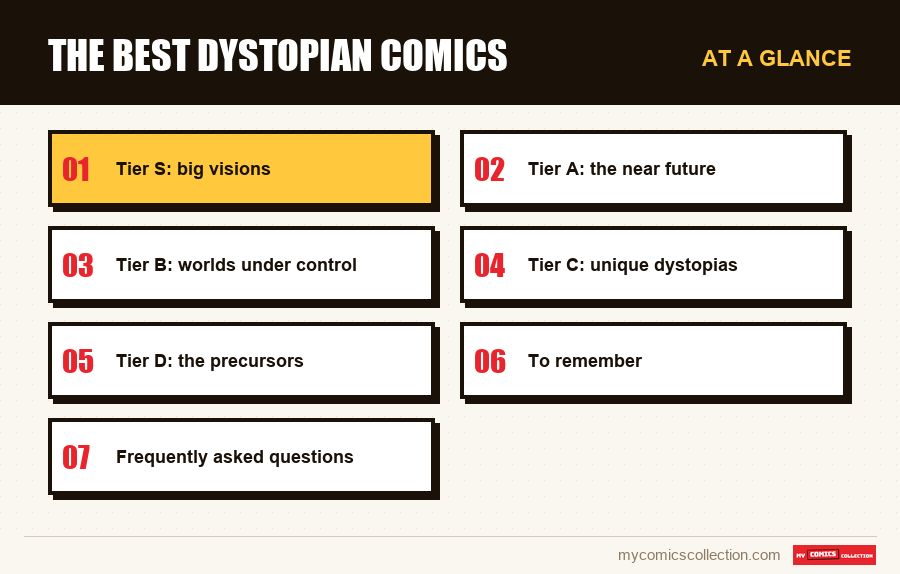
Start my trial →Tier S: big visions
V for Vendetta (Moore & Lloyd) remains the reference dystopia, born under the Thatcherite United Kingdom, whose mask has become a global symbol. The Dark Knight Returns paints a decrepit and media-driven America. Transmetropolitan imagine an ultra-consumerist future, and Judge Dredd has caricatured the police state since 1977.
Tier A: the near future
Y: The Last Man imagine a world deprived of its men. DMZ a second American civil war is taking place, Give Me Liberty (Miller & Gibbons) a fractured America, and Ex Machina crosses politics and superheroes.
Tier B: worlds under control
Lazarus by Greg Rucka imagines a world run by corporate families. The Massive , Crossed +100 and Uber explore other societal breakdowns.
Tier C: unique dystopias
Marshal Law (superheroic satire), Sweet Tooth by Jeff Lemire, Rover Red Charlie and The Surrogates offer more offbeat but striking visions.
Tier D: the precursors
Kamandi by Jack Kirby (the last boy on Earth), Nathaniel Dusk and American Flag! by Howard Chaykin closes this tier list: historical dystopias, real but less known.
To remember
- Alan Moore signs the most influential dystopia (V for Vendetta).
- Brian K. Vaughan and Brian Wood excellent in the credible near future.
- Dystopia is very political: this is its main strength.
- Each entry refers to a site file when it exists.
Three reading paths into dystopia
A tier list ranks, but it does not tell you in which order to read. Depending on what you are after, there are three entry points, each with its own works, pace and edition markers.
Path 1: short, self-contained stories
If you want a complete story with no commitment, start with V for Vendetta. First published as a British serial in the 1980s, it was gathered and completed by DC in ten issues (1988-1989), then in a single volume. The Dark Knight Returns runs four issues released in 1986 and reads in one sitting. These two works set the genre's vocabulary: an authoritarian power, a complicit media, an individual who resists.
Path 2: long near-future series
If you prefer to settle into a world, choose the Vertigo series. Y: The Last Man (60 issues, 2002-2008) and Ex Machina (50 issues, 2004-2010) blend politics and suspense. DMZ (72 issues, 2005-2012) follows a reporter in a Manhattan cut in two by a second American civil war. Their strength is credibility: we recognize our world, barely distorted.
Path 3: satire and excess
Transmetropolitan (60 issues, 1997-2002) follows the journalist Spider Jerusalem in a future saturated with consumption and media. Judge Dredd, created by John Wagner and Carlos Ezquerra for the weekly 2000 AD, caricatures the police state through Mega-City One. Here black humor is a political weapon, and you can enter through any story.
Collecting markers
- Vertigo series are easy to complete in single issues, because they had large print runs. The difficulty is mostly assembling a run without gaps, from first issue to last.
- First printings matter. For the 1980s classics, first printings are told apart from reprints by the printing notices inside.
- Collections are enough for reading. Keep original issues for the collection, and read the stories in volume form to preserve your copies.
- Judge Dredd needs a method. Its publishing history is scattered between the original weekly, albums and spin-off series: first find the collection you like.
A good thread is to read one self-contained story, one near-future series, then one satire, to gauge what dystopia says about each era: the fear of the state, of the media, of collapse.
Frequently asked questions
V for Vendetta by Alan Moore is the benchmark dystopia. The Dark Knight Returns and Transmetropolitan complete the genre's pinnacle.
Dystopia describes an organized but oppressive (often totalitarian) society; the post-apocalyptic describes a collapsed world, without structure. Some stories mix the two.
By V for Vendetta (autonomous and complete) or Y: The Last Man (accessible series). Both exist in collections.
Do you own an original edition of a dystopian classic? Estimate its value for free with our tool based on current eBay listings.