
The best historical comics, inspired by real events, are, at the top, Maus by Art Spiegelman, Persepolis by Marjane Satrapi, March by John Lewis and From Hell by Alan Moore. This tier list classifies stories anchored in History according to their quality and rigor. Facts (authors, subjects) verified, no invented ratings; each entry refers to a record when it exists.
Comics are a wonderful tool for telling History: the Shoah, segregation, wars. This tier list classifies historical comics according to their narrative quality and their documentary requirements. Many have become references, including school ones.
Editorial Ranks, Facts verified. Each entry refers to a site file when it exists.
Collecting this series?
Track what you own, what you are missing and what your collection is worth. 7 day trial.
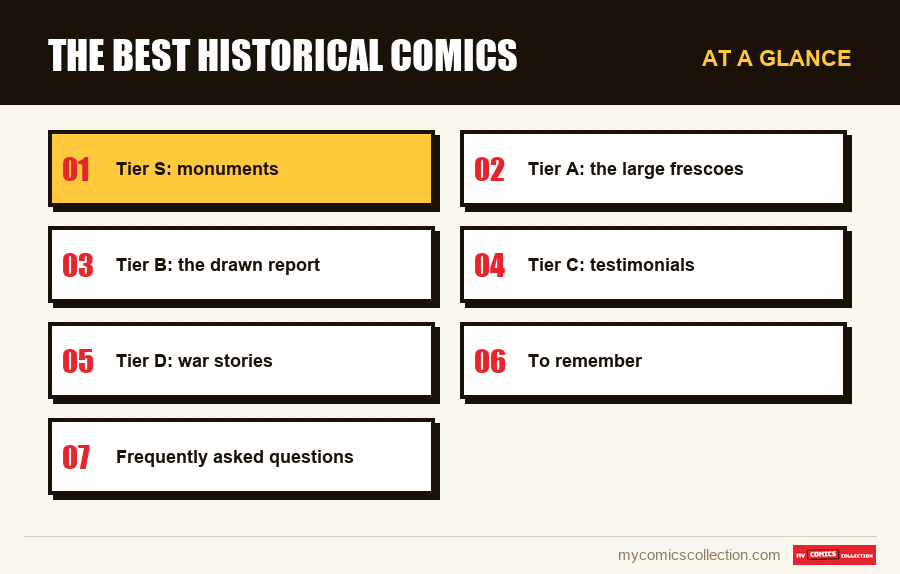
Start my trial →Tier S: monuments
Maus recounts the Holocaust experienced by the author's father: the only Pulitzer-winning graphic novel. Persepolis traces the childhood of Marjane Satrapi in revolutionary Iran. March is the story of civil rights activist John Lewis, and From Hell dives into Jack the Ripper's London with crazy documentary rigor.
Tier A: the large frescoes
Berlin by Jason Lutes depicts the Weimar Republic, Louis Riel Canadian history, and Palestine as They Called Us Enemy (Japanese-American internment camps) bear witness to major conflicts and injustices.
Tier B: the drawn report
Two Brothers , Age of Bronze (the Trojan War), The Photographer (Afghanistan) and Safe Area Goražde by Joe Sacco (the Bosnian War) illustrate the documentary power of the medium.
Tier C: testimonials
Alan's War , Gen of Hiroshima , Vietnamerica and Spring in Chernobyl forcefully combine history and personal narrative.
Tier D: war stories
The 'Nam , Charley's War and Nat Turner close this tier list: striking historical stories, straddling war comics.
To remember
- Maus proved that comics could deal with the most serious subjects.
- The historical comic is often awarded and used in schools.
- The drawn report (Joe Sacco) is a genre in its own right.
- Each entry refers to a site file when it exists.
Frequently asked questions
Maus by Art Spiegelman is unanimous: the only Pulitzer-winning graphic novel, it tells the story of the Shoah with unequaled force. Persepolis and March follow closely.
The best are based on rigorous documentary work (From Hell, Joe Sacco). Many are also recommended in educational settings for their accuracy.
By Maus or Persepolis, two accessible and moving stories, available in bound collections.
Reading historical comics by era and by theme
A tier list ranks, but it does not tell you what order to read in. Here are two ways to go through these stories: by era, to follow the thread of History, or by theme, to compare views on the same reality.
By era. Antiquity opens the journey with Age of Bronze, devoted to the Trojan War. The 19th century is read with Louis Riel for Canadian history, and Nat Turner for the 1831 slave revolt. The London of 1888 and Jack the Ripper is that of From Hell. The wars of the 20th century form the bulk of the corpus: Charley's War for the First World War, Berlin for the Weimar Republic, Maus for the Holocaust, Barefoot Gen (Gen d'Hiroshima) for the bomb, They Called Us Enemy for the internment of Japanese Americans. After 1945 come March for segregation, The 'Nam and Vietnamerica for Vietnam, Persepolis for revolutionary Iran, Un printemps à Tchernobyl for the 1986 catastrophe. Palestine, Safe Area Goražde and Le Photographe cover more recent conflicts through reportage.
By theme. For persecutions and camps, pair Maus, They Called Us Enemy and Gen d'Hiroshima: three different contexts, one shared concern for testimony. For civil rights and slavery, March and Nat Turner answer each other. For war seen from below, compare Charley's War and The 'Nam, two stories of ordinary soldiers. For reportage, Joe Sacco (Palestine, Safe Area Goražde) and Le Photographe show how drawing documents what photography does not always show.
Pairing testimony and investigation. A good habit is to read a personal story (Persepolis, La Guerre d'Alan, Vietnamerica) and then a more documentary work on the same period. The first gives the lived experience, the second the context. This alternation avoids mistaking one individual memory for the whole of history.
Points of vigilance for collecting. Many of these titles exist in several editions: separate volumes, omnibuses, revised editions. Before buying, check that the edition contains the whole story. For a classic like Persepolis or March, a complete bound edition is often more practical than scattered volumes. Think about language too: several entries are French-language works, others are translations, and translation quality matters for a documentary story.
An introductory path. To discover the genre without getting lost, go through Maus, Persepolis, March, then a Joe Sacco reportage. You will have met a family-memory story, a childhood in revolution, a political struggle and a field report, the four main ways comics tell History.
Do you own a first edition of a historical classic (Maus…)? Estimate its value for free with our tool based on current eBay listings.