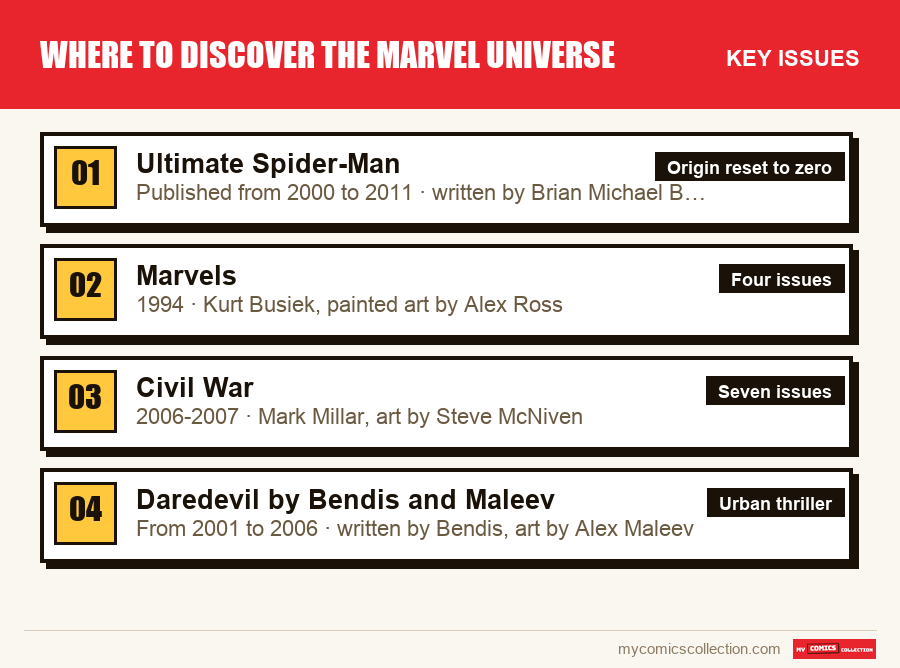
To discover the Marvel universe, the best gateways are Ultimate Spider-Man by Brian Michael Bendis (2000), Marvels by Kurt Busiek and Alex Ross (1994), Civil War (2006) and the Daredevil run by Bendis and Alex Maleev (2001). This tier list ranks comics not by their historical importance but by their accessibility for a new reader: whether they can be read without prerequisites, how clear the story is, how much they make you want to keep going. Two of these four entries run under ten issues, which makes them no-commitment tries.
The trap, when you discover Marvel, is wanting to "start from the very beginning": sixty years of continuity, thousands of issues, reboots. Pointless. The best entry points are stories that are standalone or nearly so, which set the tone of a character or of the universe without requiring prior knowledge. That is the only criterion of this tier list: how easily a beginner can open the first issue and get hooked.
As always here, the rankings are a matter of opinion, but the facts (creators, publication year, nature of the series) are verified. No invented prices: this is a reading guide, not a buying guide.
What "accessible" means in this ranking
A comic can be a masterpiece and a disaster as a first read. To avoid that misunderstanding, four measurable criteria were used to rank the titles above, and none of them concerns the absolute quality of the work.
Narrative autonomy first: the story must make sense without having read anything else. A series that opens on a death whose victim you do not know fails this test, even if it is brilliantly written. A defined length next: knowing in advance how many issues make up the story changes everything for a reader who is feeling their way. A four-issue miniseries can be tried without a second thought; a two-hundred-issue run requires a decision.
Visual readability matters just as much: pages where you can follow the reading order and recognize the characters from one panel to the next. It sounds obvious, but some of the great Marvel classics of the sixties demand real eye gymnastics, with text-heavy panels and colors limited by the printing processes of the time. Availability in collected form, finally: a story gathered in a single volume is much easier to approach than the same story scattered across issues you have to hunt down one by one.
A fifth factor, less often admitted, weighs in practice: familiarity. Someone who has seen the movies will recognize faces and conflicts, which offsets part of the entry effort. That is why Civil War works so well with an audience coming from the movies, even though it is an event, the format usually recommended last.
The four gateways, card by card
Here is what you are actually buying when someone recommends one of the four S-tier entries: the number of issues, the creators, the period, and the kind of read it represents.
Ultimate Spider-Man
Bendis wrote the entire series, in a continuity separate from the main Marvel universe. The art is by Mark Bagley up to issue 111, then by Stuart Immonen. The remarkable point for a beginner: the origin of Spider-Man, told in eleven pages in 1962, is developed here into a seven-issue arc of about one hundred eighty pages. So you have time to settle into the story before the action takes over.
Marvels
A fully painted four-issue miniseries that crosses the Marvel universe from 1939 to 1974 through the eyes of a press photographer, Phil Sheldon. Each issue is set around a major moment in Marvel's publishing history, seen from the sidewalk rather than from the sky. It is the read that gives the most context for the least effort: by the end, you will know who the great figures of the universe are and why they matter.
Civil War
The central limited series runs seven issues and can be read on its own. The US government imposes the registration of individuals with powers: Captain America opposes it, Iron Man supports it, Spider-Man is caught between the two and the X-Men stay neutral to protect mutants. The series' tagline, "Whose Side Are You On?", sums up the intent: the reader is called on to choose.
Daredevil by Bendis and Maleev
Bendis takes over the series in 2001 with a four-part story drawn by David Mack, then writes most of the following fifty-five issues until 2006, usually with Alex Maleev. No cosmic supervillain, no prerequisites: a blind lawyer, a city, a tabloid press. It is the entry to recommend to someone who reads crime novels and is wary of costumes. The Daredevil hub lists the issues concerned.
S tier: open with these
Ultimate Spider-Man (2000) is the ultimate gateway. Bendis restarts the origin of Spider-Man from scratch, in a brand-new continuity (the "Ultimate" universe), with no baggage to know. Modern dialogue, a believable teenager: it is the comic you hand to someone who has never read anything. Marvels (1994) takes the opposite angle: Busiek and Ross tell Marvel's golden age from the point of view of a simple photographer, which makes for a wonder-filled guided tour of the whole universe.
Civil War (2006) is the most readable event for a beginner: the heroes split over a registration law, Iron Man against Captain America, a clear moral dilemma carried by Steve McNiven's pages. Finally, the Daredevil run by Bendis and Maleev (2001) is a standalone urban thriller that proves Marvel can also do adult crime fiction, an ideal entry via the Daredevil hub.
A tier: the logical next step
Once the basics are in place, Jonathan Hickman's House of X / Powers of X (2019) completely reshuffles the deck for the X-Men, an excellent modern starting point for that corner of the universe. Infinity Gauntlet (1991) remains the founding cosmic blockbuster (the one that inspired the Avengers movies), readable via the key issue. Matt Fraction's Hawkeye (2012) and G. Willow Wilson's Ms. Marvel (2014) show the intimate, contemporary side of Marvel, perfect for varying the tone.
Three useful details about this tier. House of X and Powers of X are two parallel 2019 miniseries, drawn by Pepe Larraz and R. B. Silva respectively, with Marte Gracia on colors; they intertwine and must be read alternately, as the collections indicate. They launched the "Dawn of X" relaunch and a whole mutant era that lasted from October 2019 to June 2024. Infinity Gauntlet is a six-issue limited series published from July to December 1991, written by Jim Starlin, drawn by George Pérez and then by Ron Lim, Pérez having left the project after three issues and part of the fourth. As for Hawkeye, it is the fourth volume of the series, launched in 2012 by Fraction and David Aja, and it is the one that rehabilitated the character with critics. For the X-Men, the dedicated guide details the next steps once you have digested Hickman.
B tier: go deeper by character
These runs are excellent targeted entry points. Ta-Nehisi Coates's Black Panther (2016) gives Wakanda a political dimension; Jason Aaron's Thor (2012-19) is one of the great modern runs of the universe; Immortal Hulk reinvents Hulk as horror; and the Miles Morales series extends Spider-Man to a new generation.
Here again, a few dated landmarks avoid confusion at the bookstore. Coates writes the sixth volume of Black Panther with artist Brian Stelfreeze, whose first issue came out on April 6, 2016; his first arc, "A Nation Under Our Feet", ends with Wakanda's transformation into a constitutional democracy. Jason Aaron begins his cycle with Thor: God of Thunder in 2012, drawn mainly by Esad Ribić, before continuing with Russell Dauterman; his work on this series is among the reasons for his nomination for the Eisner Award for Best Writer in 2015. Immortal Hulk, by Al Ewing and Joe Bennett, ends with issue 50 in October 2021 and was nominated three times for the Eisner Award for Best Continuing Series. Finally, Miles Morales first appears in Ultimate Fallout issue 4, in August 2011, created by Bendis and artist Sara Pichelli, who also designed the black costume with the red web. His complete reading guide is on the site: reading Miles Morales in order.
C tier: to go further
Old Man Logan (2008) is a post-apocalyptic western starring Wolverine, standalone and spectacular. Hickman's Secret Wars (2015) and Annihilation (2006) require a bit more context: save them for when the universe has become familiar. Nothing inaccessible, but these are not the very first titles to open.
The detail that explains this ranking: these three stories are not published where you would look for them. Old Man Logan is not a series under its own name but an arc published in Wolverine vol. 3, issues 66 to 72, between June 2008 and June 2009, concluded in a giant-size one-shot in November 2009. Secret Wars (2015) directly extends a plot developed in the Avengers and New Avengers series, and shares its title with a 1984-1985 miniseries to which it has no direct connection. Annihilation is a 2006 crossover whose central miniseries is written by Keith Giffen, but which ties in with several parallel series; its dedicated reading guide gives the exact order, which you cannot guess.
Collecting this series?
Track what you own, what you are missing and what your collection is worth. 7 day trial.
Start my trial →The entry cost, in number of issues
A beginner does not decide based on quality, which they cannot judge, but based on the commitment required. Side by side, the gaps are considerable and nobody ever says so clearly.
Four issues for Marvels. Six for Infinity Gauntlet. Seven for the central Civil War series, and seven as well for the first arc of Ultimate Spider-Man. Six plus six for House of X and Powers of X. Seven issues of a Wolverine arc, plus a giant-size issue, for Old Man Logan. Then you move into another category: about twenty issues for Fraction and Aja's Hawkeye, about fifty for Immortal Hulk, about fifty as well for Bendis's Daredevil, one hundred sixty for Ultimate Spider-Man as a whole.
The practical reading of these figures: start with a title under ten issues. If you enjoy the experience, you will know which format to turn to, and a long run will stop feeling like a gamble. If you do not enjoy it, you will have decided for the price of four issues instead of one hundred sixty. That is also why short stories dominate the S tier of this ranking, whereas they do not dominate quality rankings such as the one for the best modern runs.
Marvel-specific traps for beginners
Beginner mistakes with Marvel almost never come from the choice of story. They come from the object bought, which does not match the story you were after. Four confusions keep coming back.
Two series are titled Ultimate Spider-Man. This is the most costly trap today. The one this guide recommends dates from 2000, written by Bendis, in the universe called Earth-1610; the Ultimate Marvel imprint it belongs to existed from 2000 to 2015. A second series of the same name began in January 2024, written by Jonathan Hickman and drawn by Marco Checchetto: it features an older Peter Parker, married and father of two, in an entirely different world called Earth-6160, born from the miniseries Ultimate Invasion (four issues, Hickman and Bryan Hitch, first issue in June 2023). It is not a reboot of the first one: it is a different proposition. Both are good, but buying one while thinking you are reading the other guarantees confusion.
Events have tie-ins, and they are not mandatory. Civil War, Annihilation and Secret Wars each exist in two forms: the central limited series, which tells the story, and the cloud of issues published in other titles during the same period. A collection may contain one, the other or a mix of both. Always check the list of collected issues on the back of the volume: it is the only information that matters, much more than the cover title.
Numbering restarts at one, regularly. The same character may have seen their series relaunched at issue 1 five or six times, hence the volume mentions. That is exactly why Coates's Black Panther is referred to as the sixth volume, and Fraction's Hawkeye as the fourth. When a recommendation gives neither the year nor the writer's name, it is useless.
French editions do not follow the American numbering. The same stories are recut into volumes, sometimes renamed, sometimes published in an order different from the original release. Go by the creators and the American publication year, never by the number printed on the spine of the French volume. It is the habit that saves the most accidental duplicates, and the common point with other universes: our guide to getting into the DC universe makes the same observation.
A four-step approach
If you want a method rather than a list, here is the one that works best to turn curiosity into a reading habit.
Choose a short entry, not the best one
Pick an S-tier title that runs under ten issues and matches what you already like in movies or novels. The goal of this first read is not to discover Marvel: it is to find out whether you enjoy reading comics, which is a different and more fundamental question.
Note the creators, not just the characters
At the end of the read, remember the names of the writer and the artist. It is the best recommendation engine there is: if you liked Bendis's Daredevil, what you liked is largely Bendis, and he has written many other things. Characters, on the other hand, change creators every two or three years, and their tone changes with them.
Start tracking from your second read
As soon as you read a long run, the need to know where you are appears. Issue-by-issue tracking prevents you from buying a volume you have already read again and from getting stuck because an issue is missing in the middle of an arc. It is also what reveals the missing issues of a series you have started.
Move from a universe to a character
After two or three reads, you will have a favorite character. That is the moment to drop general guides like this one for a dedicated guide that lays out the runs in order. The site's character hubs lead directly to each one's key issues.
Read first, collect later
A clarification that avoids a frequent disappointment: the titles in this ranking are chosen to be read, not resold. A modern collection reprinted in large numbers has no rarity, and that is just fine, since that is precisely what makes it easy to find and cheap to try.
The question of value applies to something else: the original issues, in their release condition, particularly those containing a first appearance. It is completely different territory, with its own criteria, including condition and grading by a service such as CGC. If you inherit an old lot, those are the criteria that matter, not the reading list above.
So two paths coexist, and it is perfectly possible to follow only one. The reader's path, where collections pile up and progress is measured in completed runs. And the collector's path, where you hunt for specific issues and organization becomes the real subject: that is what our complete collection management method covers. Where the two meet is keeping an inventory, useful for the reader to avoid getting lost, essential for the collector to avoid buying twice.
Finally, note that the publisher runs its own digital reading service, Marvel Unlimited, launched on November 13, 2007, which gives access to more than thirty thousand archive issues. To test several of the entries in this ranking before choosing which one to buy as a print volume, it is the least committal option there is.
A recommended path
- Never read comics? Ultimate Spider-Man, then Civil War.
- Want to "see it all"? Marvels, the ideal guided tour.
- Into crime/thrillers? Bendis's Daredevil.
- Fan of the X-Men (movies)? House of X / Powers of X.
- Came via the cosmic movies? Infinity Gauntlet, then Annihilation later.
- Graphic novel reader? Marvels, then the standalone stories of the medium.
- Most of them exist as hardcover collections, the most comfortable format to start with.
What next: where to go from here
This guide deliberately stops at the first read. Beyond that, the site keeps dedicated guides that lay out each character in order, and it would be absurd to summarize them here: Spider-Man, Daredevil, Thor, Black Panther, Hulk, the Avengers or the Fantastic Four.
If it is the event format that won you over, the ranking of the best events and crossovers picks up where Civil War leaves off. If you want to stick to bounded stories, the one on the best miniseries is made for that. And if the question is no longer "where to start" but "what you absolutely must have read", the selection of comics to read once in your life answers that other question, which does not have the same winners.
Frequently asked questions
Ultimate Spider-Man (Bendis, 2000) is the most widely agreed-upon entry point: it restarts the character's origin from scratch, with no continuity prerequisites. The origin, told in eleven pages in 1962, is developed here into a seven-issue arc, which gives you time to settle into the story. If you prefer an even shorter try, Marvels runs four issues and offers a panorama of the entire universe rather than a single character.
No. The Marvel universe is too vast to be taken "from the beginning". It is better to choose a standalone run (like those in the S tier) and follow the character you like. Publication order becomes useful later, when you want to follow a specific run from start to finish, and that is when character reading guides really come into their own.
Civil War, yes: the dilemma (a registration law that divides the heroes) is clear and self-contained. Other events like Secret Wars require more context. The real precaution concerns the object you buy rather than the story: the central Civil War series runs seven issues, but the event generated many tie-ins in other titles. A collection may contain some, others, or a mix, hence the importance of reading the list of collected issues.
Because Marvel reused the name of its imprint. The first series, the one most guides recommend, began in 2000 under Bendis's pen, in a continuity known as Earth-1610, and the Ultimate Marvel imprint lasted from 2000 to 2015. A second series with the same title began in January 2024, written by Jonathan Hickman and drawn by Marco Checchetto, in a separate world called Earth-6160. It features an adult Peter Parker, married and a father. The two are independent: check the year and the writer's name before buying.
Between four and seven, a single collection. Marvels runs four issues, Infinity Gauntlet six, the central Civil War series seven, and the first arc of Ultimate Spider-Man seven as well. That is more than enough to know whether the medium suits you. Long runs like Immortal Hulk, Bendis's Daredevil or Ultimate Spider-Man in its entirety can be decided afterwards, once the format no longer requires any adjustment effort.
No, and it is sometimes better not to expect that. The movies are a real help, since they make faces and conflicts familiar, which reduces the entry effort. But the plots often differ a lot from those of the comics that inspired them: the movie based on Civil War, for example, freely borrows its central conflict without following how it unfolds. Approach the comics as a separate work, not as an extended version of what you have seen.
Modern collections, no: they are reprinted in large numbers, and that is precisely what makes them easy to find and low-risk to try. Value lies elsewhere, in original issues in good condition, particularly those containing a first appearance, where condition and possible grading by a grading service weigh heavily. These are two distinct approaches: you can read a lot without collecting anything, and vice versa.
By going by the creators and the American publication year, not the volume title. French editions recut the same issues into different collections, sometimes rename them and do not always follow the original release order. The list of collected issues, printed on the back or in the first pages, is the only reliable information. Keeping an inventory of what you already own solves the problem for good, especially when you start following several series in parallel.
Inherited a pile of Marvel comics and want to know what it is worth? Estimate it for free with our tool based on current eBay listings.