The best events and crossovers in comic book history are, at the top, Crisis on Infinite Earths (1985), The Infinity Gauntlet (1991), Secret Wars (1984) and Civil War (2006). This tier list classifies the major crossovers of universes according to their scale, their influence and their quality. Facts (authors, dates) verified, no invented odds.
The event is a perilous exercise: bringing together dozens of heroes in a plot that really matters. The best redefine their world; the less good ones are just a commercial pretext. This tier list distinguishes those who have lastingly marked the medium, by their narrative audacity and their posterity.
Editorial Ranks, Facts verified. Each event refers to a key number when it exists.
Collecting this series?
Track what you own, what you are missing and what your collection is worth. 7 day trial.
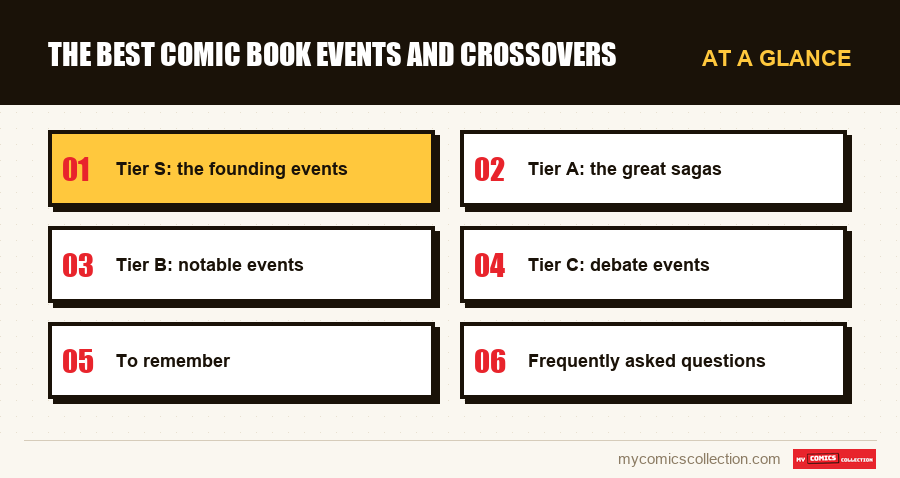
Start my trial →Tier S: the founding events
Crisis on Infinite Earths (1985) overhauled the entire DC multiverse: the most influential event in history. The Infinity Gauntlet (1991) is the cosmic blockbuster that inspired the Avengers films. Secret Wars (1984) invented the modern concept of the crossover event (and introduced Spider-Man's black suit). And Civil War (2006) divided Marvel heroes on a political issue that has remained cult.
Tier A: the great sagas
Blackest Night transformed the Green Lantern universe into an undead epic. The Dark Phoenix Saga (1980) remains the dramatic peak of the X-Men. House of X / Powers of X (2019) redefined mutants for a decade, and Annihilation relaunched the cosmic Marvel.
Tier B: notable events
Sinestro Corps War prepared Blackest Night. Secret Wars Hickman version (2015) merged all the Marvel universes. Age of Apocalypse dared a total alternate reality for the X-Men, and Flashpoint served as a pivot to the New 52.
Tier C: debate events
Infinite Crisis , Avengers vs. X-Men and Final Crisis divide readers: ambitious but sometimes confused. They remain important milestones, a step below the consensus events.
To remember
- Geoff Johns and Jonathan Hickman are the great architects of modern events.
- A founding event redefines its universe (Crisis, Secret Wars) rather than extending it.
- The #1 event numbers are often sought after collection keys.
- Each event refers to a key number of the site when it exists.
Frequently asked questions
Crisis on Infinite Earths (DC, 1985) is the most influential, The Infinity Gauntlet (Marvel, 1991) the most emblematic cosmic side. The choice depends on the preferred universe.
Not for the best: Infinity Gauntlet, Civil War or Dark Phoenix Saga can be read as the main series, without the countless tie-ins. The collections bring together the essentials.
Major event #1s and important first-appearance numbers can be. But many recent events are drawn in large quantities: rarity is not guaranteed.
Do you have a key event number (Secret Wars #8, Infinity Gauntlet #1, etc.)? Estimate its value for free with our tool based on current eBay listings.
In what order should you read the big events?
An event reads better with some context, because many are linked to each other. On the DC side, Crisis on Infinite Earths (1985) is the starting point for the whole logic of the big "Crisis" events: Infinite Crisis (2005) and Final Crisis (2008) belong to that legacy, even though all three can be read separately. Sinestro Corps War (2007) directly sets up Blackest Night (2009), and Flashpoint (2011) serves as the pivot toward the New 52.
On the Marvel side, the landmark is different: the Marvel universe has had two events with the same name. Secret Wars (1984, Jim Shooter) invented the modern event crossover, while Secret Wars (2015, Jonathan Hickman) merged all the Marvel universes. They are two separate series, with different authors and stakes: always check the date and the writer when you buy or catalog either one.
To get started without getting lost, a simple order works well. Begin with a self-contained, ambitious event such as The Infinity Gauntlet (Jim Starlin, 1991), the cosmic blockbuster that inspired the Avengers films. Continue with Civil War (Mark Millar and Steve McNiven, 2006) for an event built around a conflict between heroes, then with House of X / Powers of X (Hickman, 2019) to see how an event can redefine a franchise for a decade.
On the collecting side, three points of caution. First, event #1 issues are often sought-after keys: if you only want one per event, that is generally the best pick. Next, decide from the start whether you collect only the central miniseries or also the tie-ins, those satellite titles that multiply the issues to acquire. Finally, clearly distinguish first printings from collected reprints, which do not carry the same collecting value.
An event is also judged by its legacy: the best ones redefine their universe rather than extend it. When you hesitate between two sagas, choose the one that lastingly changed the characters, such as The Dark Phoenix Saga (1980, Claremont and Byrne) for the X-Men or Annihilation for Marvel's cosmic side.