
The best cosmic comics, those that play out on the scale of galaxies and gods, are at the top The Infinity Gauntlet (1991), Annihilation (2006), Green Lantern: Rebirth (2004) and the New Gods by Jack Kirby (1971). This tier list classifies the great cosmic stories according to their scale and success. Facts (authors, dates) verified, no invented odds.
Superheroic space opera is a genre all its own: cosmic entities, all-powerful artifacts, galactic wars. This tier list brings together the stories that carry this excess with the most mastery: those that make you dizzy without losing the emotion. Criterion: cosmic scale combined with the quality of the story.
Editorial Ranks, Facts verified. It is a reading guide.
Collecting this series?
Track what you own, what you are missing and what your collection is worth. 7 day trial.
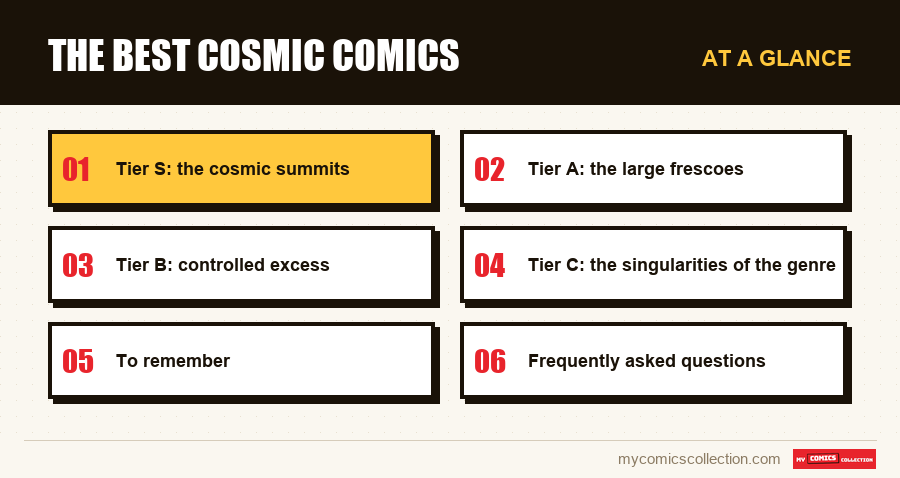
Start my trial →Tier S: the cosmic summits
The Infinity Gauntlet (1991) is the cosmic blockbuster par excellence: Thanos erases half of the universe, the acknowledged matrix of the Avengers films. Annihilation (2006) relaunched the entire space side of Marvel with a galactic war. Green Lantern: Rebirth gave DC its cosmic backbone again. And the New Gods by Jack Kirby (1971) laid the mythological foundations of the genre with Darkseid and Apokolips.
Tier A: the large frescoes
Le Silver Surfer by Lee and Buscema is the most poetic cosmic tale of Marvel origins. THE Guardians of the Galaxy by Abnett and Lanning (2008) modernized space opera. THE Thor of Jason Aaron unfolds a divine ladder, and The Eternals (1976) continues the Kirby mythology.
Tier B: controlled excess
The Thanos Quest (1990) tells the story of Thanos gathering the Infinity Gems. Sinestro Corps War is the big modern Green Lantern event. Infinity War continues the Starlin saga, and Nova (DnA) offers an endearing cosmic hero.
Tier C: the singularities of the genre
Adam Warlock (Starlin, 1975) is the psychedelic matrix of the entire Marvel cosmology. Prophet (Brandon Graham) and Ody-C (Matt Fraction) reinvent space opera with rare formal audacity: a notch more demanding, but fascinating.
To remember
- Jim Starlin is the master of the genre: Thanos, Warlock, Infinity Gauntlet, it's him.
- The cosmic overflows Marvel: DC (New Gods, Green Lantern) and indie (Prophet) also shine.
- This is the genre that inspired recent cinema (the Avengers films).
- Each entry refers to a key file or number on the site.
Frequently asked questions
The Infinity Gauntlet (Starlin, 1991) is the reference: it is the story that defined the cosmic blockbuster and inspired the Avengers films.
By The Infinity Gauntlet, autonomous and spectacular, then Annihilation for the modern space aspect. Lee and Buscema's Silver Surfer is ideal for origins.
Jim Starlin at Marvel (Thanos, Adam Warlock) and Geoff Johns at DC (Green Lantern) are the two major references of the genre.
Three threads to find your way in the cosmic genre
Superhero space opera can look like a maze: entities, gems, empires and wars that echo from one series to the next. In practice, three guiding threads are enough to find your bearings, and each has its own entry issues.
The Starlin thread at Marvel
Jim Starlin gave Thanos his cosmic dimension. The character makes his first appearance in Iron Man #55 (February 1973), long before the big events. He then returns in the 1990s in a trilogy read in publication order: The Thanos Quest (1990), The Infinity Gauntlet (1991, six issues) and Infinity War (1992). Adam Warlock, a psychedelic creature from the same pen (1975), serves as the philosophical thread of this cosmology.
The Kirby and Lee thread
The foundations of Marvel's cosmic side were laid in Fantastic Four #48-50 (1966), the Galactus Trilogy, in which Galactus and the Silver Surfer appear. The Surfer then gets his own series (Lee and Buscema, 1968), while Kirby continues his mythology at Marvel with The Eternals (1976) and at DC with the New Gods (1971), which introduce Darkseid and Apokolips. Reading these origins sheds light on everything that follows.
The modern thread
At Marvel, Annihilation (2006) relaunched the space side, and then Abnett and Lanning's Guardians of the Galaxy (2008) and Nova (2007) extended its universe. At DC, Geoff Johns's Green Lantern: Rebirth (2004) sets up the Sinestro Corps War (2007), a major event best read in that order.
Tips for the collector
- Start with a standalone story like The Infinity Gauntlet before going back to the origins: reading is smoother and you will know which issue deserves a place in your collection.
- Spot the true first appearances, such as Fantastic Four #48 for Galactus or Iron Man #55 for Thanos: they are more meaningful entry issues than a mere saga chapter.
- Tell apart the popular events of the moment from those with lasting impact: the cosmic genre is carried by the movies, but the market does not reward every issue the same way.
- Favor collected editions for reading the big sagas, and keep your original-issue purchases for the keys you really want to own.
One last tip: cosmic stories answer one another. Once you have read a full thread, go back to the first issues: you will spot clues you did not notice the first time.
Do you have a cosmic key number (Infinity Gauntlet #1, Silver Surfer, etc.)? Estimate its value for free with our tool based on current eBay listings.