To discover the DC universe, the best entry points are Batman: Year One by Frank Miller (1987), All-Star Superman by Grant Morrison and Frank Quitely (2005), Batman: The Long Halloween (1996) and DC: The New Frontier by Darwyn Cooke (2004). This tier list classifies comics according to their accessibility for a new reader: read without prerequisites, understand the DC spirit, make you want to continue, and not according to their rating.
DC has more than eighty years of publications, multiverses and regular reboots (Crisis, New 52, Rebirth). Wanting to “take it all back” is the best way to give up. The right method: start from a story autonomous that captures the essence of a character. That's the only criterion here: not historical importance, but ease of entry for someone discovering.
The ranks are editorial; the facts (authors, dates, nature of the series) are verified. It is a reading guide, without any invented ratings.
Collecting this series?
Track what you own, what you are missing and what your collection is worth. 7 day trial.
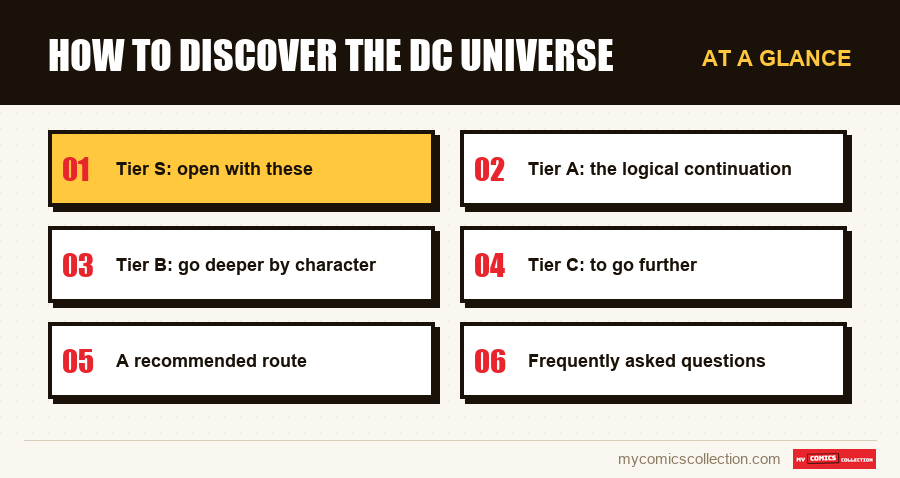
Start my trial →Tier S: open with these
Batman: Year One (1987) is the ideal entry: a sober and realistic origin story, complete in four issues, accessible via key issue Batman #404. In front, All-Star Superman distills into twelve chapters everything that Superman embodies Luminous: the best possible introduction to the character. The Long Halloween is a thriller Batman against a backdrop of gang war, the acknowledged matrix of Nolan's trilogy. The New Frontier by Darwyn Cooke resurrects the DC Silver Age in a retro-optimistic fresco: a gateway to the entire universe.
Tier A: the logical continuation
Watchmen (1986), technically DC, is completely self-contained and remains a pinnacle of the medium, readable via his first number. Kingdom Come (1996) imagines the twilight of DC heroes in painting by Alex Ross. Superman: Red Son reinvents Superman in the USSR. And Green Lantern: Rebirth by Geoff Johns clearly raises Green Lantern: perfect for this cosmic corner of DC.
Tier B: go deeper by character
Le Batman by Scott Snyder (2011) is the character's great modern run. The Sandman by Neil Gaiman opens the door to “mature” DC (Vertigo label), via Sandman #1. Flashpoint disrupts the timeline around Flash, and the JLA by Grant Morrison (1997) shows the League at its epic peak.
Tier C: to go further
Crisis on Infinite Earths (1985) is foundational but dense: it is better to approach it once you are familiar with the multiverse, via the key number. Green Arrow: Year One offers a nervous origin of Green Arrow, and the Wonder Woman by Greg Rucka (2016) resets the counters for the Amazon. Excellent titles, just a notch less “first contact” than the thirds above.
A recommended route
- Never read comics? Batman: Year One, then The Long Halloween.
- Want to understand Superman? All-Star Superman.
- Do you like SF/chronology? Red Son or The New Frontier.
- Fan of adult fantasy? Sandman.
- Most are available in bound collections, an ideal format for getting started.
Frequently asked questions
Batman: Year One (Miller & Mazzucchelli, 1987) is the most recommended entry point: short, self-contained and realistic. All-Star Superman is the Superman side equivalent.
No. Crisis is historically important but dense for a beginner. Better to start with a standalone story and come to it later, once the DC multiverse is familiar.
Watchmen is published by DC but takes place in an independent, completely self-contained world. This is precisely what makes it an excellent entry level reading, without any prerequisites.
The landmarks to know before diving into DC continuity
DC regularly resets its universes, which explains why the same hero has several versions and why newcomers quickly feel lost. Four dates are enough to find your bearings, and they will also tell you which era an issue you come across at a convention belongs to.
Four turning-point dates
- 1985-1986, Crisis on Infinite Earths (Wolfman and Pérez): the merger of the multiverse, the starting point of a refreshed continuity.
- 2005, Infinite Crisis: the return of the multiverse, with Geoff Johns writing.
- 2011, Flashpoint (Johns and Kubert): the event that leads to the New 52 relaunch, whose flagship is Snyder and Capullo's Batman.
- 2016, DC Universe Rebirth #1: a new relaunch that repositions Superman as a pillar of continuity.
You do not need to have read these events to get started. They mainly serve as landmarks when you trace a character's timeline backward.
The labels that spare you prerequisites
Some stories are deliberately detached from continuity. Kingdom Come, for example, is an Elseworlds tale: a standalone story that imagines a future without committing the rest of the universe. The Sandman belongs to the adult side of the Vertigo label, and Watchmen takes place in an independent world. These stories are ideal entry points precisely because they ask nothing more than to be read.
A three-stage reading plan
- Stage one, standalone stories: Batman: Year One (four issues) then All-Star Superman (twelve chapters). They give the essence of two characters with no prerequisites.
- Stage two, a grand saga: The New Frontier, Kingdom Come or Watchmen, depending on whether you prefer Silver Age nostalgia, Alex Ross's painting or the deconstruction of the superhero.
- Stage three, a modern run by character: Snyder's Batman, Green Lantern: Rebirth or Morrison's JLA. Keep Crisis on Infinite Earths for last, once the multiverse feels familiar.
On the collecting side
Most of these titles exist in bound collections: it is the best way to read without breaking the bank. If the urge to collect comes afterward, track down each story's entry issue, for example Batman #404 for Year One or The Sandman #1, rather than chasing everything that carries the DC logo.
A simple rule to avoid impulse buys: read first, collect later. A story you truly loved deserves its place, neatly stored and cataloged, in your library.
Do you have old DC issues and want to know their rating? Estimate them for free with our tool based on current eBay listings.