Annihilation is read in a specific order, and that order is not the order of the issue numbers. The event opens with a single 48-page issue, Annihilation: Prologue (March 15, 2006, written by Keith Giffen, drawn by Scott Kolins). Next come four four-issue miniseries published in parallel from April to July 2006: Silver Surfer, Super-Skrull, Nova and Ronan. Then the main series, Annihilation #1 to #6 (August to December 2006, Giffen on script, Andrea Di Vito on art), and a two-issue epilogue, Heralds of Galactus (January and February 2007). That makes 25 issues for the event alone. Everything reads without knowing anything that came before, and the direct sequel, Annihilation: Conquest, leads to the Nova (2007) and Guardians of the Galaxy (2008) series by Dan Abnett and Andy Lanning.
An event spread over several simultaneous miniseries poses a problem for the reader that reading a classic series never does: there is no obvious order. The four Annihilation miniseries each carry an issue #1, take place at the same moment in the story, and tell four fragments of the same war seen through four characters. Reading them badly, that is, in release-date order week by week, gives an impression of mush. Reading them well takes exactly the same time and gives one of the best science fiction stories the publisher has put out.
This article is a user's manual. It says what to read, in what order, what is essential and what is supplementary, and it settles the question that costs the most in the end: should you gather fifty separate issues or buy three collections. Both answers are defensible, but not for the same reasons and not for the same collector.
Two parts of the subject are deliberately left aside here, because they deserve their own treatment: Richard Rider's journey and Annihilus's trajectory. This guide sticks to the architecture of the whole and how to approach it.
The exact architecture of the event
Before any reading order, you need the map. Annihilation is not a six-issue series with side issues: it is a three-tier structure, owned as such by the publisher at the time of publication.
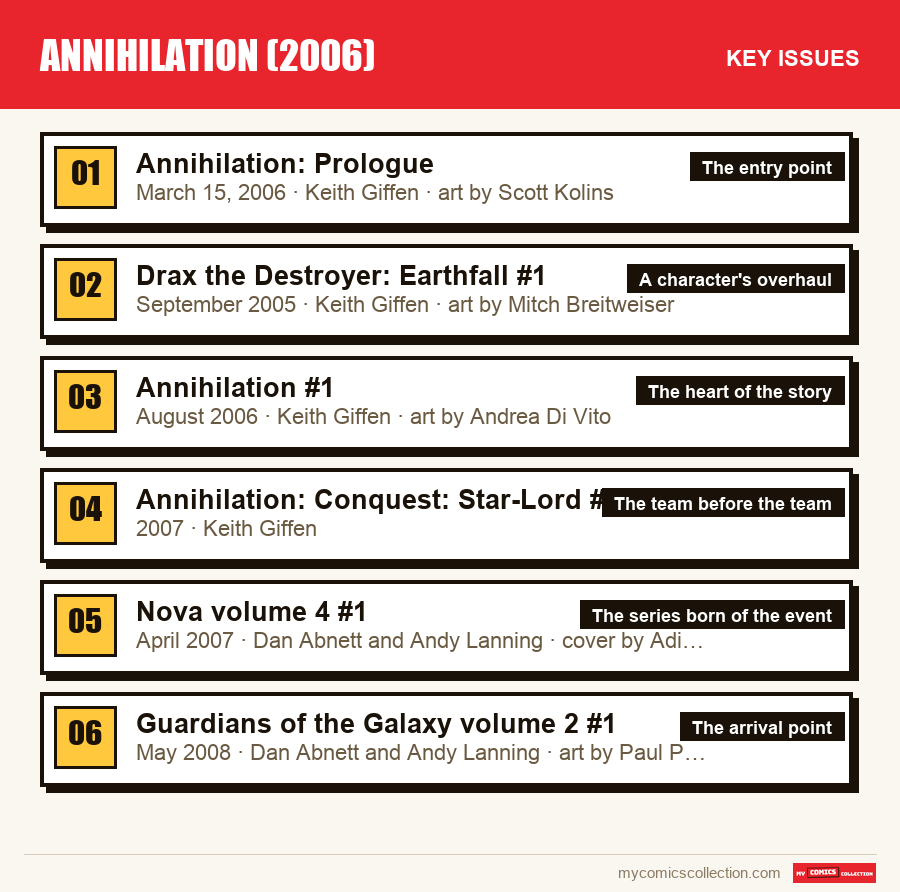
First tier, the trigger. Annihilation: Prologue, a single 48-page issue released on March 15, 2006. Keith Giffen writes, Scott Kolins draws. This issue is not an optional introduction: it is where the Annihilation Wave bursts out of the Negative Zone, Xandar falls and the Nova Corps is wiped out. Whoever skips it does not understand why the four miniseries all start in an already ruined world.
Second tier, the four miniseries. Four issues each, launched one week apart between April 1st and 26, 2006, finished in July. Each follows one character while the war advances:
- Annihilation: Silver Surfer #1 to #4, by Keith Giffen, art by Renato Arlem.
- Annihilation: Super-Skrull #1 to #4, by Javier Grillo-Marxuach, art by Gregory Titus.
- Annihilation: Nova #1 to #4, by Dan Abnett and Andy Lanning, art by Kev Walker.
- Annihilation: Ronan #1 to #4, by Simon Furman, art by Jorge Lucas.
Third tier, the convergence. Annihilation #1 to #6, from August to December 2006, script by Keith Giffen, art by Andrea Di Vito. The four trajectories meet there in a single conflict. Then Annihilation: Heralds of Galactus #1 and #2 (January and February 2007), which closes the heralds file.
Total: one issue, sixteen issues, six issues, two issues. Twenty-five. That is far fewer than the event's reputation suggests, and it is one of its reading arguments: it is finished, bounded, and requires no outside purchase to be understood.
The reading order, step by step
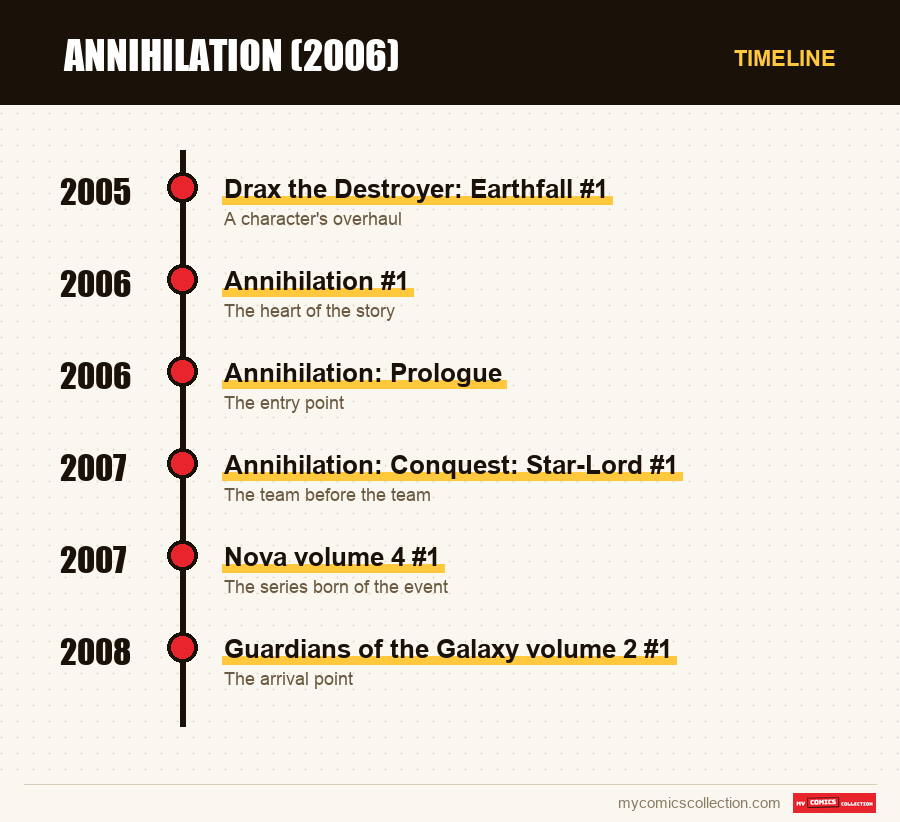
Here is the path to follow. It is built for the clarity of the story, not for release dates.
The two preludes, useful but not required
Two earlier sets prepare the ground without carrying the event's logo. Drax the Destroyer: Earthfall #1 to #4 (September to December 2005), by Keith Giffen and Mitch Breitweiser, where the old, massive Drax literally dies to let a slimmer and smarter version emerge: it is that character, not the old one, who goes through Annihilation. And Thanos #7 to #12 (2004), also by Giffen, which sets the cosmic tone the event will pick up. Reading them first enriches the whole. Not reading them prevents nothing from being understood.
Annihilation: Prologue, first and without exception
The only issue whose position is non-negotiable. Forty-eight pages that set up the invasion, the fall of Xandar and the state of the sector after the shock. Everything else starts from there.
The four miniseries in parallel, in waves of issues
The method that works: read the four issues #1, then the four issues #2, then the four issues #3, then the four issues #4. Not one whole miniseries after another. The four stories are contemporary: reading them in waves respects the intended simultaneity and avoids seeing the same weeks of war four times from a different angle.
If you read only one miniseries, take Nova
For a reader in a hurry, it is the only one of the four that is structurally indispensable, because its character becomes the pivot of the conflict and the commander of the United Front in the main series. The other three are magnificent and dispensable for strict comprehension.
Annihilation #1 to #6, in one go
The main series is written as a continuous story, not as six episodes. This is where everything is decided: the United Front, the opportunistic alliance struck with the enemy, the betrayal that follows, the release of Galactus as a last-resort weapon. Read it in one or two sittings.
Heralds of Galactus, as an epilogue
Two issues, January and February 2007. It files away what the main series left open on the heralds' side. To be read afterward, never before: the story assumes the outcome is known.
Annihilation: Conquest, the real sequel
Same format, a year later: a Conquest Prologue (2007, by Abnett and Lanning), three four-issue miniseries, then Annihilation: Conquest #1 to #6, from August 2007 to June 2008. The enemy changes completely in nature: in place of a biological army from elsewhere, a techno-organic intelligence, the Phalanx, led by Ultron, which takes the Kree empire and its planet Hala in a few weeks.
And only then, the regular series
Nova (volume 4, April 2007 to April 2010, 36 issues, by Abnett and Lanning) starts during Conquest and crosses with it. Guardians of the Galaxy (volume 2, launched in May 2008, 25 issues, Abnett and Lanning on script, Paul Pelletier on art for the first seven) is born directly from the end of Conquest. This is the tier where you stop reading an event and settle into a lasting line.
The three Conquest miniseries, for the record
They follow the same wave logic as the 2006 ones, and each sets up a character the sequel reuses:
- Annihilation: Conquest: Quasar #1 to #4, by Christos Gage, where Phyla-Vell seeks the savior announced by the Supreme Intelligence and ends up exhuming Adam Warlock from his cocoon.
- Annihilation: Conquest: Star-Lord #1 to #4, by Keith Giffen, where Peter Quill takes up his Star-Lord identity again to lead a commando of improbable resisters on Hala.
- Annihilation: Conquest: Wraith #1 to #4, by Javier Grillo-Marxuach, which introduces the character whose intervention traps Ultron in the denouement.
In Conquest's main series, it is Phyla-Vell who delivers the fatal blow to Ultron with the Quantum Bands, while Richard Rider brings back Technarchs to infect him. This detail matters for the reading: the end of Conquest redistributes the roles of the whole team, which, three months later, becomes the 2008 version of the Guardians of the Galaxy. If the subject interests you for its own sake, the Guardians of the Galaxy reading guide and the history of the team in comics take over from that exact point.
Essential, useful, optional: the hierarchy
Everything above is not of equal worth. Here is the hierarchy I would defend in front of someone with a limited budget and limited time.
Essential, 11 issues. Annihilation: Prologue, Annihilation: Nova #1 to #4, Annihilation #1 to #6. It is a complete, coherent story, readable from end to end, that leaves no gap in understanding. Anyone who wants to know what is meant when people talk about Annihilation can stop there without missing anything essential.
Strongly recommended, 8 more issues. The Silver Surfer and Ronan miniseries. The first because Giffen writes one of his best texts on the character there, in a register of cold tragedy that contrasts with the rest. The second because it turns a background antagonist into a defensible character, which is rare and well executed. The Silver Surfer reading guide places this miniseries in a broader path, and the Silver Surfer hub gathers the rest.
Supplementary, 6 issues. Super-Skrull and Heralds of Galactus. The first is a good autonomous mercenary story, the second an epilogue that mostly interests those who like Galactus mythology. You can come to them months later, in any order, with no consequence.
A separate tier, 19 issues. The whole of Conquest. It is not supplementary: it is a second reading, of the same scale and the same quality, that is better started after digesting the first. The classic mistake is to buy both events at once and read neither seriously.
Finally, the logical follow-up goes beyond this guide's scope: the two regular series that come out of it, then War of Kings (March to August 2009, still Abnett, Lanning and Pelletier), Realm of Kings and The Thanos Imperative in 2010 and 2011, which concludes the threads left by the cancellation of Nova and the Guardians. For this block's place in the whole cosmic branch, the tier list of the best cosmic comics gives an overview, and the Thanos reading guide covers the side that is its own.
The issues that really matter
A clarification before the sheets: no issue in this set is rare the way a 1960s issue is. These are 2006 to 2008 comics, printed on an industrial scale, and the print runs were nothing confidential. What creates demand here is not scarcity: it is the film adaptation of part of this cast starting in 2014, which sent readers looking for the publishing origin of these versions of the characters. The trend observed since is therefore demand concentrated on very few issues, and high-grade copies that are much harder to find than the print run would suggest, because nobody was setting aside a mid-catalog cosmic issue in 2006.
Annihilation: Prologue
The issue everyone needs and few people bought at the time. A single issue, 48 pages, with no series numbering, which plays two bad tricks on it: it files poorly in the bins and it gets forgotten in want lists. It is nonetheless the required entry point of the whole.
Drax the Destroyer: Earthfall #1
Technically outside the event, editorially at its root. It is the miniseries where the old Drax, massive and mute, is replaced by the smaller, sharper and more talkative version who will cross the whole cosmic branch that follows. Character overhauls that last twenty years are rare, and this one has lasted.
Annihilation #1
The first issue of the main series, the one where the four miniseries converge. It is also the easiest issue to find in the whole set, for a mechanical reason: it is the only one that carries both the event's bare title and the number 1, so the one casual buyers in 2006 picked up.
Annihilation: Conquest: Star-Lord #1
The most in-demand issue of the two events combined, and that is logical: it is where Peter Quill takes up his Star-Lord identity and leads a mismatched commando against the Phalanx. The group dynamic this miniseries sets up is the one the Guardians of the Galaxy will pick up from 2008, and that the movies will popularize six years later.
Nova volume 4 #1
The first issue of the regular series launched in the direct wake of Annihilation, which lasted 36 issues until April 2010 and crossed with Conquest, Secret Invasion and War of Kings. It is proof the event had worked: a publisher does not order three years of a monthly series on a critical success alone.
Guardians of the Galaxy volume 2 #1
First lineup of the team as the general public will know it: Star-Lord, Rocket Raccoon, Groot, Gamora, Drax, Adam Warlock and Phyla-Vell. Twenty-five issues until 2010. It is the direct culmination of Conquest and, of this whole set, the issue whose demand is most clearly indexed to the movies.
To place these issues in a broader landscape of cosmic first appearances, the article on cosmic first appearances deals specifically with that question.
Single issues or collections: settling it for good
This is the real question of a branching event, and it is badly framed until you put the numbers down. On the single-issue side: 25 for Annihilation, 19 for Conquest, 44 in total, spread over eight different titles, seven of which run only two to six issues. On the collection side: the publisher put out Annihilation in three volumes in 2007, then a two-volume reissue in 2018, then an omnibus in 2022.
This double existence changes everything, because it means neither option is a bet on availability. The text is permanently accessible in one form or another. The tradeoff therefore concerns what you want to own, not what you want to read.
Collections win on four points. The first is order: the collected editions already integrate the reading order, which removes the work this article does. The second is cost per page, systematically better once you are talking about forty issues. The third is storage: three volumes against twenty-five bagged issues, the difference in space and handling is considerable. The fourth is rereading, because an event this dense gets reread, and a collection is reread without opening twenty-five bags.
Single issues win on three points. The first is the object: the original covers, the ads, the release rhythm, what the collection partly erases. The second is gradualness, and it is the most concrete argument: you can buy the eleven essential issues, read them, and decide afterward whether to continue. A collection imposes its scope all at once. The third is residual value, because it is single issues, not collections, that resell and can be graded.
From this comparison comes a recommendation I hold to be solid in most cases: read in collections, collect in single issues, and buy in single issues only what you have already read. Put differently, the collection answers the question "do I like it," and the single issue answers the question "do I want to keep it." Reversing the order, that is, buying forty-four single issues before having read one, is the most effective way to build an incomplete collection of a story you did not like that much.
One particular case deserves a mention: if only one issue of the set interests you as a piece, take it in single-issue form regardless of everything else, and read the whole in collection. An issue bought for what it represents does not need its neighbors.
Tracking a set with no continuous numbering
The practical trap of this event is neither its price nor its availability: it is its structure. Eight titles, an issue with no number, miniseries that all carry the same prefix, and two events similar enough that you confuse Annihilation: Nova #3 and Annihilation: Conquest: Quasar #3 when checking what is missing.
Three reflexes avoid most mistakes. The first is to enter each title as a distinct series, with its full prefix, and not as Annihilation issues: confusion begins the moment you write "Annihilation #2" to refer to a miniseries. The second is to mark the prologue separately, since it has no number and no tracking will spontaneously ask for it. The third is to note, for each title, the expected number of issues, four for the seven miniseries and six for the two main series, so a gap is immediately visible.
This is exactly the kind of situation for which issue-by-issue tracking beats a hand-written list, and for which automatic detection of missing issues saves the most time: on a hundred-issue series, a gap is spotted by eye, on eight series of four to six issues, it is not. If you are also considering grading one of the issues on the list, the basics of grading deserve a prior read, because a 2006 comic in high grade and the same one in middling grade do not follow the same buying logic at all.
Why this set mattered
One last remark, because it sheds light on the reading order proposed above. What distinguishes Annihilation from the events of its time is not its scale: it is that it was built on the margins. The publisher's cosmic branch was then a secondary terrain, far from the franchises that carried sales, and that marginality left the writers an unusual freedom of tone. Characters die, a herald of Galactus becomes a weapon of war, an antagonist betrays his ally and pays for it, and none of it is undone within six months.
The editorial consequence is documented: the publisher followed with a regular Nova series, a second event of the same format, then the 2008 Guardians of the Galaxy, and this block produced in three years the cosmic cast the movies went looking for. That is why the reading order matters so much here: it is not a closed story you read out of curiosity, it is the first tier of a five-year construction in which each level assumes the previous one.