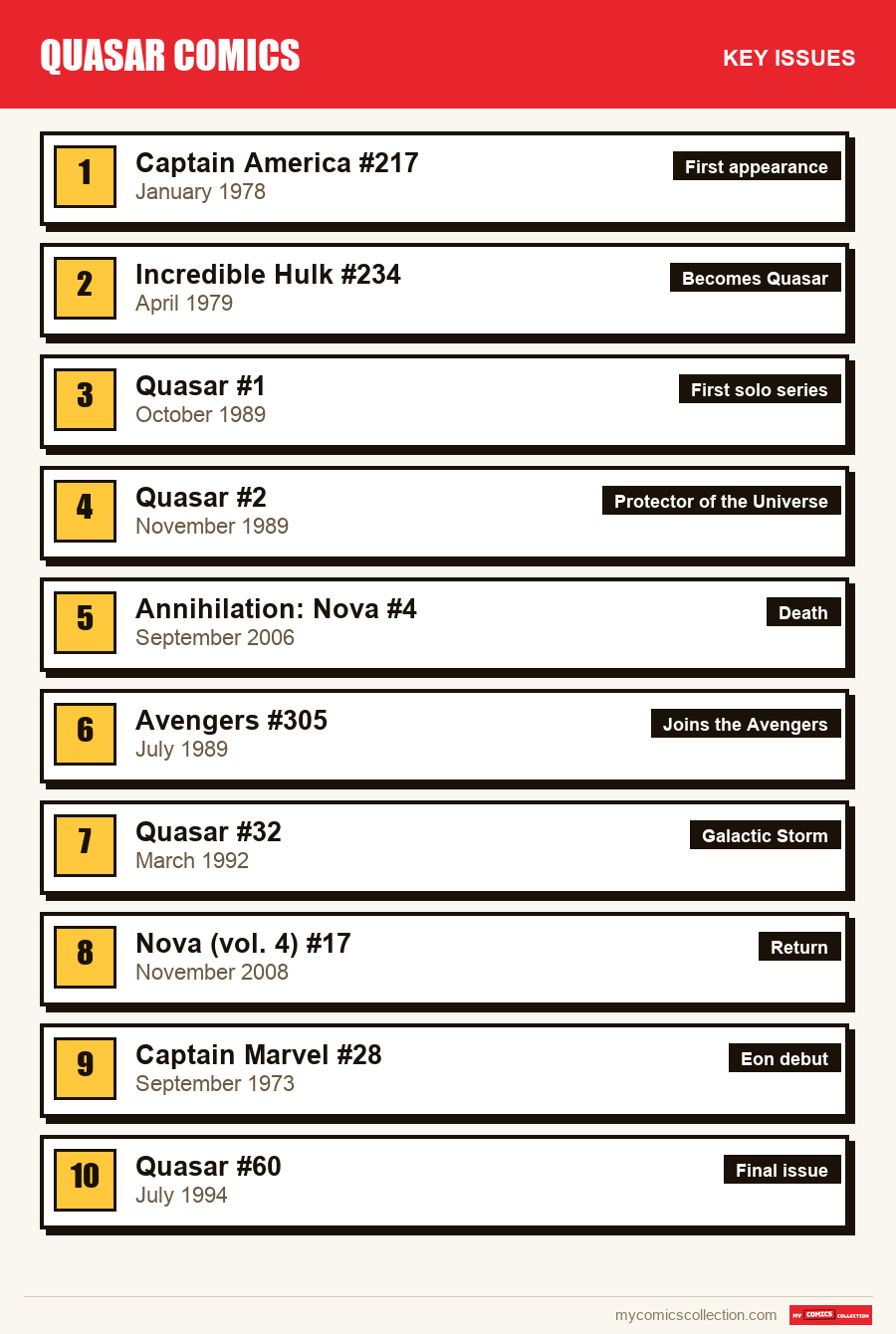
Wendell Vaughn, alias Quasar, debuts in Captain America #217 (January 1978) by Roy Thomas, Don Glut and John Buscema as Marvel Boy / Marvel Man, before becoming Quasar in Incredible Hulk #234 (April 1979) when he dons the Quantum Bands. His solo series Quasar #1 (October 1989) by Mark Gruenwald runs 60 issues through 1994. Annihilation: Nova #4 (September 2006) marks his iconic death at the hands of Annihilus, before a later return. As of 2026 he remains broadly undervalued within the Marvel cosmic segment.
Quasar is one of the most unjustly overlooked Marvel cosmic heroes in the mainstream collector market. While Silver Surfer, Adam Warlock, Captain Marvel, Nova and Beta Ray Bill soak up the speculative attention tied to MCU announcements and the Hickman / Cates runs, Wendell Vaughn and his Quantum Bands float at 2026 values that are surprisingly modest given his narrative importance within Marvel continuity. The first Protector of the Universe of the modern era, a pivot of Operation Galactic Storm, the sacrificial victim of Annihilation, Quasar nonetheless checks every box of the sleeper issue: a long benchmark run by Mark Gruenwald, an iconic death reframed within a major crossover, and rich source material for a possible cosmic Avengers project post-Doomsday / Secret Wars.
This guide traces the character's complete editorial history starting from Captain America #217 (January 1978) by Roy Thomas, Don Glut and John Buscema, breaks down the five key issues that structure the modern Quasar collection, and offers an honest 2026 market read: what's worth chasing now, what can wait, and where the auction and eBay sold-listing ranges sit for CGC 9.6 and 9.8 grades. The logic remains that of a patient buy thesis, calibrated on CGC scarcity and on the probability (low but not zero) of an MCU or Marvel Studios signal within 24 to 48 months.
Wendell Vaughn: created in Captain America #217 (January 1978) by Thomas, Glut and Buscema
Wendell Vaughn officially debuts in Captain America #217 (January 1978), written by Roy Thomas and Don Glut, pencilled by John Buscema and inked by Pablo Marcos, with the cover also signed by Buscema. The issue, published under editor Roy Thomas, falls within a transitional period for the Captain America series between the Steve Englehart run and the long Mark Gruenwald era that kicks off a few years later. Wendell appears as a young S.H.I.E.L.D. agent recruited for "Project Marvel Man," an experimental program aimed at equipping a human with cosmic bracelets recovered from a Kree: the famed Quantum Bands previously worn by the original Crusader.
The origin story laid out in Captain America #217 and continued immediately in Captain America #218 (February 1978) rests on one essential narrative point: the Quantum Bands are psychoreactive weapons that require exceptional mental stability so as not to destroy their wearer. Where other candidates in the S.H.I.E.L.D. program failed (psychotic episodes, neurological trauma), Wendell Vaughn manages to master the bracelets through his ability to focus not on power but on control. This psychological trait remains the pillar of the character's writing across the next four decades: Quasar isn't the most powerful of the cosmic heroes but the most measured, which paradoxically makes him the most reliable across long arcs.
For the 2026 collector, Captain America #217 (January 1978) is the absolute number-one key issue of the Quasar chronology. Late-1970s Captain America print runs were relatively large (estimated 200,000 to 250,000 copies, Diamond / Sparkle City), which makes raw NM copies relatively accessible but CGC 9.6 and 9.8 grades much rarer because of the production flaws typical of the era (centering, newsprint yellowing, staple stress). The ranges observed at auction and on eBay sold listings in 2025-2026 sit between €120 and €280 for CGC 9.4, €280 to €480 for CGC 9.6 and €580 to €950 for CGC 9.8, with more pronounced volatility from grade 9.8 upward owing to the modest transaction volume per quarter.
Note two important nuances for hunting the issue. First, Captain America #217 also contains the first appearance of Project Bluebird, a S.H.I.E.L.D. narrative device reused in later arcs, which adds a secondary key issue layer. Second, the issue has been reprinted regularly and included in trade paperbacks (notably Quasar Classic Vol. 1 and the Marvel Boy Omnibus collection), but these reprints do not hold CGC-recognized first-appearance status and do not appreciate. For the long-term collection, target the original January 1978 edition, standard Marvel Comics Group barcode, in CGC 9.6 minimum if the budget allows.
Quantum Bands and the Marvel Boy / Marvel Man / Quasar origin: the transformation
Between 1978 and 1979, Wendell Vaughn carries the Marvel Boy, then Marvel Man identities in succession before adopting the Quasar name for good. This evolution plays out across several appearances scattered through Marvel continuity and forms a mini-cluster of secondary key issues that advanced collectors fold into their complete Quasar run. Incredible Hulk #234 (April 1979) by Roger Stern and Sal Buscema marks the first appearance of Wendell Vaughn under the Quasar identity and the first public use of the Quasar name in Marvel continuity. This issue is the second priority key issue after Captain America #217 and remains curiously undervalued for the first appearance of a mainstream heroic identity.
The 2025-2026 ranges observed on Incredible Hulk #234: CGC 9.4 between €80 and €160, CGC 9.6 between €180 and €320, CGC 9.8 between €380 and €680. Raw NM copies (raw meaning ungraded) trade between €30 and €60 on eBay sold listings, which makes it a reasonable entry point for the collector who wants to cover the origin arc without investing in CGC. The CGC 9.8 scarcity on this issue is explained by the massive Incredible Hulk print run of the era (the series topped 300,000 Diamond copies) combined with a newsprint production quality that makes grades above 9.6 genuinely demanding.
The Quantum Bands themselves deserve a narrative digression. The bracelets were created by the Kree and originally worn by Eon, a cosmic entity who serves as mentor to Wendell Vaughn in the Quasar mythology. Eon's first appearance comes in Captain Marvel #28 (September 1973) by Jim Starlin and Mike Friedrich, a Silver / Bronze Age key issue that takes on retrospective importance within the framework of Marvel cosmic cosmology. This issue remains at reasonable ranges (CGC 9.4 between €60 and €140, CGC 9.6 between €180 and €320) and makes a fitting thematic complement for advanced Quasar collectors.
The founding appearance of the Protector of the Universe concept also comes within Starlin's Captain Marvel cycle, with Captain Marvel #29 (November 1973) establishing the transferable cosmic title. When Mar-Vell dies in Marvel Graphic Novel #1 (April 1982), an iconic key issue logged by CGC as the first Marvel graphic novel and the death of Captain Marvel, the title becomes vacant. This vacancy in Marvel continuity opens the door to the narrative transition that will culminate with the Protector of the Universe title being granted to Quasar in his solo series issue. The collector who wants to understand the long-term cosmic arc benefits from a chronological read combining these issues, even though only Captain America #217 and Incredible Hulk #234 carry the CGC-recognized key issue label for Quasar himself.
Solo series Quasar #1 (October 1989) by Gruenwald: 60 benchmark issues
Quasar #1 (October 1989), written by Mark Gruenwald, pencilled by Paul Ryan and inked by Bob Layton, launches the solo series that would structure the character's mythology for the next three decades. The cover, signed by Paul Ryan, shows Quasar in a dynamic cosmic pose characteristic of the late-1980s / early-1990s turn. The issue opens a run of 60 issues stretching from October 1989 to July 1994, written in full by Mark Gruenwald, which makes it one of the most coherent and longest solo runs in Marvel's editorial output of the era: comparable to the Hama run on G.I. Joe or the Claremont run on Uncanny X-Men in terms of creative continuity.
Mark Gruenwald uses the Quasar series as a laboratory to develop an entire Marvel cosmic cosmology that reaches well beyond the central character. Eon, Kosmos, the Watcher Uatu, the Infinites, the Protector of the Universe concept, the role of an Operation Galactic Storm operative, the crossovers with the Avengers and with the Captain Marvel arcs: all of it finds articulation across the 60 issues. For the 2026 reader, this run is a less consensus but perhaps more complete entry point than Starlin's Infinity Gauntlet / War / Crusade for understanding the pre-Annihilation Marvel cosmic architecture. Several cosmic collectors even regard Quasar (1989-1994) as the editorial cornerstone that makes the mid-2000s cosmic renaissance possible.
For the 2026 collector, the Quasar #1 (October 1989) ranges remain surprisingly modest. CGC 9.4 between €30 and €60, CGC 9.6 between €60 and €120, CGC 9.8 between €120 and €240. Raw NM copies trade between €8 and €20 on eBay and in European comic shops, which makes it a key issue accessible to nearly any budget. This modest value is precisely the sleeper argument: for the first issue of a major cosmic character's solo series, with a Gruenwald-signed 60-issue run, current levels are inconsistent compared with comparables such as Sleepwalker #1, Darkhawk #1 or Nova Vol. 4 #1.
Beyond issue #1, several issues from the run deserve spec attention. Quasar #2 (November 1989) contains Eon's first full appearance in contemporary costume and the confirmation of Wendell Vaughn as Protector of the Universe. Quasar #25 (August 1991) features a crossover with Operation Galactic Storm in the making. Quasar #54 (January 1994) marks the start of the run's final arc with a return to the character's origins. Quasar #60 (July 1994) is the last issue and concludes the series definitively for the time. These secondary issues trade between €2 and €8 raw NM on the secondary market, which makes it possible to assemble a complete 60-issue run for €150 to €350 depending on grades and the patience of the hunt.
Avengers run and Operation Galactic Storm (1992): Quasar as cosmic pivot
Quasar officially joins the Avengers in Avengers #305 (July 1989) by John Byrne and Paul Ryan, the first issue of the Avengers sequence in which Wendell Vaughn becomes a regular member of the main team. This integration concretizes a Marvel editorial strategy aimed at connecting the Gruenwald cosmic mythology with the rapidly expanding Avengers franchise, and sets the stage for the major Operation Galactic Storm crossover that begins in 1992. For the 2026 collector, Avengers #305 remains a moderately priced secondary key issue (raw NM between €4 and €10, CGC 9.8 between €60 and €120).
Operation Galactic Storm is a 19-issue crossover published between January and June 1992, spanning seven Avengers-family series (Captain America, Avengers, Avengers West Coast, Iron Man, Thor, Quasar, Wonder Man), coordinated by Mark Gruenwald with a writing line-up including Bob Harras, Roy Thomas, Mark Gruenwald himself and Len Kaminski. The narrative arc pits the Avengers against the intergalactic Kree-Shi'ar war and places Quasar at the heart of several key moments thanks to his Protector of the Universe status. The crossover notably includes the controversial Avengers vote sequence regarding the preemptive execution of the Kree Supreme Intelligence, which divides the team and constitutes an important narrative rupture point for later Avengers arcs.
The specific Operation Galactic Storm key issues tied to Quasar include Captain America #398 (March 1992) which kicks off the crossover, Quasar #32 (March 1992) and Quasar #33 (April 1992) which contain the most substantial Quasar contributions to the arc, and Avengers #347 (May 1992) which concludes the crossover with the final vote. For the 2026 collector, these issues trade at very accessible prices (raw NM between €2 and €8 per issue, CGC 9.8 between €30 and €80 for the most representative issues), which makes it possible to assemble a complete Operation Galactic Storm set for €100 to €250 depending on grades.
Beyond Operation Galactic Storm, Quasar continues to appear regularly in the Avengers through the Heroes Reborn arcs (Captain America #449 and the parallel 1996-1997 sequence) and then in Avengers Forever (1998-1999) by Kurt Busiek and Carlos Pacheco, a 12-issue mini-series that revisits the full Avengers chronology and gives Quasar several memorable sequences. Avengers Forever #1 (December 1998) also remains an interesting secondary Quasar key issue (CGC 9.8 between €30 and €60) for collectors who want to complete the character's Avengers arc. Quasar's trajectory within the Avengers franchise culminates narratively in the early 2000s before the cosmic shift that sets the stage for Annihilation.
Annihilation (2006-2007): the death of Quasar and the cosmic renaissance
Annihilation is a Marvel cosmic crossover published between September 2006 and March 2007, structured into a prologue series (Annihilation: Prologue, May 2006), four precursor mini-series of four issues each (Annihilation: Nova, Annihilation: Silver Surfer, Annihilation: Super-Skrull, Annihilation: Ronan, released between May and September 2006), and a central mini-series Annihilation #1-6 (September 2006 to March 2007) written by Keith Giffen, with Andrea Divito on art and Laura Villari on color. The crossover also brings together Annihilation: Heralds of Galactus (2007) as an epilogue tie-in. The whole thing kicks off the Marvel cosmic renaissance of the 2000s that would culminate with Annihilation: Conquest, War of Kings, Realm of Kings, The Thanos Imperative and Avengers: Infinity (Hickman).
For Quasar, the Annihilation crossover occupies a place that is both central and tragic. Wendell Vaughn takes part in the resistance against the Annihilation Wave led by Annihilus from the Negative Zone, and battles the invader over the early issues of the main mini-series. Annihilation #1 (September 2006) contains the first large-scale confrontations and establishes Quasar as one of the front-line cosmic heroes committed to the defense. The dramatic sequence culminates in Annihilation: Nova #4 (September 2006) with Quasar's death at the hands of Annihilus, an iconic scene that left a lasting mark on the cosmic collector community and remains one of the most discussed moments of the crossover.
For the 2026 collector, the Annihilation key issues tied to Quasar remain surprisingly accessible. Annihilation: Prologue #1 (May 2006) trades between €6 and €15 raw NM, CGC 9.8 between €60 and €120. Annihilation #1 (September 2006) between €5 and €12 raw NM, CGC 9.8 between €50 and €100. Annihilation #4 (November 2006) trades between €8 and €20 raw NM, CGC 9.8 between €80 and €160. These ranges are modest given the narrative importance of the crossover and the relative scarcity of CGC 9.8 grades on these mid-print-run issues (estimated Diamond 60,000 to 90,000 copies per mini-series issue).
Quasar's return comes in Nova Vol. 4 #17 (November 2008) by Dan Abnett and Andy Lanning, during the Secret Invasion event, in the wake of the cosmic renaissance launched by Annihilation. This return, which sees Wendell Vaughn resurrected in a partially modified form, is an interesting secondary key issue for complete cosmic collectors (CGC 9.8 between €40 and €80). Quasar then continues to appear occasionally across the DnA Cosmic arcs, in Avengers Assemble, in Guardians of the Galaxy 2008 and in several cosmic mini-series, without ever regaining the centrality of his Gruenwald 1989-1994 solo run but remaining a recurring figure of the Marvel cosmic stable. The new Phyla-Vell, who temporarily inherits the Quasar title within the DnA Guardians, is also a speculative key issue in her own right that goes beyond the Wendell Vaughn scope of this guide.
Collecting this series?
Track what you own, what you are missing and what your collection is worth. 7 day trial.
Start my trial →2026 Marvel cosmic values: why Quasar stays undervalued and how to position your collection
The 2026 Marvel cosmic segment shows a marked split between characters whose values have exploded under the MCU effect (Star-Lord, Gamora, Drax, Rocket via Guardians of the Galaxy 2014, Captain Marvel via Carol Danvers 2019, Adam Warlock via Guardians of the Galaxy Vol. 3 in 2023) and characters whose values stay compressed despite comparable narrative importance (Quasar, Beta Ray Bill before his recent spec, Phyla-Vell, Genis-Vell, Moondragon, Ronan to a lesser extent). Quasar belongs firmly to the second category: his 2026 ranges remain consistent with those observed in 2018-2020, without the MCU spec rerating that affected most other major cosmic characters.
Three structural factors explain this relative undervaluation. First, the absence of an explicit MCU signal to date: Marvel Studios has announced no Quasar live-action project or cameo, unlike several other cosmic characters who have benefited from at least a mention in official SDCC or D23 announcements. Second, narrative complexity and a deficit of mainstream recognition: Wendell Vaughn lacks the pop-culture pull of a Silver Surfer or the immediate readability of a Nova Sam Alexander, which limits spec demand outside savvy collectors. Third, an abundance of supply on post-1989 issues thanks to the modest but not rare print runs of the Gruenwald solo series.
For the 2026 collector, these three factors are just as many sleeper arguments if you adopt a 24-48 month horizon. A Quasar mention in a Marvel Studios trailer, an announcement of an appearance in Avengers: Doomsday or Avengers: Secret Wars, or even a simple cameo in a Disney+ series could trigger a significant revaluation of the Captain America #217 and Incredible Hulk #234 key issues. The probability stays low in the short term but is not negligible in the medium term given the MCU's evolution toward the post-Multiverse Saga cosmic arcs. The recommended strategy combines a priority purchase of Captain America #217 CGC 9.6+ as the centerpiece, an Incredible Hulk #234 CGC 9.6+ and Quasar #1 CGC 9.8 complement as satellites, and optional exposure to the Annihilation #1 and #4 key issues at accessible entry prices.
To round out the 2026 market read, keep in mind that Quasar remains a bet on patience and not on aggressive spec. The return / risk profile is more that of a Marvel cosmic sleeper with limited diversification: €50 to €300 per key issue depending on the grade targeted, total exposure €500 to €1,500 to cover Captain America #217, Incredible Hulk #234, Quasar #1, Annihilation #1 and Annihilation #4 in CGC 9.6+. This exposure fits cleanly within a broader cosmic collection including Adam Warlock, Captain Marvel, Silver Surfer, Nova Richard Rider and the more recent Hickman / Cates key issues. To estimate the precise value of your copy, our free eBay estimator calculates the value in 30 seconds from current eBay listings. To go further on the overall method, see our guide to investing in modern comics 2020-2026, our list of 2026 sleeper issues that mentions Quasar in its Marvel cosmic segment, and our complete CGC guide comparison to calibrate your target grades before any key issue purchase.
Key issues to know
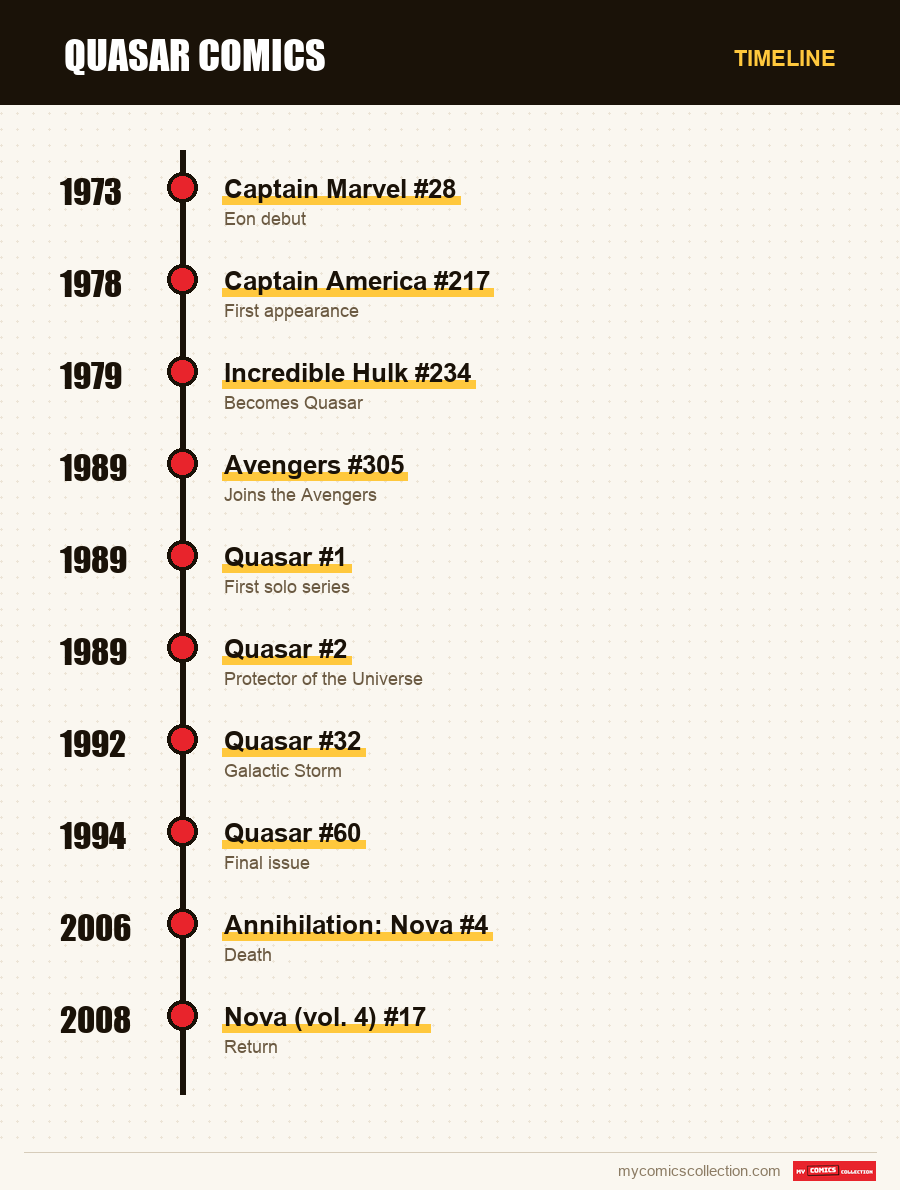
Captain America #217
Roy Thomas and Don Glut write, John Buscema draws: Wendell Vaughn makes his first appearance, as Marvel Boy, among the recruits of S.H.I.E.L.D.'s super-agent program. It is the starting point of the character's whole timeline.
Incredible Hulk #234
Roger Stern and Sal Buscema have Wendell Vaughn drop the mocked Marvel Man name in favor of Quasar. It is the hero's first appearance under his definitive identity.
Quasar #1
Mark Gruenwald and Paul Ryan launch the solo series, which Gruenwald will write alone for sixty issues. This first episode revisits how Vaughn put on the Quantum Bands to repel an A.I.M. raid.
Quasar #2
Sent on a mission to Uranus, Vaughn is met by the cosmic entity Eon, who appoints him the new Protector of the Universe, successor to the late Captain Marvel. The issue sets the character's cosmic role.
Annihilation: Nova #4
Alongside Nova, Quasar attacks Annihilus aboard his ship, but he is killed and the conqueror seizes the Quantum Bands. This death, written by Dan Abnett, is one of the high points of the Annihilation saga.
Avengers #305
Written by John Byrne and drawn by Paul Ryan, the team reforms and Quasar becomes a member. He will stay tied to the Avengers until Operation: Galactic Storm.
Quasar #32
The third chapter of Operation: Galactic Storm, the nineteen-part crossover pitting the Avengers against the Kree-Shi'ar war. An alert leads Quasar to Mar-Vell's tomb, at the heart of the conflict.
Nova (vol. 4) #17
Dan Abnett and Andy Lanning bring back Wendell Vaughn, now a being of quantum energy, released from a Project P.E.G.A.S.U.S. container during the Skrull invasion. He fights alongside Nova and Darkhawk.
Captain Marvel #28
Jim Starlin and Mike Friedrich introduce Eon, the cosmic entity who will later make Vaughn the Protector of the Universe. An issue upstream of Quasar's mythology, at the heart of Starlin's cosmic cycle.
Quasar #60
"The Long Goodbye" concludes Mark Gruenwald's run: hunted by the Presence and Darkstar, Vaughn fakes his death on Earth and exiles himself into space. The series ends with its sixtieth issue.
FAQ: Quasar comics and key issues
What is Quasar's first appearance in the comics?
Wendell Vaughn's first appearance is Captain America #217 (January 1978) by Roy Thomas, Don Glut and John Buscema, where he appears under the Marvel Boy / Marvel Man identity as a S.H.I.E.L.D. agent wearing the Quantum Bands. The first use of the Quasar name comes in Incredible Hulk #234 (April 1979) by Roger Stern and Sal Buscema, the second priority key issue of the chronology. Captain America #217 remains the absolute number-one key issue, CGC-recognized as the first appearance of Wendell Vaughn. For the long-term collection, target CGC 9.6 minimum on Captain America #217 and CGC 9.4+ on Incredible Hulk #234.
How much is Quasar #1 (1989) in CGC 9.8 worth in 2026?
The 2025-2026 ranges observed on Quasar #1 (October 1989) by Mark Gruenwald and Paul Ryan: CGC 9.8 between €120 and €240, CGC 9.6 between €60 and €120, CGC 9.4 between €30 and €60. Raw NM copies trade between €8 and €20 on eBay sold listings and in European comic shops. These levels stay modest given the first-issue status of a 60-issue solo series signed by Mark Gruenwald, which makes it one of the most accessible sleeper issues in the Marvel cosmic segment. Always check recent auction sales before any CGC 9.8 purchase above €200.
Does Quasar die in Annihilation, and which issue contains his death?
Yes, Quasar dies in Annihilation: Nova #4 (September 2006) at the hands of Annihilus, within the Annihilation crossover published between May 2006 and March 2007. The sequence remains one of the most iconic deaths of the Marvel cosmic renaissance and is a CGC-recognized death-of-Quasar key issue. Wendell Vaughn returns later in Nova Vol. 4 #17 (November 2008) by Dan Abnett and Andy Lanning, during the Secret Invasion event. Annihilation #4 trades in CGC 9.8 between €80 and €160 over the 2025-2026 period.
Is the Mark Gruenwald Quasar run (1989-1994) worth reading in 2026?
Yes, the Mark Gruenwald run on Quasar #1-60 (October 1989 to July 1994) is one of the most coherent cosmic solo series in the Marvel stable, with a single writer across the entire span and an articulated cosmic cosmology that sets the stage for the cosmic renaissance of the 2000s. The run develops Eon, the Protector of the Universe concept, the Quantum Bands, the Avengers connections and several major crossovers including Operation Galactic Storm. For the 2026 reader, the run remains accessible in TPB (Quasar Classic Vol. 1 and onward) or in original issues at very low prices (€2 to €8 per issue raw NM), which makes it possible to assemble a complete 60-issue set for €150 to €350.
Why does Quasar remain undervalued in 2026 within the Marvel cosmic segment?
Three structural factors explain Quasar's relative undervaluation in 2026. First, the absence of an explicit MCU signal to date, unlike Silver Surfer, Adam Warlock, Captain Marvel, Nova and Star-Lord, who have all benefited from appearances or Marvel Studios announcements. Second, narrative complexity and a deficit of mainstream recognition, with Wendell Vaughn remaining a niche character recognized only by savvy cosmic collectors. Third, an abundance of supply on post-1989 issues thanks to the modest but not rare print runs of the Gruenwald solo series. These three factors are just as many sleeper arguments if you adopt a 24-48 month horizon on a possible MCU or Marvel Studios announcement.