
Star-Lord (Peter Quill) first appears in the black and white magazine Marvel Preview #4 (January 1976), created by writer Steve Englehart and artist Steve Gan. The character then went through a long editorial purgatory before being revived by Keith Giffen in 2007, then propelled to the rank of leader of Guardians of the Galaxy by Dan Abnett and Andy Lanning in 2008: the direct basis of James Gunn's 2014 film.
Few Marvel characters have had such an erratic editorial journey as Star-Lord. Born in a confidential magazine intended for an adult audience, he spent most of the 1980s and 1990s in a drawer, reappearing occasionally in cosmic crossovers, then literally exploded into the light at the cinema in 2014. In the meantime, he will have changed his costume, his mission and sometimes even his parentage, at the discretion of the screenwriters who took up the concept.
Retracing the editorial history of Star-Lord also means retracing that of the cosmic side of the Marvel universe: from the pulp science fiction of the 1970s in the style of Robert Heinlein to the uninhibited space comedy that conquered the general public forty years later. This file looks back on the key stages of this story, on the issues that really matter to a collector, and on what we really know about their rarity and their value.
Confidential Origins: Marvel Preview #4 (1976)
Star-Lord is not born in a classic comic book but in Marvel Preview, a black-and-white anthology magazine format that Marvel used in the 1970s to test more mature concepts than those permitted by the Comics Code. Issue #4, dated January 1976, features Peter Quill from the pen of Steve Englehart and the pencil of Steve Gan. The character is conceived as a solitary interplanetary policeman, in a vein of heroic science fiction quite far from the mischievous troop leader that the general public would discover decades later.
This number 4 now constitutes the founding piece of any Star-Lord collection worthy of the name. The CGC census cited by market specialists reports a tight population in very high grade: around 80 copies rated 9.8 and around a hundred rated 9.6, a relatively low volume for a comic of this era, partly because the magazine format on thicker paper has withstood time better than classic stapled comics, but also because the prints of Marvel Preview remained confidential compared to monthly series for the general public. The Overstreet 2024 guide valued an NM- (9.2) copy at around $475, a useful benchmark for situating the order of magnitude of a copy in very good condition, knowing that auctions on higher grades (9.6, 9.8) have historically exceeded a thousand dollars during peaks of the character's popularity in the cinema.
Chris Claremont, John Byrne and the Complete Origin (Marvel Preview #11)
The character returns from issue 11 of Marvel Preview, published in the summer of 1977, this time with a story by Chris Claremont, drawn by John Byrne and inked by Terry Austin. This is the very first collaboration of this trio which would become historic a few years later on Uncanny X-Men. This issue develops for the first time the complete origin of Peter Quill and introduces Jason of Sparta, his biological father, a point of filiation which will become central in later stories, and which the cinema will voluntarily choose to ignore, as we will see later.
The most notable editorial anecdote of this issue concerns its cover: the promotional text compared the story to "a science fiction saga in the tradition of Robert A. Heinlein", a catchphrase which displeased the writer's rights holders enough for Marvel to withdraw and reprint the issue. This story, now well documented by Bronze Age specialists, adds a layer of rarity relating to the very first impressions of the number 11, even if it remains anecdotal compared to the importance of the number 4 for the first appearance.
The character continues his journey in the following issues of Marvel Preview until the end of the 1970s, carried by a handful of authors convinced of the potential of the concept, without ever obtaining its own monthly series. This absence of a regular solo title largely explains why Star-Lord remains, at this time, a secondary character: unlike Spider-Man or a Hulk who benefit from uninterrupted editorial continuity, Peter Quill depends entirely on the goodwill of isolated authors to exist on paper.
Crossing the desert (1980s-1990s)
After stopping Marvel Preview, Star-Lord enters a long period of editorial dormancy. The character did not get any series regulars during the 1980s and only appeared sporadically in minor cosmic titles. This almost total absence from the editorial radar for almost two decades has a direct consequence for collectors: there is practically no intermediate "key" issue between the end of the 1970s and the mid-2000s. The secondary market for the character therefore focuses almost exclusively on the original core of Marvel Preview, which paradoxically simplifies the task of anyone wishing to put together a targeted collection: there are not dozens of forgotten mini-series to track down, only a handful of well-identified milestones.
This editorial void also illustrates a common phenomenon in the history of Marvel: a concept deemed too singular or too linked to a specific narrative context (here, the imaginary post-Star Wars space opera of the 1970s) can remain dormant for years before a new generation of screenwriters rediscovers it with a fresh perspective. This is exactly what happened in the mid-2000s, when Marvel relaunched its entire cosmic offering.
The Modern Revival: Annihilation: Conquest: Star-Lord (2007)
The real turning point came in 2007 with the four-issue miniseries Annihilation: Conquest: Star-Lord, written by Keith Giffen and drawn by Timothy Green II. This is the first title bearing the character's name in over a decade. Keith Giffen completely redesigned the visual identity of the character, with a new costume which would become the basis of all subsequent incarnations, both comics and cinema.
On a narrative level, this mini-series tells the story of the formation of the motley team (Star-Lord, Rocket Raccoon, Groot, Mantis, Bug, Captain Universe) which a few months later would become the Guardians of the Galaxy in their modern form. It is here, and not in a team already bearing this name previously, that the casting is put in place which will directly inspire the 2014 film. This mini-series remains sought after today by collectors who want to document the transition between the lone Star-Lord of the 1970s and the team leader that he then becomes, even if it remains less expensive than the founding issue of 1976 since it benefited from a much larger print run, typical comics from the mid-2000s.
Dan Abnett, Andy Lanning and the Guardians of the Galaxy era (2008-2010)
A few months after Giffen's mini-series, Marvel launched a series in 2008 Guardians of the Galaxy ongoing written by the tandem Dan Abnett and Andy Lanning, drawn by Paul Pelletier for the first seven issues. Star-Lord officially becomes the leader of a team made up of Rocket Raccoon, Groot, Gamora, Drax the Destroyer, Adam Warlock and Phyla-Vell, later joined by Quasar. It is this precise configuration (and not that of the historical Guardians of 1969, a completely different team originating from the 31st century) which constitutes the direct matrix of the cult film of 2014.
The Abnett/Lanning run, which spanned several dozen issues until 2010, permanently established Peter Quill as a more calm strategist than in his first incarnations, while retaining a touch of irony which foreshadowed the half-serious, half-comic tone that James Gunn would adopt in the cinema. In terms of the collection, number 1 of this 2008 series today constitutes the essential benchmark for documenting the first appearance of the modern formation of the complete team, even if its circulation is significantly higher than that of Marvel Preview #4 places it in a much more accessible price bracket.
The 2013 Bendis relaunch: Star-Lord joins the big leagues
Even before the film's release, Marvel confirmed the growing importance of the character by entrusting Guardians of the Galaxy to Brian Michael Bendis, then one of the publishing house's most prominent screenwriters after his flagship years on Avengers and Ultimate Spider-Man. This new series, drawn by Steve McNiven, begins in March 2013 as part of the Marvel NOW! editorial relaunch. and takes as its starting point a spectacular decision: Earth is declared a no-go zone for the rest of the galaxy, which pushes Peter Quill to recruit Iron Man on the team to find out why. The series will continue for 27 issues until 2015, seeing unexpected reinforcements like Angela, Agent Venom or Captain Marvel.
This choice to entrust the title to a screenwriter of Bendis's caliber, a year before the film's release, is not insignificant: it reflects the growing confidence of the publisher in the commercial potential of the character, at a time when the general public still knew almost everything about Star-Lord and his team. In terms of collection, this series remains the most financially accessible of the three major “Guardians of the Galaxy” iterations (2008, 2013, then the relaunches following each film), since it benefits from the high digital and paper print runs typical of the direct market of the 2010s, far from the confidentiality of a black and white magazine from 1976.
Legendary Star-Lord and Star-Lord (2016): the post-cinema era
The phenomenal success of the 2014 film naturally pushes Marvel to increase the number of solo titles. Legendary Star-Lord begins in July 2014, a few weeks before the release of the film, under the pen of Sam Humphries and the pencil of Paco Medina: a series which openly capitalizes on the emerging craze for the character played by Chris Pratt. Two years later, in December 2016, a new solo series simply titled Star Lord is born, written by Chip Zdarsky and drawn by Kris Anka, with a first arc called “Grounded” which voluntarily isolates Peter Quill on Earth, far from his cosmic companions, to explore a more intimate side of the character.
These two series from the 2010s remain much easier to access financially today than the publications from the 1970s, since they benefited from standard print runs from the modern era of the direct market. However, they remain of real interest for any collector who wishes to cover the entire editorial arc of the character, in particular because they document the evolution of his characterization as the film in turn influenced the writing of the comics: a relatively rare feedback phenomenon in the history of Marvel, where it is usually the paper material which nourishes the adaptation, and not the other way around.
Collecting this series?
Track what you own, what you are missing and what your collection is worth. 7 day trial.
Start my trial →The impact of adaptations on the rating
The movie Guardians of the Galaxy, directed by James Gunn starring Chris Pratt as Peter Quill, was released theatrically in the United States on August 1, 2014 after a world premiere at the Dolby Theater in Hollywood on July 21. The film grossed $773.3 million worldwide, making it one of the biggest surprise box office hits of the year. Two sequels will follow, Flight. 2 in 2017 and Flight. 3 in 2023, as well as appearances of the character in Avengers: Infinity War and Avengers: Endgame.
The effect of this cinematic success on the collectible market is documented: sales data compiled between 2018 and 2020 on CGC graded copies of Marvel Preview #4 show significant peaks in 9.8 (around $2,600 in 2019 according to sales records at the time, before a decline observed in the following years), with a classic tiering by grade: copies around 9.0-9.2 were then trading in a range of $300 to $400, while intermediate grades like 8.0 were around $250 to $300. These figures date from a specific moment in the market and should not be taken as a current rating: the comics market fluctuates greatly depending on cinema news, the releases of new films in the franchise and the more general cycle of demand for collectibles.
One point is worth noting to collectors who discover the character through the film before going back to the comics: Peter Quill's parentage is significantly modified. In the comics, his father is J'son of Spartax, ruler of a galactic empire, whose first version, Jason of Sparta, appears as early as Marvel Preview #11 in 1977. In the cinema, James Gunn chooses an entirely different father, Ego the Living Planet, played by Kurt Russell in Flight. 2. This divergence is not anecdotal for a collector: it means that the issues devoted to Peter Quill's father in classic comics (notably this famous issue 11 from 1977) tell a story parallel to that of the big screen, and not a simple summary of what we see in the films. It is precisely this kind of nuance that makes reading the original comics interesting even for a viewer who already knows the cinematic plot by heart.
Buying Guide: Collecting Star-Lord Smartly
Building a coherent Star-Lord collection requires clearly distinguishing rare pieces from the rest, as the difference in circulation between publications from the 1970s and those from the years 2000-2010 is significant. Here are the practical points to know before buying:
- Check the format first : Marvel Preview #4 and #11 are black and white magazines, not classic stapled comic books. Their larger format and thicker paper also change the conservation criteria: look for the absence of spine folds, stains and discoloration, a common defect on this magazine paper from the 1970s.
- Favor white or close to white pages on copies from 1976-1977: the paper used for Marvel Preview tends to yellow more quickly than classic comics of the same period, which makes a copy with light pages much more sought after at equivalent grade.
- Distinguish clearly between the two “Guardian teams” before purchasing an issue presented as a “first appearance”: the original team from 1969 (Marvel Super-Heroes #18) has no relation to Peter Quill nor to the modern formation popularized by the film; it is the 2008 series by Abnett and Lanning which inaugurates the casting known today.
- Don't forget Annihilation: Conquest: Star-Lord (2007) to document the character's costume/mission transition between his 1970s solitary incarnation and his role as team leader: it's an often underappreciated narrative milestone compared to issue #1 of the 2008 series which immediately follows.
- Have the grade and authenticity confirmed before any purchase over a few hundred euros : on a number like Marvel Preview #4, the difference in value between a 9.2 and a 9.6 can be considerable; a recent CGC certificate remains the best way to avoid unpleasant surprises on very high grades.
- Always compare several recent sales rather than a single displayed price: comics linked to active film franchises experience rapid price variations depending on current events (film release, casting announcement, license anniversary).
If you're unsure about the realistic price range for a specific example you own or are considering purchasing, the site's valuation tool uses current eBay listings to give a low, mid, and high range based on series, number, and stated condition. This is a more reliable starting point than a fixed list price, especially on a character whose rating has been as directly punctuated by the cinematic calendar as Star-Lord.
For collectors who follow several series in parallel, keeping a centralized track of what you already own (numbers, grades, acquisition dates) avoids duplicates and makes it easier to follow the evolution of the price over time, particularly on a character whose value can change quickly according to Marvel Studios announcements.
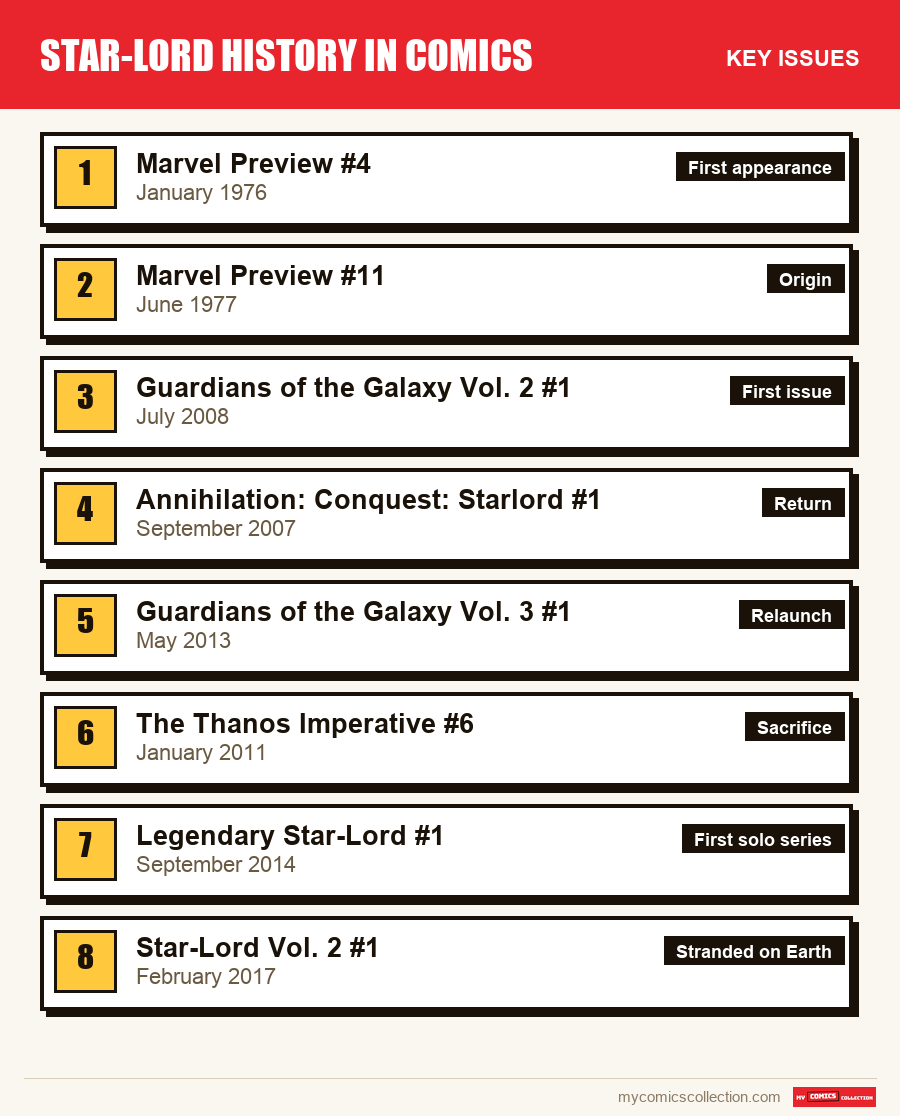
The key issues to know
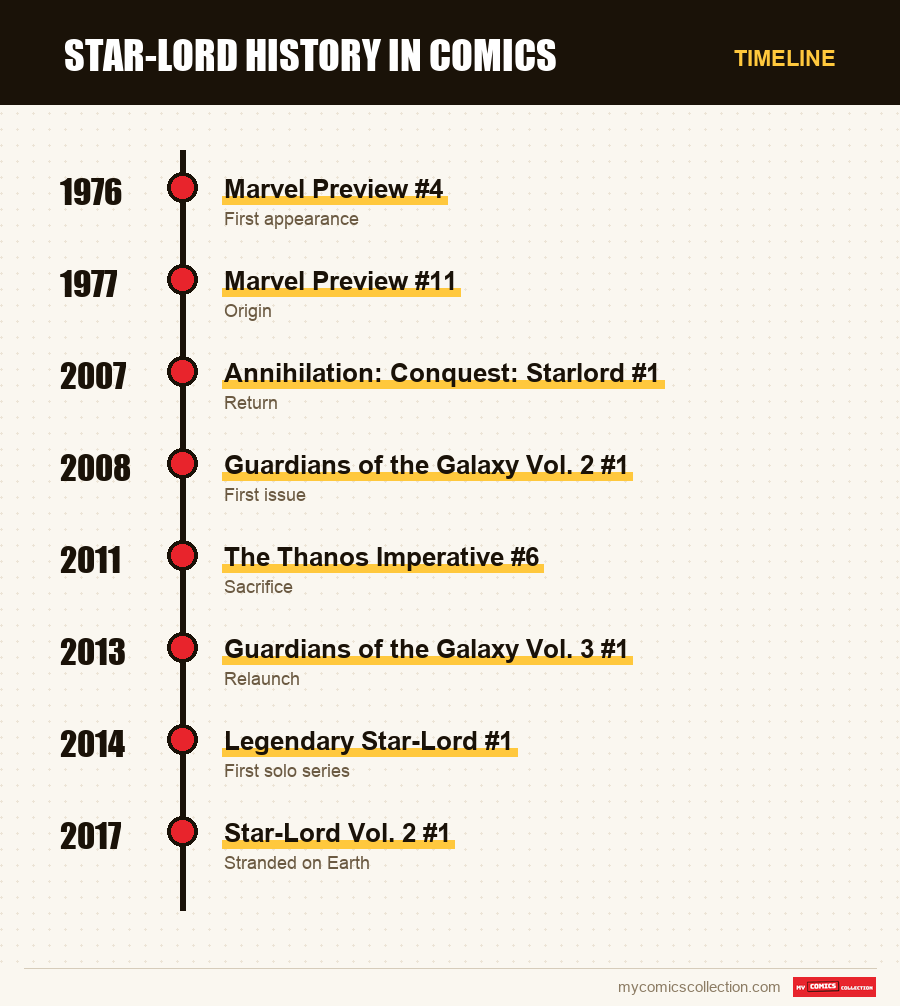
Marvel Preview #4
In this black-and-white magazine, Steve Englehart and Steve Gan introduce Peter Quill, born in a small Ohio town, whose mother Meredith is killed by aliens. As an adult, he takes on the identity of Star-Lord. It is the character's ultimate key issue.
Marvel Preview #11
Chris Claremont, John Byrne and Terry Austin, together for the first time, expand on Peter Quill's origins and introduce his father, Jason of Sparta, ruler of a distant empire. The story also introduces Star-Lord's sentient ship. A trio that would go on to define Uncanny X-Men.
Guardians of the Galaxy Vol. 2 #1
Dan Abnett, Andy Lanning and Paul Pelletier launch the modern Guardians, led by Star-Lord: this is the line-up that directly inspired the 2014 film. The team has no link to the 1969 Guardians. The essential marker of the character's modern era.
Annihilation: Conquest: Starlord #1
Keith Giffen and Timothy Green II give Peter Quill a four-issue miniseries, the first to bear his name in years, as a lead-in to Annihilation: Conquest. Quill assembles a ragtag squad that includes Rocket Raccoon and Groot. The link between the lone hero of the 1970s and the team leader.
Guardians of the Galaxy Vol. 3 #1
A Marvel NOW! relaunch by Brian Michael Bendis and Steve McNiven: a council of galactic empires declares Earth off-limits to all alien interference, and Star-Lord refuses to go along. Iron Man joins the team. The series paves the way for the film released the following year.
The Thanos Imperative #6
The conclusion of Dan Abnett and Andy Lanning's event, drawn by Miguel Sepulveda: Star-Lord and Richard Rider send the Guardians home and stay alone against Thanos in a collapsing universe. Their teammates raise statues in their honor. The end of the Guardians' first modern run.
Legendary Star-Lord #1
Sam Humphries and Paco Medina give Peter Quill a solo series as the first film approached. The character gets a new costume, matching the one seen in the film. An affordable issue to represent the movie-era Star-Lord.
Star-Lord Vol. 2 #1
Chip Zdarsky and Kris Anka launch a new solo series with "Earth-Lord": cut off from his teammates, Peter Quill has to get used to life on Earth again. The series explores a more personal side of the character. Released at the end of 2016, with a 2017 cover date.