Guardians of the Galaxy (2014), directed by James Gunn, is inspired by the modern version of the team, launched in 2008 by Dan Abnett and Andy Lanning, which fixes the line-up of the film. Each member comes from a distinct comic origin: Star-Lord in Marvel Preview #4 (1976), Rocket in Marvel Preview #7 (1976), Groot from Tales to Astonish #13 (1960), Gamora in Strange Tales #180 (1975) and Drax in Iron Man #55 (1973). The film retains the spirit of the gang but largely reinvents the characters. Detailed comparison, film versus comics.
Marvel Studios' riskiest bet at the time, Guardians of the Galaxy brought hitherto confidential characters to the forefront. Under the direction of James Gunn, the film assumes the tone of an offbeat space adventure, carried by a motley crew. To compose it, he draws on a recent rereading of comics while going back, for each member, to sometimes very ancient origins. Decryption.
As in each article, only verified information (distribution, dates, numbers, creators) is stated; the comparative analysis is ours, without reproducing dialogue or protected images.
Title : Guardians of the Galaxy (2014)
Director: James Gunn
Actors: Chris Pratt (Peter Quill / Star-Lord), Zoe Saldana (Gamora), Dave Bautista (Drax), Vin Diesel (voice of Groot), Bradley Cooper (voice of Rocket), Lee Pace (Ronan), Michael Rooker (Yondu)
Exit : August 1, 2014 (United States)
Studio: Marvel Studios
Goalkeepers (2008 team): Dan Abnett & Andy Lanning, film line-up
Star Lord: Marvel Preview #4 (1976) ·Rocket: Marvel Preview #7 (1976)
Groot: Tales to Astonish #13 (1960) ·Gamora: Strange Tales #180 (1975)
Drax: Iron Man #55 (1973, with Thanos, Jim Starlin)
- Le 2008 line-up (Star-Lord, Gamora, Drax, Rocket, Groot), set by Abnett and Lanning.
- The spirit of band of misfits become heroes in spite of themselves.
- Rocket and Groot, the unlikely duo, faithful to their dynamic comics.
- Gamora, “the most dangerous woman in the galaxy”, linked to Thanos.
- The decor cosmic from Marvel, populated by empires and alien races.
- Individual origins are largely rewritten: each member comes from scattered and often old comics.
- Star Lord becomes a human lover of 1980s music, far from the more austere character of 1976.
- Drax sees his origin simplified to a revenge-seeking father, without his cosmic origin story.
- Yondu, a member of the original 1969 team, becomes a pest with a very different role.
- Le your, a space musical, is a signature of James Gunn.
The 2008 team: the film matrix
There are two “Guardians of the Galaxy” in the comics. The first, born in 1969, takes place in the distant future and has almost nothing to do with the film. The second, launched in 2008 by Dan Abnett and Andy Lanning following the great cosmic sagas of the time, brings together exactly the core that the public will know on screen: Star-Lord, Gamora, Drax, Rocket and Groot. It is this modern version which serves as the matrix for the film. The feature film retains the essentials (the spirit of a band of misfits, the humor, the camaraderie forged in the chaos) while allowing great freedom on the details.
This choice illustrates a constant in Marvel adaptations: drawing on the most recent and most cinematic rereading, rather than the historical version. For the reader, Abnett and Lanning's series remains the closest reading to the film.
Five members, five scattered origins
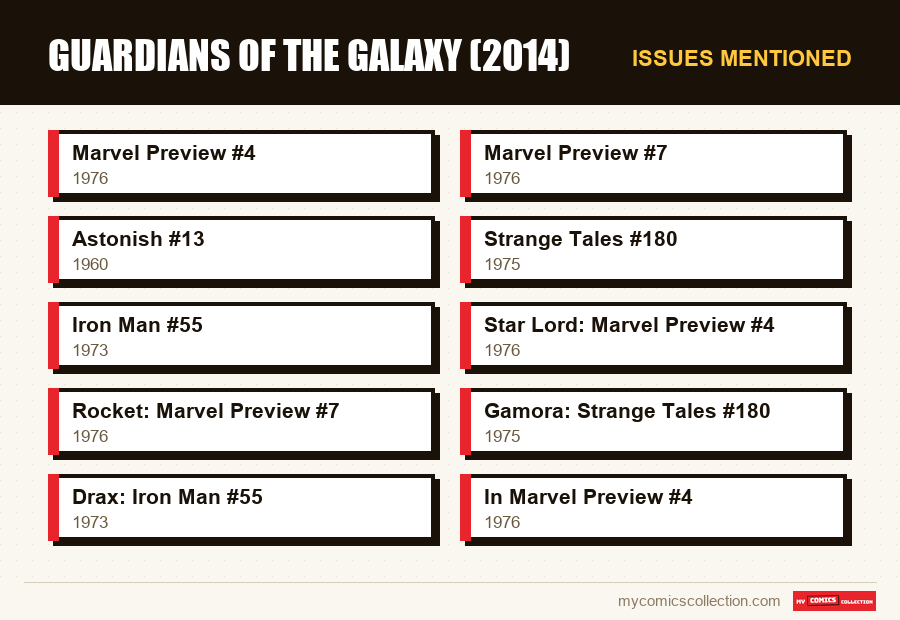
What's special about the Guardians is that each member comes from a different corner of Marvel history:
- Star Lord (Peter Quill): Appeared in Marvel Preview #4 (1976), created by Steve Englehart and Steve Gan. Originally more serious and mystical, on screen he becomes a nostalgic adventurer lulled by the music of the 1980s.
- Rocket Raccoon: Born in Marvel Preview #7 (1976), popularized by Bill Mantlo and Keith Giffen. The film retains its explosive mix of tactical genius and dirty character.
- Groot: The oldest: he appears from Tales to Astonish #13 (1960), originally as a plant monster in an anticipation story, long before becoming the endearing companion that we know.
- Gamora: Created by Jim Starlin in Strange Tales #180 (1975), adopted daughter of Thanos, faithful to her status as a formidable warrior.
- Drax: Appeared in Iron Man #55 (1973), in the same issue as Thanos, also created by Jim Starlin. The film simplifies its cosmic origin into a quest for personal revenge.
Thanos, Ronan and the Cosmic Web
The film takes place in the Marvel galaxy populated by empires and tyrants. Ronan the Accuser, main antagonist, and above all Thanos, in ambush, connect the Guardians to the overall plot of the saga and the Infinity Stones. This link is not an arbitrary addition: in the comics, Gamora and Drax are deeply linked to Thanos and the great cosmic epics of Jim Starlin. The film exploits this relationship to anchor a seemingly isolated adventure in a much larger story, preparing for the clashes to come.
James Gunn and the space comedy
The success of the film owes a lot to the vision of James Gunn, who assumes a tone of uninhibited adventure comedy, punctuated by a retro soundtrack that has become inseparable from the characters. This bias does not exist as is in the comics: it is an added layer which humanizes the strip and makes accessible a cosmic part of Marvel known to be difficult. By relying on emotion and humor rather than literal fidelity, Gunn transformed obscure characters into popular icons: proof that an adaptation can create its own identity while respecting the collective spirit of its source.
Collecting this series?
Track what you own, what you are missing and what your collection is worth. 7 day trial.
Start my trial →Yondu, the Ravagers and the 1969 team
A character in the film establishes a discreet bridge with the very first version of the Guardians: Yondu. In the comics, Yondu Udonta is a founding member of the original team that appeared in 1969, a band of heroes evolving in the distant future, very different from the modern group. The film recovers the name and the blue archer with the whistling arrow, but makes it something completely different: a leader of Ravagers, a big-hearted smuggler who raised Peter Quill. This reinvention illustrates the film's method, which draws elements from both versions of the team (the 2008 line-up for the core, a 1969 veteran for the color) without worrying about literal fidelity. For the reader, this is the opportunity to discover that the Guardians have, in reality, two distinct histories separated by almost forty years.
The Marvel Galaxy: Nova Corps, Kree and Xandar
The film takes care to populate its cosmic setting with institutions from the comics: the Nova Corps, an intergalactic police force based on the planet Xandar, and the Kree empire, of which Ronan the Accuser is a renegade fanatic. These elements are not inventions: they belong to the rich space mythology that Marvel has developed over the decades, from the sagas of Jim Starlin to the great cosmic crossovers of the 2000s. Building on this background, the film anchors the Guardians in a coherent universe, where empires and galactic police give weight to the adventure. It is also this cosmic fabric which discreetly connects the film to the Infinity Stones and the threat of Thanos, preparing the great clashes to come.
Where to start reading
To find the film team, the ideal reading is the series by Dan Abnett and Andy Lanning launched in 2008, as well as the cosmic sagas that surround it (Annihilation and its sequels): this is where the core brought to the screen is formed. Those curious about individual origins can then go back to the first appearances (Marvel Preview #4 for Star-Lord, Strange Tales #180 for Gamora, Iron Man #55 for Drax and Thanos) to measure the progress made. Finally, Jim Starlin's great epics around Thanos illuminate the cosmic canvas in which the film is set. From 1973 to 2008, this journey covers both the roots and the modern version of the Guardians.
Chronology of comics to know
- 1960: Tales to Astonish #13: first appearance of Groot (plant monster).
- 1973: Iron Man #55: first appearances of Drax and Thanos (Jim Starlin).
- 1975: Strange Tales #180: First appearance of Gamora.
- 1976: Marvel Preview #4 (Star-Lord) and #7 (Rocket Raccoon).
- 2008: relaunches Abnett & Lanning: the line-up of the film.
Collection side: what numbers to aim for after the film
The Guardians offer exciting collecting terrain, as each member has their own key. Iron Man #55 (first appearances of Drax and Thanos) is the centerpiece, one of the most sought-after cosmic keys of the 1970s. Strange Tales #180 (Gamora) and Marvel Preview #4 (Star-Lord) are other major targets. Tales to Astonish #13 (Groot) appeals to lovers of ancient curiosities. These issues cover a wide range of budgets, from the Silver Age to the Bronze Age. As always, condition and gradation determine value; relying on recent real sales is strongly recommended before any purchase. A piece of advice for getting started: rather than aiming straight away for Iron Man #55, which is often expensive, you can start with the more affordable first appearances (Star-Lord, Rocket) or with the collections of the series by Abnett and Lanning, which offer the best ratio between reading pleasure and budget. This progressive approach makes it possible to build a coherent collection around the film without breaking the bank on a single piece.
The verdict: spirit before letter
- Loyalty: the 2008 line-up and the spirit of the band of misfits are respected.
- Freedoms: the largely rewritten individual origins and a musical comedy tone specific to James Gunn.
- Collectible numbers: Iron Man #55 (Drax and Thanos), Strange Tales #180 (Gamora), Marvel Preview #4 (Star-Lord).
Guardians of the Galaxy is the perfect example of an adaptation that favors the spirit over the letter: by freely rewriting characters born decades apart, the film creates a coherent and endearing family. For the collector, it's a mine, because each member refers to a distinct first appearance, from 1960 to 1976, making this band of misfits one of the richest teams to collect. Few films will have done so much to restore value to forgotten comics, nor proven with such brilliance that a second-rate character can become, overnight, a global icon.
Its place in the saga and for the collector
Guardians of the Galaxy proved something that no one thought possible: the general public could become attached to almost unknown characters, a tree that only says one sentence and an armed raccoon. This success validated the idea that a successful adaptation comes down to emotion and tone, not prior notoriety. It had a direct effect on the collection market: the first cosmic apparitions, long neglected, saw their prices rise, transforming forgotten numbers into sought-after keys. Iron Man #55 (Drax and Thanos), Strange Tales #180 (Gamora) or Marvel Preview #4 (Star-Lord) perfectly illustrate this phenomenon, where cinema brings comics from the 1970s back to life. For the collector, the film is a lesson: the nuggets sometimes hide in the less glamorous corners of the Marvel catalog. By taking these characters “from the bottom of the toy box”, the Guardians have opened up an entire section of the cosmic collection, and reminded us that the value of a comic can change overnight depending on an adaptation.
Frequently asked questions
From the modern team launched in 2008 by Dan Abnett and Andy Lanning, which sets the line-up of the film (Star-Lord, Gamora, Drax, Rocket, Groot). The original 1969 team is very different.
In Marvel Preview #4 (1976), created by Steve Englehart and Steve Gan. Originally more serious and mystical, on screen he becomes a nostalgic adventurer who loves music from the 1980s.
Yes: both debut in Iron Man #55 (1973), created by Jim Starlin. It is one of the most sought after cosmic keys of the 1970s.
Yes, he is the oldest of the Guardians: he appears as early as Tales to Astonish #13 (1960), originally as a plant monster, long before becoming the endearing companion of the film.
Iron Man #55 (first appearances of Drax and Thanos) is the centerpiece. Strange Tales #180 (Gamora) and Marvel Preview #4 (Star-Lord) are the other big targets.
Does the film make you want to collect Guardians? Estimate the value for free of your issues (Iron Man #55, Strange Tales #180…) with our tool based on current eBay listings.