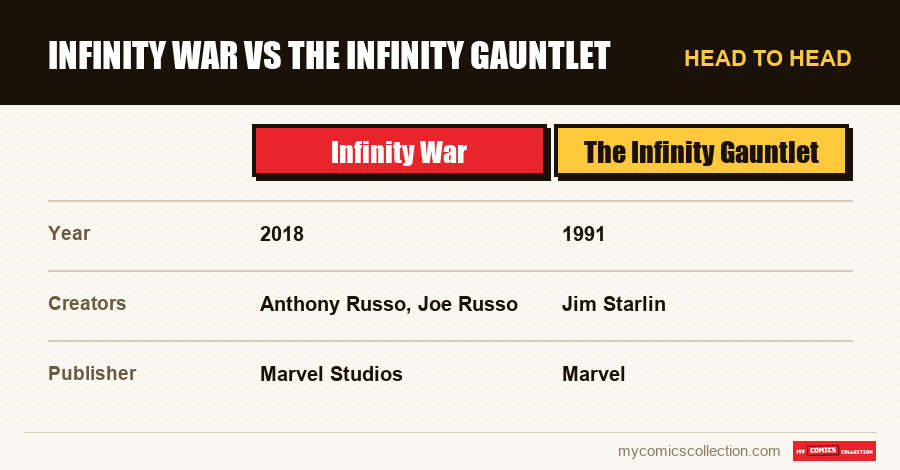
Avengers: Infinity War (2018), directed by Anthony and Joe Russo , adapts the cult event “The Infinity Gauntlet”(1991) by Jim Starlin, George Pérez and Ron Lim, where Thanos brings together the six Infinity Stones to erase half of the universe. The Mad Titan first appears in Iron Man #55 (1973), also by Starlin. The film retains the central gesture, the snap of the fingers, but reorganizes the characters and the motivations of Thanos. Detailed comparison, film versus comics.
Point of convergence of ten years of films, Infinity War brings together dozens of heroes facing a single threat: Thanos. The Russo brothers adapt one of Marvel's most famous events, while bending it to the needs of a cinematic story built since 2008. Let's see what the film takes from “The Infinity Gauntlet” and what it transforms.
As in each article in the series, only verified information (distribution, dates, numbers, creators) is stated; the comparative analysis is ours, without reproducing dialogue or protected images.
Title : Avengers: Infinity War (2018)
Directors: Anthony and Joe Russo
Actors: Josh Brolin (Thanos), Robert Downey Jr., Chris Hemsworth, Chris Evans, Benedict Cumberbatch, Zoe Saldana (Gamora), and all the heroes of the saga
Exit : April 27, 2018 (United States)
Studio: Marvel Studios
“The Infinity Gauntlet”(1991): Jim Starlin, George Pérez & Ron Lim
Iron Man #55 (1973): 1st appearance of Thanos (Jim Starlin)
“The Thanos Quest”(1990): Thanos reunites the gems
The Infinity Stones/Gems: six artifacts of absolute power
- Thanos bringing together the six Infinity Stones in a gauntlet.
- Le snap of fingers which wipes out half of the life in the universe.
- THE outdated heroes, unable to prevent the catastrophe.
- The intimate connection between Thanos and Gamora, his adopted daughter.
- The size cosmic and tragic specific to the sagas of Jim Starlin.
- Thanos' motivation: in the comic, he acts out of love for Death personified; the film makes him an ideologue of balance.
- Lady Death, central character of the comic, is absent from the film.
- The cosmic actors (Adam Warlock, Silver Surfer, Nova) are replaced by the heroes of the saga.
- The process is entirely reorganized around the characters from the cinema.
- The film ends with snap, where the comic explored its consequences.
“The Infinity Gauntlet” (1991): the direct source
Infinity War adapts one of the most famous events in Marvel history: “The Infinity Gauntlet”, a six-issue miniseries published in 1991, written by Jim Starlin and drawn by George Pérez and then Ron Lim. The plot is the one that the film takes up in broad terms: Thanos brings together the six Infinity Gems (power, time, space, reality, soul, spirit) in a golden gauntlet, becoming all-powerful, before erasing half of life in the universe with a snap of his fingers. This gesture, one of the most iconic in comics, is faithfully transposed, as is the helplessness of the heroes in the face of an adversary who has become a god. The film also retains the tragic and cosmic dimension that is the signature of Starlin's sagas.
The big difference is Thanos' motivation. In the comic, the Titan carries out this massacre out of love for Lady Death, the incarnation of Death whose favor he desperately seeks to gain. The film dismisses this character and rewrites Thanos as an ideologist: convinced that the universe is threatened by overpopulation, he believes he is making a necessary sacrifice to rebalance life. This rereading makes the character more rational and, paradoxically, more disturbing.
Iron Man #55 (1973): The Birth of the Mad Titan
Thanos first appears in Iron Man #55 (1973), created by Jim Starlin: the same issue that introduced Drax, Mentor and Kronos. From his beginnings, the Titan is conceived as a cosmic nihilist, obsessed with death and absolute power. The film respects this essence (a being of overwhelming power, driven by unshakeable conviction) while humanizing his relationship with Gamora, his adopted daughter, whose sacrifice becomes one of the most heartbreaking moments of the story. This relationship, present in the comics, is amplified to give the colossus an unexpected emotional flaw.
The Infinity Stones and “The Thanos Quest”
The entire cinematic saga is based on the Infinity Stones, scattered film after film. In the comics, Thanos' quest to reunite them is told in "The Thanos Quest" (1990), a direct prelude to "The Infinity Gauntlet". The film condenses this hunt into a single gripping story, where Thanos snatches the Stones from the heroes one by one. The very concept of these gems, each granting mastery over an aspect of reality, dates back to the 1970s in the comics, before being unified by Starlin. By building its entire saga around these artifacts, cinema has paid homage to one of the most fruitful ideas in Marvel science fiction.
The characters, from paper to screen
- Thanos: True to his power and his obsession, but rewritten as an ideologue of balance rather than as a lover of Death.
- Gamora: His relationship with Thanos, present in the comics, becomes the emotional heart of the film.
- The heroes of the saga: They replace the cosmic actors of the comic (Adam Warlock, Silver Surfer, Nova).
- Doctor Strange: Guardian of the Time Stone, he plays a central strategic role.
- Lady Death: Key character from the comic, purely and simply absent from the film.
Collecting this series?
Track what you own, what you are missing and what your collection is worth. 7 day trial.
Start my trial →The Russo brothers and the culmination of a decade
Making Infinity War posed a unique challenge: bringing together dozens of heroes from different franchises into a single coherent story. The Russo brothers take up the challenge by making Thanos the true protagonist of the film: it is his journey, his quest, his logic which structures the story. This bold choice, where the antagonist occupies the center, reinforces the tragic dimension: the spectator witnesses, helpless like the heroes, the inexorable march of the Titan towards his goal. By daring to end with a defeat, the film breaks the conventions of the genre and pays homage to the dramatic scale of Starlin's sagas, where the stakes always went beyond simple victory.
The big absences from the comic: Warlock, Silver Surfer, Nova
An essential difference separates the film from its source: the distribution. In “The Infinity Gauntlet”, the heroes who face Thanos are largely cosmic figures: Adam Warlock, as a true protagonist and strategist, the Silver Surfer, Nova, or even Doctor Strange in a mystical role. Adam Warlock, in particular, is the central character of the comic, the one who orchestrates the response. The film, built on ten years of terrestrial stories, replaces these cosmic actors with the heroes that the public knows: the Avengers, the Guardians, Spider-Man, Black Panther. This transfer changes the nature of the story: where the comic was a cosmic epic populated by abstract entities, the film relies on the viewer's attachment to characters he has followed for years.
This choice also explains why the end of the film hits so hard: it is not distant figures who disappear in the snap of the fingers, but familiar and beloved heroes. By adapting the idea of the comic while changing its protagonists, the film gains in emotional impact what it loses in cosmic scope. It’s a perfect illustration of how an adaptation must sometimes betray the letter of its source to preserve, and even amplify, its tragic spirit.
Where to start reading
The main reading is obviously “The Infinity Gauntlet” (1991) by Jim Starlin, George Pérez and Ron Lim, the event which directly inspires the film. It can be preceded by “The Thanos Quest” (1990), which tells of the collection of gems, and go back to Iron Man #55 (1973) for the first appearance of the Titan. Cosmic enthusiasts will then be able to explore Starlin's other sagas, from “Infinity War” (the 1992 event, not to be confused with the film) to “Infinity Crusade”. From 1973 to 1991, this journey covers most of the mythology of Thanos, one of Marvel's greatest villains. These cosmic sagas, reputed to be dense and philosophical, are among the most ambitious ever published, and greatly reward the reader ready to venture beyond terrestrial stories.
Chronology of comics to know
- 1973: Iron Man #55: First appearance of Thanos.
- 1990: “The Thanos Quest”: Thanos gathers the Infinity Gems.
- 1991: “The Infinity Gauntlet”: the event that inspires the film.
Collection side: what numbers to aim for after the film
Infinity War points to major cosmic keys. Iron Man #55 (first appearance of Thanos) is the centerpiece, one of the most sought-after Bronze Age keys, whose popularity exploded with the central role of the Titan on screen. The Infinity Gauntlet #1 (1991) is an iconic modern number, still accessible and directly linked to the film. The collections of “The Infinity Gauntlet” and “The Thanos Quest” offer the best entry point into reading. These targets span varying budgets, from the prestigious 1973 issue to the 1990s comic. As always, condition and grading determine value; relying on recent real sales is strongly recommended before any purchase.
Its place in the saga and for the collector
Infinity War is the culmination of ten years of films, the point where all the plots converge. Its ending, one of the most daring ever dared by a blockbuster, left a lasting impression on the public. For the collector, the effect was considerable: Iron Man #55 saw its value soar, and all the issues linked to Thanos and the Infinity Stones experienced a spectacular resurgence of interest. This film perfectly illustrates how cinema can transform a comic book villain into a global icon, and make a 1973 issue one of the most coveted keys on the market. Beyond speculation, it invites you to discover the work of Jim Starlin, whose cosmic sagas are among the most ambitious and philosophical in comics. By bringing “The Infinity Gauntlet” to the screen, the saga has done justice to one of its creative peaks.
The verdict: the cult event, rewritten for the cinema
- Loyalty: the gauntlet, the six Stones, the snap of the fingers and the helplessness of the heroes come directly from the comic.
- Freedoms: Thanos rewrites as an ideologist of balance, the absence of Lady Death, the heroes of the saga replacing the cosmic actors.
- Collectible numbers: Iron Man #55 (Thanos), The Infinity Gauntlet #1 (1991).
Infinity War achieves the feat of adapting a sprawling event while bending it into a cinematic saga built since 2008. By placing Thanos at the center and daring to end with a defeat, the film honors the tragic scale of Jim Starlin's sagas. For the reader and the collector, it opens the door to the cosmic universe of Marvel, and to one of its most prestigious first appearances. By making a villain the heart of its story and daring to conclude with catastrophe, Infinity War redefined what a blockbuster could afford. It is the triumph of an idea born in Jim Starlin's comics several decades ago: that of an antagonist whose implacable logic forces the spectator to contemplate the unthinkable, the failure of heroes in the face of something greater than them.
Frequently asked questions
From the event “The Infinity Gauntlet” (1991) by Jim Starlin, George Pérez and Ron Lim, where Thanos brings together the six Infinity Gems and erases half of the universe with a snap of his fingers.
In the comic, Thanos acts out of love for Lady Death, whom he seeks to seduce. The film dismisses this character and rewrites him as an ideologue convinced of saving the universe from overpopulation.
In Iron Man #55 (1973), created by Jim Starlin, in the same issue as Drax. This is one of the most sought after Bronze Age keys on the market.
No. Central character of the comic, the incarnation of Death is absent from the film, which replaces Thanos's love quest with an ideological motivation.
Iron Man #55 (Thanos' first appearance) is the centerpiece of the Bronze Age. The Infinity Gauntlet #1 (1991) is an iconic and more accessible modern issue.
Does the film make you want to collect? Estimate the value for free of your issues (Iron Man #55, Infinity Gauntlet…) with our tool based on current eBay listings.