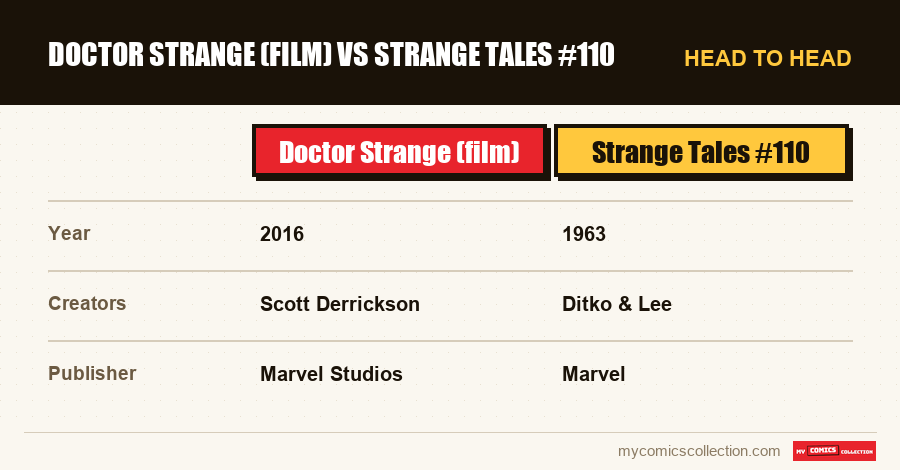
Doctor Strange (2016), directed by Scott Derrickson with Benedict Cumberbatch, adapts the master of the mystical arts born in Strange Tales #110 (1963) by Steve Ditko and Stan Lee: issue which also contains the Elder and Wong. The film takes up the emblematic origin (the arrogant surgeon broken by an accident, in search of healing) and summons Dormammu , appeared in Strange Tales #126 (1964). It retains Ditko's psychedelic imagery but modifies the Ancient One and the role of relics. Detailed comparison, film versus comics.
With Doctor Strange, the saga opened a door to the supernatural and parallel dimensions. Directed by horror filmmaker Scott Derrickson, the film draws on one of Marvel's most visually daring characters, whose aesthetic owes everything to the graphic genius of Steve Ditko. Let's see what the adaptation keeps from its 1960s roots and what it transforms.
As in each article in the series, only verified information (distribution, dates, numbers, creators) is stated; the comparative analysis is ours, without reproducing dialogue or protected images.
Title : Doctor Strange (2016)
Director: Scott Derrickson
Actors: Benedict Cumberbatch (Stephen Strange), Chiwetel Ejiofor (Mordo), Rachel McAdams (Christine Palmer), Benedict Wong (Wong), Mads Mikkelsen (Kaecilius), Tilda Swinton (the Elder)
Exit : November 4, 2016 (United States)
Studio: Marvel Studios
Strange Tales #110 (1963): 1st appearance of Doctor Strange, the Ancient One and Wong (Ditko & Lee)
Strange Tales #115 (1963): the origin of Strange
Strange Tales #126 (1964): Dormammu's first appearance
The Eye of Agamotto: iconic relic of the character
- L'origin: a brilliant and arrogant surgeon, broken by an accident, who seeks healing from the Ancient One.
- La spiritual redemption of Strange, from materialism to magic.
- Dormammu and the Dark Dimension, a major cosmic threat.
- Mordo and Wong, central figures in Strange's entourage.
- L'psychedelic aesthetic inherited from Steve Ditko, worlds that bend and fracture.
- The Elder becomes a woman of Celtic origin, where the comic presented him as an old Asian sage.
- Mordo goes from immediate enemy to ally who gradually switches.
- Dormammu is defeated by a temporal trick, a confrontation specific to the film.
- L'Eye of Agamotto is identified with an Infinity Stone (the Time Stone).
- The character of Christine Palmer occupies a fleshed-out romantic role.
Strange Tales #110 (1963): the birth of a master of magic
Doctor Strange appears in Strange Tales #110 (July 1963), creation by artist Steve Ditko scripted by Stan Lee. This issue introduces in the same gesture the sorcerer, his master the Elder and his faithful servant Wong. The full origin: that of the genius surgeon whose hands are destroyed in a car accident, and who, in desperate search for healing, discovers magic from the Ancient One: will be detailed a little later, in Strange Tales #115. The film takes up this plot literally: the arrogance of the practitioner, the decline, the initiatory journey, the spiritual rebirth. This is one of the cases where the adaptation follows the moral arc of its source very faithfully.
Above all, the film honors the visual legacy of Ditko, whose boards depicted impossible dimensions, architectures that fold in on themselves and hallucinatory mental landscapes. This aesthetic, revolutionary in the 1960s, finds a spectacular translation on screen, making the film one of the most visually daring of the saga.
Strange Tales #126 (1964): Dormammu and the Dark Dimension
The film's ultimate enemy, Dormammu, is born in Strange Tales #126 (November 1964), also by Ditko and Lee. Demonic entity reigning over the Dark Dimension, he is one of Strange's most powerful and recurring adversaries. The film maintains its nature, a cosmic threat that covets our reality, and places it at the top of its hierarchy of dangers. On the other hand, the way in which Strange defeats him, by imprisoning him in a time loop until he is exhausted, is an invention of the film, of great narrative elegance: the hero triumphs through intelligence and sacrifice rather than through force. This much-discussed outcome illustrates the film's fidelity to the idea that Strange is a strategist as much as a magician.
The Ancient One, Mordo and the freedoms of the film
Several characters are revisited. L'Ancient, presented in the comics as an old Asian sage, becomes on screen a woman of Celtic origin, a choice which sparked debate but aimed to avoid certain stereotypes. Mordo, Strange's sworn enemy from the first comics, is reinvented as an ally for whom the film prepares the slow shift towards antagonism, a more progressive trajectory. Finally, the Eye of Agamotto, a classic relic of the character, is identified in the film with one of the Infinity Stones, the Time Stone, in order to connect the sorcerer to the overall plot of the saga. These adjustments demonstrate how the film adapts a complex mystical universe to the needs of a connected cinematic narrative.
The characters, from paper to screen
- Stephen Strange: Faithful to the origin of 1963: the arrogance of the surgeon, the fall, the mystical rebirth.
- The Elder: Reinvented as a Celtic woman, while retaining her role as mentor and Sorcerer Supreme.
- Mordo: From immediate enemy in the comics to ally who switches, a slower trajectory.
- Wong: Faithful companion, modernized into a master and guardian rather than a simple servant.
- Dormammu: Faithful cosmic threat, defeated by a temporal ruse specific to the film.
Collecting this series?
Track what you own, what you are missing and what your collection is worth. 7 day trial.
Start my trial →Scott Derrickson and visual vertigo
The choice of Scott Derrickson, a director with a background in horror, gives the film a particular texture: a taste for the strange, a sense of unease, an opening towards the unknown. But it is above all in the visual deployment that the film honors its roots: the sequences where the cities fold like kaleidoscopes translate onto the screen the graphic audacity of Ditko, whose boards from the 1960s had anticipated, fifty years in advance, an imagery that cinema was only able to render in the digital age. In this, Doctor Strange is as much a tribute to a designer as an adaptation of a character: it reminds us that the power of comics also lies in their formal invention.
Where to start reading
The Queen Reading remains the original run by Steve Ditko and Stan Lee, from Strange Tales #110 (1963): there we find the origin, the Ancient One, Wong, Mordo and Dormammu, as well as the aesthetic that defined the character. Those curious about more modern stories will be able to explore the major contemporary runs of Doctor Strange, which deepen his dimension as guardian of reality. Finally, to understand the place of the Eye of Agamotto and the Infinity Stones in mythology, Marvel's cosmic sagas offer additional insight. From 1963 to today, this journey covers both the psychedelic origins and the cosmic issues of the sorcerer.
A gateway to the mystical and the multiverse
Beyond its plot, Doctor Strange opens up an entirely new territory to the saga: that of magic, parallel dimensions and, ultimately, the multiverse. In the comics, Strange is the guardian of reality, the Sorcerer Supreme who protects our world from threats from elsewhere. The film patiently sets up this universe: the Sanctum Sanctorum, the cape of levitation endowed with its own will, the mystical relics, the incantations. So many elements directly inherited from the comics of Ditko and his successors, who had built an esoteric mythology of crazy richness. By laying these foundations, the film sets the stage for future narratives where reality itself becomes malleable.
This dimension makes Strange a character apart in the saga: neither soldier, nor engineer, nor god, but a scholar of the supernatural whose power rests on knowledge and discipline. This is also what makes it valuable to the overall story, because it is the key to opening the doors to the cosmic and the magical. The film, while respecting this singularity, remains faithful to the unique place that the wizard has occupied in comics since 1963.
Chronology of comics to know
- 1963: Strange Tales #110: First appearance of Doctor Strange, the Ancient One and Wong.
- 1963: Strange Tales #115: Strange's detailed origin.
- 1964: Strange Tales #126: First appearance of Dormammu.
Collection side: what numbers to aim for after the film
Doctor Strange highlights beautiful keys to the Silver Age. Strange Tales #110 (first appearance of the sorcerer, the Elder and Wong) is the centerpiece, sought after and rated in high ranks. Strange Tales #115 (the origin) and Strange Tales #126 (Dormammu's first appearance) are other major targets for those who want to possess the character's milestones. These numbers, driven by the wizard's on-screen popularity, fall into a mid-to-high price range depending on condition. As always, gradation makes all the difference; relying on recent real sales is strongly recommended before any purchase. Note that Strange Tales #110 combines several first appearances in a single issue (Doctor Strange, the Ancient One, Wong), which reinforces its interest: to own this piece is to hold the birth certificate of an entire mystical section of Marvel. For a more measured budget, the collections bringing together the Ditko run allow you to discover this founding period without aiming for the original issues, which are often expensive.
Its place in the saga and for the collector
Doctor Strange expands the saga towards the mystical and the multiverse, opening up an entire section of the Marvel universe previously untapped on screen. The sorcerer, guardian of Time, becomes an essential part of the great intrigues to come. For the collector, the film has revived interest in one of Marvel's most unique characters, and in the Ditko issues that saw him born. Strange Tales #110, long appreciated only by connoisseurs, has established itself as an essential key to the Silver Age. Beyond speculation, the film above all invites us to rediscover a graphically revolutionary part of comics, the one where Ditko drew dimensions that no one had imagined before him. This is perhaps its greatest contribution: to remind us that behind each adaptation lies the genius of a creator, here a designer ahead of his time. As such, to own an issue from the Ditko period is to own a fragment of this visual revolution which took comics into a new dimension.
The verdict: a faithful origin, a successful visual vertigo
- Loyalty: the origin of the fallen surgeon, mystical redemption and Dormammu are respected.
- Freedoms: the Ancient One reinvented, Mordo as an ally, the Eye of Agamotto identified with the Time Stone.
- Collectible numbers: Strange Tales #110 (First appearance), #115 (Origin), #126 (Dormammu).
Doctor Strange succeeds in the double challenge of an adaptation faithful to the 1963 origin and a visual spectacle worthy of Ditko's audacity. By taking up the moral arc of the character while connecting him to the Infinity Stones, the film opens the saga to new horizons. For both the reader and the collector, it is an invitation to go back to the roots of one of Marvel's most inventive characters. Few heroes owe so much to a single artist: without the graphic imagination of Steve Ditko, Doctor Strange would never have existed in this form, and the film recognizes this by making its visual vertigo a constant homage to these revolutionary plates from 1963.
Frequently asked questions
From the origin posed in Strange Tales #110 (1963) and #115 by Steve Ditko and Stan Lee, as well as the threat of Dormammu, which appeared in Strange Tales #126 (1964).
The film reinvents the character, presented in the comics as an old Asian sage, into a woman of Celtic origin. This choice, debated, aimed in particular to avoid certain stereotypes, while retaining his role as mentor.
By a temporal trick: he locks Dormammu in a time loop until he is exhausted, an outcome specific to the film. The hero triumphs through intelligence and sacrifice rather than through force.
In the film, yes: he is identified with the Time Stone to connect Strange to the overall plot of the saga. In the comics, the Eye of Agamotto is a classic mystical relic of the character.
Strange Tales #110 (first appearance of Doctor Strange, the Ancient One, and Wong) is the centerpiece. Strange Tales #126 (first appearance of Dormammu) is the other big target.
Does the film make you want to collect Doctor Strange? Estimate the value for free of your issues (Strange Tales #110…) with our tool based on current eBay listings.