Doctor Strange in the Multiverse of Madness (2022), directed by Sam Raimi, dives into the multiverse relying on the arc “House of M”(2005) by Brian Michael Bendis, where the Red Witch rewrites reality. The film introduces America Chavez , born in Revenge #1 (2011), the evil grimoire of Darkhold and the group of Illuminati (New Avengers #7, 2005). He retains Wanda's devastating power but reorients her motivations. Detailed comparison, film versus comics.
Second Doctor Strange solo film, Multiverse of Madness hands over the reins to Sam Raimi, master of horror, for a dive into parallel realities. The film draws on several significant stories from the comics to build its plot around a Scarlet Witch consumed by grief. Source-by-source decryption.
As in each article in the series, only verified information (distribution, dates, numbers, creators) is stated; the comparative analysis is ours, without reproducing dialogue or protected images.
Title : Doctor Strange in the Multiverse of Madness (2022)
Director: Sam Raimi
Actors: Benedict Cumberbatch (Stephen Strange), Elizabeth Olsen (Wanda / Scarlet Witch), Xochitl Gomez (America Chavez), Benedict Wong (Wong), Chiwetel Ejiofor (Mordo)
Exit : May 6, 2022 (United States)
Studio: Marvel Studios
“House of M”(2005): the Scarlet Witch rewrites reality (Bendis)
Revenge #1 (2011): 1st appearance of America Chavez
New Avengers #7 (2005): the Illuminati
The Darkhold: evil grimoire of black magic
- La Red Witch capable of rewriting reality, echoing “House of M”.
- Wanda's desire to find your children, tragic engine.
- America Chavez and its power to travel between universes.
- Le Darkhold, corrupting grimoire of black magic.
- THE Illuminati, secret advice from the greatest minds.
- Wanda becomes the antagonist, a much darker role than in most comics.
- America Chavez sees its history and origins simplified.
- THE Illuminati are reinvented with a composition specific to the film.
- La famous line from “House of M” is reused, but in a completely different context.
- Le your horrible by Sam Raimi is a signature foreign to comics.
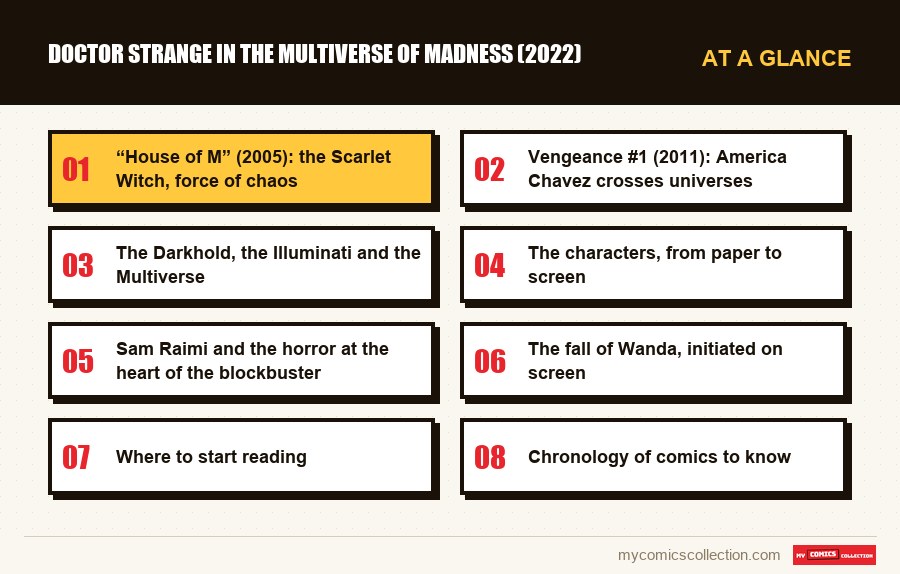
“House of M” (2005): the Scarlet Witch, force of chaos
The heart of the film, a Scarlet Witch whose power threatens reality itself, draws from the “House of M” arc (2005) by Brian Michael Bendis and Olivier Coipel. In this seminal tale, Wanda, devastated by the loss of her children and her own instability, rewrites entire reality with a single wish, creating a world where mutants dominate. The film takes up this founding idea: a Wanda consumed by grief, whose power to manipulate reality makes her the most dangerous being in the universe. The motivation is faithful, to find the children she lost, and the film even reuses, in a completely different context, the most famous line of the arc, spoken by Wanda in a moment of change. This is one of the most direct adaptations of the tragic and menacing aura of the Scarlet Witch from the comics.
The big difference lies in the status of the character: where the comics oscillate between heroine and threat, the film clearly makes Wanda the antagonist, a corrupt chaos magician ready to do anything for her goal. This radical choice is based on the events of previous productions of the saga to justify its fall.
Vengeance #1 (2011): America Chavez crosses universes
The film introduces America Chavez, a heroine with a singular power: opening portals between universes by punching the air. The character was born in Vengeance #1 (2011), created by Joe Casey and Nick Dragotta, before becoming a popular figure among young Marvel heroes. The film retains his spectacular power and role as an object of desire: his ability to travel the multiverse is precisely what Wanda seeks to take from him. On the other hand, its history and origins are largely simplified for the purposes of the story. America becomes the common thread that carries Strange through realities, embodying innocence threatened in the face of Wanda's misguided power.
The Darkhold, the Illuminati and the Multiverse
The film summons several emblematic elements from the comics. THE Darkhold, a dark magic grimoire of corrupting power, is a source of forbidden knowledge that drives its readers to madness; he plays a central role in Wanda's downfall. THE Illuminati, this secret council bringing together the greatest minds on Earth (introduced in New Avengers #7, 2005, by Bendis and McNiven), appear in an alternative version specific to the film, bringing together variants of known heroes. Finally, the multiverse itself, an ancient and fundamental concept in Marvel cosmology, structures the entire story, allowing Strange and America to traverse radically different realities. The film thus draws from a vast reservoir of concepts to compose its nightmarish journey.
The characters, from paper to screen
- Doctor Strange: Confronted with its own variants, it questions its nature and its moral limits.
- Scarlet Witch (Wanda): True to his “House of M” power, but clearly placed as an antagonist.
- America Chavez: Faithful Power (multiversal journey), simplified story.
- The Illuminati: Reinvented as an alternate version, bringing together hero variants.
- Wong: Sorcerer Supreme, faithful ally of Strange.
Collecting this series?
Track what you own, what you are missing and what your collection is worth. 7 day trial.
Start my trial →Sam Raimi and the horror at the heart of the blockbuster
The choice of Sam Raimi, master of horror and director of the first Spider-Man trilogy, gives the film a unique identity in the saga: jump scares, undead, macabre imagery and virtuoso camerawork. This horrific tone has no direct equivalent in the Doctor Strange comics, but it is consistent with the nature of the character, guardian against supernatural threats. Raimi transforms a superhero film into a waking nightmare, where magic becomes a source of fear. This divisive audacity of tone illustrates the saga's desire to diversify its registers by entrusting each film to a filmmaker with an assertive style. By letting Raimi unfold his universe, the film dares an unusual visual and emotional experience, faithful to the esoteric and disturbing dimension of Marvel magic.
This approach fits with the character of Wanda, whose fall evokes both tragedy and horror film. By filming her as a monstrous and pitiful figure at the same time, Raimi gives her a rare dramatic scale, faithful to the ambivalence which has always characterized the Scarlet Witch in the comics.
The fall of Wanda, initiated on screen
To understand the Scarlet Witch of the film, we must keep in mind that her fall was carefully prepared by previous productions of the saga, notably the series which featured her in the throes of mourning. Consumed by the loss of her loved one, Wanda had created, through her magic, an illusory reality where she lived an artificial happiness with two children born from her power. The end of this illusion, and the disappearance of these imaginary children, constitute the trauma which pushes her, in the film, to cross the multiverse to find them. This continuity between series and film, specific to the saga, gives its shift towards antagonism a tragic coherence and depth. Wanda does not become evil on a whim, but through maternal pain taken to the extreme.
This construction resonates with the spirit of comics, where the Scarlet Witch has always been a tragic character, whose immense power is inseparable from psychological fragility. From “Avengers Disassembled” to “House of M,” Wanda’s great stories explore precisely this link between excessive power and intimate distress. The film continues this tradition by making its grief the engine of catastrophe, true to the idea that Marvel's most devastating threats are often born from deeply human wounds. This is what distinguishes Wanda from a simple villain: we fear her as much as we pity her.
Where to start reading
The queen reading is “House of M” (2005) by Bendis and Coipel, the direct source of the film’s Wanda. It can be preceded by “Avengers Disassembled” (2004), which begins its fall. For America Chavez, Kieron Gillen's "Young Avengers" series (2013) offers its best development, as well as its own series in 2017. Those curious about the Illuminati will find their origin in New Avengers #7 (2005). Finally, Doctor Strange's big runs shed light on the character and Marvel magic. From 2005 to today, this journey covers the sources of a film which draws on several modern stories.
Chronology of comics to know
- 2005: “House of M”: the Scarlet Witch rewrites reality.
- 2005: New Avengers #7: The Illuminati.
- 2011: Revenge #1: First appearance of America Chavez.
Collection side: what numbers to aim for after the film
Multiverse of Madness highlights modern keys. Revenge #1 (first appearance of America Chavez) is an issue from the 2010s whose popularity increased with the arrival of the character on screen, still accessible for a first purchase. Issues of “House of M” (2005) are popular modern targets, as is New Avengers #7 (Illuminati). These stories, available in collections, offer an excellent entry point to a controlled budget. As always, condition and gradation determine value; relying on real recent sales is strongly recommended. Vengeance #1 is a great example of a recent first appearance propelled by cinema, one to watch for any collector attentive to trends.
Its place in the saga and for the collector
Multiverse of Madness deepens the concept of the multiverse, called upon to structure the future of the saga, while sealing the tragic fate of the Scarlet Witch. For the collector, the film reignited interest in Vengeance #1 and in Wanda's great stories, notably "House of M." This film illustrates the effect of cinema on recent first appearances, the popularity of which can soar as soon as an adaptation is announced. Beyond speculation, it invites you to discover one of Marvel's most complex and powerful characters, the Scarlet Witch, whose editorial story combines heroism, madness and redemption. By entrusting its cinematography to Sam Raimi, the film dares a horrific reinterpretation which does justice to the dark side of the character, while opening wide the doors to the multiverse.
The verdict: the power of Wanda, in horror mode
- Loyalty: the Scarlet Witch who rewrites reality (“House of M”), the Darkhold, the Illuminati and America Chavez come from the comics.
- Freedoms: Wanda clearly antagonistic, America's story simplified, a horrific tone specific to Raimi.
- Collectible numbers: Vengeance #1 (America Chavez), “House of M” (2005), New Avengers #7 (Illuminati).
Multiverse of Madness adapts the devastating power of the Scarlet Witch through the prism of horror, under the inspired direction of Sam Raimi. Building on “House of M” and introducing America Chavez, the film explores the multiverse while providing Wanda with a tragic conclusion. For reader and collector alike, it's an invitation to discover one of Marvel's most memorable modern stories, and a recent debut to watch closely. By combining horror and superheroics, the film proves once again that the saga can reinvent itself by changing register, as long as it remains faithful to the soul of its characters.
Frequently asked questions
Mainly from “House of M” (2005) by Brian Michael Bendis, where the Scarlet Witch rewrites reality. The film also introduces America Chavez (Vengeance #1, 2011), the Darkhold and the Illuminati (New Avengers #7, 2005).
She oscillates between heroine and menace. In “House of M”, consumed by grief, she turns reality upside down. The film clearly places her as the antagonist, a chaos magician corrupted by the Darkhold.
A heroine capable of opening portals between universes, appearing in Vengeance #1 (2011). The film retains her power but simplifies her story, making her the object of Wanda's lust.
The concept comes from New Avengers #7 (2005): a secret council of Earth's greatest minds. The film offers an alternative version specific to its universe, bringing together variations of known heroes.
Vengeance #1 (first appearance of America Chavez) is a recent debut appearance to watch out for. Other popular modern targets include “House of M” (2005).
Does the film make you want to collect? Estimate the value for free of your issues (Vengeance #1, House of M…) with our tool based on current eBay listings.