Avengers: Age of Ultron (2015), directed by Joss Whedon , stages Ultron, artificial intelligence born in Avengers #54-55 (1968) by Roy Thomas and John Buscema. The film also introduces Vision (Avengers #57, 1968) and the twins Quicksilver and the Scarlet Witch , appeared in X-Men #4 (1964). It retains Ultron's DNA, a creation that turns against its parents, but changes its creator and the context. Despite the title, it does not follow the 2013 “Age of Ultron” comic event. Detailed comparison, film versus comics.
The second major gathering in the saga, Age of Ultron was supposed to be darker and denser than the first. Joss Whedon summons one of the team's most emblematic enemies and enriches the cast with three major characters. For this, the film goes back to the comics of the late 1960s while freeing itself from the modern event from which it nevertheless borrows the name. Decryption.
As in each article, only verified information (distribution, dates, numbers, creators) is stated; the comparative analysis is ours, without reproducing dialogue or protected images.
Title : Avengers: Age of Ultron (2015)
Director: Joss Whedon
Actors: Robert Downey Jr., Chris Evans, Chris Hemsworth, Mark Ruffalo, Scarlett Johansson, James Spader (Ultron), Elizabeth Olsen (Wanda), Aaron Taylor-Johnson (Pietro), Paul Bettany (Vision)
Exit : May 1, 2015 (United States)
Studio: Marvel Studios
Avengers #54-55 (1968): appearance of Ultron (Roy Thomas & John Buscema)
Avengers #57 (1968): 1st appearance of Vision (modern synthezoid)
X-Men #4 (1964): 1st appearance of Quicksilver and the Scarlet Witch
Ultron created by Hank Pym: classic lineage of comics
- Ultron, AI which turns against its creators to “save” the world from humans.
- The parentage link: Ultron creates Vision, which ends up turning against him.
- Vision, synthezoid with consciousness and a stone on its forehead.
- The twins Quicksilver and the Scarlet Witch, speed and chaos magic.
- The theme of the creation that escapes its master, at the heart of Ultron since 1968.
- The creator of Ultron: Hank Pym in the comics, the film attributes him to Tony Stark and Bruce Banner.
- The twins are not Magneto's children here (separate rights): their powers come from HYDRA-related experiments.
- The title picks up the event “Age of Ultron” (2013), but the plot has nothing to do with it.
- Vision is born from a mixture between the AI Jarvis, Ultron and an Infinity Stone, a genesis specific to the film.
- The story condenses decades of continuity in a single crisis.
Avengers #54-55 (1968): The Birth of Ultron
Ultron appears in Avengers #54 (1968), first masked as the "Crimson Cowl", before being fully revealed in Avengers #55, with a script by Roy Thomas and art by John Buscema. Its nature is established from the outset: an artificial intelligence which turns against humanity and against its creators, driven by a chilling logic: “saving” the world by ridding it of those who designed it. The film faithfully takes up this DNA: a synthetic mind which concludes that the best way to protect the Earth is to put an end to humanity. James Spader lends Ultron a disturbing irony which prolongs the character's coldness on screen.
The great freedom of the film concerns the paternity of Ultron. In the comics, he is the creation of Hank Pym (Ant-Man), who despite himself conceives a parricide “son”. The character of Pym not yet being established in the cinema at this stage, the film attributes the creation of Ultron to Tony Stark and Bruce Banner: a choice which modifies the symbolic scope of the story while retaining the idea of the creator overwhelmed by his work.
Avengers #57 (1968): Vision, the monster's child
Vision, one of the most striking characters in the film, is born in Avengers #57 (1968). A synthezoid with consciousness and emotions, it is, in the comics, created by Ultron to infiltrate the Avengers, before rebelling and joining the team. The film retains this paradoxical connection, the weapon designed by the monster which turns against him, but reinvents its genesis: on screen, Vision is born from a mixture between Stark's AI Jarvis, the body prepared by Ultron and an Infinity Stone lodged in his forehead. This hybrid origin, specific to the film, serves the logic of the Stones which structures the entire saga.
X-Men #4 (1964): The Maximoff Twins
Quicksilver (Pietro) and the Scarlet Witch (Wanda) appear in X-Men #4 (1964), created by Stan Lee and Jack Kirby. In the comics, they begin as members of the Brotherhood of Evil Mutants before joining the Avengers, and are long presented as Magneto's children. This last link being linked to separate rights at the time, the film gets around the obstacle: the twins here draw their powers from experiments carried out by HYDRA. The function remains the same (speed for one, chaos and mind manipulation for the other) but their origin is completely rewritten.
A borrowed title, an autonomous plot
A detail that often traps readers: the film takes the title of the event “Age of Ultron” published in 2013, but does not adapt the story. This comic crossover offered a very different apocalyptic and temporal story, where Ultron had already taken control of the world. The film only keeps the name, evocative and effective, and constructs its own plot from the classic DNA of the character. This is an example of how cinema sometimes draws from comics a simple title with strong resonance, regardless of the content.
Collecting this series?
Track what you own, what you are missing and what your collection is worth. 7 day trial.
Start my trial →The characters, from paper to screen
- Ultron: Faithful to its essence of 1968 (the parricide AI), but linked to Stark and Banner rather than Hank Pym.
- Vision: The connection with Ultron is preserved; its genesis is hybridized with Jarvis and an Infinity Stone.
- Scarlet Witch (Wanda): Loyal Powers, origin rewritten via HYDRA rather than Magneto.
- Quicksilver (Pietro): The fast twin, whose destiny is influenced by the film.
- The Avengers: The team from the first film, now experienced, faced with a threat born of their own hands.
Joss Whedon and the shadows on the board
Back after the first Avengers, Joss Whedon seeks to darken the formula: heroes' guilt, monstrous creation born of good intentions, internal fractures. This relative darkness revives a tradition in Avengers comics, where the greatest threats often arise from within, from an error by a member of the team. Ultron, the misguided “son” of his creators, is the perfect incarnation. The film thus reflects on technological responsibility: what happens when we create an intelligence that we no longer control? which resonates with contemporary anxieties as much as with the 1968 story.
Vision and the Scarlet Witch, a cult comic book couple
The film sows the seeds of a relationship that, in the comics, has become one of Marvel's most memorable: that of Vision and the Scarlet Witch. After both joining the Avengers in the 1960s and 70s, the synthezoid and the chaos manipulator live an improbable love story, culminating in a famous miniseries from the 1980s which features them as a couple. This romance between an artificial creature and a human witch has informed decades of stories about identity, family and loss. Age of Ultron only sketches their closeness, but it lays the foundations for a link that later productions of the saga will fully exploit.
The Scarlet Witch, in particular, is a character of considerable power in the comics, capable of rewriting reality itself: as in the big event "House of M" (2005), where a single sentence of hers turns the mutant universe upside down. The film only scratches the surface of this rise to power, but it already establishes Wanda as a force apart, whose potential exceeds that of most of her teammates. For the reader, it is an invitation to explore a heroine whose importance has continued to grow over the decades.
Where to start reading
The founding reading is Avengers #54-55 (1968), for the birth of Ultron, immediately followed by Avengers #57 for that of Vision: these three issues establish everything that the film takes up. We can then go back to X-Men #4 (1964) for the debut of the Maximoff twins, then explore the modern stories which have deepened the Scarlet Witch and Vision, who have become major characters. Those curious about the title can finally take a look at the event “Age of Ultron” (2013): keeping in mind that the film only uses the name. From 1964 to today, this journey covers the origins of all the film's newcomers.
Chronology of comics to know
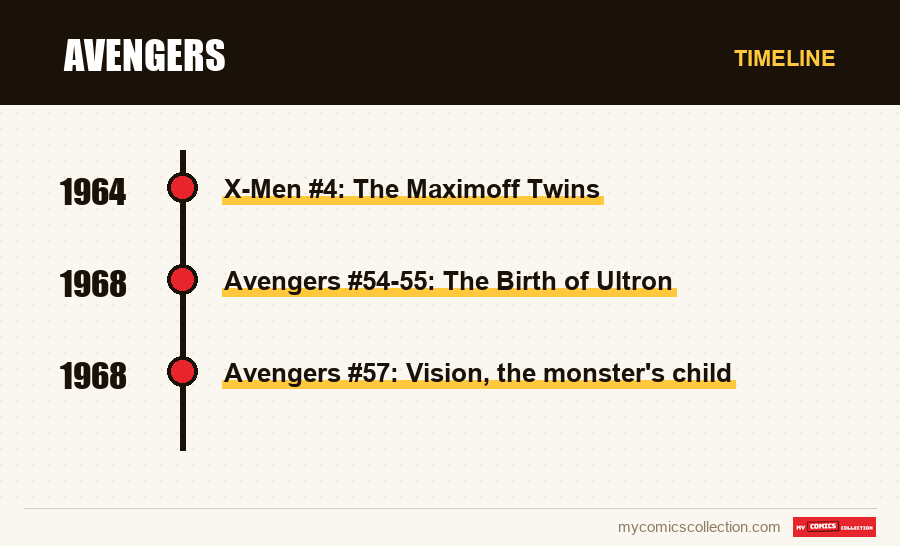
- 1964: X-Men #4: First appearances of Quicksilver and the Scarlet Witch.
- 1968: Avengers #54-55: appearance of Ultron, created by Hank Pym.
- 1968: Avengers #57: First appearance of Vision.
- 2013: event “Age of Ultron”: the film only borrows the title.
Collection side: what numbers to aim for after the film
Age of Ultron highlights keys from the late 1960s. Avengers #55 (Ultron's first full appearance) and Avengers #57 (Vision's first appearance) are sought-after issues of the Silver Age, buoyed by the enduring popularity of both characters on screen. X-Men #4 (first appearances of the Maximoff twins) is another prime target, especially since it is also a major issue for the mutant universe. These keys are in an intermediate price range, more affordable than the very first issues from 1962-1963. As always, condition and gradation determine value; relying on real recent sales remains recommended.
The verdict: a 1968 classic brought up to date
- Loyalty: the essence of Ultron, his relationship to Vision and the powers of the twins are respected.
- Freedoms: Ultron created by Stark/Banner, the twins' origin rewritten via HYDRA, and a title borrowed from an unrelated event.
- Collectible numbers: Avengers #55 (Ultron), Avengers #57 (Vision), X-Men #4 (the twins).
Age of Ultron draws from the 1968 comics a strikingly modern antagonist: an artificial intelligence who judges humanity unworthy of survival. By reattributing its creation and rewriting the origin of the twins, the film adapts to the constraints of cinema while preserving the heart of the story. For the collector, it highlights a beautiful cluster of keys from the end of the Silver Age, around three characters who have become essential.
Its place in the saga and for the collector
Age of Ultron occupies a pivotal place: it fractures the team from the inside and lays the groundwork for future conflicts, notably by installing Vision and the Stone lodged in his forehead, called to play a decisive role in the rest of the saga. The tensions that arise here between the heroes directly prepare for their future division. For the collector, the film highlights a cohesive cluster of keys from the late 1960s (Avengers #55 (Ultron), Avengers #57 (Vision)) as well as a major issue of the mutant universe, X-Men #4 (the Maximoff twins). These numbers, located in an intermediate range, constitute excellent targets for those who want to have significant first appearances without aiming for the overpriced grails of 1962-1963. By shining the spotlight on Ultron, Vision and the Scarlet Witch, the film has lastingly revived interest in these characters and their founding numbers: another reminder that cinema and collecting now move forward hand in hand.
Frequently asked questions
From the birth of Ultron in Avengers #54-55 (1968) and Vision in Avengers #57, plus the twins' debut in X-Men #4 (1964). Despite its title, the film does not adapt the 2013 “Age of Ultron” event.
Hank Pym (Ant-Man). The film instead attributes its creation to Tony Stark and Bruce Banner, as Hank Pym was not yet established in the cinema at this point in the saga.
This link was a matter of separate rights at the time. The film gets around the obstacle by having their powers arise from experiments carried out by HYDRA, rather than from their original mutant parentage.
A mix between Stark's AI Jarvis, a body prepared by Ultron and an Infinity Stone. In the comics (Avengers #57, 1968), it is Ultron alone who creates it to infiltrate the Avengers.
Avengers #55 (Ultron's first full appearance) and Avengers #57 (Vision's first appearance), as well as X-Men #4 (the Maximoff twins), three sought-after keys from the late 1960s.
Does the film make you want to collect the Avengers? Estimate the value for free of your issues (Avengers #55, #57, X-Men #4…) with our tool based on current eBay listings.