
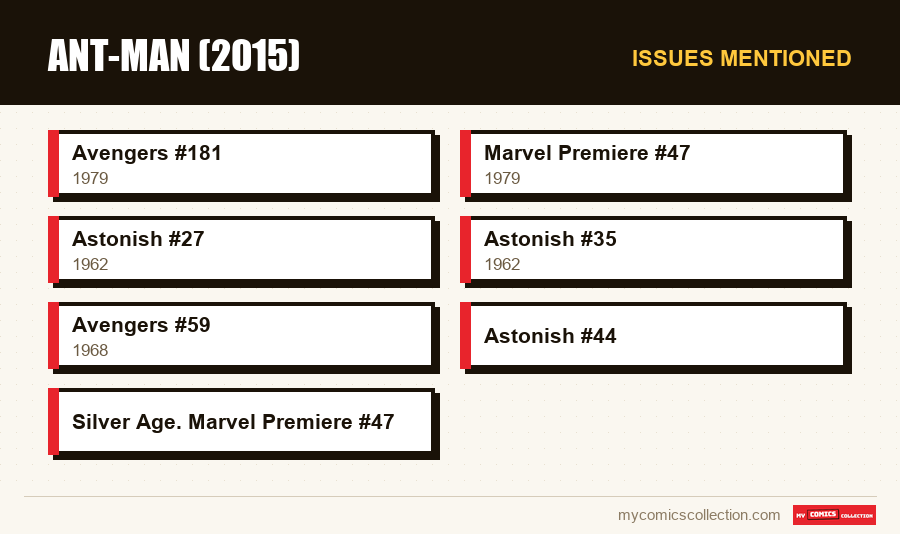
Ant-Man (2015), directed by Peyton Reed with Paul Rudd, features the second Ant-Man from the comics, Scott Lang , appeared in Avengers #181 (1979) and became a miniature vigilante in Marvel Premiere #47 (1979). The film is also based on the very first Ant-Man, Hank Pym , born in Tales to Astonish #27 (1962) and costumed from Tales to Astonish #35 (1962). It retains the mechanics of the repentant burglar mentored by Pym, but reassigns the identity of Yellowjacket to the villain and reinvents Hope van Dyne. Detailed comparison, film versus comics.
After a long series of classic superheroes, Ant-Man dares to create a small-scale heist film, mixing comedy and science fiction. Under the direction of Peyton Reed, the story is based on a rare feature of comics: the mantle of Ant-Man has been worn by several men. It is this transmission which structures the film, which chooses to tell the story not of the pioneer, but of his successor. Source-by-source decryption.
As in each article in the series, only verified information (distribution, dates, numbers, creators) is stated; the comparative analysis is ours, without reproducing dialogue or protected images.
Title : Ant-Man (2015)
Director: Peyton Reed
Actors: Paul Rudd (Scott Lang), Michael Douglas (Hank Pym), Evangeline Lilly (Hope van Dyne), Corey Stoll (Darren Cross / Yellowjacket), Michael Peña (Luis)
Exit : July 17, 2015 (United States)
Studio: Marvel Studios
Tales to Astonish #27 (1962): 1st appearance of Hank Pym (Lee, Lieber & Kirby)
Tales to Astonish #35 (1962): Hank Pym becomes Ant-Man
Avengers #181 (1979): Scott Lang's first appearance
Marvel Premiere #47 (1979): Scott Lang becomes Ant-Man (Michelinie, Layton, Byrne)
- La coat transmission: Scott Lang, second Ant-Man, succeeds Hank Pym.
- Scott Lang, repentant burglar, who steals the costume before becoming its hero: true to Marvel Premiere #47.
- THE Pym particles, miniaturization and ant control.
- Hank Pym, genius scientist and creator of technology.
- Darren Cross, antagonist from the same 1979 story.
- Hank Pym is an elderly mentor: the film glosses over his career as the founding Avenger and creator of Ultron.
- Yellowjacket was an identity of Pym in the comics; the film gives it to villain Darren Cross.
- Hope van Dyne is largely reinvented: in the comics, Hope Pym is a villain from an alternative future.
- Le heist movie tone, comic and family, is suitable for adaptation.
- The story condenses decades of history of the two Ant-Mans in a single plot.
Tales to Astonish #27 and #35 (1962): the first Ant-Man
The mantle of Ant-Man is born with Hank Pym. The scientist appears in Tales to Astonish #27 (January 1962), in a story of anticipation where a researcher tests a reduction formula; he returns, this time in costume and fully heroic, in Tales to Astonish #35 (September 1962). Created by Stan Lee, Larry Lieber and Jack Kirby, Pym would become a founding member of the Avengers and one of Marvel's most important scientific minds. The film retains its central invention, particles that allow you to shrink while increasing force, but makes a radical choice: not to tell its hero story. On screen, Pym is already old, withdrawn, and transmits his knowledge rather than fighting. His entire career as an Avenger, including his role as the creator of Ultron, is left offscreen.
This bias allows the film to focus on a more accessible and lighter figure: the successor. It's a clever way of circumventing the heavy continuity of Pym to offer a new entry point.
Marvel Premiere #47 (1979): Scott Lang takes over
The film's hero, Scott Lang, first appeared in Avengers #181 (1979) before becoming the second Ant-Man in Marvel Premiere #47 (1979), with a script by David Michelinie and art by Bob Layton and John Byrne. Its origin is exactly that of the film: a burglar, driven by necessity, steals Hank Pym's Ant-Man costume: before the latter, rather than punishing him, allows him to become a hero. This idea of a thief redeemed by the trust of his mentor is the emotional heart of the film, taken almost as is. This is one of the cases where the adaptation faithfully follows the letter of a precise story from the comics.
Yellowjacket, Hope and the freedoms of film
The film, however, allows for several notable deviations. The villain, Darren Cross, does exist in the comics (he appears in the same Marvel Premiere #47), but the identity of Yellowjacket attributed to him on screen belonged to Hank Pym himself, who adopted him in Avengers #59 (1968). The film recovers this name and this silhouette to dress its antagonist, a typical example of recombination. As for Hope van Dyne, she is largely a creation of the film: in the comics, Hope Pym, daughter of Hank and Janet, is a supervillain from an alternate future. The film makes her a determined ally, called to become the Wasp, completely reorienting the character.
The characters, from paper to screen
- Scott Lang: True to Marvel Premiere #47: the repentant burglar who became a hero thanks to the grace of his mentor.
- Hank Pym: Reduced to the role of elderly mentor, his storied career as an Avenger left off-camera.
- Hope van Dyne: Reinvented as a heroic ally and future Wasp, the opposite of the villainess of the comics.
- Darren Cross / Yellowjacket: Antagonist from the comics, with an identity borrowed from Pym.
- Janet van Dyne: The first Wasp, mentioned implicitly, historical pillar of the Pym universe.
Collecting this series?
Track what you own, what you are missing and what your collection is worth. 7 day trial.
Start my trial →Peyton Reed and the miniature heist movie
Ant-Man takes on an unusual genre for a superhero film: the heist film. Under the leadership of Peyton Reed, the story is organized around a burglary, with a motley crew, a meticulous plan and omnipresent humor. This light tone is an added layer that doesn't exist as is in the comics, but it serves the character admirably: a hero whose power involves becoming tiny naturally lends itself to ingenuity rather than brute force. The film thus transforms a constraint, a superpower considered unspectacular, into a comic and visual asset, proving that a secondary character can carry a film in its own right.
Where to start reading
To discover the two Ant-Mans, we can start with the origins of Hank Pym (Tales to Astonish #27 and #35, 1962), then switch to the founding arc of Scott Lang (Marvel Premiere #47, 1979), the closest to the film. Those curious about family dynamics will benefit from exploring the stories featuring Janet van Dyne, the first Wasp, whose historical importance is immense. Finally, Scott Lang's modern runs, lighter and centered on his authorship, perfectly extend the spirit of the film. From 1962 to the present, this journey covers both the pioneer and his successor, the two faces of Ant-Man.
The Wasp, forgotten half of the founding duo
An essential part of Ant-Man's mythology surfaces in the film without being fully developed: the Wasp. In the comics, Janet van Dyne becomes Hank Pym's partner from the first stories in the 1960s, and the Ant-Man / Wasp duo are among the founding members of the Avengers. It's even Janet who, in the comics, finds the name of the team. The film evokes this story implicitly, through Hank's mourning for his missing wife, and above all prepares for the future: Hope van Dyne, reinvented as a heroic ally, is clearly destined to take on the role of the Wasp. By placing this transmission at the heart of its subtext, the film pays a discreet homage to a duo too often eclipsed in popular memory, even though they are one of the historical pillars of the Avengers.
This family dimension (two generations of costume wearers, couples of scientist-adventurers) is what distinguishes Ant-Man from the other heroes of the saga. The film makes it its emotional material, preferring the intimate to the spectacular, faithful to a tradition of comics where the private lives of the Pyms weighed as much as their exploits.
Chronology of comics to know
- 1962: Tales to Astonish #27: First appearance of Hank Pym.
- 1962: Tales to Astonish #35: Hank Pym becomes Ant-Man.
- 1968: Avengers #59: Hank Pym adopts the identity of Yellowjacket.
- 1979: Avengers #181 then Marvel Premiere #47: arrival of Scott Lang, second Ant-Man.
Collection side: what numbers to aim for after the film
Ant-Man offers a two-tiered array of keys. Tales to Astonish #27 (first appearance of Hank Pym) is a major key to the Silver Age, all the more sought after as Pym is a founding Avenger; its high ranks reach new heights. Tales to Astonish #35 (first costumed Ant-Man) is another historical target. Bronze Age side, Marvel Premiere #47 (first Scott Lang as Ant-Man) remains much more affordable and directly linked to the film. This diversity makes it possible to target both a prestigious piece and an accessible key. As always, condition and gradation determine value; relying on recent real sales is strongly recommended before any purchase. A tip for getting started: Marvel Premiere #47 offers an excellent ratio between historical importance (first appearance of a hero brought to the screen) and still reasonable price, which makes it an ideal entry point before considering the more prestigious pieces from 1962. Fans of the Wasp can also aim for Tales to Astonish #44, the first appearance of Janet van Dyne, often neglected but historically major.
Its place in the saga and for the collector
Ant-Man gently closes “phase 2” of the saga by focusing on humor and intimate scale, going against the cosmic clashes. For the collector, it has the merit of highlighting a character with a rich editorial history but little known to the general public: few spectators know that the costume was worn by several men, nor that Hank Pym was one of the pillars of the first Avengers. Rekindling interest in Tales to Astonish #27 and Marvel Premiere #47, the film bridges two distinct eras of comics and provides a collecting journey that is both affordable and rewarding. It's also a reminder that the least flashy heroes sometimes contain the most endearing stories, and that cinema can restore value to figures who have long remained in the shadows.
The verdict: a faithful successor, a hidden pioneer
- Loyalty: Scott Lang's origin (Marvel Premiere #47) is followed closely, Pym particles included.
- Freedoms: Hank Pym reduced to mentorship, Yellowjacket given to villain, Hope van Dyne reinvented.
- Collectible numbers: Tales to Astonish #27 (Hank Pym), #35 (first Ant-Man), Marvel Premiere #47 (Scott Lang).
By choosing to tell the story of the successor rather than the pioneer, Ant-Man cleverly circumvents complex continuity to offer a fresh and accessible adventure. The film stays true to the spirit of Marvel Premiere #47, a thief's redemption through trust, while freely rearranging the cast of characters. For the reader, it is an invitation to rediscover the little-known story of a coat passed down from hand to hand since 1962. Rare are the heroes whose identity itself is transmitted in this way from generation to generation: it is this singularity, more than the size of its wearer, which makes all the richness of Ant-Man and makes it a fascinating case study for those interested in the mechanics of Marvel characters.
Frequently asked questions
On the origin of Scott Lang, second Ant-Man, in Marvel Premiere #47 (1979), and that of Hank Pym, the first Ant-Man, in Tales to Astonish #27 and #35 (1962).
The film chooses to tell the story of the successor, Scott Lang, rather than the pioneer. Pym becomes an elderly mentor, and his career as a founding Avenger and creator of Ultron is left off-camera to provide a lighter gateway.
No: Yellowjacket was originally an identity of Hank Pym himself (Avengers #59, 1968). The film attributes this name and silhouette to the true antagonist, Darren Cross.
Largely reinvented: in the comics, Hope Pym is a supervillain from an alternate future. The film makes her a heroic ally called to become the Wasp.
Tales to Astonish #27 (Hank Pym's first appearance) is the major key to the Silver Age. Marvel Premiere #47 (first Scott Lang as Ant-Man) is the more accessible Bronze Age entry and directly related to the film.
Does the film make you want to collect Ant-Man? Estimate the value for free of your issues (Tales to Astonish #27, Marvel Premiere #47…) with our tool based on current eBay listings.