
Ant-Man debuted in January 1962 in Tales to Astonish #27 as a standalone sci-fi story titled "The Man in the Ant Hill," then returned in costume in Tales to Astonish #35 (September 1962), created by Stan Lee, Jack Kirby, and Larry Lieber at Marvel Comics. Hank Pym, Scott Lang, and later Eric O'Grady have each worn the mask, from the Silver Age through the MCU era, by way of the West Coast Avengers run and the 2003 Scott Lang relaunch. This guide traces his origin , his complete biography , the series timeline , the key issues to know , and the major arcs worth collecting.
Ant-Man holds a peculiar place in Marvel mythology: neither a headliner like Spider-Man nor an icon like the Fantastic Four, the character owes his staying power to three successive bearers and to founding-member status in the Avengers, locked in as early as The Avengers #1 in September 1963. Hank Pym first appears as an anonymous scientist before Pym Particles give the costume its lasting editorial reach. More than sixty years after Tales to Astonish #27, the character has gone from a second-tier curiosity to mainstream cultural property thanks to the three Ant-Man feature films released between 2015 and 2023.
This article follows a methodical structure: editorial origin, profile of the three bearers, timeline of the solo and team series, top 10 key issues to add to a collection, major arcs and classic runs, then adaptations. For the detailed list of issues to hunt down and their values, the Ant-Man key issues article serves as a direct companion.
Ant-Man biography
Ant-Man is a Marvel Comics character created by Stan Lee, Jack Kirby, and Larry Lieber. His first appearance came in Tales to Astonish #27 in January 1962, in a short science-fiction story where a scientist accidentally shrinks to the size of an ant. The costume and the Ant-Man name arrived in Tales to Astonish #35 in September 1962. Three characters have held the identity in succession: Hank Pym, Scott Lang, and Eric O'Grady.
Ant-Man profile
- Real name: Henry "Hank" Pym (original), Scott Lang, Eric O'Grady
- First appearance : Tales to Astonish #27 (January 1962) as a standalone story, Tales to Astonish #35 (September 1962) as Ant-Man
- Creators: Stan Lee, Jack Kirby, Larry Lieber
- Publisher: Marvel Comics
- Affiliations: Avengers (founding member), Defenders, Future Foundation, FBI (Eric O'Grady)
- Status: Hero (antihero for Eric O'Grady)
- Alternate identities: Giant-Man, Goliath, Yellowjacket, Wasp (Pym)
Character origins
The January 1962 story ran in a science-fiction anthology, at a time when Marvel was trying to replicate the success of Fantastic Four #1 (November 1961) with other concepts. Hank Pym, a biochemist, isolates a subatomic particle capable of altering an organism's mass. He tests it on himself, gets attacked by ants, and returns to normal size: the whole story fits in eight pages. Seven months later, Stan Lee decided to relaunch the character as a costumed super hero, added a cybernetic helmet that allowed him to communicate with ants, and installed the Ant-Man title as a regular feature in Tales to Astonish. Janet Van Dyne, the future Wasp, joins the story in Tales to Astonish #44 in June 1963. Three months later, Pym and Wasp become founding members of the Avengers alongside Iron Man, Thor, and Hulk in The Avengers #1, cementing Ant-Man's place in Marvel continuity for good.
Powers and abilities
- Pym Particles: allow instant shrinking or growth of the wearer and of objects, while retaining human-level strength at ant size
- Communication with ants: a cybernetic helmet that emits and receives the pheromones and electromagnetic waves of insects
- Amplified strength at reduced size: unchanged muscle density at a tiny mass, allowing blows with the force of a full-sized human
- Scientific genius: Hank Pym is one of the five most brilliant minds on Earth in Marvel continuity, and notably the creator of Ultron
- Burglary and electronics skills: Scott Lang brings the know-how of an electronics engineer and former convict to high-tech heists
Costume and visual identity
The Ant-Man costume pairs red and black with a distinctive cybernetic helmet topped by two antennae. Hank Pym wore this outfit from 1962 to 1963 before morphing into Giant-Man (a blue-and-red costume), Goliath, Yellowjacket (yellow and black), and briefly Wasp. Scott Lang revives the red-and-black palette starting in 1979 in Marvel Premiere #47, adding articulated plating. Eric O'Grady adopts a greenish version in the series The Irredeemable Ant-Man in 2006. The Scott Lang version, popularized by the MCU from 2015 on, has become the character's modern visual reference.
Ant-Man series timeline
Ant-Man has never carried a long-running solo title, but he fits into short, memorable editorial cycles, alternating with team series where Pym and later Scott Lang hold a central role.
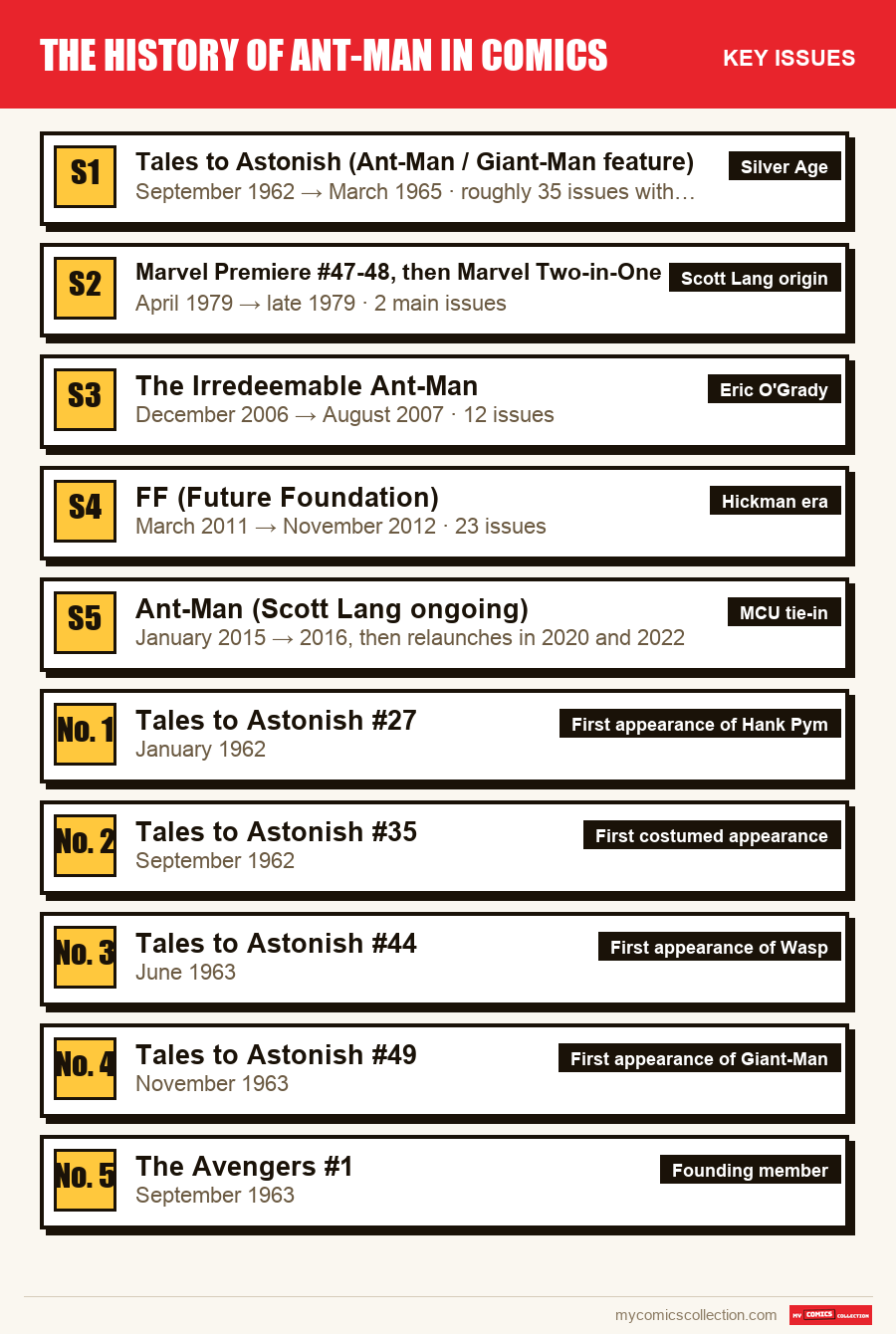
Tales to Astonish (Ant-Man / Giant-Man feature)
Hank Pym headlines the Tales to Astonish anthology starting with #35 in September 1962. Stan Lee writes, with Jack Kirby and Don Heck on art. The title introduces Wasp in #44 and the Giant-Man costume in #49, and lays the groundwork for Pym the scientist. The feature gives way to Sub-Mariner and Hulk in #59.
Marvel Premiere #47-48, then Marvel Two-in-One
David Michelinie and John Byrne launch Scott Lang in Marvel Premiere #47 (April 1979), with the story of an engineer-turned-burglar who steals Pym's Ant-Man costume to save his daughter, Cassie. Cassie would later become Stinger and then Stature, a hero of the Young Avengers.
The Irredeemable Ant-Man
Robert Kirkman and Phil Hester introduce Eric O'Grady, an opportunistic SHIELD agent, in a miniseries built around the theft of a new Ant-Man suit. The tone is decidedly antiheroic and establishes the third bearer of the identity.
FF (Future Foundation)
Jonathan Hickman folds Scott Lang into the Future Foundation, the team that succeeds the Fantastic Four. This period is pivotal in maturing the character into a father figure after Cassie's death.
Ant-Man (Scott Lang ongoing)
Nick Spencer writes Scott Lang's first lasting solo series, launched to accompany the film Ant-Man released in July 2015. Several Al Ewing and Zeb Wells miniseries would follow through 2022 to mark the character's 60th anniversary.
Collecting this series?
Track what you own, what you are missing and what your collection is worth. 7 day trial.
Start my trial →Top 10 Ant-Man key issues
Here are the ten issues to prioritize in an Ant-Man collection. For detailed values and variants, the Ant-Man key issues guide rounds out this selection.
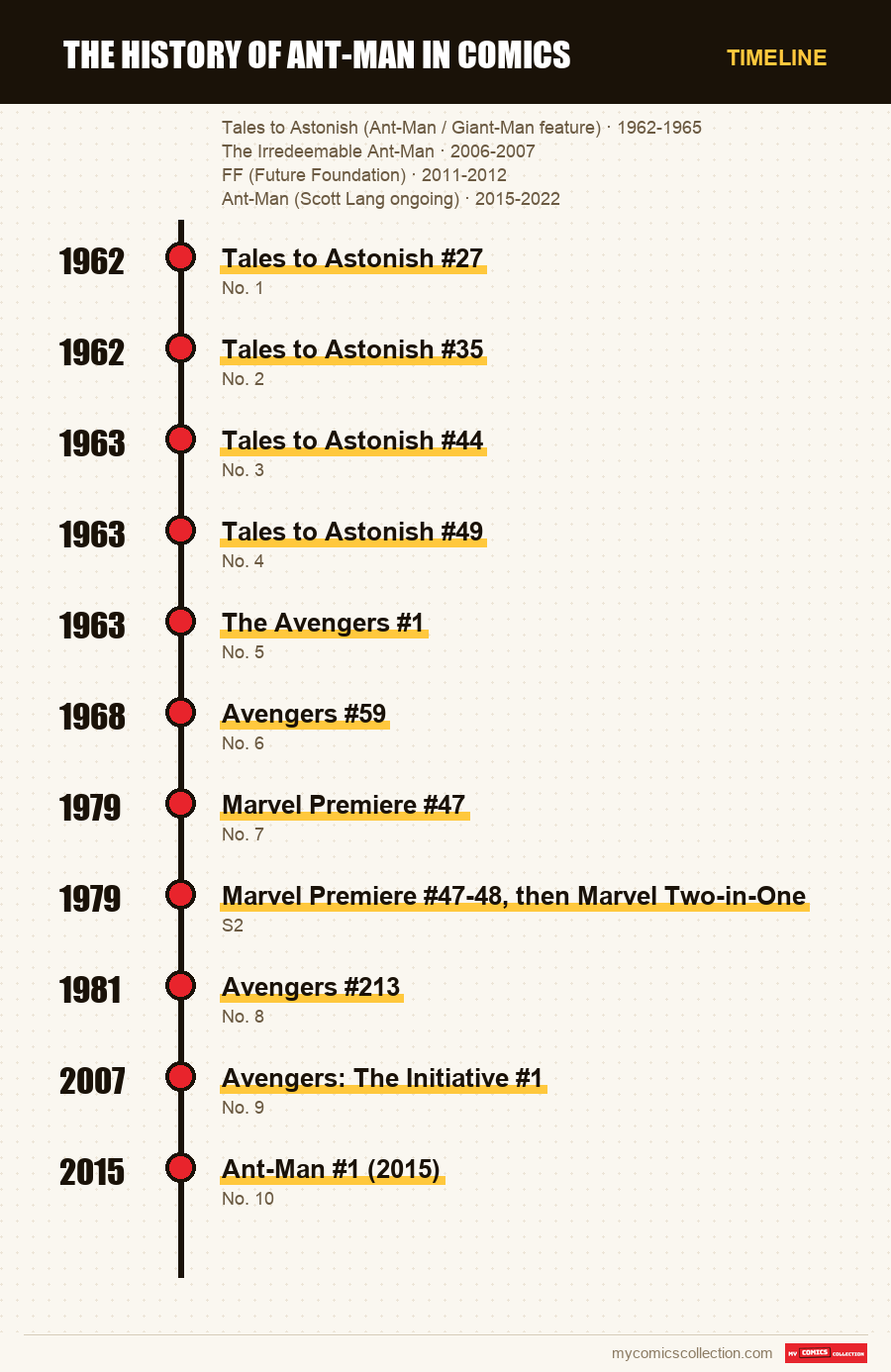
Tales to Astonish #27
First appearance of Hank Pym in the story "The Man in the Ant Hill." A foundational issue that became key after the 2015 MCU film. Retroactive continuity made it the true first appearance of the proto-Ant-Man version, which triggered a rush on the secondary market as early as 2014.
Tales to Astonish #35
The first issue with Hank Pym wearing the Ant-Man costume and the cybernetic helmet. Kirby cover. Considered by part of the market to be the "real" first appearance of Ant-Man, which makes it a permanent value rival to #27.
Tales to Astonish #44
First appearance of Janet Van Dyne / Wasp, Hank Pym's longtime partner and a future founding Avenger. A doubly sought-after issue for both Ant-Man and Wasp collectors.
Tales to Astonish #49
Hank Pym temporarily sets aside Ant-Man to become Giant-Man. A pivotal issue in Pym's journey, sought after by completist Silver Age collectors.
The Avengers #1
Pym and Wasp join Iron Man, Thor, and Hulk to found the Avengers. One of the most expensive Silver Age issues on the market and a must-have for any serious Ant-Man collection. Commands a very high value at every grade.
Avengers #59
Pym takes on the Yellowjacket identity. An important issue for understanding the character's psychological arc, which would take a dark turn in Avengers #213 in 1981.
Marvel Premiere #47
First appearance of Scott Lang in the Ant-Man costume, by David Michelinie and John Byrne. An issue that became central after the 2015 MCU film. Lang had made a brief civilian appearance in Avengers #181 in March 1979.
Avengers #213
The controversial issue in which Pym strikes Wasp, a major narrative turning point for the character. An editorial touchstone cited for four decades, written by Jim Shooter.
Avengers: The Initiative #1
Eric O'Grady joins the Initiative team in the wake of Civil War, consolidating the third bearer of the Ant-Man suit within Marvel continuity. An accessible issue for starting a modern collection.
Ant-Man #1 (2015)
Nick Spencer launches Scott Lang's first lasting solo series, six months before the film's release. Several variants were printed in low quantities, making it fertile ground for speculation among MCU collectors.
Major arcs and classic runs
Ant-Man's journey reads through five blocks of arcs that structure the character's mythology. Tales to Astonish #35-69 (1962-1965) covers the foundational Stan Lee / Jack Kirby period and the transition to Giant-Man. Avengers #59-60 (1968) marks the birth of Yellowjacket by Roy Thomas and John Buscema, with the Pym/Wasp wedding in the background. Avengers #213-230 (1981-1983), by Jim Shooter and Bob Hall, depicts Pym's downfall, his expulsion from the Avengers, and his trial: a sequence often debated but editorially decisive. Marvel Premiere #47-48 (1979) introduces Scott Lang by Michelinie / Byrne, the basis for the version the MCU popularized. Finally, Jonathan Hickman's FF run (2011-2012) repositions Scott Lang as a father figure after Cassie's death during Avengers: The Children's Crusade. The Avengers team journey remains inseparable from Ant-Man's story, and the Avengers key issues lists overlap heavily with Pym's key issues.
Adaptations and cultural impact
Ant-Man was long absent from mainstream adaptations before the film Ant-Man, released in July 2015, directed by Peyton Reed with Paul Rudd as Scott Lang and Michael Douglas as Hank Pym. The film trilogy continued with Ant-Man and the Wasp (July 2018) and Ant-Man and the Wasp: Quantumania (February 2023). Scott Lang plays a pivotal role in Avengers: Endgame (April 2019), since it's his proposal to travel through the Quantum Realm that sets off the time heist. The effect on the secondary comics market was clear: Tales to Astonish #27 , Tales to Astonish #35 , and Marvel Premiere #47 all saw their values climb noticeably between 2014 and 2019. Before the trilogy, the character had made a few animated appearances (The Avengers: Earth's Mightiest Heroes in 2010-2012) and a video-game cameo in Iron Man, but never had a true dedicated franchise.
Build your Ant-Man collection methodically
Catalog the Ant-Man series in one click, identify the key issues you're missing, and track their estimated value from current eBay listings. 7-day free trial.
🚀 Start your free 7-day trial