Ant-Man and the Wasp: Quantumania (2023), directed by Peyton Reed with Paul Rudd , introduces the big bad Kang the Conqueror , born in Avengers #8 (1964) in the guise of a temporal conqueror. The film also features MODOK ( Tales of Suspense #93, 1967) and develops the Quantum Kingdom. It retains the essence of Kang while reinventing him, and radically transforms MODOK. Detailed comparison, film versus comics.
Third part of the Ant-Man saga, Quantumania changes scale by plunging its heroes into the Quantum Kingdom and introducing the future great antagonist of the saga: Kang the Conqueror. Under the direction of Peyton Reed, the film adapts a complex character from the comics while laying the foundations for a major confrontation. Source-by-source decryption.
As in each article in the series, only verified information (distribution, dates, numbers, creators) is stated; the comparative analysis is ours, without reproducing dialogue or protected images.
Title : Ant-Man and the Wasp: Quantumania (2023)
Director: Peyton Reed
Actors: Paul Rudd (Scott Lang), Evangeline Lilly (Hope), Jonathan Majors (Kang), Michelle Pfeiffer (Janet), Michael Douglas (Hank Pym), Kathryn Newton (Cassie Lang)
Exit : February 17, 2023 (United States)
Studio: Marvel Studios
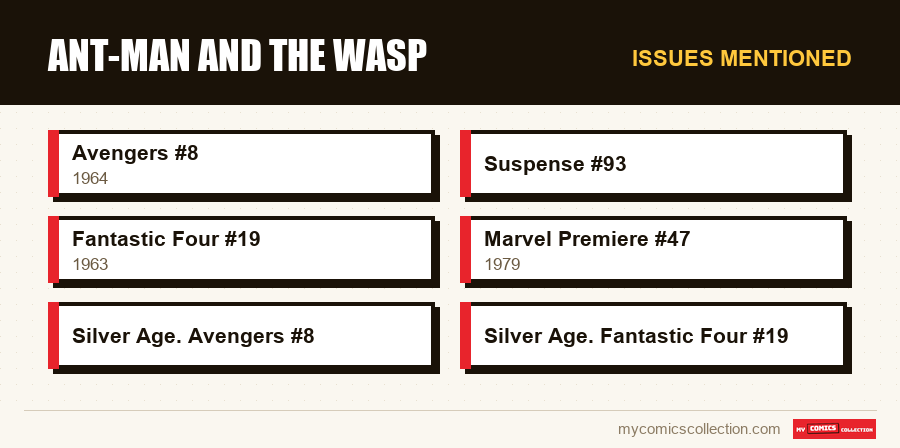
Avengers #8 (1964): Kang the Conqueror's first appearance
Fantastic Four #19 (1963): Rama-Tut, first incarnation of Kang
Tales of Suspense #93 (1967): 1st appearance of MODOK
The Quantum Realm/microverse: the infinitely small
- Kang the Conqueror, master of time and conqueror of empires.
- His countless variations through the multiverse, the central spring of the character.
- MODOK, being with a disproportionate head designed to kill.
- Cassie Lang, Scott's daughter, with powerful powers.
- Le Quantum Realm, world of the infinitely small.
- Kang is exiled to the Quantum Realm, an origin specific to the film.
- MODOK becomes Darren Cross, the villain of the first Ant-Man, an unprecedented fusion.
- Le Quantum Realm is presented as a populated and vast universe, well beyond comics.
- Cassie sees his accelerated path to heroism.
- Kang's complex story is simplified and centralized on a variant.
Avengers #8 (1964): Kang the Conqueror
The film's big bad, Kang the Conqueror, is one of Marvel's most complex antagonists. He appears under this name in Avengers #8 (1964), created by Stan Lee and Jack Kirby: a conqueror from the future, master of temporal technology, who travels through eras to establish his domination. His particularity, developed over the decades, is the existence of countless variants of himself across time and realities: Rama-Tut (appearing as early as Fantastic Four #19, 1963), Immortus, the Pharaoh, and many others. The film retains this essence of temporal conqueror and, above all, this crucial idea of multiplicity: the Kang that we face is only one variant among an infinity, suggesting a much larger threat. Jonathan Majors plays a Kang who is both majestic and disturbing, faithful to the character's excessive ambition.
The freedom of the film consists in situating this specific Kang in exile in the Quantum Realm, banished by his own variants: a specific origin which does not exist as is in the comics, but which serves to introduce the character while preserving the mystery of his multiplicity. The film thus lays the groundwork for an antagonist originally called upon to structure an entire phase of the saga.
Tales of Suspense #93 (1967): MODOK, merged with Darren Cross
The film also features MODOK, one of Marvel's strangest villains. The character was born in Tales of Suspense #93 (1967), created by Stan Lee and Jack Kirby: a being with a disproportionate head, an atrophied body, whose acronym designates an organic machine designed solely to kill. The film retains this grotesque and emblematic silhouette, but operates an unexpected fusion: MODOK becomes Darren Cross, the antagonist of the first Ant-Man, transformed after his disappearance in the Quantum Realm. This rereading, much commented on, links the villain to the continuity of the Ant-Man saga while offering a nod to a cult character from the comics. The treatment, both comical and pathetic, divides, but remains faithful to the absurd appearance that has always characterized MODOK.
The Quantum Realm, a world to explore
Quantumania makes the Quantum Realm the central setting of its plot. Inspired by the microverse of comics, this universe accessible by shrinking to infinity, it is presented here as a vast world, populated by civilizations, creatures and strange landscapes, well beyond what the comics showed. This new scale transforms the Quantum Realm into a real adventure territory, like a miniature space opera universe. The film reveals the past of Janet van Dyne, who survived there for decades, and her connection to Kang. By developing this world in this way, the film extends a specificity of the Ant-Man saga, the exploration of the infinitely small, while giving it an unprecedented epic scale. The microverse, long a secondary setting in comics, here becomes a cosmic issue.
The characters, from paper to screen
- Kang the Conqueror: Temporal Conqueror faithful to Avengers #8, with its variants; his quantum exile is unique to the film.
- MODOK: Silhouette faithful to the comics, merged with Darren Cross from the first Ant-Man.
- Cassie Lang: Scott's daughter, endowed with great powers, towards heroism.
- Janet van Dyne: His past in the Quantum Realm and his connection to Kang are revealed.
- Scott Lang: Always a father above all, drawn into an issue that goes beyond him.
Collecting this series?
Track what you own, what you are missing and what your collection is worth. 7 day trial.
Start my trial →Cassie Lang and the next generation
The film gives increasing importance to Cassie Lang, Scott's daughter. In the comics, Cassandra Lang, introduced as a child in Marvel Premiere #47 (1979), later became a heroine in her own right under the names Stature then Stinger, member of the Young Avengers, endowed with the same powers of size as her father. The film accelerates this trajectory by making her reach heroism. This rise to power of a new generation is a theme dear to the saga, already present in the passing of the torch from Ant-Man to the Wasp. It is part of a broader trend in the saga to prepare for a succession, as its founding heroes age. Cassie embodies this continuity, a bridge between Scott's generation and the future of the universe.
This theme of generational transmission has been at the heart of the identity of the Ant-Man saga since its beginnings, where the mantle already passed from Hank Pym to Scott Lang. By making Cassie a heroine, the film extends this logic and fidelity to the spirit of the comics, where the Young Avengers precisely represent this new generation called to succeed the veterans.
Kang, an antagonist cut out for excess
Quantumania had a clear ambition: to present Kang as the new great threat of the saga, an antagonist with potential comparable to that of Thanos. This choice is based on a specificity of the character in the comics: his multiplicity. Where Thanos was unique, Kang is legion-infinite variations scattered across time and realities, making him a potentially inexhaustible threat. This characteristic makes him the ideal antagonist of an entire saga built around the multiverse: each variant can embody a new danger, in a new context. The film lays the foundations of this threat by presenting a first Kang, while allowing a glimpse of the existence of his countless doubles.
In the comics, Kang has indeed carried major events, from “Avengers Forever” to “Kang Dynasty”, where he deploys temporal strategies of dizzying complexity. His nature as a time master allows him to manipulate the past, present and future, making him one of Marvel's most devious adversaries. By introducing it, the film opens up a whole section of its mythology to the saga (that of time travel, paradoxes and alternative realities) rich in narrative possibilities. For the reader, discovering Kang through his great stories means diving into some of the most ambitious plots ever conceived around the manipulation of time.
Where to start reading
To discover Kang, we can go back to Fantastic Four #19 (1963, Rama-Tut) and Avengers #8 (1964, Kang), then explore the character's major temporal stories, notably "Avengers Forever" and "Kang Dynasty". For MODOK, Tales of Suspense #93 (1967) is the source. Those curious about Cassie Lang will find her in the “Young Avengers”. Finally, stories exploring the microverse shed light on the Quantum Realm. From 1963 to the present, this journey covers the source material for a film that introduces one of Marvel's most complex antagonists.
Chronology of comics to know
- 1963: Fantastic Four #19: Rama-Tut, first incarnation of Kang.
- 1964: Avengers #8: first appearance of Kang the Conqueror.
- 1967: Tales of Suspense #93: first appearance of MODOK.
- 1979: Marvel Premiere #47: First appearance of Cassie Lang (child).
Collection side: what numbers to aim for after the film
Quantumania highlights the keys to the Silver Age. Avengers #8 (Kang's first appearance) is the centerpiece, a sought-after number whose popularity has risen with the announced importance of the character. Fantastic Four #19 (Rama-Tut, Kang's first incarnation) is another target for continuity fans. Tales of Suspense #93 (first appearance of MODOK) will appeal to collectors of atypical villains. These numbers cover various budgets. As always, condition and gradation determine value; relying on real recent sales is strongly recommended. Avengers #8 remains the priority target for a collector interested in the Master of Time.
Its place in the saga and for the collector
Quantumania was designed to launch a new big saga-wide threat, presenting Kang as the potential successor to Thanos. For the collector, the film revived interest in Avengers #8, the first appearance of an antagonist with considerable potential, as well as in Fantastic Four #19 and the character's temporal stories. This film illustrates the effect of anticipation specific to cinema: the rating of a number can rise as soon as a character is announced as central. Beyond speculation, it invites us to discover Kang, one of Marvel's richest and most complex antagonists, whose multiplicity of variants offers infinite narrative material. By introducing the Master of Time, the film opens the door to a fascinating part of Marvel mythology, that of time travel and parallel realities.
The verdict: the master of time introduced
- Loyalty: Kang Temporal Conqueror and his variants, MODOK and the Quantum Realm come from the comics.
- Freedoms: Kang exiled in the Quantum Realm, MODOK merged with Darren Cross, a microverse of unprecedented magnitude.
- Collectible numbers: Avengers #8 (Kang), Fantastic Four #19 (Rama-Tut), Tales of Suspense #93 (MODOK).
Quantumania introduces Kang the Conqueror, one of Marvel's most complex antagonists, while expanding the Quantum Realm into a true adventure universe. Faithful to the essence of the master of time and its countless variants, the film allows itself notable liberties, notably on MODOK. For reader and collector alike, it's an invitation to explore Marvel's temporal mythology, and a major first appearance of the Silver Age to aim for.
Frequently asked questions
Kang appears under this name in Avengers #8 (1964), created by Stan Lee and Jack Kirby. His first incarnation, Rama-Tut, had previously appeared in Fantastic Four #19 (1963). He is a conqueror from the future, master of time.
Multiplicity is at the heart of the character: across time and realities, there are countless variants of Kang (Rama-Tut, Immortus, etc.). The film takes up this idea, the Kang faced being only one variation among an infinity.
His grotesque silhouette (disproportionate head, atrophied body) is faithful to Tales of Suspense #93 (1967). But the film carries out an unprecedented fusion by making MODOK a transformation of Darren Cross, the villain of the first Ant-Man.
Scott Lang's daughter, introduced as a child in Marvel Premiere #47 (1979). In the comics, she becomes a heroine (Stature, then Stinger) within the Young Avengers, endowed with the same great powers as her father.
Avengers #8 (Kang's first appearance) is the centerpiece of the Silver Age. Fantastic Four #19 (Rama-Tut) and Tales of Suspense #93 (MODOK) are other interesting targets.
Does the film make you want to collect? Estimate the value for free of your issues (Avengers #8, Tales of Suspense #93…) with our tool based on current eBay listings.