
Loki (2021), created by Michael Waldron with Tom Hiddleston, sends the god of mischief into the cogs of VAT, the Temporal Variation Authority born in Thor #372 (1986). The agent Mobius comes from Fantastic Four #346 (1990), and the introspective tone of Loki evokes the run “Agent of Asgard”(2014). The series retains the spirit of the character and the TVA while inventing Sylvie and reorienting “He Who Remains”. Here is the detailed comparison, series versus comics.
Third Disney+ series in the Marvel universe, Loki takes the most popular character in the saga on a temporal and existential adventure. The series draws on specific concepts from the comics while opening the door to the multiverse. Source-by-source decryption.
As in each article in this series, only verified information (creators, distribution, dates, comic numbers) is stated; the comparative analysis is ours, without reproducing dialogue or protected images.
Title : Loki (2021-2023, 2 seasons)
Creator: Michael Waldron
Actors: Tom Hiddleston (Loki), Owen Wilson (Mobius), Sophia Di Martino (Sylvie), Gugu Mbatha-Raw (Ravonna), Jonathan Majors (He Who Remains)
Broadcast: from June 2021, Disney+
Studio: Marvel Studios
Thor #372 (1986): 1st appearance of the TVA (Walt Simonson)
Fantastic Four #346 (1990): 1st appearance of Mobius
“Loki: Agent of Asgard”(2014): Al Ewing, the introspective Loki
Journey into Mystery #85 (1962): Loki's first appearance
- La VAT, bureaucracy responsible for monitoring the weather.
- Mobius, placid and methodical agent of the VAT.
- Loki introspective character, forced to confront himself.
- THE multiple variations of Loki, stands out dear to comics.
- The link with Kang / The One Who Remains and the multiverse.
- Sylvie, female variant of Loki, is a creation specific to the series.
- VAT is reinvented as a retrofuturistic administration, larger than in the comics.
- The one who remains is repurposed as the architect of the multiverse, linked to Kang.
- Mobius is humanized and brought closer to Loki.
- The plot begins on “multiverse saga”, specific to cinematographic continuity.
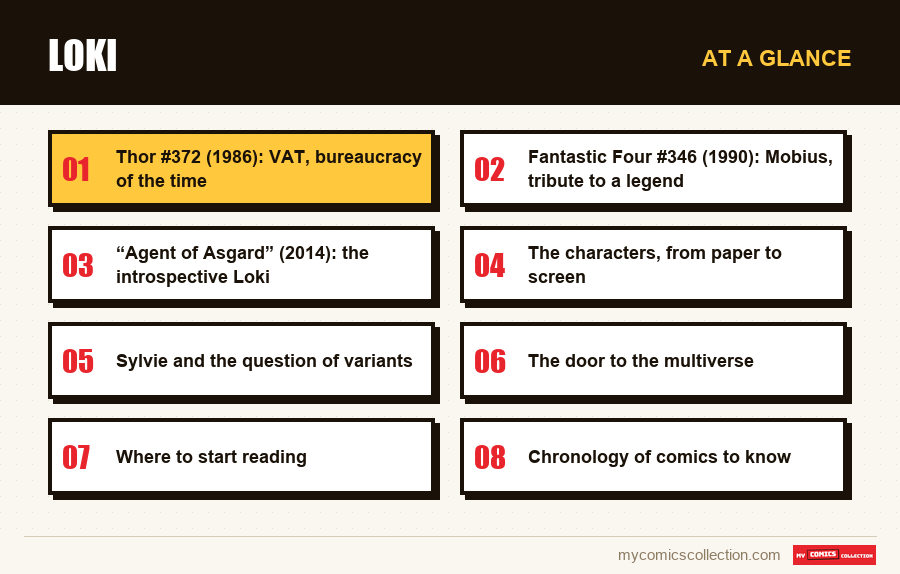
Thor #372 (1986): VAT, bureaucracy of the time
The central setting of the series, the TVA (Time Variance Authority), comes directly from the comics. She appears in Thor #372 (1986), created by Walt Simonson: an organization responsible for monitoring and "cleaning up" timelines deemed dangerous for the multiverse, populated by interchangeable bureaucrats. The series faithfully captures this fascinating concept: a cosmic administration that manages time like a public service, with its paperwork, procedures and outdated aesthetic. It considerably amplifies its scale, making the TVA a labyrinthine retrofuturistic place, but the basic idea, civil servants of the time tracking down “variants”, is indeed that of Simonson. This setting offers Loki a unique playground, where his trickster nature clashes with implacable bureaucratic logic.
The humor born from this contrast, the god of mischief reduced to the rank of an administrative file, is one of the tastiest springs of the series, and arises directly from the absurd but brilliant idea of a bureaucracy of time, imagined in the comics from 1986.
Fantastic Four #346 (1990): Mobius, tribute to a legend
Agent Mobius, played by Owen Wilson, is a character with a tasty story. He appears in Fantastic Four #346 (1990), created by Walt Simonson, and his original appearance is a direct homage to Mark Gruenwald, a Marvel writer and editor renowned for his encyclopedic knowledge of continuity-a guardian of the universe's coherence, as the TVA is of time. The series takes up the character but deeply humanizes him: Mobius becomes a placid and benevolent investigator, whose relationship with Loki structures the story. This rapprochement between the agent and the trickster, specific to the series, offers one of its strongest emotional threads. Mobius embodies a figure of confidence and reflection, a perfect counterpoint to Loki's chaos.
“Agent of Asgard” (2014): the introspective Loki
The great contribution of the series is the transformation of Loki into an introspective character, forced to confront his own nature. This approach owes much to Al Ewing's "Loki: Agent of Asgard" (2014), which explored the question of whether Loki could escape his role as an eternal villain, change and reinvent himself. The series takes up this existential question: through the TVA, Loki is confronted with his own variants, with his failures, with the possibility of being something other than a traitor condemned to lose. This psychological depth, inherited from modern comics, makes the series much more than a temporal adventure: a meditation on identity, free will and the possibility of change. Loki, long frozen in his role as antagonist, gains a new humanity.
The characters, from paper to screen
- Loki: Introspective, confronted with himself, in the spirit of “Agent of Asgard”.
- Mobius: Faithful to Fantastic Four #346, humanized and brought closer to Loki.
- Sylvie: Female variant of Loki, a creation specific to the series (inspired by several elements).
- VAT: True to the concept of Thor #372, greatly amplified.
- The one who remains: Architect of the Multiverse, repurposed and linked to Kang.
Collecting this series?
Track what you own, what you are missing and what your collection is worth. 7 day trial.
Start my trial →Sylvie and the question of variants
The series grants itself notable freedom with Sylvie, the female variant of Loki. The character does not exist as is in the comics, even if it borrows elements from several figures (including an Enchantress named Sylvie and the concept of "Lady Loki"). This creation serves the central theme of the series: the exploration of the multiple faces of the same being. By confronting Loki with a radically different version of himself, the series questions what defines an identity beyond its variations. This idea of variants, dear to comics, where a character exists in countless forms across the multiverse, becomes the driving force for self-reflection. Sylvie is not just an ally or an adversary: she is a mirror, forcing Loki to question who he really is.
This game on variants also prepares the opening of the multiverse, a major source of cinematic continuity. By making the TVA the guardian of a “sacred timeline” and the One who remains its architect, the series lays the foundations of a vast story to come, while remaining faithful to the spirit of the comics, where time and parallel realities are an infinite playing field.
The door to the multiverse
Beyond its hero, Loki occupies a strategic place in the saga: it is the series which officially opens the multiverse. By revealing that the TVA maintains a single “sacred timeline” while pruning all others, and by introducing the One Who Remains, the architect of this system, the series lays the foundations for a vast narrative to come, where parallel realities and variants multiply. This idea of the multiverse, old in comics (where alternative universes, designated by “Earth” numbers, have coexisted for decades) here becomes the driving force of an entire phase of the saga. Loki, by shattering the single timeline, triggers this proliferation of realities.
This pivotal role gives the series an importance that goes beyond its own narrative. By relying on temporal and multiversal concepts well established in the comics, it gives coherence to the expansion of the saga, while offering Loki a destiny worthy of his status as the public's favorite character. The trickster, long confined to the role of antagonist, thus becomes one of the involuntary architects of the future of the universe. For the reader, it is an invitation to explore Marvel's great multiversal stories, from "Exiles" to the cosmic sagas, where the play on parallel realities has always been a limitless field of invention.
Where to start reading
To extend the series, Al Ewing's "Loki: Agent of Asgard" (2014) is the closest reading to his introspective Loki. Those curious about TVA will find it in Thor #372 (1986) and Simonson's time stories. For Loki himself, we can go back to his first appearance in Journey into Mystery #85 (1962), then follow his evolution, notably in “Journey into Mystery” by Kieron Gillen (2011), which had already humanized the character. From 1962 to 2014, this journey covers the sources of a series that reinvents the god of mischief.
Chronology of comics to know
- 1962: Journey into Mystery #85: First appearance of Loki.
- 1986: Thor #372: first appearance of the TVA.
- 1990: Fantastic Four #346: First appearance of Mobius.
- 2014: “Loki: Agent of Asgard” (Al Ewing): the introspective Loki.
Collection side: what numbers to aim for after the series
Loki highlights keys from several eras. Journey into Mystery #85 (Loki's first appearance) is a major key to the Silver Age, highly sought after. Thor #372 (first appearance of TVA) is a Copper Age issue whose popularity has risen with the series. Fantastic Four #346 (first Mobius) is a more confidential but interesting target. These numbers cover various budgets. As always, condition and gradation determine value; relying on real recent sales is strongly recommended. Thor #372 is a fine example of an issue propelled by an adaptation, the TVA having become central in the continuity, which makes it a privileged target for any collector attentive to the concepts called to structure the future of the saga.
Its place in the saga and for the collector
Loki is a pivotal series: it officially opens the multiverse and introduces the One Who Remains, foreshadowing the antagonist called to structure an entire phase, as confirmed Quantumania. For the collector, it reignited interest in Thor #372 and the TVA, as well as the great Loki stories. It illustrates the effect of series on the market: an obscure concept like VAT can become central and increase the price of its first appearance. Beyond speculation, the series invites you to discover “Loki: Agent of Asgard”, one of the most inventive modern runs, and to explore the richness of a character whose humanization has transformed perception. By making Loki a being in search of redemption, the series continues an evolution begun in the comics.
The verdict: the trickster facing himself
- Loyalty: TVA, Mobius, the introspective Loki and the variant game come from the comics.
- Freedoms: Sylvie (own creation), amplified VAT, He who remains reoriented towards Kang.
- Collectible numbers: Journey into Mystery #85 (Loki), Thor #372 (TVA), Fantastic Four #346 (Mobius).
Loki reinvents the god of mischief as an introspective character, immersed in the temporal bureaucracy of the TVA. Faithful to the concepts of the comics (the TVA, Mobius, Loki in search of change from “Agent of Asgard”) the series opens the multiverse while deepening its hero. For reader and collector alike, it is an invitation to discover the stories that humanized Loki and Marvel's most fascinating temporal concepts. By transforming the god of mischief into the hero of an existential odyssey, the series confirms that Loki is much more than a villain: he is one of the richest and most surprising characters in the entire universe, capable of endlessly reinventing himself.
Frequently asked questions
From TVA (Thor #372, 1986), Mobius (Fantastic Four #346, 1990) and especially the run “Loki: Agent of Asgard” (2014) by Al Ewing, which made Loki an introspective character in search of change.
The Time Variation Authority, an organization responsible for monitoring and cleaning timelines, appeared in Thor #372 (1986) by Walt Simonson. The series amplifies it into a vast retrofuturistic administration.
Not as is. Sylvie is a creation of the series, borrowing elements from several characters (including an Enchantress named Sylvie and the concept of "Lady Loki"). It serves the theme of the many faces of Loki.
A TVA agent appearing in Fantastic Four #346 (1990), whose original appearance pays homage to Mark Gruenwald, keeper of Marvel continuity. The series humanizes him into a placid and caring investigator.
Journey into Mystery #85 (first appearance of Loki) on the Silver Age side, and Thor #372 (first appearance of TVA) on the Copper Age side, whose popularity has increased thanks to the series.
Does the series make you want to collect? Estimate the value for free of your issues (Journey into Mystery #85, Thor #372…) with our tool based on current eBay listings.