
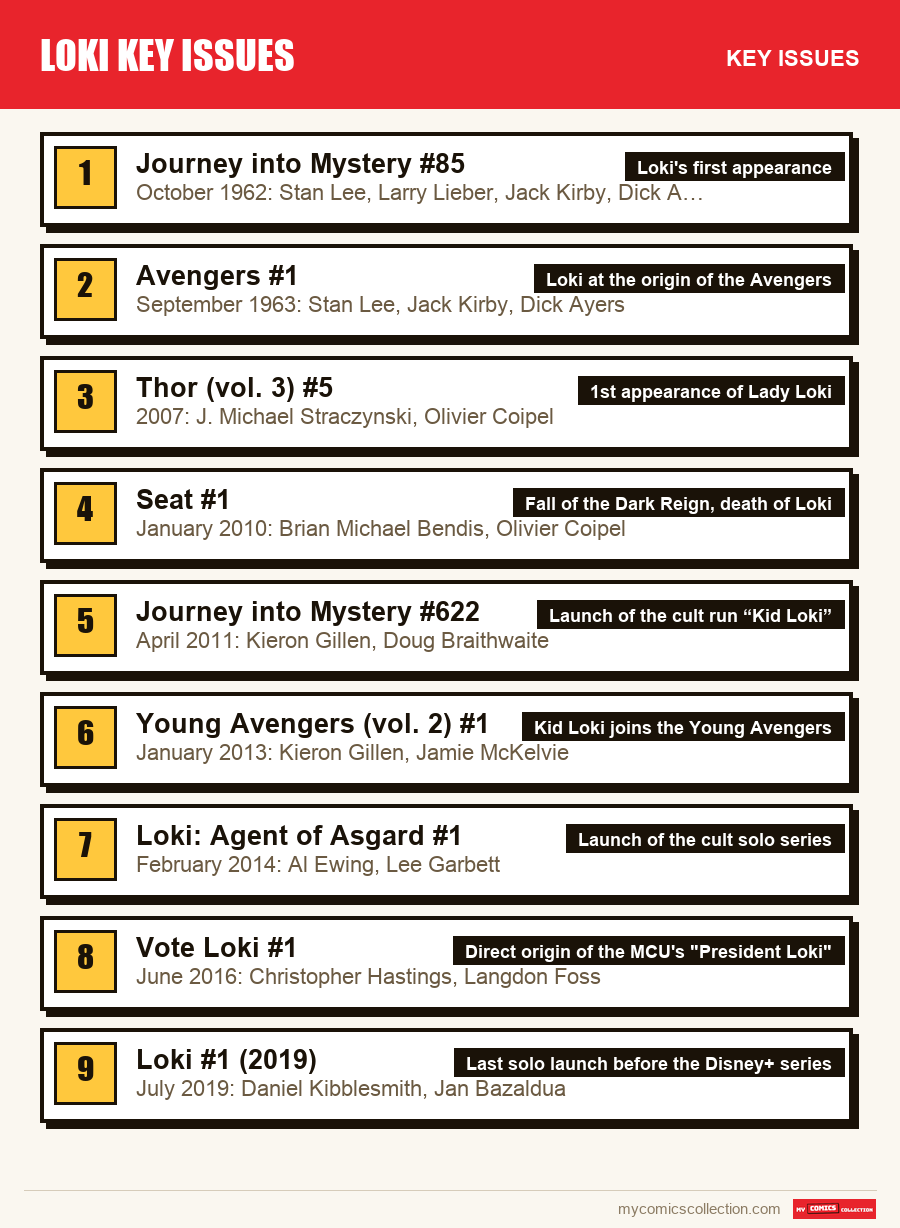
Loki's absolute key number is Journey into Mystery #85 (October 1962), his very first appearance with Odin, Heimdall and Balder: a CGC 9.6 copy sold for $90,000 in June 2025, an absolute record for this comic. Next come Avengers #1 (1963, where Loki's trap gives birth to the Avengers), Thor (vol. 3) #5 (2007, first appearance of Lady Loki/Sylvie) and Journey into Mystery #622 (2011, launch of Kieron Gillen's cult run on Kid Loki). The Disney+ series has permanently increased the popularity of these titles, particularly those related to Sylvie.
Few Marvel characters have a bibliography as long and as fragmented as Loki. Between the Shakespearean villain of the 1960s, the recurring manipulator of the Thor runs of the 2000s, the child redeemer imagined by Kieron Gillen and the agent of Asgard version Al Ewing, there are almost as many “first appearances” as there are incarnations of the god of mischief. For a collector, this wealth is both an opportunity and a trap: it is easy to confuse a simple notable print with an authentic key number which will weigh on the price in the long term.
This article focuses exclusively on the numbers to have to constitute a coherent Loki collection: first appearances of each major version of the character, editorial turning points (death, rebirth, change of status), and launches of solo series. It does not retrace the complete narrative history of the character: for this, the article story of Loki in comics details his story development since 1962 until today. The angle here is that of the collector: which issues to buy, why they matter, and what we really know about their value on the market.
All price data cited below comes from documented sales (Heritage Auctions, GoCollect) or public CGC censuses. When no reliable data exists for a given number, the article clearly states this rather than putting forward a made-up number.
From creation by Stan Lee to modern redesign: editorial benchmarks
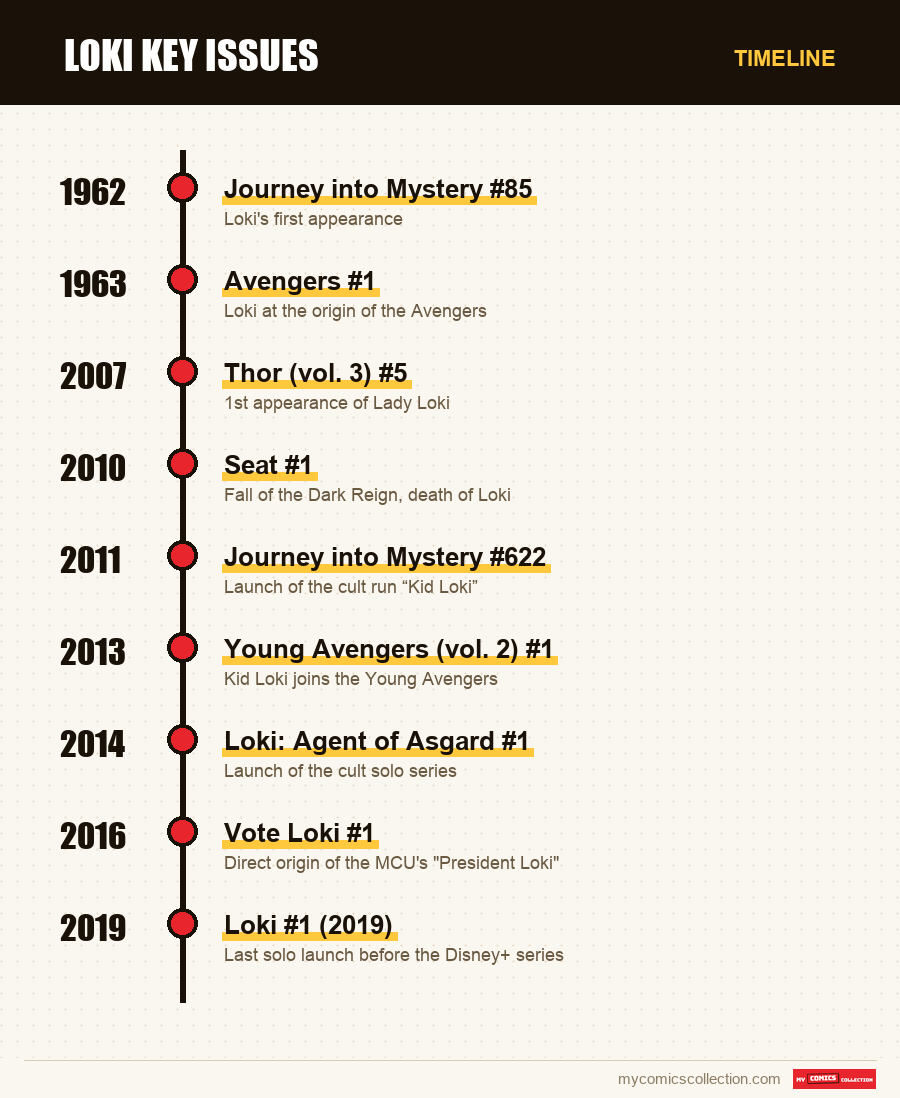
Loki was born in October 1962 under the pen of Stan Lee and Larry Lieber, drawn by Jack Kirby and inked by Dick Ayers, in Journey into Mystery #85. The character is then just one antagonist among others for Thor, but the narrative trick which consists of making him a jealous, deceitful demigod and intrinsically linked to his adopted brother will prove to have exceptional longevity. Less than a year later, in September 1963, it was Loki's plan to trap Thor that accidentally pushed Iron Man, Hulk, Ant-Man and the Wasp to unite: Avengers #1 literally owes its editorial existence to a ploy of the god of mischief.
For the following decades, Loki remained a recurring villain in the Thor mythology without experiencing a major break in status. The real collecting turning point arrives with J. Michael Straczynski's run on Thor (volume 3, 2007), which introduced a female version of the character-Loki's spirit reincarnated in Sif's body-quickly nicknamed "Lady Loki" by fans. This iteration would become, years later, the basis of the character of Sylvie in the Disney+ series.
The second big turning point came in 2010 with the event Siege. Brian Michael Bendis depicts the fall of the Dark Reign and the apparent death of Loki, which paves the way for his rebirth as a child in the pages of Journey into Mystery relaunched by Kieron Gillen in 2011. This run, considered by a large part of critics as one of the best ever devoted to the character, lastingly transformed the perception of Loki: no longer just a villain, but a tragic figure seeking to escape his own narrative. This editorial mechanic (death, rebirth, age or gender change) is why Loki generates so many distinct “first appearances” to watch out for, much more than a character with a stable narrative status. To understand the complete sequence of these arcs, direction the article dedicated to the history of the character; here, we stick to the numbers to look for in stores or on the secondary market.
Journey into Mystery #85
The absolute holy grail of any Loki collection. This 13-page story introduces Loki, Odin, Heimdall, Balder and Asgard in the same breath: a concentration of Asgardian mythology that did not exist before this issue. It occupies 27th place in Overstreet's ranking of "Top 50 Silver Age Comics", proof of its status as a centerpiece of the Marvel Silver Age, alongside Journey into Mystery #83 (Thor's first appearance). Its rating has significantly strengthened since the announcement of the Disney+ series in 2019, particularly on copies rated 7.0 and above.
Avengers #1
Loki is not the title character of this founding issue, but he is the plot trigger: it is his remote manipulation of Thor (Donald Blake) which pushes Iron Man, Hulk, Ant-Man and the Wasp to regroup for the first time. This status as “catalyst of the Avengers” makes it an essential issue for those who want to trace Loki’s real influence on the Marvel universe, well beyond his sole appearances in the Thor comics. It appears in 13th position in the Overstreet Top 50 Silver Age ranking, just ahead of Journey into Mystery #85 in general awareness but with equally strong demand among Avengers collectors.
Thor (vol. 3) #5
In Straczynski's highly acclaimed run on the return of Thor, Loki's spirit finds himself trapped in Sif's body: the female version of the character is born, quickly renamed "Lady Loki" by the fandom. It is this precise iteration which will inspire years later the character of Sylvie, played by Sophia Di Martino in the Disney+ series Loki. Long considered a secondary number of the JMS run, this title experienced a spectacular revaluation after the broadcast of season 1 in 2021, when spectators discovered that Sylvie was a direct variant of this original concept.
Seat #1
First issue of the event mini-series which closes the era of the Dark Reign orchestrated by Norman Osborn. Loki dies there in circumstances which will directly condition his resurrection in a radically different form the following year. This issue is pivotal in understanding why the Loki who appears in Journey into Mystery #622 is not a simple character relaunch but a full-fledged storyline rebirth: death in Siege #1 is the narrative condition of everything that follows for Gillen.
Journey into Mystery #622
Kieron Gillen resurrects the historic title Journey into Mystery to establish a whole new status for Loki: reincarnated as a child after his death in Siege, he becomes the protagonist of one of the best-received runs of the 2010 decade, alongside main artist Doug Braithwaite. This issue #622 is the official starting point for “Kid Loki,” a version that has profoundly influenced the way Marvel has written the character ever since: including his later return in comics tied to the Disney+ series. The popularity of Gillen's run saw a marked resurgence after the success of the Sylvie version on screen, with both incarnations sharing the same character mechanics seeking to free themselves from their villainous destiny.
Young Avengers (vol. 2) #1
This launching Marvel NOW! brings together Wiccan, Hulkling and Hawkeye (Kate Bishop) around newcomers: Loki (in his teenage version from Gillen's run), Marvel Boy and America Chavez. Issue #1 marks Loki's first appearance as a full member of a superhero team, an unprecedented status for a character previously confined to the role of antagonist or lone protagonist. The series, praised for its artistic direction by Jamie McKelvie, remains one of the most recommended entries for following the evolution of the “young” version of the god of mischief.
Loki: Agent of Asgard #1
Al Ewing offers here one of the best gateways to discovering Loki solo: the character, now an adult again, tries to escape the weight of his own legend by working as a secret agent for Asgard. The series crosses the events of Original Sin and Axis and introduces during the run the concept of "King Loki", a future and corrupted version of the character. Issue #1 has had several printings (including a third printing sought after by collectors of MCU variants) as demand has remained strong over the years, this run being regularly cited as the best introduction for new readers.
Vote Loki #1
This four-issue satirical mini-series, written in the middle of the 2016 American presidential election, features Loki's candidacy for the presidency of the United States. The first printing was estimated at around 29,500 copies distributed, a modest figure which partly explains the relative rarity of issue #1 in high conservation. Its collector relevance exploded after the broadcast of the Disney+ series, where a brief shot shows Loki wearing an outfit and a crown almost identical to those on the cover of this issue: direct and assumed inspiration from the character of “President Loki” played by Tom Hiddleston on screen.
Loki #1 (2019)
Published a few months before the official announcement of the casting of the Disney+ series, this series by Daniel Kibblesmith takes up Loki just after his death in War of the Realms and his rebirth as king of the frost giants of Jötunheim. Issue #1 benefited from favorable critical reception for its tone and storytelling, and today constitutes a practical milestone for collectors wishing to mark the boundary between “pre-Disney+” Loki comics and the explosion of demand that followed the announcement and subsequent broadcast of the series in 2021.
Collecting this series?
Track what you own, what you are missing and what your collection is worth. 7 day trial.
Start my trial →The impact of the Disney+ series on the rating of Loki comics
Few recent adaptations have had as measurable an effect on the paper comic market as the series Loki, broadcast on Disney+ from June 2021 with Tom Hiddleston in the lead role. Three numbers in particular have seen their rating evolve in a documented manner since the project was announced in 2019:
- Journey into Mystery #85: demand strengthened for grades 7.0 and above as soon as the series was announced, a movement confirmed by the record sale of $90,000 for a CGC 9.6 in June 2025, itself higher than the previous record of $84,000 established in April 2024 at Heritage Auctions for a CGC 9.4.
- Thor (vol. 3) #5: the introduction of the character of Sylvie, a variant directly inspired by the Lady Loki of 2007, increased the values of this number in a ratio ranging from double to triple depending on the grade brackets during season 1.
- Journey into Mystery #622 and the Young Avengers of 2013: the rediscovery of Kid Loki by a new audience after the series revived interest in Kieron Gillen's entire run, since considered one of the best entry points into the modern mythology of the character.
This mechanism is not specific to Loki: each notable Marvel adaptation historically produces a peak in searches and purchases on the first appearance issues of the character(s) concerned, followed by a stabilization at a higher level than before the announcement. The particularity of Loki lies in the depth of its editorial history: unlike a character with a stable narrative status, each change of form (Lady Loki, Kid Loki, King Loki, President Loki) constitutes a distinct and potentially collectible "first appearance", which multiplies the entry points for a buyer, and the pitfalls for those who do not master the exact editorial chronology of the character.
Buying Guide to Collecting Loki
- Distinguish first appearance and simple striking cover. Many issues feature Loki on the cover without it being an actual editorial milestone. Always check if it is a real first appearance of an incarnation of the character (original Loki, Lady Loki, Kid Loki, King Loki, President Loki) before paying a premium.
- Prioritize the state over the Silver Age. For Journey into Mystery #85 and Avengers #1, the gap in value between an average grade (VG/FN) and a high grade (VF+ and above) is considerable; a restored example loses a significant part of its value compared to an equivalent universal grade example. Systematically use a grade comparison before buying: our article CGC grade 9.0 vs 9.8 precisely details the difference in height between neighboring bearings.
- Be wary of multiple prints on modern comics. Loki: Agent of Asgard #1 and Loki #1 (2019) have had several printings; only the first print generally carries the most stable premium, with later prints (2nd, 3rd) worth primarily for their relative rarity and not for first appearance status.
- Check the story context before purchasing a “first appearance”. Certain issues dedicated to Loki (like Siege #1) are major narrative milestones without being first appearances in the strict sense: their collector value is based on other criteria (importance of the event, circulation, demand for the complete series).
- Compare actual sales rather than a fixed list price. Traditional rating guides struggle to keep up with the speed of post-adaptation market movements; cross-referencing several recent eBay sales for the same number and grade gives a more reliable image than a static list price.
- Do not neglect the transition numbers. Journey into Mystery #622 and Young Avengers (vol. 2) #1 remain more accessible today than the big Silver Age issues while carrying a strong symbolic charge for the modern version of the character: a good entry point to start a Loki collection without a Silver Age budget.
- Document each acquisition. Systematically note the origin, grade and price paid for each key number; it is the best protection against redemption errors and the best tool to follow the evolution of your collection over time via the collection management application.
To situate each issue in the grand narrative of Loki (why Siege leads to Journey into Mystery #622, how the character goes from villain to antihero) the article story of Loki in comics usefully completes this selection of key numbers. And to delve deeper into the character's complete profile on the site, the page Loki centralizes all the content dedicated to it.