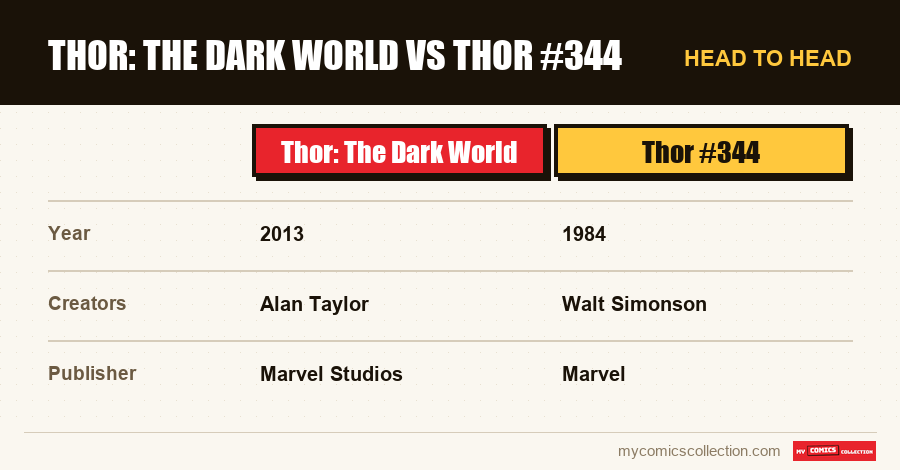
Thor: The Dark World (2013), directed by Alan Taylor with Chris Hemsworth and Tom Hiddleston, draws its antagonist from Walt Simonson's run: Malekith the Accused appears in Thor #344 (1984), just like Algrim/Kurse (Thor #347). The film features the Dark Elves of Svartalfheim and a weapon, the Aether, revealed as one of the Infinity Stones (the Reality Stone). It retains the key figures from the source but reinvents Loki's motivations and central role. Detailed comparison, film versus comics.
The God of Thunder's second solo adventure, The Dark World expands the cosmic dimension of the saga while deepening the relationship between Thor and Loki. For its plot, the film relies on an antagonist taken from the character's most famous run, that of Walt Simonson, while inserting him into the broader mechanics of the Infinity Stones. Source-by-source decryption.
Faithful to our method, we only state verified facts (distribution, dates, numbers, creators) and offer an original comparative analysis, without reproducing dialogue or protected images.
Title : Thor: The Dark World (2013)
Director: Alan Taylor
Actors: Chris Hemsworth (Thor), Tom Hiddleston (Loki), Natalie Portman (Jane Foster), Anthony Hopkins (Odin), Christopher Eccleston (Malekith), Idris Elba (Heimdall)
Exit : November 8, 2013 (United States)
Studio: Marvel Studios
Thor #344 (1984): 1st appearance of Malekith the Accused (Walt Simonson)
Thor #347 (1984): Algrim, future Kurse (Walt Simonson)
The Dark Elves of Svartalfheim: Asgardian mythology
The Aether / Reality Stone: one of the Infinity Stones
- Malekith the Accused, lord of the Dark Elves, taken from Simonson's run.
- Algrim / Kurse, the lieutenant transformed into an almost invincible brute.
- THE Dark Elves of Svartalfheim, one of the Nine Realms.
- The register cosmic and mythological specific to Asgard.
- The rivalry Thor/Loki, pushed towards a forced alliance.
- Ether becomes an Infinity Stone, to connect the film to the overall plot of the saga.
- Malekith's motivations are simplified: destroy the universe via darkness, where the comic deployed more twisted intrigues.
- Loki occupies a much larger place than in the source, to the point of stealing the spotlight from the antagonist.
- Jane Foster becomes the host of the Aether, a central role absent from the 1984 comic.
- The story condenses a long saga of Simonson in a tight plot.
Thor #344 (1984): Malekith and Simonson's run
The film's antagonist comes from a specific and prestigious moment in the character's history. Malekith the Accused first appears in Thor #344 (June 1984), at the heart of Walt Simonson's run, considered the thunder god's most notable period. Devious lord of the Dark Elves of Svartalfheim, Malekith is a cruel manipulator, fond of psychological games as much as brute force. The film retains the figure (the pale complexion, the hatred of Asgard, the elven people) but simplifies its designs: on screen, it seeks above all to plunge the universe back into darkness with the help of the Aether, while the comic deployed more tortuous intrigues.
This choice to draw from Simonson is not trivial: it recognizes that Thor's best enemies are found in this period. For the reader, this makes Thor #344 an ideal gateway to a run that has become cult.
Thor #347 (1984): Algrim, the future Kurse
The colossus that accompanies Malekith on screen also comes from Simonson. Algrim, a loyal dark elf, appears in Thor #347 (September 1984) before becoming Kurse, an almost indestructible brute driven by vengeance. The film takes up this trajectory, the faithful transformed into a living weapon, by compressing it, but keeps the essential dynamic: Kurse embodies pure power in the service of Malekith's ruse. It’s a great example of the film’s fidelity to the cast of characters in its source run.
The Aether, or how to connect Thor to the saga
The great freedom of the film comes from the Ether. In The Dark World, this ancient weapon coveted by Malekith is revealed as one of the Infinity Stones-the Reality Stone. This choice does not come from the 1984 comic: it serves the overall strategy of the saga, which takes the Stones from film to film to prepare for a future confrontation. By transforming a local artifact into a piece of a cosmic puzzle, the film places an Asgardian adventure within a much larger plot. Jane Foster, by becoming the involuntary host of the Aether, inherits a central role that the comic did not give her.
The characters, from paper to screen
- Thor: More mature than in the first film, he faces an enemy from outside Asgard while managing his family conflicts.
- Loki: Its place is disproportionately enlarged compared to the source: the film focuses on the alchemy between the two brothers, to the point of eclipsing Malekith.
- Malekith: Visually faithful, but with simplified motivations in a thirst for destruction.
- Kurse (Algrim): Malekith's sword arm, taken from Thor #347.
- Jane Foster: Promoted to the rank of key plot element by becoming the host of the Aether.
Alan Taylor and the aesthetics of the kingdom
The film entrusts its direction to Alan Taylor, whose experience of television fantasy universes permeates the rendering of Asgard: less flashy, more earthy and martial than in the first part. This approach seeks to anchor the mythology in a credible materiality, halfway between science fiction and legend. It extends an idea already present from the first film: treat Asgardian magic as a very advanced science, in order to bring together the cosmic and the rest of the saga. Around Thor, we find the secondary figures from the comics (the Three Warriors, Sif, Heimdall) who give flesh to Asgardian life.
Collecting this series?
Track what you own, what you are missing and what your collection is worth. 7 day trial.
Start my trial →The Nine Realms and the Convergence
The Dark World deploys the Asgardian cosmology inherited from the comics more widely: the Nine Kingdoms connected by the world tree Yggdrasil, of which Asgard, Svartalfheim (the Dark Elves) or Midgard (Earth) are only a few branches. The film adds the Convergence, a rare alignment of these realms that opens passages between worlds and serves as a driving force for the plot. This mythological architecture, taken from Nordic legends and enriched by decades of comics, gives the film its scope: we leave Earth for a conflict that embraces several planes of existence. This is also what sets Thor apart from the rest of the saga: his natural playground is the cosmic and the legendary, not the technological realism of Iron Man.
This taste for the epic still owes a lot to Walt Simonson, whose run in the 1980s brought the mythological dimension of the character to incandescence: notably with the threat of Surtur, the fire demon, one of the peaks of his saga. Without directly adapting it, The Dark World is bathed in this imagination of warring kingdoms and primordial forces. For the reader, it is an additional invitation to discover this founding run, the matrix of so many elements taken up on screen.
Where to start reading
To extend the film, the main reading is Walt Simonson's run, starting with the issues where Malekith and Algrim appear (Thor #344 and #347, 1984). We discover not only the enemies of the film, but also the epic scale that redefined the character. Readers curious about the Aether and the Infinity Stones will then be able to explore the great cosmic sagas of Jim Starlin, where these artifacts take on their full meaning. Finally, for the Thor / Loki dynamic so central to the film, the modern runs of the god of thunder offer particularly rich material. This progression, from 1984 to contemporary stories, covers the three main sources of the plot.
Chronology of comics to know
- 1984: Thor #344: first appearance of Malekith the Accused (run Simonson).
- 1984: Thor #347: Algrim, future Kurse.
- 1970s-1990s: cosmic sagas by Jim Starlin, where the Infinity Stones take on their importance (in the background).
Collection side: what numbers to aim for after the film
Simonson's run focuses the film's collectible targets. Thor #344 (first appearance of Malekith) and Thor #347 (Algrim / Kurse) are key numbers from the 1980s, still accessible compared to the holy grail of the Silver Age, and carried by the presence of the characters on screen. More broadly, Simonson's complete run remains one of the most recommended to own, in both issues and collections. As always, condition and gradation determine value; better to rely on actual recent sales before buying. It is an excellent entry point for a collector who wants to aim for significant keys without the budget of the very first appearances of 1962. It should also be noted that the stories linked to the Infinity Stones, including the Reality Stone embodied here by the Aether, have seen their popularity explode with the cinema: the great cosmic sagas of Jim Starlin which feature them have thus become essential collections, often reissued and easy to obtain. For those who want to understand the mechanics of the Stones which run through the entire saga, it is a reading investment as valuable as it is affordable, and an ideal complement to Simonson's issues.
The verdict: a noble antagonist, an intrigue serving the whole
- Loyalty: Malekith, Kurse and the Dark Elves are faithfully taken from Simonson's run.
- Freedoms: the Aether transformed into the Infinity Stone, simplified motivations and an omnipresent Loki.
- Collectible numbers: Thor #344 (Malekith) and #347 (Kurse), affordable keys from the 1980s.
The Dark World is a film torn between two missions: to tell an Asgardian adventure faithful to Simonson, and to advance the great clock of the Infinity Stones. This dual objective explains its tensions, but also its value for the reader: it highlights a run unfairly unknown to the general public and transforms two enemies from the 1980s into sought-after collector's targets. This is perhaps its greatest success: making you want to reopen Simonson's comics to find, even richer, the figures that the film only sketched.
Its place in the saga and for the collector
Often considered a minor episode in the saga, The Dark World nevertheless plays a discreet but crucial role: it introduces the Reality Stone, one of the six Infinity Stones that the main plot collects film after film. As such, he is an essential link in the chain that will lead to subsequent cosmic confrontations. For the collector, the interest of the film focuses on the run of Walt Simonson, from which it draws its antagonists: it is the ideal opportunity to take an interest in a cult period, unfairly unknown to the general public, where the key issues (Thor #344 for Malekith, #347 for Kurse) remain clearly more accessible than the holy grails of the Silver Age. The film thus acts as a spotlight focused on the 1980s of Thor, inviting the reader to discover stories of rare epic richness. Far from being a simple interlude, The Dark World illustrates the patient strategy of the saga: each film, even secondary, advances a piece of the puzzle and highlights a part of the comics to be explored.
Frequently asked questions
From Walt Simonson's run: Malekith the Accused appears in Thor #344 (1984) and Algrim/Kurse in Thor #347. The film adds the Aether, revealed as the Reality Stone, one of the Infinity Stones.
The film makes it one of the Infinity Stones to connect the plot to the entire saga. This identification does not come from the 1984 comic, where Malekith pursued other objectives.
The cruel and manipulative lord of the Dark Elves of Svartalfheim, created by Walt Simonson (Thor #344, 1984). The film maintains his appearance and his people, but simplifies his motivations to a thirst for destruction.
The film focuses on the chemistry between Thor and Loki, very popular since the first part. This disproportionate place in relation to the source sometimes goes so far as to eclipse the main antagonist, Malekith.
Thor #344 (Malekith's first appearance) is the main target, along with Thor #347 (Kurse). Two keys from the 1980s that are still accessible, at the heart of Walt Simonson's cult run.
Does the film make you want to collect Thor? Estimate the value for free of your numbers (Thor #344, #347…) with our tool based on current eBay listings.