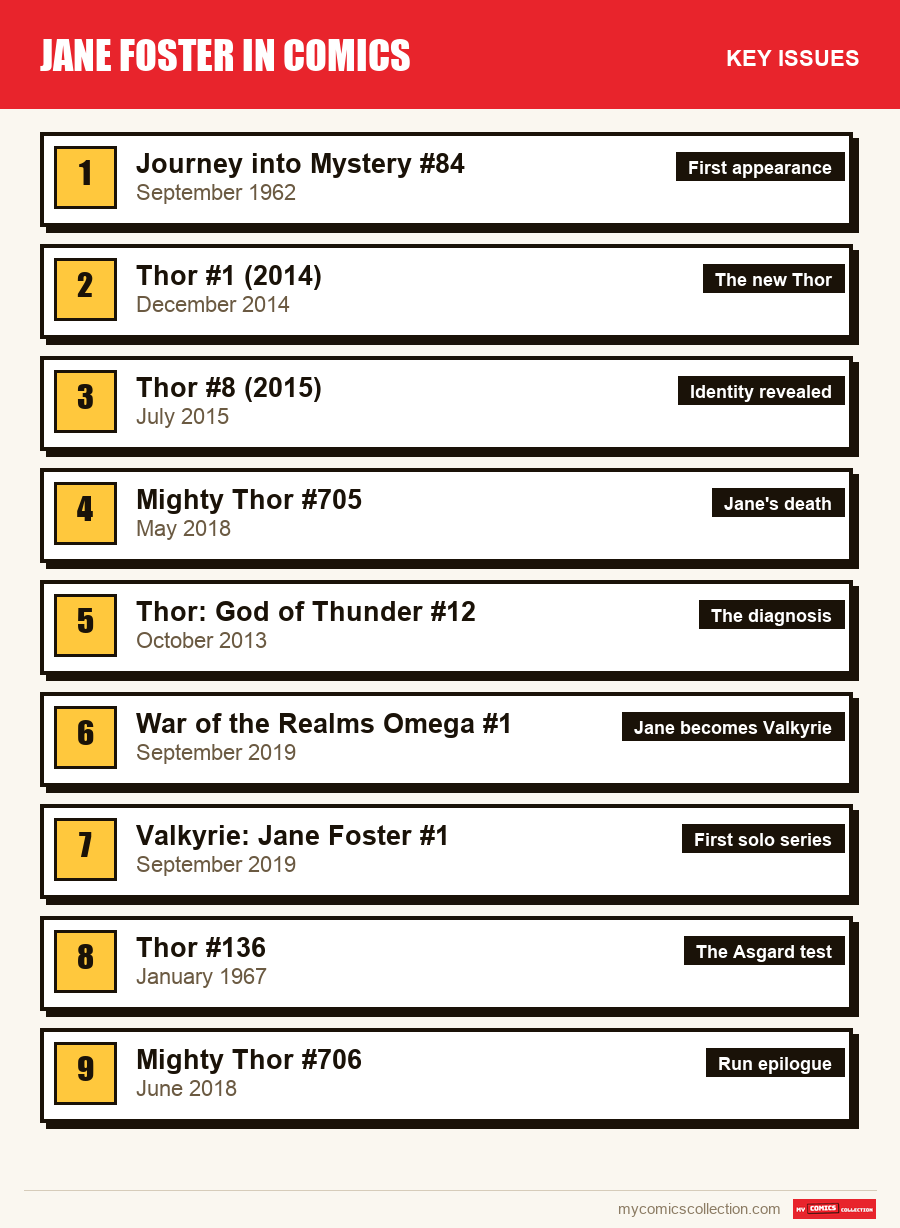
Jane Foster first appears in Journey into Mystery #84 (September 1962), created by Stan Lee, Larry Lieber and Jack Kirby as a nurse and love interest of Donald Blake. For more than fifty years, she remained a secondary character before in 2014 screenwriter Jason Aaron and artist Russell Dauterman transformed her into the new Thor in Thor vol. 4 #1, revelation confirmed in the #8 of May 2015. She carries the hammer while chemotherapy fights her cancer, until the conclusion of her run in Mighty Thor #705-706 (2018), before becoming Valkyrie during the War of the Realms. The major keys to watch remain JIM #84 (first appearance) and Thor #1 (2014) with its Dauterman variants.
Few secondary characters in the Marvel universe have had as spectacular an editorial trajectory as Jane Foster. Introduced in 1962 as a simple romantic foil for Doctor Donald Blake: the mortal identity of the first Thor -, she has long been confined to the classic role of love interest in Silver Age comics: capable, devoted, but rarely an actress in her own story. We had to wait more than half a century for a screenwriter to decide to completely turn the tables and entrust him, literally, with the hammer of the god of thunder.
This switch, made in 2014 by Jason Aaron, is not just another editorial gimmick. It redefined the character over the long term, generated one of the most critically-received Thor runs since Walt Simonson in the 1980s, and eventually made it to the big screen with Natalie Portman reprising the role in Thor: Love and Thunder in 2022. For a collector, understanding this story in several acts is essential: it explains why certain specific issues concentrate all the market value, while dozens of other episodes where Jane appears remain simple midgrade without premium.
In this guide, we retrace the complete history of Jane Foster in comics (her creation, her long journey through the editorial desert, her metamorphosis into Thor, her transition to the status of Valkyrie) then we detail what a buyer or seller must know before positioning themselves on the key issues of her saga.
Jane Foster: from Donald Blake's nurse to cult character
Jane Foster was born from the pens of Stan Lee and Larry Lieber, brought to images by Jack Kirby, in Journey into Mystery #84, dated September 1962 and sold at the time for twelve cents. This is only Thor's second appearance in Marvel comics, one month after his introduction in issue #83. Jane is presented as the nurse of Doctor Donald Blake, the lame surgeon who is none other than the mortal identity under which Odin exiled his son to Earth to teach him humility. The dynamic established from this issue is classic of the time: an impossible love triangle, since Blake is in love with his nurse without ever being able to reveal to her that he is also the Nordic god whom she admires from afar.
This status of love interest would last, with variations, for most of the following decades. Jane goes through Stan Lee's runs, then successive incarnations of the Thor title under the pen of multiple screenwriters, without ever really becoming an active agent in the plot. She even married Doctor Keith Kincaid for a time in the pages of Thor during the 1970s, before returning to orbit around the main character in the reboots. The most notable run of this intermediate period remains that of J. Michael Straczynski (2007-2009), where Jane finds a role as a doctor in Broxton, Oklahoma, the reconstructed city near Asgard that has fallen to Earth: a realistic anchor point which prepares, without knowing it yet, the rest of her journey.
A secondary role but never anecdotal
It would be unfair to reduce these first fifty years to mere waiting. Jane Foster remains, throughout this period, one of the most stable links between Thor and Earth: it is through her eyes that readers often perceive the human dimension of a Norse god otherwise busy fighting against ice giants or Loki. Successive screenwriters use it as a moral indicator of the main character: the way Thor treats Jane says a lot about his evolution as a hero worthy of wielding Mjolnir. It is precisely this narrative legitimacy accumulated over half a century which will make credible, in 2014, the most commented upon twist of the Marvel NOW period.
2014: the twist that transformed Jane Foster into Thor
In fall 2014, Marvel relaunched the Thor series with a new volume written by Jason Aaron and drawn by Russell Dauterman, colors by Matt Wilson. Thor vol. 4 #1 appears on October 1, 2014 at the price of $3.99 and ends with a shattering cliffhanger: Thor Odinson proves unworthy to lift Mjolnir, simply murmuring “I am no longer worthy” before a female silhouette, remaining in the shadows, takes the hammer in his place. The identity of this new wielder of the hammer was deliberately kept secret for several months, fueling intense speculation among readers and on specialized forums.
The revelation falls in Thor vol. 4 #8, published in May 2015: the new Thor is none other than Jane Foster herself. The choice is not trivial. Jason Aaron builds his legitimacy by relying directly on the inscription engraved on Mjolnir from the character's origins: anyone worthy can lift the hammer, regardless of gender or lineage. By choosing Jane, the screenwriter completes a loop that began fifty-two years earlier: the character long confined to the background literally becomes the holder of the title.
The price of power: cancer and chemotherapy
The twist doesn't stop at a simple casting change. Jason Aaron introduces a tragic dimension that radically distinguishes this run from previous female incarnations of superheroes: at the time she becomes Thor, Jane Foster is in the middle of chemotherapy to treat cancer. Each transformation into a thunder goddess purges her body of ongoing treatments, slowing down her healing without ever making the disease itself disappear, since the cancer affects Jane at the cellular level and therefore survives the magical metamorphosis. The story thus establishes a constant tension: each fight that Jane leads in Thor form brings her a little closer to death as Jane Foster, mortal. This narrative mechanic, hailed by critics as one of the strongest of the decade at Marvel, transforms what could have remained a marketing gimmick into a true heroic tragedy, where the act of saving the Nine Kingdoms literally pays with one's life.
The run unfolds over several consecutive series carried by the same main creative trio: Thor vol. 4 (2014-2015), then Mighty Thor vol. 2 (2015-2018). With the 2017 Marvel Legacy renumbering, the series returns to the historical numbering of the title and concludes with Mighty Thor #700 to #706 (2017-2018), an editorial choice that symbolically connects Jane Foster's run to the full story of the title since Journey into Mystery. The conclusion of this saga sees Jane Foster face the ultimate choice between continuing to fight as Thor at the cost of her life, or accepting death as a healed mortal.
From Thor to Valkyrie: the continuation of Jane Foster's journey
The character does not disappear with the end of his run like Thor. During the crossover event War of the Realms (2019), where Malekith invades the Nine Realms, Jane Foster is led to become the first of a new generation of Valkyries after the death of Brunnhilde, the previous holder of the title. She receives Undrjarn, the Total Weapon, capable of transforming into any weapon according to the will of its wielder, and even a pair of wings allowing her to fly. This new status of Valkyrie gives rise to a solo series, Valkyrie: Jane Foster, which deepens her role as psychopomp responsible for escorting the fallen heroes to Valhalla: an obvious thematic continuity with her past as a health professional, now transposed into a mythological register.
Jane Foster has since continued to appear regularly in the Thor pages and in various Marvel events, oscillating between supporting roles and one-off solo arcs. Her complete trajectory (nurse, doctor, Thor, Valkyrie) makes her today one of the most accomplished examples of a secondary character elevated, over time, to the rank of full-fledged hero in the Marvel universe.
The impact of adaptations on the rating
Jane Foster's career in cinema has directly influenced the comic book market relating to her. Natalie Portman plays the character from Thor (2011) and Thor: The Dark World (2013), but as a simple astrophysicist, a classic love interest faithful to the character's pre-2014 period. It was during San Diego Comic-Con in July 2019 that Kevin Feige and director Taika Waititi announced that the fourth Thor film would be titled Thor: Love and Thunder and that Natalie Portman will reprise her role, but this time in the skin of the Mighty Thor comics version, a choice explicitly inspired by the run of Jason Aaron and Russell Dauterman. The film is finally released in July 2022, after a postponement linked to the pandemic.
This announcement immediately reignited speculative interest in the seminal episodes of the Jane Foster/Thor arc, particularly Thor vol. 4 #1 (2014) and its many cover variants, including limited editions signed by Russell Dauterman (1:10, 1:20 and 1:25 variants, including the “variant design” highly sought after by collectors). Issue #8, which contains the reveal of Jane's identity, as well as the episodes explicitly chronicling her battle with cancer, also saw demand increase on the secondary market as the film's release approached. In the older segment, Journey into Mystery #84 remains the gold standard: as the character's first appearance and Thor's second historical appearance, this Silver Age issue boasts particularly high documented sales at the highest grades: an unrestored copy rated 9.4 sold for $35,850 in July 2012, while an unrestored 9.0 copy reached $8,500 in January 2019; at more common grades around 6.0, sales are more in the $1,100 to $1,300 range. These figures illustrate the considerable gap in value between very high collector grades and reading copies, a classic phenomenon on Silver Age comics with low recorded circulations.
It should be noted that, unlike other characters whose first appearance focuses all the attention, the Jane Foster saga distributes its value over several well-identified entry points: the character's first appearance (1962), the first appearance as Thor (2014), the revelation of his identity (2015), and to a lesser extent the concluding issues of his run (2017-2018). A collector who specifically targets the "Jane Foster story" must therefore think in terms of a key portfolio rather than a single number.
Collecting this series?
Track what you own, what you are missing and what your collection is worth. 7 day trial.
Start my trial →Buying guide
- Check the exact nature of the key before purchasing: Journey into Mystery #84 is the character's first appearance in her original nurse form, while Thor vol. 4 #1 (2014) is Jane's first appearance as Thor (unidentified silhouette on cover): two very different keys in rarity and buyer profile, not to be confused in a search.
- On Journey into Mystery #84, favor unrestored copies: the difference in value between an “unretouched” copy and a restored copy or one with color defects (Silver Age requires) is considerable; systematically ask for grading details if the comic is not encapsulated.
- Spot the variants of Thor #1 (2014): the standard coverage of Russell Dauterman, the “variant design” 1:10, and the rarer ratios (1:20, 1:25) do not have at all the same liquidity nor the same rating; the standard cover remains the easiest to resell, the rare variants are aimed at a smaller audience.
- Number #8 (identity revelation) is worth watching separately: often neglected in favor of #1, it nevertheless constitutes the real narrative tipping point and remains underrated in relation to its importance in the character's story.
- Don't neglect the concluding episodes (Mighty Thor #700-706): they close the arc of Cancer and Farewell to the Hammer, an emotional climax of the run that is of particular interest to readers coming from the film adaptation.
- Systematically use an estimator based on actual sales before setting a purchase or sale price, the rating of these numbers having fluctuated greatly depending on cinema announcements since 2019.
- Consider long-term storage: sleeve and cardboard for all Silver Age like JIM #84, and for modern prints (2014-2018), storage away from light remains recommended even if the paper is of better quality than in the 1960s.
To organize this type of search on several keys at once (release dates, creators, variants) the use of a collection management application allows you to keep precise track of what you already have and what is still missing from the series.
Key issues to know
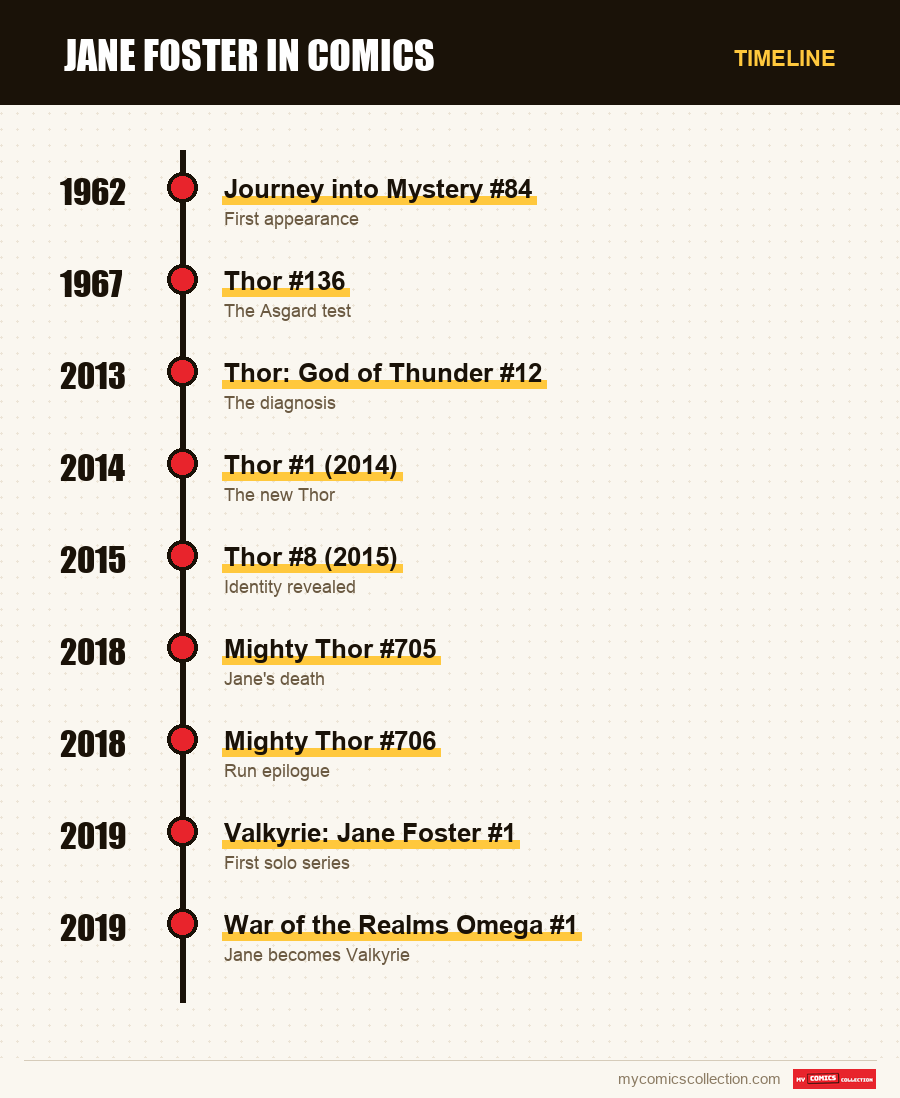
Journey into Mystery #84
Jane Foster debuts as the nurse of Dr. Donald Blake, Thor's human identity, just one month after the thunder god's own debut in #83. Stan Lee and Larry Lieber wrote it, with Jack Kirby on art. A fun detail for purists: one caption still calls her Jane Nelson. This is the cornerstone of her entire saga.
Thor #1 (2014)
Released on October 1, 2014 with a December cover date, this Jason Aaron and Russell Dauterman relaunch shows Thor Odinson rendered unworthy and unable to lift Mjolnir, before an unknown woman takes up the hammer. It is the first full appearance of the new Thor, whose identity stays secret. A brief glimpse of the future goddess had already appeared a few weeks earlier in Thor: God of Thunder #25.
Thor #8 (2015)
Released in May 2015, "The Woman Beneath the Mask" finally lifts the secret: the new Thor is Jane Foster. Odinson, convinced he has unmasked Agent Roz Solomon, picks the wrong suspect, but readers learn the truth. The issue also sets the price of the power: every transformation wipes out the effects of her chemotherapy.
Mighty Thor #705
The climax of "The Death of the Mighty Thor": even though one more transformation will kill her, Jane takes up the hammer to face the Mangog. She binds the monster with Gleipnir, hurls it into the Sun along with Mjolnir, then succumbs to her cancer. Jason Aaron and Russell Dauterman deliver the most moving chapter of the run.
Thor: God of Thunder #12
In this Earth-bound issue drawn by Nic Klein, Jason Aaron brings Jane Foster, now a doctor, back alongside Thor. It reveals that she has breast cancer. Planted a year before the relaunch, this detail gives her later turn with the hammer its full tragic weight.
War of the Realms Omega #1
In the story "The Job I Have to Do", written by Al Ewing and Jason Aaron and drawn by CAFU, the spirits of Brunnhilde and the Valkyries who fell during War of the Realms ask Jane to carry on their duty. She accepts and becomes Valkyrie. Her weapon, Undrjarn, was born from the remains of a Mjolnir from another universe.
Valkyrie: Jane Foster #1
The first series to bear her name, written by Jason Aaron and Al Ewing and drawn by CAFU. Jane embraces her role as Valkyrie, able to sense approaching death and escort the fallen to the afterlife. Undrjarn proves to be an all-weapon that takes whatever shape its bearer desires.
Thor #136
Odin agrees to let Thor marry Jane if she proves worthy of the gods. Made immortal, she fails the final test and asks to become mortal again. Sent back to Earth with no memory of Asgard, she meets Dr. Keith Kincaid, her future husband, while Thor is reunited with Sif. Stan Lee and Jack Kirby close the first chapter of the romance.
Mighty Thor #706
The final issue of the run, "At the Gates of Valhalla" closes Jane's saga with the hammer. She is brought back to life, while Thor Odinson reclaims the name of Thor. For collectors, it is the natural companion to #705 and the closing door of the whole Jane Foster era.