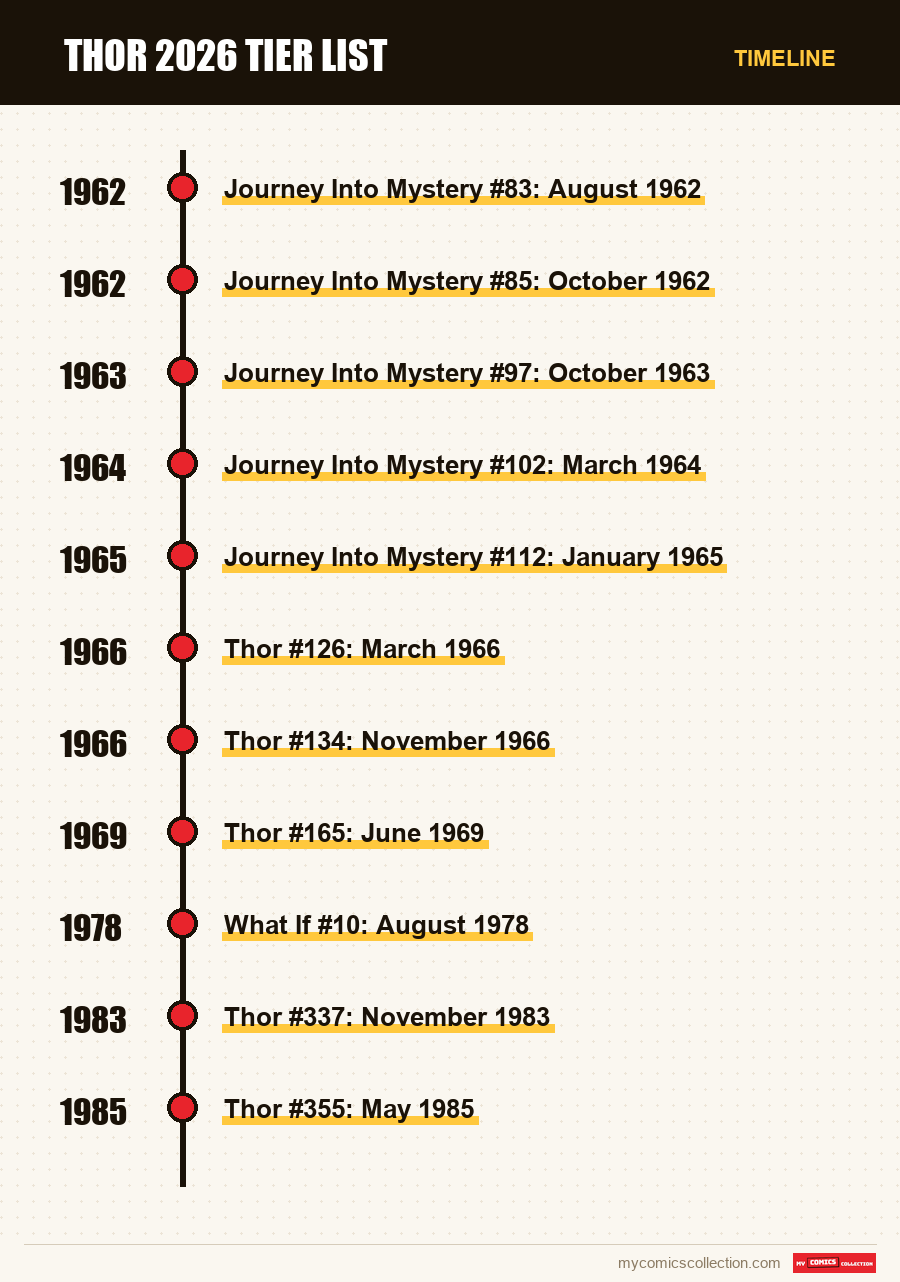
The 2026 tier list of key issues Thor ranks the numbers by valuation potential: Tier S blue-chip (Journey Into Mystery #83 August 1962 first appearance Thor Lee/Lieber/Kirby, JIM #85 October 1962 first Loki, JIM #112 January 1965 Thor versus Hulk, Thor #337 November 1983 first Beta Ray Bill Walter Simonson): central assets at €1,500-90,000 depending on grade. Tier A (JIM #97 October 1963 start Tales of Asgard backup, Thor #126 March 1966 official renumbering, JIM #102 March 1964 first Sif, Thor #355 May 1985 run Simonson epic). Tier B solid sleepers (Thor #134 November 1966 first High Evolutionary, Thor #165 June 1969 first full Warlock cocoon Lee/Kirby, What If #10 August 1978 Jane Foster Thor). Tier C speculative bets 2026-2027 (Thor solo MCU Phase 6, Asgardians of the Galaxy).
Building a solid Thor collection in 2026 requires a rigorous method: without a clear hierarchy of numbers, the collector disperses his budget on secondary issues while Asgardian blue-chips continue to appreciate out of reach. The Thor tier list is the discipline tool that separates must-have from nice-to-have, defensive investment from calculated bet, purchasing urgency from opportunistic patience.
Ce guide tier list Thor 2026 classifies major key issues into four tiers (S, A, B, C) based on three weighted criteria: narrative historical importance in Asgard mythology, rolling five-year market performance documented via GoCollect and Heritage Auctions, and likelihood of MCU catalyst in the 2026-2030 window. Each issue is documented with exact publication date, full creative team and price range by CGC grade. Objective: to allow the French-speaking collector to build a budgeted purchasing strategy, without wasting a euro on the classic pitfalls of the Thor catalog (fake Journey Into Mystery reprints, renumbering #126, premium on multiple Mjolnir wielders).
Thor 2026 tier list methodology
A useful tier list doesn't just line up numbers in order of price: it prioritizes based on a coherent investment and collection thesis. For Thor in 2026, three methodological axes structure the classification and allow the collector to make reproducible rather than emotional decisions.
Tier S/A/B/C classification criteria
- Narrative historical significance (40%): first appearances of structuring characters (Thor, Loki, Sif, Beta Ray Bill, Jane Foster Thor), founding events (worthy of the hammer, run Simonson, renumbering #126), canonical runs cited by academic critics and the collecting community.
- Market performance 5 years (35%): CGC price trend documented on GoCollect, Heritage Auctions, ComicConnect between 2021 and 2026. An issue that has tripled and then plateaued is not equivalent to an issue that progresses linearly with low volatility.
- Probability of MCU catalyst 2026-2030 (25%): proximity of the character with Phase 6 Marvel Studios announcements, potential presence in anticipated Disney+ projects, traction of verifiable rumors about The Cosmic Circus and Murphy's Multiverse. The Asgardians remain a rich universe still largely unexploited in cinema.
Definition of third parties Thor
- Tier S: blue-chip: central numbers, globally recognized value, no risk of historical downgrading. These are the defensive assets of the Thor collection. If you could only have four Thor numbers, these would be them, regardless of rank.
- Tier A: fundamentals: Historically critical issues with solid performance but without the absolute status of Tier S. Make up the backbone of a serious Thor collection spanning Silver and Bronze Age.
- Tier B: sleepers with conviction: issues undervalued in view of their editorial significance, with catalyst identified at 12-36 months. Moderate risk, re-rating potential documented by sector analyses.
- Tier C: speculative bets: numbers with a strong thesis but dependent on uncertain future events (MCU casting announcements, Disney+ confirmations, Asgardians of the Galaxy projects). Limited budget allocation recommended.
Voluntary out-of-scope
This tier list does not classify secondary annuals without a major first appearance, event crossovers (unless documented direct influence), nor modern post-2015 variants which have lost any lasting speculative premium. For the parallel market for Marvel Tales reprints and fake Journey Into Mystery, see analyzes key issues Thor Silver Age before any purchase of issues before 1970 from unverified eBay.
Tier S: the central Thor blue-chips
Four issues absolutely dominate the Thor catalog and constitute the defensive core of any serious Asgardian collection. They combine absolute high-grade rarity, indisputable historical significance and maximum liquidity on the major Heritage Auctions and ComicConnect auction markets. These blue-chips typically constitute 50 to 60% of a heritage-oriented Thor collector's budget allocation.
Journey Into Mystery #83: August 1962 (Stan Lee / Larry Lieber / Jack Kirby)
The absolute founding number. Published by Marvel Comics in August 1962, Journey Into Mystery #83 introduced Thor's first appearance in the Marvel Universe under the screenplay by Stan Lee (with his brother Larry Lieber providing dialogue) and art by Jack Kirby. The initial pitch, a disabled doctor Don Blake discovers the hammer Mjolnir in a Norwegian cave and transforms into the god of thunder, invents the formula of the hero with a dual divine identity that underpins all Thor mythology to this day. It is the canonical origin story recognized worldwide as one of the ten most important issues of Silver Age Marvel.
- CGC 9.0: public sales 2024-2026 between €75,000 and €95,000. Census CGC 9.0 less than 35 copies worldwide.
- CGC 7.0: €22,000 to €32,000. This is the most accessible mid-grade for a high-end investment.
- CGC 6.0: €12,000 to €18,000. Institutional entry point.
- CGC 4.0: €4,500 to €7,200. The grade of serious collectors with a capped budget.
- CGC 2.0: €1,800 to €2,800. The minimum acceptable to preserve blue-chip status.
5-year trend: +210% between 2021 and 2026 in CGC 7.0, with a post-Thor: Love and Thunder (2022) acceleration which has never completely reversed. No documented market correction greater than 15% over 36-month rolling windows since 2012. The number appears at the top of the long-term recommendations in the analyzes key issues Thor Silver Age and remains systematically liquid even in periods of bear markets.
Journey Into Mystery #85: October 1962 (Stan Lee / Larry Lieber / Jack Kirby)
Loki's first appearance. Published October 1962, JIM #85 introduces Thor's adopted half-brother from the pens of Stan Lee and Larry Lieber, drawings Jack Kirby. Loki Laufeyson, god of mischief, instantly becomes the structuring antagonist of the Thor mythology: ambivalent brotherly relationship, manipulation, treachery. The character has become one of the MCU's most profitable cultural assets thanks to Tom Hiddleston's portrayal in six Marvel Studios films plus the Loki Disney+ series (2021-2023).
- CGC 9.4: €38,000 to €58,000. Census 9.4 under 25 copies.
- CGC 9.0: €18,000 to €28,000.
- CGC 7.0: €6,500 to €9,500.
- CGC 6.0: €3,800 to €5,500.
- CGC 4.0: €1,500 to €2,400.
- CGC 2.0: €650 to €1,000.
5-year trend: +260% in CGC 7.0 between 2021 and 2026, mainly driven by the two Loki Disney+ seasons. The role soon to be taken up in Avengers: Doomsday (December 2026) structurally reinforces the bullish thesis. To understand the full narrative evolution of the character, see the story of Loki in comics which details the major Silver Age arcs up to Loki: Agent of Asgard.
Journey Into Mystery #112: January 1965 (Stan Lee / Jack Kirby)
Thor versus Hulk: the iconic fight. Published January 1965, JIM #112 contains one of the most famous clashes of Silver Age Marvel: Thor versus Hulk in full power, told in narrative flashback. Stan Lee on the script and Jack Kirby on the drawing (Chic Stone inking) penned an issue which instantly became an absolute reference in the fan culture debate on the power hierarchy of Marvel heroes. The clash was taken up culturally in Thor: Ragnarok (2017) with the Sakaar arena, creating a lasting halo effect on the rating.
- CGC 9.4: €12,000 to €18,000.
- GCC 9.2: €5,500 to €8,200.
- CGC 9.0: €3,200 to €4,800.
- CGC 8.0: €1,400 to €2,200.
- CGC 7.0: €800 to €1,200.
- CGC 6.0: €480 to €720.
5-year trend: +175% in CGC 9.0. The issue benefits from double exposure (Thor franchise and Hulk franchise), which makes it a particularly defensive asset in the event of rotation between the two MCU licenses. Number frequently cited in Thor key number references as a must for any serious Silver Age Marvel collection.
Thor #337: November 1983 (Walter Simonson)
First appearance of Beta Ray Bill. Published November 1983, Thor #337 marked the legendary start of the Walter Simonson run (screenplay and art, John Workman lettering) that redefined the franchise for the following decade. The issue introduces Beta Ray Bill, the horse-like alien who becomes the first non-Asgardian being deemed worthy of lifting Mjolnir. The scene has become iconic to the point of being the only Bronze Age Thor issue to systematically surpass Silver Age key issues in grade 9.8.
- CGC 9.8: €4,200 to €6,800. Census 9.8 limited to approximately 800 copies.
- CGC 9.6: €1,400 to €2,100.
- CGC 9.4: €580 to €880.
- GCC 9.2: €280 to €420.
- CGC 9.0: €170 to €260.
- CGC 8.5: €110 to €170.
5-year trend: +320% in CGC 9.8 between 2021 and 2026. Beta Ray Bill made an unconfirmed but visually recognizable appearance in Thor: Ragnarok (statue in the Grandmaster's Tower) and remains expected for Asgardians of the Galaxy. The issue is one of the most watched sleepers in the Marvel Bronze Age catalog and consistently appears in spec key analyzes 2027 Marvel/DC.
Tier A: solid Thor fundamentals
Tier A brings together the issues that form the backbone of a serious Thor collection. They combine documented narrative importance and continued market performance, without achieving absolute Tier S monument status. The budget weighting rule suggests that they represent 30-40% of the Asgardian Silver and Bronze Age oriented collector's total allocation.
Journey Into Mystery #97: October 1963 (Stan Lee / Jack Kirby)
Starting Tales of Asgard. Published October 1963, JIM #97 introduces the backup story Tales of Asgard, created by Stan Lee on the screenplay and Jack Kirby on the drawings. This secondary series of mythological adventures structures the Asgardian universe for the following decades: first systematic development of Odin, Heimdall, Balder, first mapped Nine Realms. Without Tales of Asgard, the Marvel Thor mythology remains a superficial veneer on Norse folklore rather than a self-contained story universe.
- CGC 9.4: €4,800 to €7,200.
- GCC 9.2: €2,400 to €3,600.
- CGC 9.0: €1,300 to €1,950.
- CGC 8.0: €550 to €820.
- CGC 7.0: €280 to €420.
- CGC 6.0: €160 to €240.
5-year trend: +120% in CGC 9.0. Number undercovered by the speculative retail market but recognized as a cornerstone by institutional collectors and academic analyzes of Marvel mythology.
Journey Into Mystery #102: March 1964 (Stan Lee / Jack Kirby)
First appearance of Sif. Published March 1964, JIM #102 introduced Lady Sif, warrior Asgardian goddess and Thor's alternate romantic interest opposite Jane Foster. Stan Lee and Jack Kirby position the character as a full-fledged fighting partner, creating a strong female figure rare in Silver Age Marvel. Jaimie Alexander played Sif in Thor (2011) and Thor: The Dark World (2013) then made a notable return in Thor: Love and Thunder (2022).
- CGC 9.4: €6,200 to €9,200.
- GCC 9.2: €3,200 to €4,800.
- CGC 9.0: €1,800 to €2,700.
- CGC 8.0: €750 to €1,150.
- CGC 7.0: €380 to €580.
- CGC 6.0: €210 to €320.
5-year trend: +145% in CGC 9.0. Sif is among the Asgardian female characters to watch for Disney+ projects oriented Asgardians or Valkyrie spin-off. To understand Sif's place in the broader mythology, see the Asgard key numbers which detail the entire Marvel divine genealogy.
Thor #126: March 1966 (Stan Lee / Jack Kirby)
The official renumbering. Published March 1966, Thor #126 marks Journey Into Mystery's transition to the solo title Thor under the character's own name. The issue resumes continuous numbering (Journey Into Mystery #125 becomes Thor #126), signaling the commercial and cultural maturity of the character. Stan Lee on screenplay and Jack Kirby on drawing maintain creative continuity while establishing Thor as a major solo franchise in the Marvel catalog.
- CGC 9.6: €5,500 to €8,200.
- CGC 9.4: €2,200 to €3,300.
- GCC 9.2: €1,100 to €1,650.
- CGC 9.0: €580 to €870.
- CGC 8.0: €240 to €360.
- CGC 7.0: €130 to €200.
5-year trend: +110% in CGC 9.2. Cornerstone number for completionists but often overlooked by first-time buyers who are unaware that the Thor continuity really begins with Journey Into Mystery #83. See the investment guide 2027 pillar strategy to understand the value of official Silver Age renumberings.
Thor #355: May 1985 (Walter Simonson)
The Simonson run at the top. Published May 1985, Thor #355 is one of the most recognized issues of the Walter Simonson run (1983-1987), unanimously considered the greatest creative period of the Thor franchise. The issue illustrates the confrontation between Thor and Lorelei in the context of a cosmic saga combining Beta Ray Bill, Mailing Mister, and the rest of the Ragnarok arcs. The Simonson run still serves as a narrative reference for Thor writers and artists today.
- CGC 9.8: €380 to €580.
- CGC 9.6: €140 to €210.
- CGC 9.4: €75 to €115.
- GCC 9.2: €42 to €65.
- CGC 9.0: €28 to €42.
5-year trend: +85% in CGC 9.8. The entire Simonson run (Thor #337 to #382) constitutes a complete investment recommended for Bronze Age oriented collectors: see our Thor collection guide for the full run accumulation strategy.
Tier B: Thor sleepers to be convinced
Tier B is the favorite playground for informed Thor collectors. The numbers are accessible there, their assessment thesis documented by sectoral analyses, and the favorable potential/risk ratio. They typically represent 20 to 30% of a diversified Thor allocation, and allow you to complete a serious collection without exposing the entire budget to Tier S blue-chips.
Thor #134: November 1966 (Stan Lee / Jack Kirby)
First appearance of High Evolutionary. Published November 1966, Thor #134 introduced Herbert Edgar Wyndham, an evolutionary geneticist turned quasi-divine being known as the High Evolutionary. Stan Lee and Jack Kirby create a character who becomes central to the cosmic Marvel mythology, linked to Wundagore Mountain, Knull, Quicksilver and Scarlet Witch (originally presented as his creations), and the New Men. The character was portrayed by Chukwudi Iwuji in Guardians of the Galaxy Vol. 3 (2023), creating an immediate halo effect on the rating.
- CGC 9.6: €4,800 to €7,200.
- CGC 9.4: €1,800 to €2,700.
- GCC 9.2: €950 to €1,400.
- CGC 9.0: €480 to €720.
- CGC 8.0: €220 to €340.
- CGC 7.0: €130 to €200.
5-year trend: +380% in CGC 9.2 between 2021 and 2026, mainly driven by Guardians of the Galaxy Vol. 3 by James Gunn. The issue remains exposed to any future appearances of High Evolutionary in Disney+ projects or cosmic crossovers. To follow other cosmic key issues related to the character, consult the story of Adam Warlock in comics of which Wundagore Mountain plays a central role.
Thor #165: June 1969 (Stan Lee / Jack Kirby)
First full appearance of Adam Warlock in his cocoon. Published June 1969, Thor #165 introduced Him (later renamed Adam Warlock) emerging in full page form from a golden cocoon for the first time, under the pen of Stan Lee and the pencil of Jack Kirby. The character had made an embryonic appearance in Fantastic Four #66-67, but it was Thor #165 which established his definitive design and his symbolic relationship to the transformation cocoon. Adam Warlock has become one of Marvel's cosmic pillars, played by Will Poulter in Guardians of the Galaxy Vol. 3 (2023).
- CGC 9.6: €7,800 to €11,500.
- CGC 9.4: €3,200 to €4,800.
- GCC 9.2: €1,600 to €2,400.
- CGC 9.0: €800 to €1,200.
- CGC 8.0: €380 to €570.
- CGC 7.0: €210 to €320.
5-year trend: +260% in CGC 9.2. The position of the number is ambivalent: legally Fantastic Four #66-67 are the "first appearances", but the market recognizes Thor #165 as the canonical full appearance. This ambiguity creates volatility that can be exploited tactically. See the complete story of Adam Warlock for the detailed chronology of the apparitions.
What If #10: August 1978 (Don Glut / Rick Hoberg)
Jane Foster finds Mjolnir. Published August 1978, What If #10 offers an alternative history where Jane Foster discovers Mjolnir in place of Don Blake and becomes Thordis, female prototype of the god of thunder. Don Glut on screenplay and Rick Hoberg on drawing signed the first documented narrative precedent of Jane Foster Thor, the canonical version of which will be launched by Jason Aaron in 2014 (Thor: Goddess of Thunder, Thor Vol. 4 #1). Natalie Portman played this version in Thor: Love and Thunder (2022).
- CGC 9.8: €1,800 to €2,700.
- CGC 9.6: €580 to €870.
- CGC 9.4: €240 to €360.
- GCC 9.2: €130 to €200.
- CGC 9.0: €75 to €115.
5-year trend: +320% in CGC 9.8 driven by Thor: Love and Thunder. The issue remains a structural sleeper as the collecting community still debates its canonical status for Jane Foster Thor. For the full character timeline, see story of Jane Foster in comics which traces the evolution from 1962 to modern Mighty Thor.
Collecting this series?
Track what you own, what you are missing and what your collection is worth. 7 day trial.
Start my trial →Tier C: speculative bets Thor 2026-2027
Tier C concentrates bets with a strong thesis but high uncertainty. Recommended budget allocation: 10-20% of total Thor budget. Buying multiple copies of the same issue is sometimes relevant here if conviction is high and the entry price low. This category is particularly suited to collectors who wish to take targeted speculative positions on upcoming MCU announcements while limiting exposure to overall risk.
Thor solo MCU Phase 6: support keys
Although Chris Hemsworth has cast doubt on his return as Thor, Marvel Studios has not ruled out a fifth solo installment as part of Phase 6. Verifiable rumors about The Cosmic Circus and Murphy's Multiverse suggest a post-Mjolnir-oriented solo Thor, possibly with Stormbreaker as the central weapon. Several numbers would benefit from halo effects:
- Thor #339 (January 1984): first appearance of Stormbreaker, hammer of Beta Ray Bill. CGC 9.8 currently at €800-1,200, exposed to any MCU confirmation.
- Thor #316 (February 1982): beginning of Egghead/Foundry arcs tied into expanded cosmic mythology.
- Thor: God of Thunder #2 (January 2013): first appearance of Gorr the God Butcher on cover. The character played by Christian Bale in Thor: Love and Thunder could return.
Asgardians of the Galaxy: the cosmic thesis 2027-2028
The Asgardians of the Galaxy project, mentioned in several pre-DC Studios James Gunn interviews, remains a strong spec thesis for Phase 7 MCU. The comic team (Asgardians of the Galaxy #1, September 2018) includes Valkyrie, Angela, Skurge, Throg and other secondary Asgardians. Several first appearances could benefit:
- Thor #347 (September 1984): Skurge the Executioner in the Simonson run. CGC 9.8 at €280-420.
- Age of Ultron #10 AI (August 2013): Angela's first appearance in the Marvel Universe after her arrival from Image Comics.
- Thor Annual #14 (1989): backup story about Throg, frog version of Thor. Extreme sleeper with low attention span market.
Avengers: Doomsday / Secret Wars 2027 build-up numbers
Marvel Studios has confirmed Avengers: Doomsday (December 2026) and Avengers: Secret Wars (May 2027). Several Thor issues will benefit from halo effects:
- Thor #1 (Vol. 4, October 2014): Jane Foster becomes Thor canonically, paving the way for Mighty Thor.
- Mighty Thor #705 (April 2018): death of Jane Foster Thor, potential narratively exploitable return.
- Thor Vol. 1 #382 (August 1987): end of the Simonson run, Surtur final.
For technical purchasing arbitrations, the investment strategy analysis 2027 pillar offers detailed budget weighting grids by identified catalyst and by time horizon.
Thor allocation strategy by collector budget
A tier list only has value when operationalized by a budgetary strategy. Here are three typical profiles adjusted to the Thor 2026 market, calibrated to maximize the historical importance / committed budget ratio.
Budget €5,000: the Bronze Age heart collection
- Thor #337 CGC 9.4 (€700): Beta Ray Bill, Tier S Bronze Age anchor.
- Thor #134 CGC 8.0 (€280): High Evolutionary, Tier B high value.
- What If #10 CGC 9.6 (€700): Jane Foster Thor, Tier B exposed MCU.
- Thor #355 CGC 9.6 (€180): run Simonson, Tier A accessible.
- Thor #126 CGC 7.0 (€160): renumbering, historic Tier A.
- JIM #112 CGC 6.0 (€600): Thor versus Hulk, Tier S entry point.
- JIM #102 raw VF (€500): Sif, Tier A raw conservation.
- Reserve €1,880: window opportunities + targeted Tier C (Thor #339, Thor #347).
This allocation builds a base representative of the three ages (Silver-Bronze-Modern Asgardian) while keeping a tactical reserve for MCU Phase 6-7 announcements.
Budget €15,000: the institutional collection
Suggested allocation: 55% Tier S, 30% Tier A, 10% Tier B, 5% Tier C.
- JIM #83 CGC 4.0 (€6,000): absolute cornerstone.
- JIM #85 CGC 6.0 (€4,500): first Loki, second MCU pillar.
- JIM #112 CGC 7.0 (€1,000): Thor versus Hulk.
- Thor #337 CGC 9.6 (€1,700): Beta Ray Bill high grade.
- JIM #102 CGC 7.0 (€480): Fundamental sif.
- Thor #134 CGC 9.0 (€600): High Evolutionary Tier B.
- Reserve €720: Tier B (What If #10) and tactical opportunities.
Budget €50,000+: the Asgardian blue-chip wallet
At this level, the top priority is grade quality. Buy a JIM #83 CGC 7.0 (€28,000) rather than ten mid-grade Tier B issues. Resale liquidity is paramount, and the Heritage Auctions and ComicConnect market concentrates its best performances on the higher grades. The 70/20/10 rule applies: 70% Tier S high grade, 20% Tier A in matched grade, 10% Tier B and C for speculative diversification.
For continued arbitration between Marvel franchises, see key issues Iron Man Silver Age to understand the correlations between founding Avengers franchises and individual keys like Tales of Suspense #39, Tales to Astonish #27 and Journey Into Mystery #83.
Classic pitfalls to avoid in the Thor franchise
The Thor collection has specific pitfalls that can erode a well-planned budget. Four families of risks dominate and require particular vigilance from the French-speaking collector, often less exposed to the subtleties of the Marvel Silver Age catalog than the Anglo-Saxon market.
Journey Into Mystery #83 versus reprint Journey Into Mystery #84 Marvel Tales
The most common trap. Original Journey Into Mystery #83 (August 1962) has been reprinted multiple times in Marvel Tales, Marvel Spotlight, and other anthology titles. Novice buyers regularly confuse Thor's first appearance with Journey Into Mystery #84 (the next issue, which picks up the origin in the second part), or worse with Marvel Tales reprints worth €10-30 compared to €6,000+ for the original. Buy exclusively CGC slabbed for pre-1970 issues, or via trusted sellers with guaranteed authentication documented by verifiable CGC serial number on official basis.
- Always check the publication date printed at the bottom of the page.
- The Marvel/Atlas publisher code changes between 1962 and 1965, a reliable visual indicator of authenticity.
- The original 1962 covers use specific printing screens not present in the reprints.
Multiple Mjolnir wielders and narrative confusion
The Thor franchise has had many canonical wielders of the Mjolnir hammer: Donald Blake (1962-1985), Beta Ray Bill (1983), Eric Masterson/Thunderstrike (1988-1993), Dargo Ktor (future), Jane Foster (2014-2018), Volstagg (Ultimate Thor War of the Realms), Throg. This multiplicity of "first appearances of [version] Thor" traps novice buyers who believe they are acquiring an isolated key when they are purchasing a secondary issue from a parallel lineage.
- Always check which Thor it is (canonical Asgardian versus alternate version).
- A "first Jane Foster Thor" may mean What If #10 (1978), Thor Vol. 4 #1 (2014), or Mighty Thor #1 (2015) depending on the context. Demand accuracy of date and volume.
- New post-2010 #1 relaunches are generally only worth a fraction of Vol. 1 original.
Overrated Modern Thor Variants
Post-2014 variant covers (1:25, 1:50, 1:100, sketch covers Russell Dauterman and others) massively lost their speculative premium after the 2021-2022 peak. 90% of Jane Foster Thor variants purchased for €150-400 in 2022 are now selling for €30-90. Avoid variant ratios as a main strategy and favor pre-2013 live newsstand covers for their documented authentic rarity. The Thor ratio variants secondary market remains extremely volatile and concentrated on only 4-5 artists.
Premium for first minor appearances
The speculative market has sometimes inflated the first appearances of tertiary Asgardian characters (Hogun, Fandral, Volstagg pre-Warriors Three trilogy, Karnilla, Ulik) on simple MCU casting rumors that have never been confirmed. Distinguish reliable sources (The Cosmic Circus, Murphy's Multiverse) from unverified Twitter feeds. The Warriors Three (Journey Into Mystery #119, August 1965) are for example structurally important but often overrated in intermediate grades compared to their historical reality. For an overview of the Asgardian ecosystem, check out the Asgard key numbers which hierarchize the entire pantheon.
Thor Portfolio Tracker 2026-2030
A tier list is not static. MCU catalysts, changes in editorial management at Marvel, and macro-economic cycles in the collecting market cause the rankings to evolve year after year. This is the recommended review method to keep your Thor portfolio relevant over the long term.
Quarterly review cycle
- Q1: previous year report: Heritage Auctions and ComicConnect sales, calculation of progression by issue and by grade. Recalibration of the budgetary weighting according to the evolution of Tier B towards potential Tier A.
- Q2: analysis of San Diego Comic-Con and D23 announcements (July-August). Updated Tier C targets based on MCU Phase 6-7 confirmations and Asgardians of the Galaxy rumors.
- Q3: monitoring of Disney+ Thor-adjacent releases (Loki spinoffs, What If subsequent seasons) and price impact observed D+30, D+90, D+180. The Loki rating has typically moved +35 to +60% in the 90 days following Disney+ seasons.
- Q4: end-of-year tax arbitrage, opportunistic sales of positions having achieved their objectives, tactical accumulation of sleepers in grade matched.
Thor Re-ranking Indicators
Three signals can justify moving a Tier C number to Tier B, or Tier B to Tier A specifically on the Thor franchise:
- Official Marvel Studios casting announcement on the issue's central character (for example, confirmed casting of Beta Ray Bill would bolster Thor #337 towards the top Tier S).
- Reduction of the CGC 9.8 census below a structural threshold (typically 50 copies in public circulation for the Bronze Age, 100 for the Modern Age).
- Price progression greater than 100% over 18 rolling months with stability over the following 24 months (elimination of the risk of a speculative bubble).
Thor operational monitoring tools
To manage a Thor portfolio diversified over 30-100 issues, manual tools (Excel, Google Sheets) quickly reach their limits. Dedicated applications like Comics Manager keep daily-updated eBay estimates in one place, to read alongside the CGC census and the MCU announcements calendar. See the complete guide Comics Manager for initial setup and free estimate for individual arbitrations, updated daily.
Horizon 2027-2030: Thor zones to monitor
Four major theses will probably structure the following decade on the Thor franchise:
- Post-Secret Wars movie (2027): MCU reset announced, major opportunity for secondary Asgardians if cosmic Asgard reboot. Reverse risk if Thor disappears from the reset timeline.
- Asgardians of the Galaxy official confirmation: would trigger an immediate revaluation of Skurge (Thor #347), Angela, and the entire late Simonson run.
- Loki season 3 Disney+: Loki remains the most successful MCU asset for the Thor franchise. Any Disney+ expansion structurally pulls JIM #85 upwards.
- Disney+ saturation: risk of market fatigue if the Marvel Studios rate drops below 2 films/year, a scenario which would disproportionately penalize Tier B and C Thor compared to Tier S Silver Age already established.
For collectors wishing to actively track the global market, the overview of referenced comics and the index of key issues comics provide a systematic entry point. For the Thor franchise specifically, the Thor character sheet centralizes the resources and chronologies useful for building a reasoned collection.
Thor 2026 tier list FAQ
Journey Into Mystery #83 (August 1962, Lee/Lieber/Kirby) remains the absolute foundational issue of the Thor franchise. If the budget only allows one Tier S acquisition, it is this one, ideally in CGC 4.0 minimum to preserve blue-chip status and resale liquidity. JIM #85 (October 1962, first Loki) is the central second choice if budget allows, particularly strong thanks to Tom Hiddleston's continued MCU exposure.
Thor #337 (November 1983, first Beta Ray Bill, Walter Simonson) offers a better budgetary entry point (CGC 9.4 at €580-880) than JIM #112 (Thor versus Hulk, CGC 6.0 at €480-720). For a first Bronze Age sleeper purchase, #337 maximizes the importance/price ratio with a concrete MCU upside. JIM #112 remains more prestigious historically and offers double exposure (Thor and Hulk franchises), but requires a higher grade for optimal liquidity.
What If #10 (August 1978) in CGC 9.8 has already grown by +320% over 5 years after Thor: Love and Thunder. The initial speculative bet is largely consumed. Buying today assumes a strong thesis on a return of Jane Foster Thor in an MCU or Disney+ project within 18-24 months. In the raw VF/NM version, the entry point at €60-100 remains defensible for long-term conservation and the debate on the canonical status of the number retains a residual speculative upside.
Three strict rules: buy exclusively CGC slabbed copies (or CBCS for constrained budgets) for any Journey Into Mystery issue before 1965, check the concordance of the CGC serial number on the official CGC database, refuse any purchase of raw originals over €500 without documented third-party authentication. Marvel Tales reprints and pirate copies of JIM #83 are the most common pitfalls for beginner French-speaking buyers, particularly on non-specialized marketplaces.
For Journey Into Mystery #83 and #85: CGC 6.0 minimum is the institutional liquidity threshold. Below (4.0-5.5), resale remains possible but with a significant negotiated discount. For JIM #112 and Thor #126: CGC 7.0-8.0 offer the most relevant preservation/price ratio with excellent liquidity. For Thor #337 Bronze Age: CGC 9.4-9.6 are the sweet spots, with 9.8 often overselling the actual census rarity. Grade 9.8 nevertheless remains the only truly liquid one for international buyers.
Related articles
- Thor key numbers: complete collector's reference
- Key issues Thor Silver Age: investment guide
- History of Loki in comics
- Story of Jane Foster in comics
- Spec keys 2027 Marvel/DC films and series
Do you own Thor comics? Estimate the value of your collection for free to know their current rating on the 2026 market.