Thor is one of the founding pillars of the Marvel Universe, created by Stan Lee, Larry Lieber and Jack Kirby in Journey into Mystery #83 (August 1962). Collecting Thor involves navigating multiple volumes, some of the highest-rated Silver Age key issues on the market, and exceptional creative runs: from Kirby to Simonson, from Jurgens to Jason Aaron. This guide gives you the keys to building a coherent Thor collection, prioritizing your purchases and protecting your copies.
The God of Thunder holds a unique place in the Marvel pantheon. Unlike most superheroes, Thor blends Norse mythology, cosmic science fiction, and classic superhero action. This thematic richness has attracted leading creators for more than six decades, producing some of the most memorable runs in American comics history.
For the collector, Thor represents a particular challenge. The series began under the title Journey into Mystery (#83-125, 1962-1966), before becoming The Mighty Thor (#126-502, 1966-1996), then being relaunched several times in different volumes. Added to this are mini-series, annuals and crossovers which make monitoring more complex. Without a rigorous method, we accumulate duplicates, we miss essential numbers, and we lose sight of the real value of our collection.
This guide covers the essential runs, the key issues to target as a priority, purchasing strategies according to your budget, and good conservation practices. Whether you're just starting out or looking to complete an advanced collection, you'll find a concrete roadmap here. For a more holistic approach to collection management, also see our complete story of Thor in comics.
The great Thor runs to collect
Thor's editorial history is punctuated by major creative periods. Each has its own personality, market and collectibles. Here are the runs every Thor collector should know.
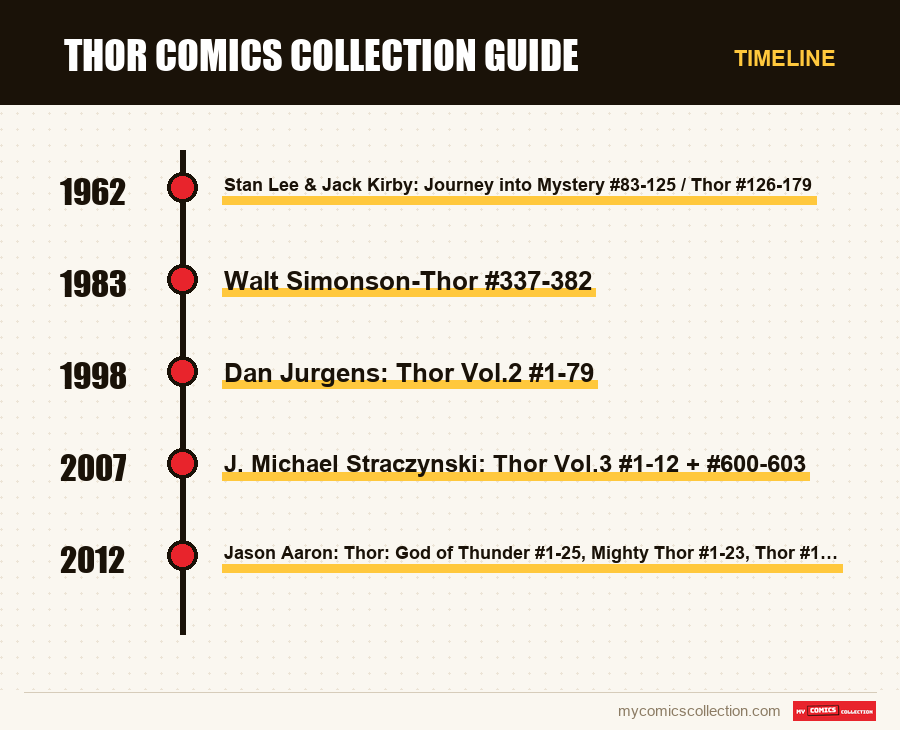
Stan Lee & Jack Kirby: Journey into Mystery #83-125 / Thor #126-179 (1962-1970)
The foundations. Lee and Kirby create Thor in Journey into Mystery #83, introduce the essentials of Asgardian mythology (Odin, Loki, Heimdall, the Bifrost, the Frost Giants) and gradually increase in narrative power. The episodes called “Tales of Asgard” in backup stories are graphic gems from Kirby. From Thor #126, the series takes its definitive title. The run culminates with the "Galactus" arc (#160-162) and the departure of Kirby in 1970. These Silver Age issues are rare in good condition and highly rated: a Journey into Mystery #83 in CGC 6.0 is trading around $30,000 to $40,000.
Walt Simonson-Thor #337-382 (1983-1987)
The absolute reference. Walt Simonson takes control of the title with Thor #337 , which introduces Beta Ray Bill, the first non-Asgardian character deemed worthy of lifting Mjolnir. This number is one of the most requested key issues from the Bronze/Copper Age. Simonson continues with monumental arcs: the saga of Surtur (#340-353), the transformation of Thor into a frog (#364-366), the curse of Hela (#372-374). His approach combines authentic Norse mythology, epic storytelling and revolutionary dynamic drawing. The complete run #337-382 is considered one of the ten best runs in the history of Marvel comics, all series combined.
Dan Jurgens: Thor Vol.2 #1-79 (1998-2004)
Often underestimated, the run of Dan Jurgens brings narrative stability to the character after the turbulence of Heroes Reborn. Jurgens explores the Thor/Jake Olson duality, deepens the relationship with Odin, and produces a memorable final arc where Thor becomes king of Asgard and imposes his law on Earth. The issues are still very affordable on the secondary market: this is an attractive buying window for patient collectors.
J. Michael Straczynski: Thor Vol.3 #1-12 + #600-603 (2007-2009)
JMS revives Thor after the destruction of Asgard in the events of Avengers Disassembled and Ragnarok. He reconstructs Asgard above Broxton, Oklahoma, and delivers an introspective tale beautifully illustrated by Olivier Coipel. Coipel's drawings on these issues are among the finest of the decade. Short but impactful, this run is easy to complete and copies in VF/NM can still be found at a moderate price.
Jason Aaron: Thor: God of Thunder #1-25, Mighty Thor #1-23, Thor #1-16 + War of the Realms (2012-2019)
The most ambitious run of the modern era. Jason Aaron starts with Thor: God of Thunder #1 (2012), illustrated by Esad Ribic, and the "God Butcher / Godbomb" arc (#1-11) which is unanimously considered one of the best Thor arcs ever written. He then introduces Jane Foster as new Thor in Thor Vol.4 #1 (2014), a bold narrative choice that divides fans but produces moments of pure emotion: notably Mighty Thor #705-706, Jane's death and resurrection. The saga culminates with the crossover War of the Realms (2019). In total, Aaron spans over seven years of Thor continuity in a cohesive narrative tapestry. The first issues of God of Thunder in CGC 9.8 are starting to gain value.
Where to start? If you are new to Thor, the run Simonson #337-382 is the essential entry point: financially accessible (excluding #337), narratively complete, and artistically exceptional. For modern readers, Jason Aaron offers a complete and recent course. Consult our guide to Thor key numbers to go deeper.
Thor key issues to prioritize
Here are the reference numbers that every Thor collector should know and target according to their budget:
- Journey into Mystery #83 (1962): First appearance of Thor. Key issue Silver Age foreground. CGC 4.0: approximately $15,000. CGC 6.0: $30,000-40,000. The absolute Holy Grail of the Thor collection.
- Journey into Mystery #85 (1962): First appearance of Loki. Highly in demand thanks to the character's MCU popularity. CGC 5.0: around $5,000-7,000.
- Journey into Mystery #89 (1963): Classically considered to be the first appearance of Thor in his classic costume with the red cape. Key issue underrated.
- Journey into Mystery #103 (1964): First appearance of Enchantress and Executioner. Iconic Asgardian villains.
- Thor #134 (1966): First appearance of the High Evolutionary. Key issue cross-series (linked to Guardians of the Galaxy and Marvel cosmic events).
- Thor #165 (1969): First full appearance of Him/Adam Warlock. Key from the highly rated cosmic Silver Age.
- Thor #337 (1983): First appearance of Beta Ray Bill (Simonson). The ultimate Copper Age key issue for Thor. CGC 9.8: $800-1,200.
- Thor #411 (1989): First appearance of the New Warriors (in cameo). Key issue cross, requested by 90s collectors.
- Thor Vol.4 #1 (2014): Jane Foster becomes Thor. Key from the modern era, upside potential linked to the MCU.
Collecting this series?
Track what you own, what you are missing and what your collection is worth. 7 day trial.
Start my trial →Conservation and grading: protecting your investment
Thor Silver Age comics are particularly susceptible to degradation. Newsprint paper from the 1960s yellows, staples rust, and covers crack if not properly protected. Here are the essential rules.
Pouches and boards
Use Mylar pouches (type E. Gerber Mylites 2) for your valuable copies. Mylar is chemically inert and does not emit acidic gases, unlike standard polypropylene. Associate them with acid-free boards (acid-free backing boards) replaced every 3-5 years. For common comics, archival quality polypropylene sleeves are sufficient.
Storage
Store your comics vertically in short boxes or long boxes in acid-free cardboard. Ideal temperature: 18-22°C. Relative humidity: 40-50%. Absolutely avoid attics (thermal variations), cellars (humidity) and direct exposure to the sun. A Journey into Mystery #83 in VG can be worth $5,000; a poorly preserved copy that goes from VG to Good loses several thousand dollars.
Have your copies graded
For keys worth more than $200-300, the professional grading (CGC or CBCS) is strongly recommended. The slab permanently protects the comic and authenticates its state. A Thor #337 in raw NM can sell for $80-120, but in CGC 9.8 it reaches $800-1,200. The cost of grading ($30-50 per copy in standard service) is largely profitable on key numbers.
Collection strategy: build smart
Collecting Thor comprehensively is a long-term project. Here's a step-by-step approach to structuring your purchases.
Level 1. The fundamentals (budget €200-500)
Start with the full runs in playback quality. The Simonson run (#337-382) can be found in lots for €150-300 in average VF condition. Add the first numbers of God of Thunder by Jason Aaron. You will have the two best Thor runs for a controlled budget. Focus on reading and learning before investing in key issues.
Level 2: Modern key issues (budget €500-2,000)
Target Thor #337 in CGC 9.4 or more ($400-600), Thor Vol.4 #1 in CGC 9.8 ($50-80), and the first issues of each major volume. Complete with the JMS/Coipel run and the Jurgens run, both affordable. This level builds the skeleton of your collection with pieces that have real potential for valorization.
Level 3. The Silver Age (budget €2,000 and more)
Attack them Journey into Mystery starting with the most affordable issues (#90-125 in GD/VG condition, often found between $50 and $200 each). Gradually climb towards the key issues: JIM #85 (Loki), JIM #83 (first appearance). Buy the best condition your budget allows: a single copy in VF is better than three in Poor. Watch Heritage Auctions and ComicConnect auctions for rare pieces.
Tier 4: Prestige Collection
For advanced collectors: aim for high-grade (8.0+) CGC copies of Silver Age key issues, original Kirby or Simonson pages, and “pedigree” copies (identified provenance, such as the Pacific Coast collection or the Don/Maggie Thompson collection). These pieces are heritage investments whose value tends to increase over the long term.
Budget and valuation: follow the market
The Thor comics market has experienced several waves of growth, particularly after each MCU film (Thor 2011, Ragnarok 2017, love and thunder 2022). Silver Age key issues remain in an uptrend over the long term, while Modern issues are more volatile.
- Journey into Mystery #83: Regular increase of 8-12% per year over the last ten years in average scores (CGC 3.0-5.0).
- Thor #337: Stable in high notes, with peaks during MCU announcements related to Beta Ray Bill.
- Thor: God of Thunder #1-11: Gradually increasing, driven by the critical recognition of the Aaron run.
To monitor the valuation of your collection in real time, use a dedicated management tool which integrates market quotes and alerts you to significant variations. Careful monitoring allows you to identify buying and selling windows, and avoid overpaying during periods of MCU hype.
Golden rule: Never buy a key issue in the weeks following a major MCU announcement. Prices inflate by 30-50% due to speculation, then correct over the next 6-12 months. Patience is the weapon of the wise collector.
Common mistakes to avoid
- Confusing volumes: There are more than six volumes of Thor. A Thor #1 from 2014 (Jane Foster) is not a Thor #1 from 1966 (Kirby). Always check the volume and year before purchasing.
- Neglecting Journey into Mystery: Issues #83-125 are technically "Thor" but under a different title. Many beginning collectors forget about them.
- Buy raw without expertise: A seller who describes a comic as "Near Mint" on eBay may have very different criteria than you. For purchases over $100, favor graded copies or buy from reputable sellers.
- Ignoring important annuals and tie-ins: Thor Annual #5 (1976, first appearances related to the Eternals) and Thor Annual #14 (1989, Atlantis Attacks) contain significant moments of continuity.
- Underestimating the Simonson run: Some collectors jump straight to the Silver Age. Not only is the Simonson run the best Thor run, but his high-scoring numbers are starting to seriously gain value.
Managing a Thor collection requires method, patience and solid market knowledge. Using a number by number tracking tool, you keep a clear vision of your progress, identify your missing comics, and make informed purchasing decisions. The God of Thunder deserves a collection worthy of his legend.
Frequently asked questions
In Journey into Mystery #83 (August 1962), created by Stan Lee, Larry Lieber and Jack Kirby. It is the benchmark Silver Age key of any Thor collection.
Walt Simonson's run, Thor #337-382 (1983-1987), is the recommended entry point: accessible, narratively complete and artistically exceptional. It opens with Thor #337, the first appearance of Beta Ray Bill. For a more recent path, Jason Aaron's run offers a coherent whole.
There are more than six volumes of the series, and a 2014 Thor #1, where Jane Foster becomes Thor, has nothing to do with a 1966 Thor #1. Journey into Mystery #83 to #125 are also "Thor" issues under another title, which many beginners forget.
1960s paper yellows and staples rust: use Mylar sleeves and acid-free boards, stored upright, at 18 to 22 °C and 40 to 50% humidity. Avoid attics, cellars and direct sunlight, and have the most important keys graded.
No, that is the guide's golden rule. Prices swell under speculation after a major announcement, then correct within the following months: patience is the savvy collector's weapon.