Thor: Love and Thunder (2022), directed by Taika Waititi with Chris Hemsworth and Natalie Portman , adapts the run of Jason Aaron : Jane Foster becomes the Mighty Thor while battling cancer, as in the 2014 series. The antagonist, Gorr the Butcher of the Gods , is taken from Thor: God of Thunder #2 (2013), also by Jason Aaron. The film retains these strong elements but adds a flamboyant comedy specific to Waititi. Detailed comparison, film versus comics.
Thor's fourth solo film, Love and Thunder extends the comedic turn of Ragnarok while adapting one of the most acclaimed modern runs of the character, that of Jason Aaron. The film brings together a moving heroine, a terrifying antagonist and a resolutely light tone. Source-by-source decryption.
As in each article in the series, only verified information (distribution, dates, numbers, creators) is stated; the comparative analysis is ours, without reproducing dialogue or protected images.
Title : Thor: Love and Thunder (2022)
Director: Taika Waititi
Actors: Chris Hemsworth (Thor), Natalie Portman (Jane Foster / Mighty Thor), Christian Bale (Gorr), Tessa Thompson (Valkyrie), Russell Crowe (Zeus)
Exit : July 8, 2022 (United States)
Studio: Marvel Studios
Run by Jason Aaron: Jane Foster becomes Thor (2014)
Thor: God of Thunder #2 (2013): Gorr's first appearance (Aaron & Ribic)
“The Mighty Thor”: Jane Foster facing cancer
Journey into Mystery #83 (1962): origin of Thor and Jane
- Jane Foster becomes the Mighty Thor, worthy of lifting Mjolnir.
- Le Jane's cancer, which his transformation into Thor paradoxically worsens.
- Gorr the Butcher of the Gods and his crusade against all deities.
- La Necrosword, Gorr's cursed weapon.
- The questioning about the valor and vanity of the gods.
- The comic tone contrasts radically with the seriousness of Jason Aaron's arc.
- Gorr is humanized and his quest shortened compared to the long saga of the comic.
- Jane's journey is condensed into a single film.
- Zeus and the Greek pantheon are mocked, an angle specific to the film.
- La romantic relationship Thor/Jane is brought to the forefront.
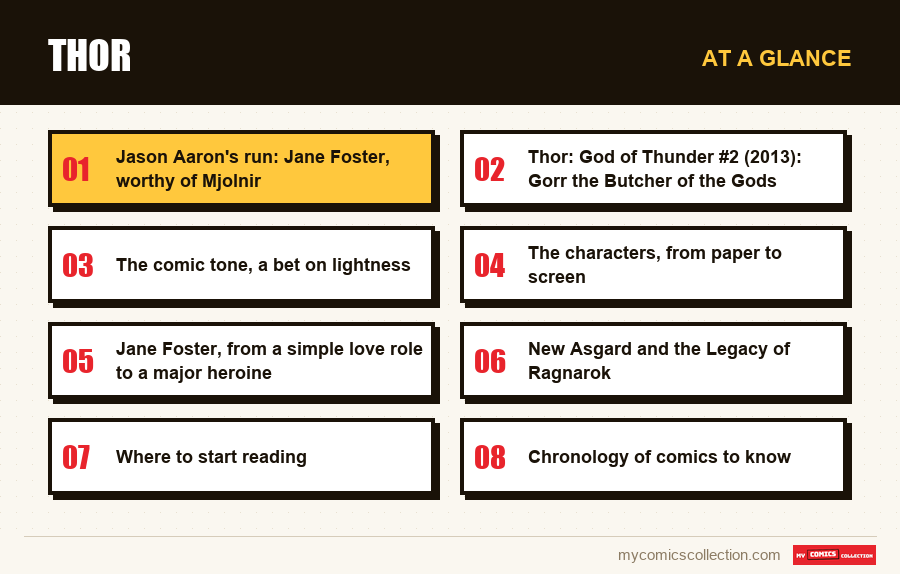
Jason Aaron's run: Jane Foster, worthy of Mjolnir
The film adapts one of the most acclaimed modern runs of Thor, that of Jason Aaron, and particularly the arc where Jane Foster becomes the Mighty Thor herself. In the comics (from 2014), while Thor considers himself unworthy of his hammer, it is Jane: the god's former love interest, present since the origins of 1962: who proves himself worthy of lifting Mjolnir and takes on the role. The film faithfully takes up this strong idea, as well as its most heartbreaking point: Jane has cancer, and each transformation into Thor, by purging her body of treatments, worsens her illness. This tragic dilemma, becoming a goddess at the cost of her own life, is the emotional heart of the story, on screen and on paper.
It is a remarkable adaptation in its principle: the film honors the audacity of a run which had made a mortal and sick woman the worthy heir of the god of thunder. Natalie Portman, back in the saga, embodies this Jane who is both vulnerable and heroic, faithful to the spirit of Aaron's comic.
Thor: God of Thunder #2 (2013): Gorr the Butcher of the Gods
The antagonist, Gorr, comes from another part of Aaron's run. He appears in Thor: God of Thunder #2 (2013), created by Jason Aaron and Esad Ribic. Its concept is chilling: a being who, abandoned by the gods he implored, swears to exterminate them all, armed with a cursed blade, the Necrosword. The film preserves this crusade against the deities and the evil weapon, as well as the original pain of the character: a father having lost his family, betrayed by his faith. Christian Bale gives him a presence that is both pitiful and terrifying. The film humanizes Gorr and shortens his long cosmic saga, but preserves his fundamental question: Do the gods deserve the devotion they demand? This question, at the heart of the comic, gives the film its depth beneath the comic veneer.
The comic tone, a bet on lightness
The film's greatest freedom lies in its tone. Where Aaron's run is marked by gravity (cancer, the death of the gods, Gorr's despair) Waititi's film adopts a register of flamboyant comedy, saturated with colors, gags and pop references. This contrast, much commented on, divides: some see it as a betrayal of the seriousness of the source, others as a way of approaching heavy themes (illness, death, faith) with a form of tenderness and lightness. The film assumes this great gap, particularly in the treatment of Zeus and the Greek pantheon, ridiculed. This bias illustrates Waititi's trademark, already at work in Ragnarok: wrapping serious issues in joyful exuberance.
This tension between the tragic background and the comic form is the key to the film. She explains her successes, the emotion of Jane's conclusion, as well as her blunders, when humor defuses moments that called for seriousness. The film nevertheless remains faithful, in its broad outlines, to the material of Aaron's run.
The characters, from paper to screen
- Thor: Continues his quest for meaning, between self-deprecation and melancholy.
- Jane Foster / Mighty Thor: True to Aaron's run: worthy of Mjolnir, but eaten away by cancer.
- Gorr: Crusade against the gods and Necrosword preserved, abridged saga and humanized character.
- Valkyrie: Became Queen of New Asgard, extending her Ragnarok arc.
- Zeus: The Greek god, mocked, an angle specific to the film.
Collecting this series?
Track what you own, what you are missing and what your collection is worth. 7 day trial.
Start my trial →Jane Foster, from a simple love role to a major heroine
Jane Foster's adaptation illustrates a remarkable evolution of the character. In the very first comics from 1962, Jane was only a nurse, love interest of the god, confined to a secondary role. Jason Aaron's run turned that perception on its head by having her become Thor herself, one of the most daring retellings of the character's history. The film crowns this rise in power by bringing this heroic and tragic Jane to the screen. It's a great example of how comics evolve their figures over the decades, and how cinema validates and amplifies these rereadings. By giving Jane a shocking conclusion, the film pays homage to half a century of character development, from self-effacing nurse to goddess of thunder.
This trajectory resonates beyond just the character: it testifies to an underlying tendency in modern comics to update classic figures, to offer them new faces and new carriers. Jane Foster as Thor, like other recent rereadings, embodies this creative vitality that cinema now strives to reflect.
New Asgard and the Legacy of Ragnarok
The film directly continues the upheavals of Ragnarok, where Asgard was destroyed and its people forced into exile. The Asgardians have since established themselves on Earth, in a town that has become New Asgard, over which Valkyrie now reigns. This situation (a people of gods taking refuge among mortals, transforming their city into a tourist attraction) brings to the film part of its humor, but also a reflection on mourning and reconstruction. It extends a recurring idea from modern Thor comics, where Asgard has been destroyed and rebuilt several times, often on Earth. The film is thus part of a continuity faithful to the spirit of Asgardian mythology, made up of cycles of end and rebirth: Ragnarök itself being, in the legend as in the comics, never a definitive end.
This backdrop gives the film a bittersweet melancholy, beneath the comic exuberance. The gods are aging figures, in search of meaning, confronted with their own mortality: a theme that Gorr, the godkiller, precisely comes to embody. By anchoring its story in a fallen and rebuilt Asgard, the film remains faithful to the tragic dimension of Thor, that of a hero haunted by the end of his world and the need to reinvent himself. It is this gravity, lurking beneath the gags, which gives the film its real interest.
Where to start reading
The reference reading is Jason Aaron's monumental run on Thor, starting with "Thor: God of Thunder" (2013), which introduces Gorr, and then "The Mighty Thor" (2014), where Jane becomes the Goddess of Thunder. This cycle, drawn in particular by Esad Ribic and Russell Dauterman, is considered one of the modern peaks of the character. Those curious about Jane's origins will go back to Journey into Mystery #83 (1962). From 1962 to today, this journey covers the spectacular evolution of a character and one of Marvel's most ambitious runs.
Chronology of comics to know
- 1962: Journey into Mystery #83: origin of Thor and first appearance of Jane Foster.
- 2013: Thor: God of Thunder #2: First appearance of Gorr the Butcher of the Gods.
- 2014: “The Mighty Thor”: Jane Foster becomes the goddess of thunder.
Collection side: what numbers to aim for after the film
Love and Thunder highlights modern keys. Thor: God of Thunder #2 (first appearance of Gorr) is a number from the 2010s whose popularity rose with the announcement of the film and the performance of Christian Bale. Other sought-after targets include the early issues of “The Mighty Thor” (2014), marking Jane’s ascension. These stories, available in collections, offer a gateway to a controlled budget. As always, condition and gradation determine value; relying on real recent sales is strongly recommended. Thor: God of Thunder #2 is a fine example of a recent first appearance propelled by cinema, one to watch for any collector attentive to current trends.
Its place in the saga and for the collector
Love and Thunder continues the reinvention of Thor that began with Ragnarok, while giving Jane Foster a central role and a memorable conclusion. For the collector, the film revived interest in Jason Aaron's run, one of the most important in the character's recent history, and increased the rating of Thor: God of Thunder #2. This film illustrates the effect of cinema on recent first appearances, the value of which can jump quickly. Beyond speculation, it invites you to discover a run of rare richness, which rethought Thor in depth: his mythology, his heirs, his enemies. By adapting the story of Jane and Gorr, the film pays homage to one of Marvel's most daring retellings, even if it packs it in a lighter register than the source.
The verdict: an acclaimed run, adapted with lightness
- Loyalty: Jane Foster became Thor, her cancer, Gorr and the Necrosword come from Jason Aaron's run.
- Freedoms: the comic tone, Gorr humanized and his abbreviated saga, the Greek pantheon mocked.
- Collectible numbers: Thor: God of Thunder #2 (Gorr), “The Mighty Thor” (2014, Jane).
Love and Thunder adapts one of Thor's most memorable runs by adding the comic exuberance of Taika Waititi. Faithful to the story of Jane Foster and Gorr, the film takes the risk of a light tone on serious themes: illness, death, faith. For both reader and collector, this is an invitation to discover Jason Aaron's run, one of the thunder god's modern peaks, and a recent debut appearance to watch out for.
Frequently asked questions
From Jason Aaron's run: "The Mighty Thor" (2014), where Jane Foster becomes the Goddess of Thunder while battling cancer, and "Thor: God of Thunder" (2013), which introduces Gorr the Butcher of the Gods.
Yes: in Jason Aaron's run (2014), Jane proves worthy of lifting Mjolnir and becomes the Mighty Thor, even though she is suffering from cancer which her transformations aggravate. The film faithfully repeats this plot.
A being abandoned by the gods he implored, who swears to exterminate them all with a cursed blade, the Necrosword. He appears in Thor: God of Thunder #2 (2013), created by Jason Aaron and Esad Ribic.
This is the signature of Taika Waititi, already at work in Ragnarok. This light tone contrasts with the seriousness of Aaron's run (cancer, the death of the gods), a divisive bias which addresses heavy themes with tenderness and humor.
Thor: God of Thunder #2 (Gorr's first appearance) is a recent debut to watch out for. The first issues of “The Mighty Thor” (2014), marking Jane’s rise, are other targets.
Does the film make you want to collect Thor? Estimate the value for free of your numbers (Thor: God of Thunder #2…) with our tool based on current eBay listings.