
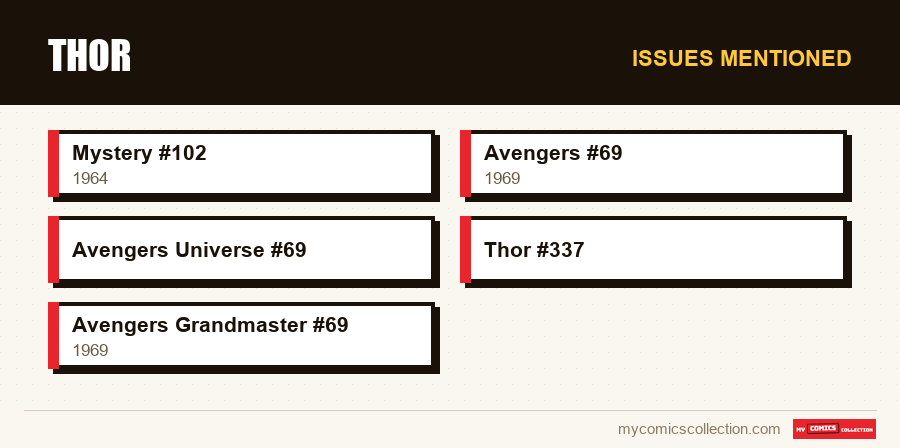
Thor: Ragnarok (2017), directed by Taika Waititi with Chris Hemsworth, combines two sources: the arc “Planet Hulk”(2006) by Greg Pak for the gladiator arena on Sakaar, and Walt Simonson's run for the destruction of Asgard. The goddess of death Hela born in Journey into Mystery #102 (1964), and the Grand Master in Avengers #69 (1969). The film retains these figures but shakes up the tone, turning towards cosmic comedy. Detailed comparison, film versus comics.
Thor's third solo film, Ragnarok brings about one of the most radical changes in tone in the saga: under the leadership of Taika Waititi, Asgardian tragedy gives way to a flamboyant and colorful adventure comedy. To build this story, the film brings together two comic book stories from different universes (one centered on Hulk, the other on Thor) and summons several ancient figures. Source-by-source decryption.
As in each article in the series, only verified information (distribution, dates, numbers, creators) is stated; the comparative analysis is ours, without reproducing dialogue or protected images.
Title : Thor: Ragnarok (2017)
Director: Taika Waititi
Actors: Chris Hemsworth (Thor), Tom Hiddleston (Loki), Cate Blanchett (Hela), Tessa Thompson (Valkyrie), Jeff Goldblum (the Grandmaster), Mark Ruffalo (Hulk), Karl Urban (Skurge)
Exit : November 3, 2017 (United States)
Studio: Marvel Studios
“Planet Hulk”(2006-2007): Greg Pak, the arena of Sakaar
Journey into Mystery #102 (1964): Hela's first appearance (Lee & Kirby)
Avengers #69 (1969): 1st appearance of the Grand Master
Run by Walt Simonson: Hela, Surtur, Skurge, the Ragnarök of Asgard
- L'gladiator arena on Sakaar, the heart of “Planet Hulk”.
- Hela, goddess of death, one of Thor's oldest enemies.
- Le Grand Master, Elder of the Universe lover of mortal games.
- Le Ragnarok, the prophetic destruction of Asgard, a theme dear to Simonson.
- Skurge the Executioner and his heroic sacrifice, taken from the Simonson run.
- The tone: the film turns into a cosmic comedy, very far from the seriousness of Simonson's comics.
- Hela becomes Thor's older sister, a family connection absent from the comics.
- Hulk on Sakaar borrows from an arc devoted to a completely different hero.
- Valkyrie is reinvented as a fallen and alcoholic warrior, far from the classic version.
- The destiny of Asgard is upset, the city being physically destroyed.
“Planet Hulk” (2006): Sakaar Arena
The most visible half of the film-Thor imprisoned, forced to fight in a gladiatorial arena on the junkyard planet Sakaar-comes from an arc devoted not to Thor, but to the Hulk. “Planet Hulk” (2006-2007), written by Greg Pak, sent the green giant to a barbarian planet where he became an arena champion before leading a revolt. The film faithfully reproduces this baroque and colorful setting: the garbage planet, the deadly games, the tyrant who reigns over the show. It's a daring recombination, which grafts the universe of one character onto that of another to offer Thor a new setting. Hulk, present in the film as champion of the arena, serves as a bridge between the two worlds.
This choice illustrates the film's total freedom with regard to continuity: rather than adapting a single story, it draws the best of two arcs to compose a new story. The result is a Thor film unlike any other.
Journey into Mystery #102 (1964): Hela, Goddess of Death
The main antagonist, Hela, is one of Thor's oldest enemies. She appears in Journey into Mystery #102 (March 1964), created by Stan Lee and Jack Kirby: an issue which also introduces Sif and Balder. Sovereign of the kingdom of the dead, figure from Nordic mythology reinterpreted by Marvel, she is a threat of colossal power. The film retains its macabre authority and its thirst for conquest, but adds a new link: on screen, Hela is the older sister of Thor, secret daughter of Odin, a family connection which does not exist in the comics. This reinvention serves the film's theme (the poisonous legacy, the hidden crimes of the fathers) while giving Cate Blanchett a high-profile role.
Avengers #69 (1969) and Simonson's run
The Grand Master, fanciful host of the Sakaar games, comes from Avengers #69 (1969): he is one of the Elders of the Universe, quasi-immortal beings obsessed with a unique activity: for him, games and competitions. The film makes him an eccentric tyrant, played with relish by Jeff Goldblum. As for the Asgardian plot (Ragnarök, the prophecy of destruction, the sacrifice of Skurge the Executor) it draws directly from Walt Simonson's run from the 1980s, the absolute reference for the character, where Hela, Surtur and Skurge played major roles. The heroic sacrifice of Skurge, in particular, is a cult moment in the comics that the film takes up with emotion.
The characters, from paper to screen
- Thor: Freed of his hammer and his usual seriousness, he gains humor and self-deprecation.
- Hela: True to her power as the goddess of death, but promoted to the rank of sister of Thor.
- The Grand Master: Elder of the Avengers Universe #69, reinvented as an eccentric master of ceremonies.
- Valkyrie: Fallen warrior with a tragic past, a modern reinterpretation of the classic character.
- Skurge: The Executor, whose heroic sacrifice is taken from Simonson's run.
Collecting this series?
Track what you own, what you are missing and what your collection is worth. 7 day trial.
Start my trial →Taika Waititi and cosmic comedy
The signature of the film lies in Taika Waititi, whose improvised humor and pop aesthetic, saturated with colors and synthesizers, radically transform the character. This comic turn has no direct equivalent in the comics, where Thor evolves more in the register of myth and tragedy. However, the film does not completely betray its source: beneath the comedy, it deals with serious themes: the fall of a kingdom, the sins of a father, the necessity of losing everything to be reborn. By packaging these ideas into an exuberant adventure, Waititi reinvents the hero without distorting him, proving that an adaptation can take immense tonal liberties while respecting the substance of its material.
Valkyrie and the Warriors of Asgard
One of the most notable characters in the film, Valkyrie, deserves a spotlight. In the comics, Valkyrie (Brunnhilde) appears in the early 1970s and becomes an important figure, particularly within the Defenders team. She embodies the Valkyries, mythological warriors responsible for leading the souls of the brave fallen in battle. The film takes this essence (an elite warrior from Asgard, formidable in combat) but reinvents it profoundly: on screen, Valkyrie is a broken survivor, haunted by the massacre of her order by Hela, who drowns her guilt in alcohol and the bounty hunter. This rereading, carried by Tessa Thompson, adds a melancholy depth to a character often confined to her role as a fighter. It also illustrates the film's method: taking a classic figure and loading it with a new, more contemporary personal story.
This treatment is part of a general trend in Ragnarok, which humanizes its secondary characters by giving them flaws and wounds. Where classic comics often presented heroic archetypes, the film favors ambivalent figures, in search of redemption: a modern sensibility which partly explains its success with a wide audience, beyond just fans of Asgardian mythology.
Where to start reading
Two complementary readings shed light on the film. For the Sakaar side, Greg Pak's "Planet Hulk" (2006) is the direct source, an epic and surprisingly poignant arena tale. For the Asgardian side, Walt Simonson's run (from Thor #337, 1983) remains the reference, where Hela, Surtur and Skurge display their full extent. Those curious about Hela can go back to Journey into Mystery #102 (1964) for her first appearance. From 1964 to 2006, this journey covers the scattered sources of a film which, more than any other, assumes the freedom of recombining its materials. These two arcs, often cited among the best of their respective authors, can also be read very well independently of the film, for the pleasure of pure cosmic adventure.
Chronology of comics to know
- 1964: Journey into Mystery #102: first appearance of Hela (and Sif).
- 1969: Avengers #69: First appearance of the Grand Master.
- 1980s: run by Walt Simonson: Ragnarök, Skurge, Surtur.
- 2006-2007: “Planet Hulk”: Sakaar Arena.
Collection side: what numbers to aim for after the film
Ragnarok points to several interesting keys. Journey into Mystery #102 (Hela's first appearance) is a doubly valuable Silver Age issue, since it also contains the first appearance of Sif; her rating soared with the central role of Hela on screen. Avengers #69 (first Grand Master) is a more accessible key. On the modern side, the collections of “Planet Hulk” and Simonson’s run offer the best reading-budget ratio, without aiming for expensive original issues. For a collector, this film is a great gateway to Thor's great cosmic days. As always, condition and gradation determine value; relying on recent real sales is strongly recommended before any purchase.
Its place in the saga and for the collector
Ragnarok redefines Thor just before the great gatherings to come, stripping him of everything that defined him-his hammer, his hair, his kingdom-to force him to reinvent himself. This clean slate prepares its role in the rest of the saga. For the collector, the film had a notable effect: it shone the spotlight on long-sideline characters like Hela and Valkyrie, boosting interest in their first appearances. Journey into Mystery #102, appreciated only by connoisseurs, has established itself as a sought-after key. Beyond speculation, the film above all invites us to rediscover two peaks of comics, “Planet Hulk” and Simonson’s run, which are among the most creative stories of their respective eras. By bringing them to the screen, even freely, Ragnarok pays them a beautiful tribute.
The verdict: absolute freedom of tone
- Loyalty: Sakaar (“Planet Hulk”), Hela, the Grand Master and the sacrifice of Skurge (Simonson) are well taken from the comics.
- Freedoms: the comic tone, Hela promoted to sister of Thor, Valkyrie reinvented and Asgard destroyed.
- Collectible numbers: Journey into Mystery #102 (Hela) and Avengers #69 (Grandmaster).
Thor: Ragnarok is undoubtedly the film in the saga which takes the most liberties with its source, and yet, it respects its substance. By recombining “Planet Hulk” and Simonson’s run into a flamboyant cosmic comedy, Taika Waititi reinvents the god of thunder without betraying him. For the reader and the collector, it is an invitation to explore two of Marvel's most imaginative stories, and to rediscover a goddess of death born in 1964. By proving that a third solo film could completely reinvent its hero rather than repeat the formula, Ragnarok breathed a breath of creative freedom from which the entire saga benefited. That's also what adapting a comic is: daring to take risks, even if it means surprising purists, to better capture the energy and audacity that make comics so rich.
Frequently asked questions
From two sources: “Planet Hulk” (2006) by Greg Pak for the Sakaar arena, and Walt Simonson's run for the destruction of Asgard. Hela comes from Journey into Mystery #102 (1964) and Avengers Grandmaster #69 (1969).
No. In the comics, Hela is the goddess of death, Thor's long-time enemy, but not related. The film invents this family bond to serve its theme of poisonous inheritance.
This part of the film resumes “Planet Hulk”, an arc dedicated to the Hulk, where the green giant becomes a gladiator on the planet Sakaar. The film grafts this setting onto the universe of Thor.
Yes, it's a cult moment from Walt Simonson's run, where Skurge the Executioner heroically sacrifices himself. The film takes it up with emotion.
Journey into Mystery #102 (first appearance of Hela and Sif) is the key to the Silver Age most related to the film. Avengers #69 (first Grandmaster) is a more accessible target.
Does the film make you want to collect Thor? Estimate the value for free of your issues (Journey into Mystery #102…) with our tool based on current eBay listings.