Thor (2011), directed by Kenneth Branagh with Chris Hemsworth and Tom Hiddleston, adapts the god of thunder born in Journey into Mystery #83 (1962) by Stan Lee, Larry Lieber and Jack Kirby. Loki appears shortly after in Journey into Mystery #85 (1962). The film also borrows heavily from J. Michael Straczynski's modern retelling (2007), which humanized Thor in a small American town. It retains the Asgardian base and the fraternal conflict, but reinvents Thor's bond with Jane Foster and the mechanics of his fall. Detailed comparison, film versus comics.
With Thor, Marvel Studios took the opposite gamble to that of Iron Man: leaving technology and realism for mythology, cosmic realms and the Shakespearean register: hence the choice of Kenneth Branagh to direct. Adapting a Nordic god while making him accessible required juggling between Kirby's legacy, the codes of myth and a recent rereading of the comics. Let's see how the film deals with its sources.
As in each article in this series, only verified information (distribution, dates, numbers, creators) is stated, the comparative analysis being our own, without reproduction of dialogue or protected images.
Title : Thor (2011)
Director: Kenneth Branagh
Actors: Chris Hemsworth (Thor), Tom Hiddleston (Loki), Natalie Portman (Jane Foster), Anthony Hopkins (Odin), Idris Elba (Heimdall), Stellan Skarsgård (Erik Selvig)
Exit : May 6, 2011 (United States)
Studio: Marvel Studios
Journey into Mystery #83 (1962): Thor's first appearance (Lee, Lieber & Kirby)
Journey into Mystery #85 (1962): Loki's first appearance (modern version)
Run by J.M. Straczynski (2007, with Olivier Coipel): Thor humanized, small town of Broxton
Norse mythology: legendary base of the character
- The Asgardian base: Odin , THE Bifröst , Heimdall , the hammer Mjolnir and its rule of “dignity”.
- Le sibling conflict Thor / Loki, dramatic engine faithful to the comics.
- La fall to Earth of a proud Thor, forced to learn humility.
- Jane Foster, the human attachment of the god, present from the first comics.
- The register mythological and solemn, inherited from Kirby and amplified by Branagh.
- The human alter ego Donald Blake, central in the 1962 comic, disappears from the film.
- Jane Foster goes from nurse (comic) to astrophysicist (film), notable modernization.
- Loki is endowed with an unprecedented tragic depth, around the secret of its Jotun origins.
- La science replaces magic: the film presents Asgard and the Bifröst as very advanced science, not pure supernatural.
- The story tightens the action on a small town and a few days, spirit inherited from the Straczynski run.
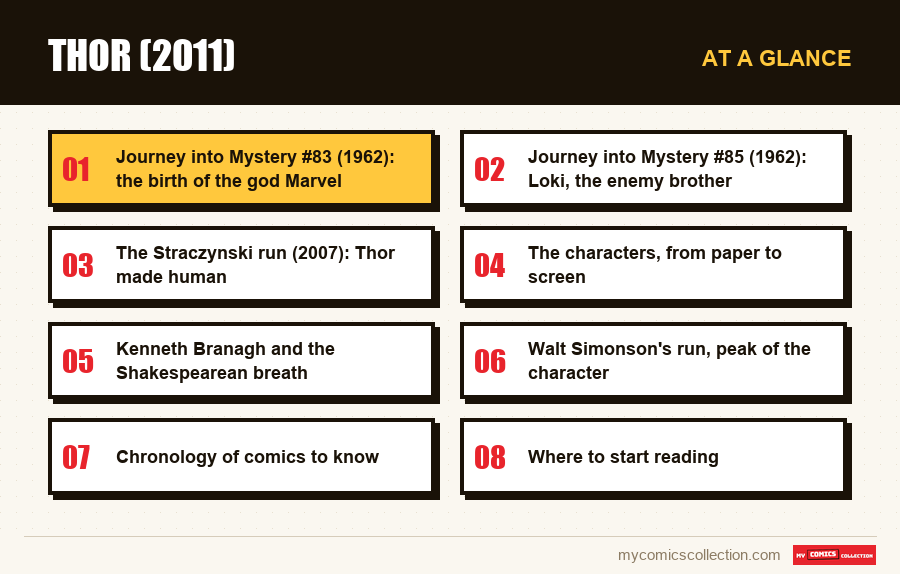
Journey into Mystery #83 (1962): the birth of the god Marvel
Marvel version of Thor appears in Journey into Mystery #83 (August 1962), conceived by Stan Lee, written by Larry Lieber and drawn by Jack Kirby. The original concept is based on a duality that the film chooses to abandon: Doctor Donald Blake, a crippled human doctor, discovers a stick that turns into a hammer and makes him Thor. This mechanism of the mortal who “becomes” the god structured the first decades of the character. The 2011 film does without it entirely and immediately presents a fully divine Thor, prince of Asgard, which radically changes the entry point into the character.
On the other hand, the entire Asgardian apparatus is faithfully preserved: Odin the father, the rainbow Bifröst, the guardian Heimdall, and of course Mjölnir with his enchantment: only he who is worthy can lift it. This last point even becomes the emotional pivot of the film, proof that certain elements of Kirby remain at the center sixty years later.
Journey into Mystery #85 (1962): Loki, the enemy brother
Loki, as modern Marvel continuity knows him, appears in Journey into Mystery #85 (October 1962). God of mischief, adopted half-brother of Thor, he quickly becomes his recurring adversary. The film takes up this conflicting brotherly relationship but adds a very elaborate tragic dimension: the revelation of his jotun (frost giants) origins and his feeling of illegitimacy fuel a more intimate betrayal than in the first comics. This rereading, driven by Tom Hiddleston's performance, has permanently redefined the character: to the point of in turn influencing readers' perception of Loki.
The Straczynski run (2007): Thor made human
If the framework comes from 1962, the sensitivity of the film owes a lot to the relaunch signed J. Michael Straczynski in 2007, designed by Olivier Coipel. This series brought Thor back to Earth, in a small American town (Broxton, Oklahoma), and confronted the grandeur of the gods with the banality of everyday life. The film transposes this idea into a town in New Mexico where the fallen prince learns humility among mortals. The contrast between the cosmic and the trivial, the way in which Thor discovers humanity at ground level, clearly bears the imprint of this run: to the point that its author was invited to the set.
The characters, from paper to screen
- Thor: The proud prince banished then redeemed is faithful to the spirit of the comics, but free of his human double Donald Blake.
- Loki: Same antagonist function, tragic depth amplified by the film around his hidden ancestry.
- Jane Foster: Present from the beginning as a love interest, she is modernized into a leading scientist.
- Odin and Heimdall: Pillars of Asgard faithfully reproduced, Odin as a Shakespearean patriarch.
- The Three Warriors and Sif: Thor's comrades in arms from the comics, present to anchor Asgardian life.
Collecting this series?
Track what you own, what you are missing and what your collection is worth. 7 day trial.
Start my trial →Kenneth Branagh and the Shakespearean breath
The choice to entrust Thor to Kenneth Branagh, filmmaker and actor renowned for his adaptations of Shakespeare, is not insignificant. He directs the entire film towards the register of family tragedy: an all-powerful father, two rival sons, a question of inheritance and betrayal. This reading is surprisingly faithful to the spirit of the best Thor comics, where the court intrigues of Asgard are as much an ancient drama as a superheroic adventure. Where other directors might have drowned in the kitsch of an armored pantheon, Branagh takes the bombast and turns it into an asset, giving the Thor/Loki conflict an emotional density that goes beyond a simple clash of powers.
This approach also explains certain staging biases: tilted cameras, theatrical settings, careful diction. The film seeks less realism than the solemnity of the myth, consistent with the tone that Kirby had given to the character in the 1960s.
Walt Simonson's run, peak of the character
Impossible to talk about Thor without citing Walt Simonson's run, considered the absolute reference for the character. Started with Thor #337 (November 1983), it notably introduced Beta Ray Bill, an alien also deemed worthy of lifting Mjölnir: an idea that struck the imagination and lastingly enriched the mythology. If the 2011 film does not directly adapt this arc, it is immersed in the universe that Simonson helped to codify: the dignity of the hammer as a moral test, Asgardian court life, the balance between the cosmic and the intimate. For any reader wishing to extend the film, this run remains the ideal gateway, and Thor #337 a highly sought-after collector's key.
Around the hero, the film populates Asgard with figures from the comics: the Three Warriors (Volstagg, Fandral, Hogun) and the warrior Sif bring the expected camaraderie and battle scenes, anchoring Thor in a community rather than in the solitude of a demigod. These are secondary characters in the paper, but their presence signals the film's desire to restore the wealth of the kingdom rather than a simple fraternal duel.
Chronology of comics to know
- 1962: Journey into Mystery #83: first appearance of Thor (and Donald Blake, Jane Foster).
- 1962: Journey into Mystery #85: first appearance of Loki in modern version.
- 1980s: Walt Simonson's run, the character's creative peak (cultural reference, in the background).
- 2007: relaunch by J. M. Straczynski and Olivier Coipel: Thor humanized, spirit taken up by the film.
Where to start reading
To get into the Thor of the comics, chronological order is not always the most rewarding. We can discover the origin in Journey into Mystery #83 (1962), but the real reading shock remains Walt Simonson's run, from Thor #337 (1983): this is where the character reaches his full epic scope. Next comes J. M. Straczynski's revival (2007), closest to the film's sensibility, which brings the god back among mortals. Those who want to dig deeper into the character of Loki will find particularly rich material in modern stories, as the writing of the enemy brother has become more refined over the years. This journey (origin, epic summit, human rereading) offers a complete panorama without getting lost in decades of continuity.
Collection side: what numbers to aim for after the film
Thor offers a very clear collection path. Journey into Mystery #83 is the grail: first appearance of the god of thunder in the Marvel version, it is a major key to the Silver Age, rare and rated in the high grades. Journey into Mystery #85 (first appearance of Loki) constitutes a second logical target, driven by the popularity of the character on screen. For a more measured budget, the great modern runs (Simonson in the 1980s, Straczynski in 2007) remain accessible in collections and issues. The ratings depend heavily on the condition and the gradation, relying on real recent sales remains the best compass. Note that Loki's lasting popularity, maintained by his repeated appearances on screen, has solidly boosted interest in Journey into Mystery #85: it is today one of the most requested first villain appearances of the Silver Age, and a safe haven for those who want to bet on a character who has become essential.
The verdict: the myth preserved, access modernized
- Loyalty: the entire Asgardian universe and the Thor/Loki duel are respected, up to the rule of dignity of Mjölnir.
- Freedoms: the abandonment of Donald Blake, a scientific Jane Foster, a tragic Loki and magic reinterpreted as advanced science.
- Collectible numbers: Journey into Mystery #83 (the grail) and #85 (first appearance of Loki).
By removing the mortal alter ego to fully embrace the divine register, Thor took a risk: that of losing the general public along the way. The film gets around it by relying on the humanist rereading of 2007 and on an unexpectedly rich Loki. Result: an adaptation that respects Kirby's pantheon while offering, via his first appearances, some of the most prestigious keys to collect.
One final point deserves the attention of curious readers: Jane Foster, reduced in the first comics to a simple love interest, has undergone a spectacular evolution. In the comics of the 2010s, under the pen of Jason Aaron, she herself becomes worthy of lifting Mjölnir and takes on the role of Thor. The 2011 film, by already modernizing her as a leading astrophysicist, unknowingly foreshadowed this rise in power. It's a great example of how adaptations and comics feed off each other, each medium in turn enriching the reading of the other, and one more reason to be interested in the recent runs of the god of thunder.
Frequently asked questions
From Thor's first appearance in Journey into Mystery #83 (1962) by Lee, Lieber and Kirby, and the modern retelling by J. Michael Straczynski (2007), which brought the god back to Earth in a small town and humanized him.
Thor's crippled human double, central in the 1962 comic, was sidelined to immediately present a fully divine Thor, prince of Asgard. The mechanism of the stick becoming a hammer is only briefly mentioned.
In Journey into Mystery #85 (1962), for its modern Marvel version. The film delves deeper into the character by revealing his Jotun (frost giant) origins and his feeling of illegitimacy.
The film presents Asgard and the Bifröst as extremely advanced science rather than pure magic, a reinterpretation intended to make the cosmic believable alongside the saga's more down-to-earth films.
Journey into Mystery #83 (1962), Thor's first appearance, is the holy grail. Journey into Mystery #85 (first appearance of Loki) is the other major target for a thematic collection around the film.
Does the film make you want to collect Thor? Estimate the value for free of your issues (Journey into Mystery #83, #85…) with our tool based on current eBay listings.