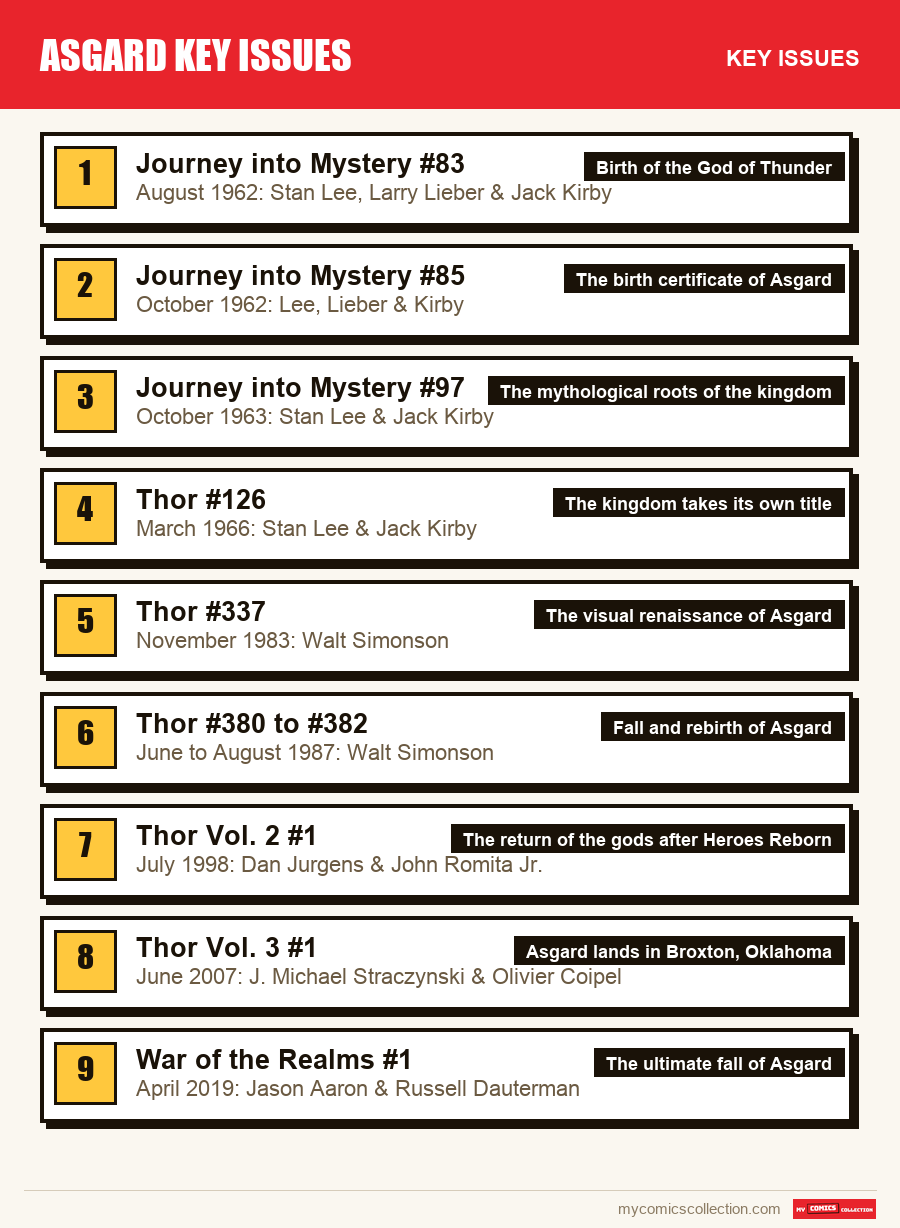
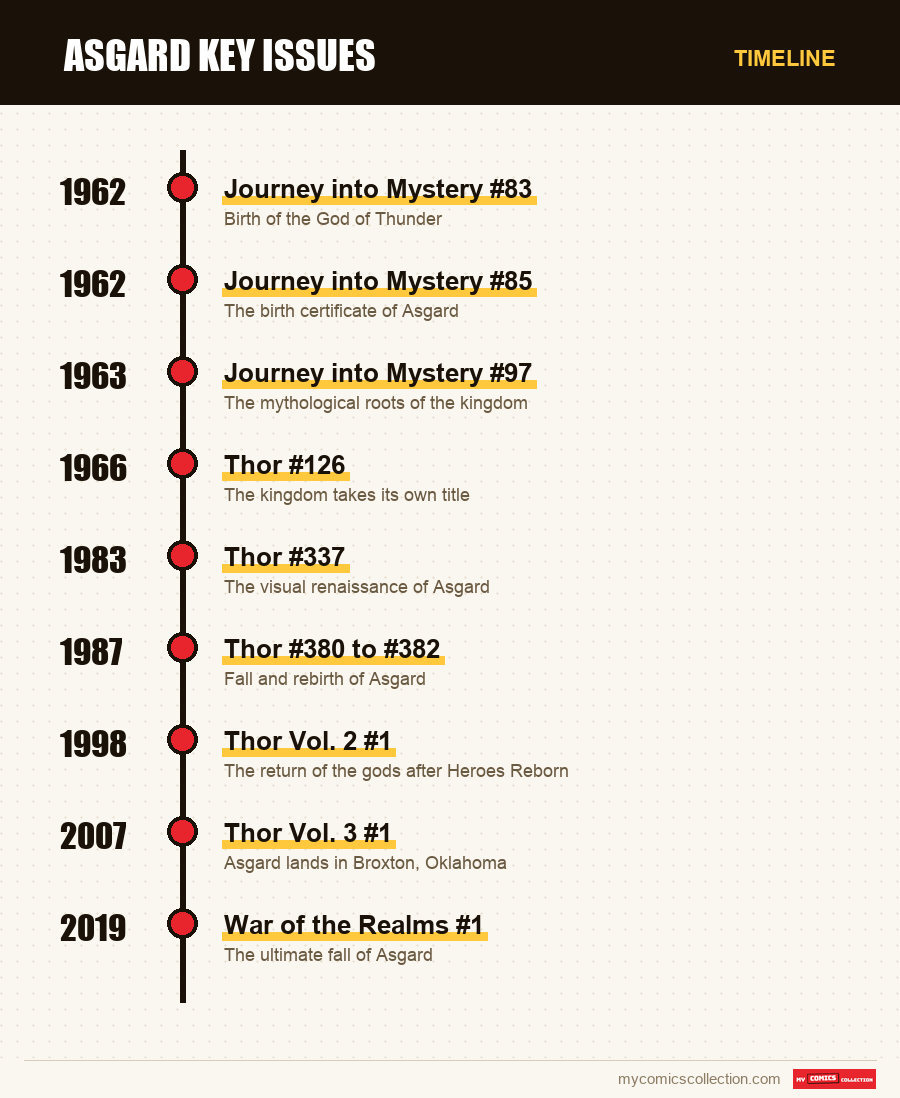
The key issues of Asgard span over sixty years of Marvel history: from Journey into Mystery #85 (October 1962), which literally introduces the kingdom alongside Loki, Heimdall and Odin, until War of the Realms #1 (2019), where Malekith reduces the Nine Realms to ashes. Between the two stands Walt Simonson's visual overhaul in Thor #337 (1983), the destruction then the rebirth of the kingdom in Thor #380-382 (1987), and the spectacular relocation of Asgard above Broxton, Oklahoma, by J. Michael Straczynski in 2007. Journey into Mystery #83 and #85 remain the centerpieces, with documented sales climbing to $432,000 for the first and $90,000 for the second on very high grade examples.
Asgard is not a simple setting in the Marvel universe: it is a character in its own right, a kingdom which has been destroyed, rebuilt, moved, invaded and reinvented according to the screenwriters who have succeeded one another on Thor since 1962. Unlike a hero whose first appearance we mainly collect, tracking down the “Asgard key issues” amounts to following the editorial evolution of an entire mythological place: its birth under the pen of Stan Lee and the pencil of Jack Kirby, its visual reconstruction by Walt Simonson in the early 1980s, its multiple falls and resurrections, until its improbable landing in a small town in the American Midwest.
For a collector, this particular dimension changes the way of approaching the search for key comics. It is not enough to look for “the first appearance of Thor”: you must identify the issues where Asgard itself changes status, gains new inhabitants (Loki, Heimdall, Balder, Surtur), or goes through a cataclysm which permanently redefines Marvel mythology. It is this alternation between mythological stability and narrative rupture which makes the subject as rich for investment in old comics as for the simple passion of the reader.
This guide details nine essential issues, with for each the real editorial context, the creators involved, and verifiable market data (documented sales, Overstreet values or CGC census) without ever putting forward an invented figure. When no recent public sale has been found for a given number, we clearly indicate this rather than estimating a range of convenience.
Asgard in the comics: an editorial history in several acts
The history of Asgard on paper begins quietly. In August 1962, Stan Lee, his brother Larry Lieber and Jack Kirby released a new feature in Journey into Mystery, a fantasy anthology title which until then published tales of monsters with no future. The character of Thor makes his debut, but the kingdom of Asgard is still only hinted at in the background. It takes two months and issue 85 for Kirby to finally lay the visual foundations of the kingdom: it is in this episode that the name "Asgard" formally appears, that Loki makes his first full appearance as a recurring antagonist, that Heimdall is introduced as guardian of the Bifrost, and that Odin appears in silhouette before being fully developed in subsequent issues.
The second structuring step occurred in 1963 with the launch of the complementary story “Tales of Asgard” in Journey into Mystery #97. It is no longer just Thor who acts on Earth: Kirby develops for the first time the complete geography and mythology of the kingdom, going back to the origin of Odin and the appearance of founding figures like Ymir, Buri and Borr, as well as Surtur, the fire demon whose fate will be sealed to that of Asgard twenty-five years later. This series of short stories, published in addition to the main series for several years, is the true birth certificate of the Asgardian cosmogony as comic readers and MCU spectators know it today.
In March 1966, Marvel renamed Journey into Mystery in Thor from issue 126, recognizing that the title had become, in effect, a solo comic dedicated to the god of thunder and his kingdom. This is the beginning of an uninterrupted continuity which will cross the Bronze Age, with its share of minor Asgardian wars, until the arrival of Walt Simonson in 1983. Simonson, as sole screenwriter and designer of the title from Thor #337, undertakes a radical graphic overhaul of Asgard: the architectures become more massive, more angular, more explicitly Nordic, and the kingdom gains a visual identity which will influence all subsequent adaptations, including cinematographic ones. His run ends four years later with the Ragnarök saga, where Asgard is literally destroyed before being reborn in issues 380 to 382.
The following decades multiply cycles of destruction and reconstruction: Asgard is left in ruins after the "Heroes Reborn" era and found devastated in Thor vol. 2 #1 in 1998, before being dramatically rebuilt above a small Oklahoma town in J. Michael Straczynski's 2007 relaunch. More recently, the event War of the Realms in 2019 sees Malekith conquer the entirety of the Ten Realms, including Asgard itself, in what remains one of the most comprehensive invasions the realm has ever suffered in modern comics. This alternation of falls and rebirths is precisely what makes Asgard such a dense collectible subject: each major editorial cataclysm generates its own key number, researched independently of the first appearances of characters.
Journey into Mystery #83
The founding number of the entire Thor/Asgard mythology. Doctor Donald Blake discovers a cane that transforms him into Thor, a Norse god exiled to Earth by his father Odin. Asgard is still only mentioned in the background, but this issue sets the gateway to everything that will follow: without it, neither Loki, nor the Bifrost, nor the Nine Kingdoms would have any reason to exist in the Marvel universe. It is ranked 6th in Overstreet's Top 50 Silver Age 2019, proof of its status among the very first Marvel comics of the Silver Age.
Journey into Mystery #85
It is here, and not in issue 83, that the kingdom of Asgard officially makes its entrance into the comics, alongside the first full appearance of Loki as an antagonist, Heimdall as guardian of the Bifrost, an appearance by Odin and the very first mention of Balder. For a collector specifically looking for "Asgard" issues rather than "Thor" issues, this comic is the equivalent of a full-fledged first appearance of the realm itself. The range of values is particularly wide depending on the state, making it a realistic entry point even for a modest budget.
Journey into Mystery #97
This issue launches the companion story "Tales of Asgard", which will give Kirby the space to build the entire cosmogony of the realm over several years. There we find the origin of Odin as well as the very first appearances of Ymir the primordial frost giant, of Buri and Borr, direct ancestors of Odin, and especially of Surtur, the fire demon who will destroy Asgard twenty-five years later under the pen of Walt Simonson. It is a relatively discreet number in the rankings of first appearances of heroes, but central for those interested in the editorial history of Asgard itself. The 2008 CGC census counted only five copies in grade 9.4 and four above, a sign of a true rarity in very high grade despite a larger original print run.
Thor #126
After 125 issues under the name Journey into Mystery, Marvel formalizes what readers already knew: the title has become a solo comic dedicated to Thor and Asgard. Issue 126 inaugurates this new era with a famous clash between Thor and Hercules, and marks the moment when the name of the kingdom becomes inseparable from the title itself in the public mind. It's also a convenient tipping point for collectors building a full run: it's the first issue to search under the "Thor" designation in the strict sense of the term.
Thor #337
Walt Simonson alone took the reins of the title, both for the script and the drawing, and completely redesigned the architecture and iconography of the kingdom: more massive citadels, more angular armor, an assumed Nordic aesthetic which would influence all subsequent adaptations, including in cinema. This issue also marks the first appearance of Beta Ray Bill, an alien warrior worthy of lifting Mjolnir, a secondary but emblematic character in this run considered one of the most significant in the entire history of Thor. The circulation at the time being high, the issue remains widely accessible in high grade, with a CGC census exceeding 3,700 copies above grade 9.2.
Thor #380 to #382
These three issues form the conclusion of the Simonson run and his long Ragnarök saga that began in issues 340. Thor faces his disastrous destiny facing the Cosmic Serpent Jormungand, sinks into a cursed sleep orchestrated by Hela, then finds himself fused against his will with the Destroyer's armor. It is in this conclusion that Asgard falls into chaos before being restored, thus completing the loop opened by the first appearance of Surtur in 1963. No public sales record has been found for these issues to date; they nevertheless remain highly sought after by collectors who piece together the entire Simonson run, considered by critics to be one of the creative peaks in the character's history.
Thor Vol. 2 #1
Upon returning to the classic Marvel universe after the “Heroes Reborn” parenthesis, Thor discovers Asgard in ruins, the Bifrost destroyed and all the Aesir missing. This first issue of Volume 2, titled “In Search of the Gods!” ", opens a run of 79 issues signed Dan Jurgens which redefines the relationship between Thor and his kingdom for the entire late 1990s and early 2000s. Published at a time of still relatively large print runs for Marvel comics, this issue remains easily found in very high grade, making it an affordable entry for anyone who wants to mark this stage in the history of Asgard in their collection.
Thor Vol. 3 #1
After several years of absence of the character, J. Michael Straczynski and Olivier Coipel are relaunching the series with an idea as simple as it is striking: Asgard no longer floats in a distant mythological plane, it is literally rebuilt above Broxton, a small fictional town in Oklahoma. This bias, which anchors the kingdom in contemporary American daily life, has lastingly marked the way in which subsequent screenwriters have treated the cohabitation between Asgard and Midgard, including in certain screen adaptations. The issue enjoyed a sustained circulation upon its release, with the value of copies concentrating mainly today on low-run variants or signed copies rather than the standard edition.
War of the Realms #1
In this event which concludes Jason Aaron's long run on Thor, Malekith the Accused successively conquers the Ten Kingdoms, leaving Midgard as the last bastion against his army. Asgard itself falls into the hands of the enemy in the pages leading up to this final confrontation, making this issue the modern culmination of all the invasions of the realm recounted since 1962. Published with a high number of variant covers, including a highly sought-after cover by J. Scott Campbell, this issue illustrates the way in which the modern market for the key comic has shifted: rarity no longer comes from the overall print run, but from the specific variant sought by collectors.
Collecting this series?
Track what you own, what you are missing and what your collection is worth. 7 day trial.
Start my trial →The impact of adaptations on the rating
Cinema played a documented role in promoting the very first Asgard-related issues. The record sale of Journey into Mystery #83 was multiplied by nearly two between 2012, when a CGC 9.4 copy sold for $222,200, and 2022, when a copy of the same grade reached $432,000: an increase that coincides with the release of several Thor films in theaters over this period, notably Thor: Ragnarok in 2017, whose title and plot directly take up the destruction of Asgard already told by Walt Simonson thirty years earlier in the comics. This cinematic reappropriation of a narrative arc borrowed almost as is from issues 380-382 mechanically brought the Simonson run back into the spotlight to a wider audience, including buyers who discovered the existence of these comics through the film.
Likewise, the idea of an Asgard rebuilt on Earth, popularized by Straczynski and Coipel in 2007 with Broxton, found an echo in the way in which subsequent films and series treated the cohabitation between the Asgardians and the Earth population, reinforcing the retrospective interest in this relaunch among readers who came from the big screen to the original comics. It is, however, important to distinguish the cultural interest generated by an adaptation from the real market value of a given issue: not all Asgard-related comics have experienced the same price dynamics, and high circulation issues like Thor #337 or War of the Realms #1 remain, despite their narrative importance, significantly more affordable than rare pieces from the Silver Age.
For a collector, the practical lesson is simple: peaks in demand linked to a cinematic release first affect the very first historical issues (Journey into Mystery #83 and #85 in the lead), while the modern issues with a large circulation see especially their rare variants gain value, without the standard edition seeing any comparable movement. Finding out about the context of an upcoming release linked to Thor or Asgard before purchasing a high-grade copy therefore allows you to anticipate, without ever speculating on unverified figures.
Buying guide
- Always check the CGC census before purchasing a copy of Journey into Mystery #83 or #85 in high grade: the population of these two issues is relatively low in NM and above, and cases of undeclared restoration are common on Silver Age comics of this value.
- For Thor #337, clearly distinguish the standard American edition from the “Canadian Price Variant” at 75 cents, which commands a net premium among collectors specializing in copper age price variants.
- On issues from the Simonson era (#337 to #382), favor copies with white to off-white pages: paper from this period yellows quickly, and the difference in value between white pages and yellowed pages can be significant on high grades.
- If your budget does not allow for Journey into Mystery #83 or #85 in collectible grade, the Marvel facsimile edition, which faithfully reproduces the original cover, allows you to complete a thematic collection without aiming for a period copy.
- For modern numbers like Thor vol. 3 #1 (2007) or War of the Realms #1 (2019), the value is played almost exclusively on low-run variant covers or copies signed by the creators: the standard edition remains easy to access and does not justify a significant premium.
- Always cross-reference a price estimate with several recent sales rather than with a single current announcement, as the prices displayed on marketplaces are often higher than the prices actually obtained.
- Before any purchase, use our free estimator to compare the low, middle and high range observed on current eBay listings of the subject number.
- If you're managing multiple Asgard-related issues within a larger Thor collection, consider using our collection tracking app to centralize status, purchase dates and estimated values.