Ant-Man and the Wasp (2018), directed by Peyton Reed with Paul Rudd and Evangeline Lilly, finally brings the Wasp to the forefront. The character of Janet van Dyne was born in Tales to Astonish #44 (1963). The antagonist, Ghost , appears in Iron Man #219 (1987), and Bill Foster (Goliath) in Avengers #32 (1966). The film retains the Pym mythology but reinvents Ghost and develops the Quantum Realm. Detailed comparison, film versus comics.
A direct sequel to the first Ant-Man, this adventure makes the Wasp a heroine in her own right: a first for the saga, whose title finally displays the name of a woman. Under the direction of Peyton Reed, the film extends the family comedy tone while drawing on several corners of the comics. Source-by-source decryption.
As in each article in the series, only verified information (distribution, dates, numbers, creators) is stated; the comparative analysis is ours, without reproducing dialogue or protected images.
Title : Ant-Man and the Wasp (2018)
Director: Peyton Reed
Actors: Paul Rudd (Scott Lang), Evangeline Lilly (Hope van Dyne / the Wasp), Michael Douglas (Hank Pym), Michelle Pfeiffer (Janet van Dyne), Laurence Fishburne (Bill Foster), Hannah John-Kamen (Ghost)
Exit : July 6, 2018 (United States)
Studio: Marvel Studios
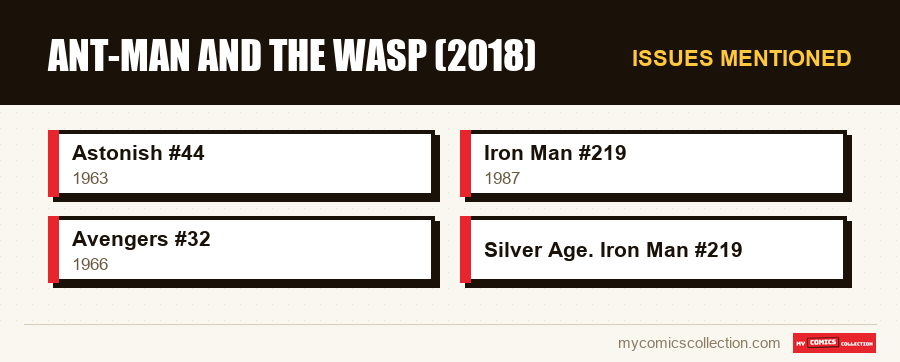
Tales to Astonish #44 (1963): 1st appearance of the Wasp (Janet van Dyne)
Iron Man #219 (1987): Ghost's first appearance (Michelinie & Layton)
Avengers #32 (1966): 1st appearance of Bill Foster (future Goliath)
The Quantum Realm: the Marvel microverse
- La Wasp, heroine in her own right, equipped with wings and stingers.
- Janet van Dyne, first Wasp and historical pillar of the Avengers.
- Ghost, an enemy capable of passing through matter, from Iron Man #219.
- Bill Foster, scientific ally linked to Pym technology.
- THE Pym particles and the journey into the infinitely small.
- Ghost goes from an anti-corporate saboteur to a woman (Ava Starr) with a tragic past.
- Hope van Dyne becomes the Wasp, while in the comics this role is that of his mother Janet.
- The Quantum Realm is developed well beyond his role in the comics.
- Bill Foster sees his Goliath story simplified.
- The tone of family comedy remains a signature of the film.
Tales to Astonish #44 (1963): the first Wasp
The Wasp is one of the founding heroes of Marvel. Janet van Dyne appears in Tales to Astonish #44 (June 1963), based on a story by Stan Lee and drawings by Jack Kirby: a young woman whose scientist father is killed, she joins forces with Hank Pym to avenge him and adopts the identity of the Wasp, equipped with wings and stingers. A founding member of the Avengers (she is the one who, in the comics, finds the name of the team) she was underestimated for a long time before being recognized as a pillar. The film does justice to this character, but with one important nuance: on screen, the active Wasp is Hope van Dyne, Janet's daughter, while Janet herself, played by Michelle Pfeiffer, is missing in the Quantum Realm. The film thus operates a generational transmission, as it did for Ant-Man.
This dynamic of passing the torch, from one generation of heroes to the next, is at the heart of the identity of the Ant-Man saga, and faithful to the spirit of the comics, where the Pym-van Dyne family has always occupied a central place.
Iron Man #219 (1987): Ghost, reimagined
The film's antagonist, Ghost, was born in Iron Man #219 (1987), created by David Michelinie and Bob Layton. In the comics, he is a man, computer saboteur and technophobe, capable of making his body intangible to pass through matter, in war against big companies. The film retains its spectacular power (the intangibility, the ability to pass through walls) but completely reinvents the character: Ghost becomes Ava Starr, a woman whose molecular instability, a source of suffering, results from an accident linked to quantum technology. This rereading transforms a B series villain into a tragic figure whose distress we understand, in line with the nuanced antagonists of the saga.
Bill Foster, the Quantum Realm and the Pym mythology
The film enriches its scientific setting with Bill Foster, ally of Hank Pym played by Laurence Fishburne. The character was born in Avengers #32 (1966), created by Stan Lee and Don Heck, and later became Goliath, capable of growing immeasurably thanks to Pym technology: one of Marvel's first African-American superheroes. The film evokes this giant past while simplifying it. Above all, the plot considerably develops the Quantum Realm, this microverse where we enter by shrinking to infinity. Present in the comics in various forms (the microverse), it takes on a new dimension here, becoming a key territory in the mythology of the saga and the place where Janet van Dyne survived for decades.
The characters, from paper to screen
- Hope van Dyne / the Wasp: Inherits the role from his mother Janet, generational transmission specific to the film.
- Janet van Dyne: The first Wasp of the comics (Tales to Astonish #44), here lost in the Quantum Realm.
- Ghost: Reinvented as a woman with a tragic past, based on a male villain from the comics.
- Bill Foster: Scientific ally taken from Avengers #32, with the simplified Goliath story.
- Scott Lang: Continues his role as hero in spite of himself, father above all.
Collecting this series?
Track what you own, what you are missing and what your collection is worth. 7 day trial.
Start my trial →Peyton Reed and Sliding Comedy
Faithful to the first part, Peyton Reed maintains the family comedy tone and the sense of play on scales: giant objects, tiny heroes, absurd pursuits. This lightness, which has no direct equivalent in comics, serves perfectly a character whose power lends itself to visual inventiveness. But the film also takes on a more emotional dimension: Janet's quest, Ava's pain, Scott's paternity. By balancing humor and sentiment, the film extends the singular identity of the Ant-Man saga within a universe dominated by cosmic issues. It's a welcome breath of fresh air, which reminds us that Marvel also knows how to tell stories at the height of a man, or an ant.
The microverse, a fertile territory of comics
The Quantum Kingdom of the film, renamed for the occasion, is inspired by an old and fascinating concept from comics: the microverse, a universe accessible by shrinking to infinity, populated by worlds and civilizations. This land has fueled many Marvel stories, providing heroes of varying sizes with a unique adventure playground. The film makes it a central location in its mythology, both a prison, this is where Janet van Dyne survived for decades, and an unexplored scientific frontier. This dimension gives the Ant-Man saga a rare singularity: it is the only one to truly explore the infinitely small as a narrative space in its own right, where the other films aim for the cosmos.
This taste for the microscopic scale is faithful to the spirit of Ant-Man and the Wasp comics, where shrinkage is not just a gadget but a door to the unknown. By developing the Quantum Realm, the film also prepares the ground for future stories, this microverse being called upon to conceal secrets that will determine the rest of the saga. For the curious reader, it is an invitation to explore a little-known but rich part of the Marvel universe, where the adventure plays out on the scale of the atom.
Where to start reading
To discover the Wasp, we can go back to Tales to Astonish #44 (1963) for her debut, then follow her evolution throughout the first Avengers, where she asserts herself as a pillar of the team. Modern runs devoted to Janet van Dyne, as well as Nadia van Dyne (another Wasp), deepen the character. For Ghost, Iron Man #219 (1987) is the direct source. Finally, stories exploring the microverse shed light on the film's Quantum Realm. From 1963 to today, this journey covers the sources of a film which finally highlights a founding heroine. It is also the opportunity to discover Nadia van Dyne, the second Wasp to appear in the 2010s, whose adventures full of optimism nicely extend Janet's legacy.
Chronology of comics to know
- 1963: Tales to Astonish #44: first appearance of the Wasp (Janet van Dyne).
- 1966: Avengers #32: first appearance of Bill Foster (future Goliath).
- 1987: Iron Man #219: First appearance of Ghost.
Collection side: what numbers to aim for after the film
This film points to keys on several levels. Tales to Astonish #44 (first appearance of the Wasp) is a historic Silver Age issue, all the more sought after because Janet van Dyne is a founding Avenger; its value has progressed with the character's increasing place on screen. Iron Man #219 (Ghost's first appearance) is an affordable key to the 1980s and directly related to the film. Avengers #32 (first appearance of Bill Foster) will appeal to fans of historical characters. These targets cover various budgets, from the Silver Age to the Bronze Age. As always, condition and gradation determine value; relying on real recent sales is strongly recommended. Tales to Astonish #44 remains the centerpiece for a collector of the Wasp, a first appearance of a founding heroine whose recognition continues to grow year after year.
Its place in the saga and for the collector
Released just after the shock of Infinity War, Ant-Man and the Wasp offers a welcome breath of fresh air while discreetly preparing for the sequel, notably via the Quantum Realm called to play a decisive role. For the collector, the film has the merit of highlighting the Wasp, long neglected despite its status as a founding member of the Avengers: Tales to Astonish #44 has gained recognition, as has Iron Man #219 for Ghost. This film once again illustrates the power of cinema to rehabilitate forgotten characters and numbers. Beyond speculation, it invites us to rediscover a pioneering heroine, whose historical importance far exceeds notoriety. By finally naming a film after her, Marvel is correcting a long-standing injustice to one of its first superheroes: a gesture that the discerning collector will appreciate.
The verdict: the Wasp finally in the spotlight
- Loyalty: the Wasp, Pym technology and Ghost's power are well taken from the comics.
- Freedoms: Ghost reinvented as a tragic woman, Hope inheriting her mother's role, the Quantum Realm amplified.
- Collectible numbers: Tales to Astonish #44 (the Wasp), Iron Man #219 (Ghost), Avengers #32 (Bill Foster).
Ant-Man and the Wasp corrects an injustice by finally putting a founding heroine front and center. Faithful to the Pym-van Dyne mythology while reinventing its antagonist, the film continues the warm and inventive identity of the Ant-Man saga. For both the reader and the collector, it is an invitation to rediscover the Wasp, one of the pioneers of the Marvel universe, and the issues that saw her birth. In a saga often dominated by global issues, this human-level film reminds us that Marvel also knows how to move people with stories of family, transmission and second chances. It is this warmth, more than the spectacle, which makes the lasting singularity of the Ant-Man saga and its Wasp finally recognized at its true value.
Frequently asked questions
Janet van Dyne, the first Wasp, appears in Tales to Astonish #44 (1963), created by Stan Lee and Jack Kirby. She is a founding member of the Avengers. In the film, his daughter Hope inherits the role.
A man: technophobic saboteur who appeared in Iron Man #219 (1987). The film reinvents the character as a woman, Ava Starr, whose intangibility results from a quantum accident and is a source of suffering.
In the form of the microverse, yes, but the film considerably expands on this territory, which becomes a key location in the mythology of the saga and the place where Janet van Dyne survived for decades.
A scientific ally of Hank Pym, appearing in Avengers #32 (1966), who later becomes Goliath thanks to Pym technology. He is one of Marvel's first African-American superheroes.
Tales to Astonish #44 (first appearance of the Wasp) is the centerpiece of the Silver Age. Iron Man #219 (Ghost's first appearance) is a more accessible key to the 1980s.
Does the film make you want to collect? Estimate the value for free of your issues (Tales to Astonish #44, Iron Man #219…) with our tool based on current eBay listings.