Avengers (2012), directed by Joss Whedon, brings together Marvel heroes in a film that draws on Avengers #1 (1963) by Stan Lee and Jack Kirby: where it is already a machination of Loki which forces the heroes to come together. The film borrows heavily from “The Ultimates”(2002) by Mark Millar and Bryan Hitch: modern team, Nick Fury modeled on Samuel L. Jackson, alien invaders. It retains the founding idea of the team but changes the composition and the antagonists. Detailed comparison, film versus comics.
The culmination of “phase 1” of Marvel Studios, Avengers took on an unprecedented challenge in cinema: bringing together five franchises into a single choral story. To achieve this, the film does not rely on a single story but weaves the founding DNA of the team from the 1960s with its modern rereading of the 2000s. Let's dissect these two sources and what the film does with them.
As in the entire series, only verified information (distribution, dates, numbers, creators) is stated, the comparative analysis remaining our editorial work, without reproduction of dialogue or protected images.
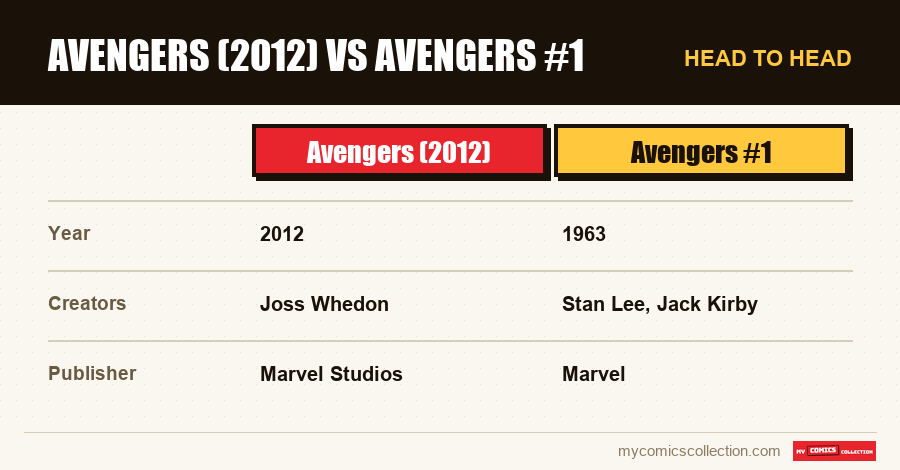
Title : Avengers (2012)
Director: Joss Whedon
Actors: Robert Downey Jr., Chris Evans, Chris Hemsworth, Mark Ruffalo (Hulk), Scarlett Johansson, Jeremy Renner (Hawkeye), Tom Hiddleston (Loki), Samuel L. Jackson (Nick Fury)
Exit : May 4, 2012 (United States)
Studio: Marvel Studios: phase 1 finale
Avengers #1 (1963): formation of the team, provoked by Loki (Lee & Kirby)
“The Ultimates”(2002-2004), Millar & Hitch: modern team, Nick Fury “Samuel L. Jackson”
The Chitauri: invaders from the Ultimate universe
Decades of Avengers runs: team dynamics and rivalries
- The founding idea: solitary heroes who are forced by threat to unite as a team.
- Loki as catalyst: already in Avengers #1, it is his machination that brings the heroes together.
- The presence of Iron Man, Thor and Hulk, members of the original core of 1963.
- THE internal friction and the clashing egos, a trademark of the team.
- The unifying role of a intelligence organization and its director.
- The composition: the film replaces Ant-Man and the Wasp (1963 founders) with Captain America, Black Widow and Hawkeye.
- Nick Fury and S.H.I.E.L.D. play the unifying role, in the manner of “The Ultimates” rather than the 1963 comic.
- The invaders are the Chitauri, borrowed from the Ultimate universe, and not the Skrulls of classic comics.
- Captain America is integrated from the start, although he only joins the team a little later in the original comics (Avengers #4).
- The film condenses decades of continuity in a single battle of New York.
Avengers #1 (1963): Loki, already at the origin of the team
The film takes up, almost like a wink, the logic of Avengers #1 (September 1963), by Stan Lee and Jack Kirby. In this issue, it is a machination of Loki, who manipulates the Hulk, which pushes several heroes to come together for the first time. The 2012 film makes exactly the same choice: it is Loki, once again, who serves as a unifying threat and causes, despite himself, the birth of the team. This fidelity to the original theme is all the more elegant as it links the first major crossover in Marvel cinema to the very first issue of the series.
The difference lies in the composition. The core of 1963 brought together Iron Man, Thor, Hulk, Ant-Man and the Wasp. The film keeps the first three, removes Ant-Man and the Wasp (who will arrive later in the saga), and replaces them with Captain America, Black Widow and Hawkeye. This hybrid team is more of the later formations of the comics than of the strictly original line-up.
“The Ultimates” (2002): the true model of the film
If the spark comes from 1963, the structure of the film owes a lot to “The Ultimates” (2002-2004) by Mark Millar and Bryan Hitch. This modern rereading of the Avengers offered a team assembled by a government agency, a realistic and cinematic tone, and above all a Nick Fury whose appearance was modeled on Samuel L. Jackson: long before the actor played the character on screen. The film inherits all of this: S.H.I.E.L.D. as conductor, the idea of an “Initiative” bringing together exceptional individuals, and a contemporary blockbuster aesthetic. “The Ultimates” has, in short, served as a blueprint for the Avengers cinema.
The Chitauri rather than the Skrulls
The choice of invaders clearly illustrates this double heritage. In classic comics, the Avengers' major alien invaders are often the Skrulls. The film prefers the Chitauri, a race created precisely for the Ultimate universe. This shift, invisible to the general public, shows to what extent the Ultimate version served as a matrix: even in its threats, the film draws from the rereading of the 2000s as much as from historical continuity.
The characters, from paper to screen
- Iron Man, Thor, Hulk: Members of the core of 1963, present in the film, each arriving with the story posed by their own feature film.
- Captain America: Integrated from the start, although he joins the team a little later in the original comics.
- Black Widow and Hawkeye: Agents who became Avengers, in the spirit of the subsequent recompositions of the team.
- Nick Fury: Unifying role directly inherited from “The Ultimates”, right down to its appearance.
- Loki: Catalyst antagonist, true to his role in Avengers #1.
Collecting this series?
Track what you own, what you are missing and what your collection is worth. 7 day trial.
Start my trial →Joss Whedon and the challenge of the ensemble film
Bringing together five franchises in the same film without any one swallowing up the others was a balancing act. Joss Whedon, experienced in team stories and sets of characters, made it the backbone of the film: rather than stacking the heroes, he highlights their frictions, their egos and their learning of the collective. This group dynamic which seeks itself before functioning is, in itself, deeply faithful to the Avengers comics, where internal disputes have always mattered as much as the fights. The film transforms industrial constraint, making stars coexist, into a dramatic engine, exactly as the original series drew its salt from the disagreement between individuals who are completely opposed to each other.
This attention to alchemy explains why the film was a landmark: it did not just align heroes, it proved that a shared universe could culminate in a coherent choral narrative. It is this success which made the crossover, until then exclusive to comics, a standard of superhero cinema.
A team with variable geometry, faithful to tradition
We could criticize the film for having modified the founding line-up of 1963, but that would be to forget an essential characteristic of the Avengers: their composition has never stopped changing. From their earliest years, comics practiced a revolving door, renewing the team as people left and arrived: to the point that a famous early lineup no longer included any of the original members. This assumed instability is part of the group's identity. By composing a hybrid team (three founders from 1963 (Iron Man, Thor, Hulk) supported by Captain America, Black Widow and Hawkeye) the film therefore does not betray the comics: it applies their most constant principle, that of a team which redefines itself according to the needs of the story. For the collector, this opens up as many avenues as there are members, each referring to their own first appearances.
Chronology of comics to know
- 1963: Avengers #1: formation of the team, triggered by a plot from Loki.
- 1964: Avengers #4: Captain America joins the team, found frozen.
- 2002-2004: “The Ultimates”: modern film matrix (S.H.I.E.L.D., Nick Fury, Chitauri).
Where to start reading
Two complementary readings allow us to understand where the film comes from. The first is historic: Avengers #1 (1963), for the formation of the team and the role of Loki, then Avengers #4 (1964), for the arrival of Captain America. The second is modern: “The Ultimates” (2002-2004), a true master plan for the feature film, where we find S.H.I.E.L.D., a Nick Fury modeled on Samuel L. Jackson and a team assembled in blockbuster style. Reading these two sources side by side is to understand the double filiation of the film: the spark of the 1960s and the architecture of the 2000s. To go further, each member refers to its own series and its first appearances, making Avengers a fantastic starting point for exploring the entire Marvel universe. We can also extend the exercise with our comparisons dedicated to each hero of the team, from the first Iron Man to Thor and Captain America, to see how each solo film also draws on very specific sources before converging on this great gathering.
Collection side: what numbers to aim for after the film
Avengers opens a prestigious collection trail. Avengers #1 (1963) is a major key to the Silver Age: the formation of the team, a highly sought-after act whose high ranks reach new heights. Avengers #4 (return of Captain America) is the other great classic linked to the film, just as coveted. For a softer budget, the collections of "The Ultimates" offer the most direct source of the film's aesthetic and remain easy to find. As always, condition and gradation determine value; It is prudent to rely on actual recent sales before purchasing. Avengers #1 deserves special attention: as the founding number of a team now known worldwide thanks to the cinema, it is one of those keys for which demand does not weaken, and well-preserved copies of which are becoming rare. For anyone starting out, aiming first for a copy of a major issue in average condition is often more judicious than accumulating secondary issues in perfect condition.
The verdict: two eras united as one team
- Loyalty: the idea of forced union and Loki's role as catalyst comes directly from Avengers #1.
- Freedoms: a revamped roster, S.H.I.E.L.D. and Nick Fury as unifiers, and Ultimate invaders (Chitauri).
- Collectible numbers: Avengers #1 (training) and Avengers #4 (Cap's return).
By marrying the spark of 1963 and the architecture of “The Ultimates”, Avengers achieves a narrative tour de force: giving the impression of an inevitable outcome where everything was, in reality, meticulously assembled. For both reader and collector, the film is an invitation to go back to both ends of the chain, the historic first issue and its modern retelling, to understand where the greatest superhero team really comes from.
After the Battle of New York: What the film started
The scope of Avengers goes far beyond its plot. By revealing, in a scene during the credits, the face of Thanos, the film discreetly opened the way to a whole decade of linked stories: a practice inherited directly from the comics, where crossover events and long-term threats have structured the universe for generations. It is this gesture that transformed the very way of conceiving of superhero cinema: no longer isolated films, but a flowing story where each part prepares the next. The Avengers of the comics had invented this logic of continuity; the film brought it to the general public.
For the collector, this revelation had a very concrete effect: it shined the spotlight on the first appearances of cosmic characters, and reminded us that the value of a comic often lies in its place in a larger story. Avengers is not just the culmination of a phase: it is the tipping point where the comic book model definitively colonized cinema.
Frequently asked questions
From Avengers #1 (1963), where Loki already provokes the formation of the team, and especially from “The Ultimates” (2002) by Millar and Hitch, whose film takes up the modern structure, S.H.I.E.L.D., Nick Fury and the Chitauri.
In part. Iron Man, Thor and Hulk belong to the 1963 core, but the film replaces Ant-Man and the Wasp with Captain America, Black Widow and Hawkeye, a formation closer to later recompositions.
The Chitauri are a race created for the Ultimate universe, from which the film is heavily inspired. The Skrulls, classic invaders of comics, then came under different rights agreements; the film therefore drew on the Ultimate version.
Yes. In Avengers #1 (1963), it is a machination of Loki, manipulating the Hulk, which pushes the heroes to come together. The film faithfully takes up this founding principle.
Avengers #1 (1963), the formation of the team, is the holy grail. Avengers #4 (Return of Captain America) is the other big key related to the film. The collections of “The Ultimates” are the most accessible entry.
Does the film make you want to collect the Avengers? Estimate the value for free of your issues (Avengers #1, #4…) with our tool based on current eBay listings.