Secret Invasion (2023), created by Kyle Bradstreet with Samuel L. Jackson, adapts the comics event of the same name (2008) by Brian Michael Bendis and Leinil Yu, where the Skrulls shapeshifters are secretly infiltrating Earth. The Skrulls were born in Fantastic Four #2 (1961). The series maintains the paranoia of “who can I trust?” » but drastically reduces the scale, making it a spy thriller centered on Nick Fury. Here is the detailed comparison, series versus comics.
A paranoid spy thriller, Secret Invasion adapts one of Marvel's great cosmic events in a much more intimate format. The series taps into an ancient threat in the Marvel Universe. Source-by-source decryption.
As in each article in this series, only verified information (creators, distribution, dates, comic numbers) is stated; the comparative analysis is ours, without reproducing dialogue or protected images.
Title : Secret Invasion (2023)
Creator: Kyle Bradstreet
Actors: Samuel L. Jackson (Nick Fury), Ben Mendelsohn (Talos), Emilia Clarke (G'iah), Kingsley Ben-Adir (Gravik), Olivia Colman
Broadcast: June-July 2023, Disney+ (6 episodes)
Studio: Marvel Studios
“Secret Invasion”(2008): event by Bendis & Leinil Yu
Fantastic Four #2 (1961): First appearance of the Skrulls (Lee & Kirby)
The Super Skrull: combination of powers
“Who can we trust? »: the paranoia of shapeshifters
- THE Skrulls, extraterrestrials capable of taking any appearance.
- L'secret infiltration of Earth by impostors.
- La paranoia: Anyone can be a Skrull.
- Nick Fury at the heart of the response.
- The concept of Super Skrull, combining several powers.
- The scale: the global event becomes a restrained spy thriller.
- Costumed heroes are almost absent, for the benefit of Fury and the agents.
- The Skrulls here are rebellious refugees, not conquerors (sequel to Captain Marvel).
- Gravik and G'iah are characters specific to the series.
- La “Harvest” of hero DNA is an invention of the series.
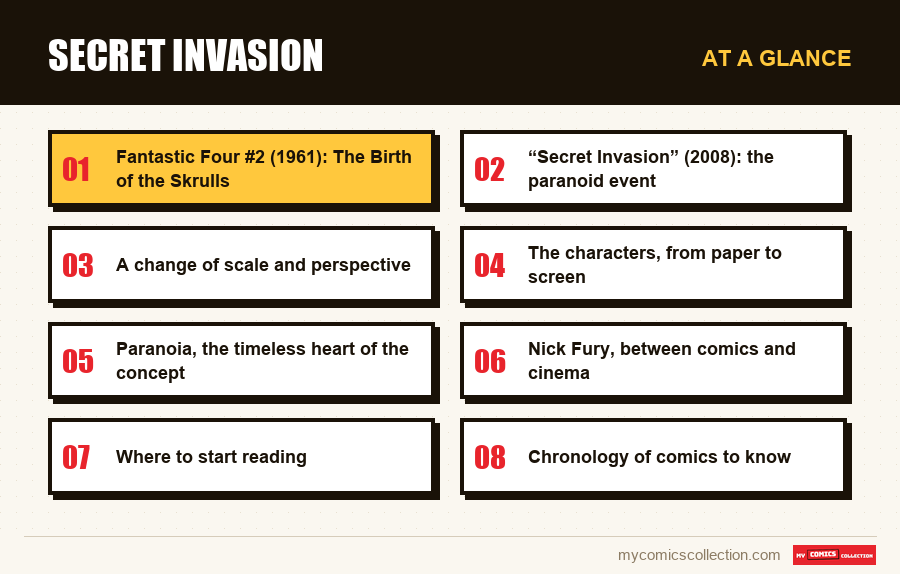
Fantastic Four #2 (1961): The Birth of the Skrulls
The Skrulls are one of the oldest threats in the Marvel Universe. They appear in Fantastic Four #2 (1961), created by Stan Lee and Jack Kirby, from the second issue of the publisher's founding comic. A warrior alien race, they possess a formidable ability: to take the appearance of anyone, which makes them perfect infiltrators and impostors. Their first plan already consisted of posing as the Fantastic Four in order to discredit them. The series faithfully captures this nature of shapeshifters and the anxiety it generates: if anyone can be a Skrull in disguise, who can we trust? This paranoia, at the heart of the concept since 1961, is the driving force of the story. The series is also based on the existence of the Super-Skrull, a warrior combining several powers, an old concept in comics.
This threat, anchored in the very first Marvel stories, offers unique dramatic potential: that of invisible betrayal, of the enemy who wears the face of a friend. The series fully exploits this resource, inherited from half a century of comics.
“Secret Invasion” (2008): the paranoid event
The series adapts the event “Secret Invasion” (2008), written by Brian Michael Bendis and drawn by Leinil Yu, one of the great crossovers of its time. The comic revealed that the Skrulls had secretly replaced many of Earth's heroes and personalities, preparing an invasion from within: hence the famous slogan, "Who can we trust?" ". This event played on paranoia across the entire Marvel Universe, revealing that major figures had been Skrulls for years. The series faithfully takes up this central idea of infiltration and generalized distrust, as well as the central role of Nick Fury in the response. However, she makes it a much more intimate story, centered on espionage and human relationships, far from the cosmic fresco of the comic.
A change of scale and perspective
The greatest freedom of the series is its change of scale. Where the comic was a global event involving dozens of costumed heroes and a spectacular invasion, the series opts for a restrained spy thriller, centered on Nick Fury, the Skrulls and a handful of agents. Superheroes are almost absent, replaced by a game of fools and conspiracies. Another major difference: the Skrulls in the series are not conquering invaders, but rebellious refugees, extending their presentation in Captain Marvel, where Talos and his people were victims of Kree imperialism. Their leader, Gravik, leads an insurrection born from the betrayal of the promises made to them. This moral reversal, specific to cinematic continuity, transforms the invasion into a story of despair and survival.
The characters, from paper to screen
- Nick Fury: Faithful to its central role in the 2008 event, at the heart of the response.
- Talos: Fury's Skrull ally, continuing his presentation in Captain Marvel.
- Gravik: Leader of the Skrull insurgency, character specific to the series.
- G'iah: Daughter of Talos, endowed at the end of the “Harvest” with hero DNA.
- The Skrulls: True to their nature as shapeshifters from Fantastic Four #2.
Collecting this series?
Track what you own, what you are missing and what your collection is worth. 7 day trial.
Start my trial →Paranoia, the timeless heart of the concept
What makes the Skrulls so effective, in the comics and on screen, is the paranoia they generate. The idea that a loved one, an ally, a trusted figure could be an impostor in disguise touches on a deep anguish: that of no longer being able to trust anyone. The 2008 event pushed this to its climax by revealing betrayals among the heroes themselves. The series makes it the heart of its spy thriller, playing on masked identities and revelations. This theme of betrayed trust, universal and timeless, is what distinguishes Secret Invasion from other stories in the saga: here, the enemy is not a clearly identifiable external force, but an insidious threat, hidden under familiar faces.
This psychological dimension, inherited directly from the comics, gives the series an adult thriller tone, closer to a spy film than a superhero blockbuster. By focusing on tension and distrust rather than spectacle, the series remains faithful to what has always been the strength of the Skrulls: the fear of the invisible enemy, who could be anyone, including the one we thought we trusted the most.
Nick Fury, between comics and cinema
The series puts Nick Fury front and center, a choice that sheds light on this character's particular history. The Fury played by Samuel L. Jackson actually owes his appearance to the comics: in the modern rereading "The Ultimates" (2002), the authors had drawn an alternative Nick Fury modeled on the actor's features, long before he played the role on screen. A rare case where fiction preceded reality. Fury, a secret agent and founder of intelligence organizations, has long been a central figure in the Marvel Universe, keeper of secrets and manipulator of shadows. The series exploits this dimension by placing him at the heart of a spy thriller, in a role faithful to his status as a disillusioned strategist.
This choice to center the story on Fury rather than on costumed heroes is consistent with the spirit of the 2008 event, where the agent played a key role in the response to the invasion. It also allows the series to adopt a more adult and more intimate tone, anchored in the world of espionage and geopolitics. Fury appears aging, disillusioned, confronted with the consequences of his own choices towards the refugee Skrulls. This humanization of a usually enigmatic character gives the series an unexpected depth. By making Fury the pivot of the story, the series pays homage to a figure who, from paper to screen, has always embodied the dark and compromised side of the Marvel universe: that of difficult decisions made away from the spotlight.
Where to start reading
Priority reading is the event “Secret Invasion” (2008) by Bendis and Yu, direct source of the series, on condition of accepting a much larger fresco. It can be preceded by runs by Bendis on the “New Avengers”, who are preparing the invasion. For the origins of the Skrulls, Fantastic Four #2 (1961) is the matrix. Finally, “Captain Marvel” and the Kree-Skrull war shed light on the cosmic context. From 1961 to 2008, this journey covers the source material for a series rooted in an ancient Marvel threat.
Chronology of comics to know
- 1961: Fantastic Four #2: First appearance of the Skrulls.
- 1960s-1970s: the Kree-Skrull war and the Super-Skrull.
- 2008: “Secret Invasion” by Bendis and Yu: the event adapted by the series.
Collection side: what numbers to aim for after the series
Secret Invasion highlights a founding key. Fantastic Four #2 (first appearance of the Skrulls) is a major issue of the Silver Age, one of the very first in the Marvel universe, highly sought after and rated. The issues of the “Secret Invasion” event (2008) are accessible modern targets, available in collections. These issues cover very different budgets, from the historical grail to recent comics. As always, condition and gradation determine value; relying on real recent sales is strongly recommended. Fantastic Four #2 is a prestigious collector's item, as the second issue of the comic that launched Marvel, and one of the few titles from the very early Marvel era still regularly traded on the market.
Its place in the saga and for the collector
Secret Invasion explores a darker and political side of the saga, centered on espionage and the identity crisis of the Skrulls. For the collector, the series has revived interest in Fantastic Four #2, one of Marvel's founding issues, and for the 2008 event. It illustrates the effect of series on the market, including for old concepts. Beyond speculation, the series invites you to discover one of Marvel's great paranoid events and to explore the wealth of the Skrulls, a timeless threat born in the second issue of Fantastic Four. By focusing on psychological tension rather than spectacle, the series assumes an adult tone which prolongs, in its own way, the founding anxiety of these shapeshifters imagined by Lee and Kirby.
The verdict: the invasion, in intimate mode
- Loyalty: the shapeshifting Skrulls, infiltration, paranoia and the role of Fury come from the comics.
- Freedoms: the reduced scale, the absence of costumed heroes, the revolting refugee Skrulls, the “Harvest”.
- Collectible numbers: Fantastic Four #2 (the Skrulls), the “Secret Invasion” event (2008).
Secret Invasion adapts a Marvel paranoid big event into an intimate spy thriller format. True to the nature of the Skrulls and the anxiety of “who can we trust?” », the series reduces the scale and reverses their role, making them rebellious refugees. For the reader as for the collector, it is an invitation to discover a founding threat of the Marvel universe, born in 1961. By banking on paranoia rather than spectacle, the series takes a risky bet but faithful to the original anguish of the Skrulls: that of an invisible enemy, who could wear the face of anyone, including that of a friend.
Frequently asked questions
From the event "Secret Invasion" (2008) by Brian Michael Bendis and Leinil Yu, where shapeshifting Skrulls secretly infiltrate Earth. The series greatly reduces the scale, making it a spy thriller centered on Nick Fury.
In Fantastic Four #2 (1961), created by Stan Lee and Jack Kirby, from the second issue of Marvel's founding comic. They are aliens capable of taking on any appearance.
The series continues their presentation in Captain Marvel, where Talos and his family were refugees victims of Kree imperialism. Their leader Gravik leads an insurrection born from the betrayal of the promises made to them.
In the spirit, yes (infiltration, paranoia, Nick Fury), but the scale is radically different: the global event with dozens of heroes becomes a restricted spy thriller, almost without costumed superheroes.
Fantastic Four #2 (first appearance of the Skrulls) is the centerpiece, one of Marvel's founding issues. The issues from the “Secret Invasion” event (2008) are accessible modern targets.
Does the series make you want to collect? Estimate the value for free of your numbers (Fantastic Four #2…) with our tool based on current eBay listings.