
Agents of S.H.I.E.L.D. (series, 2013-2020), with Clark Gregg, follows a team from the intelligence organization born in Strange Tales #135 (1965) by Stan Lee and Jack Kirby. It features Agent Coulson (created for the films) and Daisy Johnson / Quake , appeared in Secret War #2 (2004) by Brian Michael Bendis. The series draws on the mythology of S.H.I.E.L.D., Inhumans and HYDRA, while developing a largely original plot. Here is the detailed comparison, series versus comics.
The first television series in the Marvel Universe, Agents of S.H.I.E.L.D. explored behind the scenes of the intelligence organization for seven seasons. The series draws on a major part of Marvel mythology. Source-by-source decryption.
As in each article in this series, only verified information (creators, distribution, dates, comic numbers) is stated; the comparative analysis is ours, without reproducing dialogue or protected images.
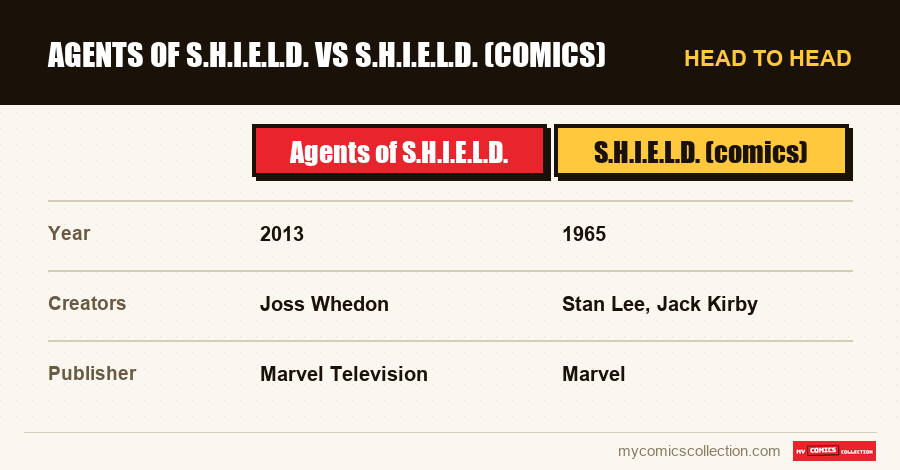
Title : Agents of S.H.I.E.L.D. (2013-2020)
Creators: Joss Whedon, Jed Whedon, Maurissa Tancharoen
Actors: Clark Gregg (Phil Coulson), Ming-Na Wen (Melinda May), Chloe Bennet (Daisy Johnson / Quake), Iain De Caestecker
Broadcast: 2013-2020, ABC (7 seasons)
Studio: Marvel Television
Strange Tales #135 (1965): 1st appearance of S.H.I.E.L.D. (Lee & Kirby)
Secret War #2 (2004): 1st appearance of Daisy Johnson / Quake
The Inhumans: Terrigenesis
HYDRA: the enemy of the shadows
- Le S.H.I.E.L.D., intelligence organization facing superhuman threats.
- Daisy Johnson / Quake, agent with seismic powers.
- THE Inhumans and Terrigenesis, which grants powers.
- HYDRA, the infiltrated enemy organization.
- Le spy tone and science fiction.
- Agent Coulson, protagonist, is a creation of the films, not the comics.
- The team and most of the characters are unique to the series.
- The plot is largely original, evolving over seven seasons.
- Time travel and space are explored in the late seasons.
- Daisy Johnson sees her redeveloped course for the series.
Strange Tales #135 (1965): S.H.I.E.L.D. in the comics
S.H.I.E.L.D. was born in Strange Tales #135 (1965), created by Stan Lee and Jack Kirby, at the height of the craze for spy stories. This international intelligence organization, led by Nick Fury, fights against superhuman threats and criminal organizations like HYDRA. Equipped with cutting-edge technology (the famous Helicarrier), it is a pillar of the Marvel universe, regularly crossing paths with superheroes. The series faithfully takes up this concept, a secret agency confronted with the strange and the superhuman, as well as its emblematic enemies, HYDRA in the lead. She explores behind the scenes of this organization, through the daily life of a team of agents. This dive into the functioning of S.H.I.E.L.D., rarely shown in detail in the films, is one of the major contributions of the series.
S.H.I.E.L.D., in the comics and on screen, embodies the “espionage” side of the Marvel universe, that of ordinary agents confronted with extraordinary threats. The series exploits this dimension by following characters without superpowers, immersed in a world of superheroes and supervillains.
Agent Coulson: a cinema creation
Notably, the protagonist of the series, Agent Phil Coulson, is not from the comics: he is a creation of the cinematic universe, appearing in the first Iron Man films and becoming popular to the point of deserving his own series. Played by Clark Gregg, Coulson is a dedicated and deadpan agent, whose "death" in Avengers had moved the public: which explains the mystery of his return to the heart of the series. This case is interesting: a character born in the cinema, so popular that he ended up being integrated into the comics themselves. The series is thus built around an original figure, which gives it great narrative freedom, while anchoring itself in the mythology of S.H.I.E.L.D. comics.
Daisy Johnson, the Inhumans and HYDRA
The series draws on several major elements from the comics. Daisy Johnson / Quake, one of its central characters, appears in Secret War #2 (2004), created by Brian Michael Bendis: Agent of S.H.I.E.L.D. endowed with seismic powers, daughter of the supervillain Mister Hyde. The series rearranges her journey but retains her power and her status as an agent. She also develops at length the Inhumans, this race whose members acquire powers through Terrigenesis: a part of Marvel mythology which becomes central in several seasons. Finally, HYDRA, the enemy organization of S.H.I.E.L.D., plays a major role, particularly in the wake of its revelation in The Winter Soldier. These elements, taken from the comics, anchor the series in the rich mythology of espionage and Marvel superhumans.
The characters, from paper to screen
- Phil Coulson: Protagonist created for the cinema, later integrated into the comics.
- Daisy Johnson / Quake: Agent with seismic powers (Secret War #2), with a redeveloped route.
- Melinda May: Elite agent, character specific to the series.
- Fitz and Simmons: The duo of scientists, creations of the series.
- The Inhumans and HYDRA: Major sections of Marvel mythology.
Collecting this series?
Track what you own, what you are missing and what your collection is worth. 7 day trial.
Start my trial →A series that has evolved
Agents of S.H.I.E.L.D. stands out for its longevity and its ability to reinvent itself over seven seasons. Beginning as a spy story anchored in the wake of the films, the series gradually explored increasingly ambitious territories: the Inhumans, virtual reality, time travel, space. This largely original development allowed it to develop a rich and autonomous plot, while regularly drawing on comic book mythology. The series thus offered an extensive panorama of the Marvel universe, exploring concepts that the films did not have time to delve into. Its ability to renew itself, season after season, has made it one of the most enduring Marvel series.
This longevity illustrates a strength of the television format: the time to develop characters and plots over time, where films must condense. Agents of S.H.I.E.L.D. was able to exploit this advantage to build an extended saga, anchored in Marvel mythology but free from its own developments. Exploring the Inhumans, HYDRA and S.H.I.E.L.D. In depth, the series enriched the perception of the Marvel universe, while offering characters like Daisy Johnson rare development. For the reader, it is an invitation to explore the “espionage and superhumans” side of comics, often eclipsed by costumed superheroes.
The link with films, an ambitious bet
Agents of S.H.I.E.L.D. was launched with an unprecedented ambition: to tie a television series to the continuity of the Marvel films, then in full expansion. This bet came to fruition in a spectacular way when the revelation, in The Winter Soldier, of the infiltration of S.H.I.E.L.D. by HYDRA directly disrupted the plot of the series, forcing its characters to deal with the collapse of their organization. This rare and daring interconnection between film and series illustrated the desire to build a truly shared universe, where events in one medium affected the other. The series thus lived to the rhythm of the great upheavals of the saga, while developing its own mythology.
This link with the films has, however, weakened over the seasons, the series gaining autonomy to explore its own territories: the Inhumans, time travel, space. This development illustrates the challenges and possibilities of a universe shared between several media: synchronizing a weekly series with films spaced several months apart is a balancing act. Agents of S.H.I.E.L.D. nevertheless proved that this model was viable, paving the way for the many Marvel series that followed. By relying on the mythology of the comics: S.H.I.E.L.D., HYDRA, the Inhumans: while dialoguing with the films, the series was a laboratory of the transmedia shared universe. For the reader, it reminds us that this logic of continuity and interconnection, now familiar in cinema, was born in comics, where stories respond and intersect for decades. Agents of S.H.I.E.L.D. was the first major television transposition, and undoubtedly one of the most accomplished in its way of combining espionage, science fiction and superhumans. In seven seasons, it will have explored almost all the registers of the Marvel house, from the spy thriller to the space opera, confirming that the richness of this universe is primarily due to its ability to reinvent itself from one story to another.
Where to start reading
To discover S.H.I.E.L.D., “Nick Fury, Agent of S.H.I.E.L.D. ” (from Strange Tales #135, 1965) presents the organization in all its espionage glory. For Daisy Johnson, Bendis's "Secret War" (2004) is the source, followed by her appearances as an agent. The stories dedicated to the Inhumans, notably those of Jack Kirby, shed light on this part of the mythology. From 1965 to 2004, this journey covers the sources of a series anchored in Marvel espionage.
Chronology of comics to know
- 1965: Strange Tales #135: First appearance of S.H.I.E.L.D. and Nick Fury (agent).
- 1960s: the Inhumans, created by Lee and Kirby.
- 2004: Secret War #2: First appearance of Daisy Johnson / Quake.
Collection side: what numbers to aim for after the series
Agents of S.H.I.E.L.D. points to various keys. Strange Tales #135 (1965, Founding of S.H.I.E.L.D. and Agent Nick Fury) is a sought-after key to the Silver Age, important to the entire Marvel espionage mythology. Secret War #2 (2004, first appearance of Daisy Johnson/Quake) is a modern number whose interest has soared with the character's on-screen popularity. These targets cover various budgets. As always, condition and gradation determine value; relying on real recent sales is strongly recommended. Strange Tales #135 is a prime target, as the founding issue of S.H.I.E.L.D., the central organization of the Marvel universe.
Its place in the saga and for the collector
Agents of S.H.I.E.L.D. was the first television series in the Marvel Universe, exploring behind the scenes of the intelligence organization over seven seasons. For the collector, it reignited interest in Strange Tales #135 and Secret War #2. It illustrates the effect of series on the market, in the long term. Beyond speculation, the series invites you to discover the “espionage” side of Marvel, that of S.H.I.E.L.D. and Inhumans, as well as characters like Quake. By exploring in depth a central organization of the Marvel universe, the series enriched the perception of this universe and proved that the television format could develop intrigues over time. It remains a milestone for Marvel adaptations on television.
The verdict: behind the scenes of the Marvel universe
- Loyalty: S.H.I.E.L.D., Quake, the Inhumans and HYDRA come from the comics.
- Freedoms: Coulson (creation of the cinema), the largely original team and plot, Daisy's journey reorganized.
- Collectible numbers: Strange Tales #135 (S.H.I.E.L.D.), Secret War #2 (Quake).
Agents of S.H.I.E.L.D. explores the behind-the-scenes of Marvel's intelligence organization over seven seasons, drawing on the mythology of S.H.I.E.L.D., the Inhumans and HYDRA. Faithful to these elements while developing a largely original plot around Agent Coulson, the series has been able to reinvent itself. For both the reader and the collector, it is an invitation to discover the “espionage and superhumans” side of Marvel. By lasting seven seasons and exploring concepts that the films did not have time to delve into, the series demonstrated the richness of the television format for developing, over time, the sprawling mythology of the Marvel universe.
Frequently asked questions
No: Phil Coulson is a creation of the cinematic universe, appearing in the first Iron Man films. Having become so popular, it was later incorporated into the comics themselves, a rare case of reverse influence.
An agent of S.H.I.E.L.D. endowed with seismic powers, daughter of the supervillain Mister Hyde, appeared in Secret War #2 (2004) by Brian Michael Bendis. The series rearranges its course but retains its power.
In Strange Tales #135 (1965), created by Stan Lee and Jack Kirby. It is an international intelligence organization led by Nick Fury, fighting against superhuman threats and HYDRA.
No: the plot is largely original, developed over seven seasons around Agent Coulson. She regularly draws on comic book mythology (S.H.I.E.L.D., Inhumans, HYDRA, Quake) while exploring her own territories.
Strange Tales #135 (1965, founding of S.H.I.E.L.D.) is the main target. Secret War #2 (2004, first appearance of Quake) is a modern issue whose popularity rises with the character.
Does the series make you want to collect? Estimate the value for free of your issues (Strange Tales #135…) with our tool based on current eBay listings.