Agent Carter (series, 2015-2016), with Hayley Atwell, follows Peggy Carter, the agent born in Tales of Suspense #77 (1966) by Stan Lee and Jack Kirby as Captain America's war love. Set in the post-war period, the series shows her fighting against sexism while participating in the founding of the S.H.I.E.L.D. It retains the spirit of the character while developing a largely original plot, extending its cinematic version. Here is the detailed comparison, series versus comics.
A retro spy story set in the 1940s, Agent Carter offers Peggy Carter, revealed in the Captain America films, her own series. It draws on a historical Marvel character and the genesis of S.H.I.E.L.D. Source-by-source decryption.
As in each article in this series, only verified information (creators, distribution, dates, comic numbers) is stated; the comparative analysis is ours, without reproducing dialogue or protected images.
Title : Agent Carter (2015-2016)
Creators: Christopher Markus and Stephen McFeely
Actors: Hayley Atwell (Peggy Carter), James D'Arcy (Edwin Jarvis), Dominic Cooper (Howard Stark), Enver Gjokaj
Broadcast: 2015-2016, ABC (2 seasons)
Studio: Marvel Television
Tales of Suspense #77 (1966): Peggy Carter (Lee & Kirby)
The founding of S.H.I.E.L.D.: the genesis of the organization
Howard Stark: Tony's father, visionary industrialist
Post-war: the context of the 1940s
- Peggy Carter, exceptional agent linked to Captain America.
- Its role in the founding of S.H.I.E.L.D.
- Howard Stark, visionary industrialist, father of Tony.
- Le post-war context and the emerging Cold War.
- The spirit of courage and determination of the character.
- The plot is largely original, extending the films rather than the comics.
- Edwin Jarvis becomes a central character, butler to Howard Stark.
- Sexism of the time is a central theme specific to the series.
- Peggy is developed far beyond her role as Captain America's love interest.
- THE antagonists (Leviathan, Zero Matter) are largely invented.
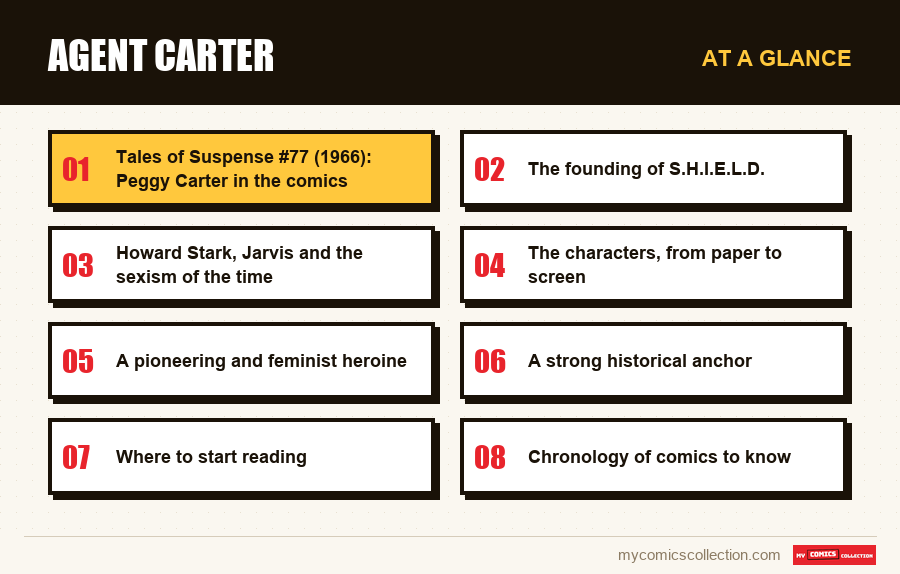
Tales of Suspense #77 (1966): Peggy Carter in the comics
Peggy Carter appears in comics as early as Tales of Suspense #77 (1966), created by Stan Lee and Jack Kirby, as Captain America's wartime love during World War II. In the comics, she long remained a secondary character, defined by her relationship with Steve Rogers. The series, extending its cinematic version introduced in First Avenger, on the contrary, makes her a heroine in her own right: an exceptional agent, brilliant and courageous, who leads her own missions in post-war America. Hayley Atwell plays a determined and witty Peggy, faithful to the film version while deepening the character. The series thus develops well beyond the comics a figure long confined to the role of a love interest.
This development illustrates a trend in modern adaptations: giving depth to secondary female characters in comics. Peggy Carter, a simple romantic foil in the 1966 stories, becomes on screen a complex and independent heroine, carrying her own series.
The founding of S.H.I.E.L.D.
One of the major issues of the series is the genesis of S.H.I.E.L.D., the central intelligence organization of the Marvel universe. In the comics, S.H.I.E.L.D. was born in Strange Tales #135 (1965), associated with Nick Fury. The series places its founding in the post-war period and makes Peggy Carter one of its architects, alongside Howard Stark. This historical anchoring gives the series a particular importance in continuity: it tells the origins of an institution which will structure the entire cinematographic universe. Peggy appears there as a pioneer, laying the foundations of an organization called to a major role. This founding dimension, specific to cinematic continuity, enriches the character while relying on the mythology of S.H.I.E.L.D. comics.
Howard Stark, Jarvis and the sexism of the time
The series develops several characters related to Peggy. Howard Stark, visionary industrialist and father of Tony Stark, is a recurring ally, present in the comics as a founding figure of Marvel's technological universe. Edwin Jarvis, his butler, becomes a central character in the series and Peggy's accomplice: a nod to the Avengers butler in the comics, whose name would later inspire Tony Stark's AI. Above all, the series makes the sexism of the time a central theme: Peggy, a brilliant agent, constantly encounters contempt from her male colleagues, who underestimate her. This feminist dimension, specific to the series and anchored in the context of the 1940s, gives the story a scope that goes beyond simple spy entertainment. Peggy plays a woman who stands out in a man's world, through her intelligence and courage.
The characters, from paper to screen
- Peggy Carter: Expanded far beyond his love interest role as Captain America from the comics.
- Edwin Jarvis: Howard Stark's butler, central character and Peggy's accomplice.
- Howard Stark: Visionary industrialist, father of Tony, recurring ally.
- Daniel Sousa: Agent and love interest, extensively developed for the series.
- The antagonists: Leviathan and Zero Matter, partly invented.
Collecting this series?
Track what you own, what you are missing and what your collection is worth. 7 day trial.
Start my trial →A pioneering and feminist heroine
The great success of the series lies in its feminist dimension, anchored in the historical context of the post-war period. By showing Peggy Carter fighting against both the nation's enemies and sexism from within her own camp, the series offers a powerful portrait of a woman ahead of her time. This approach, largely original compared to the comics where Peggy remained secondary, makes the character a figure of emancipation and independence. The series celebrates the intelligence, courage and tenacity of a heroine who refuses to be confined to the roles that society assigns to her. This reach, driven by Hayley Atwell's charismatic performance, made Peggy Carter a beloved character, whose popularity even led to her growing integration into the mythology of the saga.
This elevation of a secondary character from the comics to the rank of heroine in her own right illustrates the power of adaptations to reinvent and enrich their material. Peggy Carter, born as a simple love interest in 1966, became an iconic figure on screen, to the point of inspiring new developments in comics. The series thus helped to make Peggy much more than a war memory: an intelligence pioneer and a heroine in her own right, whose legacy looms over the entire Marvel universe.
A strong historical anchor
The great singularity of Agent Carter lies in its setting: post-war America, in the 1940s. This retro bias, rare for a superhero adaptation, gives the series a unique visual and thematic identity. Far from superpowers and cosmic threats, it tells a spy story anchored in a specific era, with its codes, its tensions and its historical context: the end of the Second World War, the start of the Cold War, the place of women in a society which sent them home after their contribution to the war effort. This anchor gives the series a particular depth and resonance, by bringing the spy adventure into dialogue with real social issues.
This historical context is also faithful to a part of Marvel mythology: that of the origins, from the Second World War to the founding of S.H.I.E.L.D., a rich period that the comics have explored through Captain America, Nick Fury and the Howling Commandos. The series is in this vein by telling the beginnings of the Marvel universe, before the era of modern superheroes. Peggy Carter appears as a bridge between the heroic era of Captain America and the birth of the institutions that will structure the saga. This founding dimension, combined with the care taken in the reconstruction of the period, distinguishes the series and gives it a special place in Marvel adaptations. For the reader, it is an invitation to explore Marvel's "retro" stories, those that delve into the roots of the universe, at a time when spies and soldiers preceded superheroes in tights.
Where to start reading
Peggy Carter having long remained secondary in the comics, there is no run centered on her like in the series. She can be discovered in her appearances in Captain America's stories, particularly those related to World War II. For S.H.I.E.L.D. context, “Nick Fury, Agent of S.H.I.E.L.D. » (from Strange Tales #135, 1965) sheds light on the genesis of the organization. Recent stories, in the wake of the series, have given Peggy a more prominent role. This course covers the sources of a largely original series but faithful to the spirit of the character.
Chronology of comics to know
- 1965: Strange Tales #135: The Founding of S.H.I.E.L.D. and Nick Fury.
- 1966: Tales of Suspense #77: Peggy Carter, Captain America's wartime love.
- 2010s: Peggy gains importance in the comics, in the wake of the series.
Collection side: what numbers to aim for after the series
Agent Carter points to keys to the Silver Age. Tales of Suspense #77 (1966, Peggy Carter) is an interesting issue for fans of the character, even if its status as a first appearance remains modest. Strange Tales #135 (1965, Founding of S.H.I.E.L.D. and Nick Fury) is a more sought-after key, important to the entire Marvel espionage mythology. These targets cover various budgets. As always, condition and gradation determine value; relying on real recent sales is strongly recommended. Strange Tales #135 is a prime target for a collector interested in the origins of S.H.I.E.L.D., the central organization of the Marvel universe.
Its place in the saga and for the collector
Agent Carter gave a supporting character from the comics his own series, while shedding light on the genesis of S.H.I.E.L.D. and the cinematographic universe. For the collector, it reignited interest in Tales of Suspense #77 and Strange Tales #135. It illustrates the effect of adaptations on the market, including for historical figures. Beyond speculation, the series invites us to discover the genesis of S.H.I.E.L.D. and the little-known role of Peggy Carter in Marvel mythology. By making a simple wartime love figure into a pioneering and feminist heroine, the series illustrates the power of adaptations to enrich their material, to the point of in turn influencing comics. Peggy Carter has thus become, thanks to the screen, an emblematic figure of the Marvel universe.
The verdict: a pioneer finally in the spotlight
- Loyalty: Peggy Carter, her connection to Captain America, the founding of S.H.I.E.L.D. and Howard Stark come from comics and movies.
- Freedoms: the largely original plot, central Jarvis, the theme of sexism, the invented antagonists.
- Collectible numbers: Tales of Suspense #77 (Peggy Carter), Strange Tales #135 (S.H.I.E.L.D.).
Agent Carter transforms a secondary character from the comics into a heroine in her own right, in a retro and feminist spy story. Faithful to the spirit of Peggy and the genesis of S.H.I.E.L.D., the series develops a largely original plot. For both the reader and the collector, it is an invitation to discover a little-known pioneer and the origins of Marvel's central organization.
Frequently asked questions
Peggy Carter appears in Tales of Suspense #77 (1966), created by Stan Lee and Jack Kirby, as Captain America's wartime love interest. The series develops her well beyond this secondary role, into a heroine in her own right.
No: Peggy having remained secondary in the comics, the plot of the series is largely original. It extends its cinematic version (First Avenger) and is based on the genesis of S.H.I.E.L.D.
Howard Stark's butler, central character of the series and Peggy's accomplice. It's a nod to the Avengers butler in the comics, whose name would later inspire Tony Stark's AI.
This is a central theme specific to the series, anchored in the context of the 1940s. Peggy, a brilliant agent, encounters contempt from her male colleagues, which gives the story a feminist scope absent from the comics.
Strange Tales #135 (1965, founding of S.H.I.E.L.D. and Nick Fury) is the most sought after target. Tales of Suspense #77 (Peggy Carter) will interest fans of the character.
Does the series make you want to collect? Estimate the value for free of your issues (Strange Tales #135…) with our tool based on current eBay listings.