
Captain Marvel (2019), directed by Anna Boden and Ryan Fleck with Brie Larson, adapts Carol Danvers, who appeared in Marvel Superheroes #13 (1968): first officer, then heroine with Kree powers. The film draws on his stint as Captain Marvel (2012, Kelly Sue DeConnick) and depicts the war between Kree and Skrulls. The original Captain Marvel, Mar-Vell , born in Marvel Superheroes #12 (1967). The film retains the essentials but rearranges the origin and reverses the role of the Skrulls. Detailed comparison, film versus comics.
The first film in the saga centered on a superheroine, Captain Marvel goes back to the 1990s to tell the origin of Carol Danvers and introduce a major cosmic scene: the war between the Kree and the Skrulls. Directed by Anna Boden and Ryan Fleck, the film draws on more than fifty years of comics while freely rearranging the character's history. Source-by-source decryption.
As in each article in the series, only verified information (distribution, dates, numbers, creators) is stated; the comparative analysis is ours, without reproducing dialogue or protected images.
Title : Captain Marvel (2019)
Directors: Anna Boden and Ryan Fleck
Actors: Brie Larson (Carol Danvers), Samuel L. Jackson (Nick Fury), Jude Law (Yon-Rogg), Ben Mendelsohn (Talos), Annette Bening, Lashana Lynch
Exit : March 8, 2019 (United States)
Studio: Marvel Studios
Marvel Superheroes #13 (1968): 1st appearance of Carol Danvers
Marvel Superheroes #12 (1967): Mar-Vell's first appearance
Captain Marvel (2012): Carol becomes Captain Marvel (Kelly Sue DeConnick)
The Kree-Skrull War: Marvel's great cosmic conflict
- Carol Danvers, military pilot whose powers have a Kree origin.
- The title of Captain Marvel and the red, blue and gold costume.
- THE Kree , warrior empire, and the Supreme intelligence.
- THE Skrulls, shapeshifting aliens.
- The power cosmic of Carol, one of the strongest in Marvel.
- The Skrulls become sympathetic refugees, reversing their traditional role as villains.
- The origin of powers is rewritten: linked to an experimental engine rather than a DNA fusion with Mar-Vell.
- Mar-Vell becomes a female scientist (Wendy Lawson), where the comic presents him as a male Kree warrior.
- The timeline is set in the 1990s, before the rest of the saga.
- Carol's amnesia and manipulation by the Kree are unique to the film.
Marvel Super-Heroes #13 (1968): The debut of Carol Danvers
Carol Danvers first appears in Marvel Super-Heroes #13 (March 1968), created by Roy Thomas and Gene Colan. Originally, she is not a superhero but a security officer of a military base, who crosses paths with the Kree Captain Marvel, Mar-Vell. It was later, in Ms. Marvel #1 (1977), that she gained powers after an accident mixing her DNA with that of Mar-Vell, becoming Ms. Marvel. The film takes up this trajectory, a soldier who gains access to a power of Kree origin, but rearranges the details: on screen, her powers come from the explosion of an experimental engine with cosmic energy, and not from a genetic fusion. This rewrite simplifies the origin while retaining the essential: Carol draws her strength from Kree technology.
The film also draws on a more recent moment in the character's history: in 2012, under the pen of Kelly Sue DeConnick, Carol Danvers abandoned the name of Ms. Marvel to take on that of Captain Marvel, with a new costume and the status of a leading heroine. It is this modern version, confident and powerful, that the film brings to the screen.
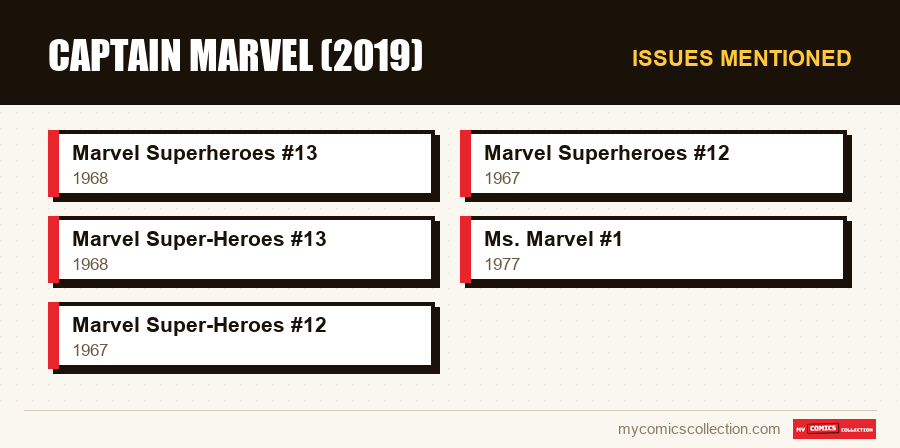
Marvel Super-Heroes #12 (1967): Mar-Vell, the first Captain Marvel
The title of Captain Marvel first belonged to another character: Mar-Vell, warrior of the Kree empire, appeared in Marvel Super-Heroes #12 (1967), created by Stan Lee and Gene Colan. Sent to spy on Earth, he ends up protecting it, becoming a major cosmic hero. The film pays homage to this character while radically transforming him: on screen, Mar-Vell becomes a scientist, Doctor Wendy Lawson, Carol's mentor. This change of gender and role, surprising for readers, serves the structure of the film, where the discovery of the truth about Lawson is a central dramatic driving force. It’s an example of how cinema can reinvent a historical figure to serve a new narrative.
Kree, Skrulls and the Great Reversal
The film is based on one of Marvel's great cosmic conflicts: the war between the Kree, a militaristic empire with blue skin, and the Skrulls, extraterrestrials capable of taking on any appearance. This conflict, culminating in the famous “Kree-Skrull War” of the Avengers (1971-1972), is a pillar of Marvel science fiction. The film takes up the protagonists but makes a daring reversal: traditionally presented as devious invaders, the Skrulls here become persecuted refugees, victims of Kree imperialism. This moral reversal, which takes the viewer on the wrong foot, transforms the story into a fable about prejudices and propaganda. It illustrates the film's desire to shake up expectations by freely appropriating an established mythology.
The characters, from paper to screen
- Carol Danvers: Faithful to his modern (2012) version of Captain Marvel, with a rearranged origin.
- Mar-Vell: Transformed into a female scientist (Wendy Lawson), the opposite of the Kree warrior from the comics.
- Talos: Skrull leader, reinvented as a friendly refugee rather than an invader.
- Nick Fury: Rejuvenated, in a 1990s version that predates the rest of the saga.
- Yon Rogg: Ambiguous Kree mentor, adversary taken from the mythology of Mar-Vell.
Collecting this series?
Track what you own, what you are missing and what your collection is worth. 7 day trial.
Start my trial →An origin located in the 1990s
The choice to set the film in the 1990s, well before the rest of the saga, gives it a particular identity: musical and cultural references of the time, dated technology, and above all a rejuvenated Nick Fury discovering the existence of cosmic threats. This shifted chronology allows the film to function as a founding origin: one which, in the logic of the saga, explains the very idea of a hero “Initiative”. The character of Carol, endowed with almost unlimited power, is presented as an ultimate asset, which justifies her decisive role in the subsequent confrontations. This retrospective construction illustrates the art of the saga of building its coherence after the fact, by linking each new film to the already existing whole.
A title worn by several heroes
The name “Captain Marvel” has a storied editorial history, worn by several characters over the decades. After Mar-Vell's death, the title was taken up by other figures: Monica Rambeau, a heroine who appeared in the early 1980s, wore it for a long time before Carol Danvers; Genis-Vell, son of Mar-Vell, succeeded him. This succession illustrates a common practice at Marvel, where a heroic mantle is passed from wearer to wearer. The film chooses to crown Carol Danvers, the most popular version today, but this richness of history explains some of the complexities of the character on screen. The name “Marvel” itself, loaded with symbolism for the publisher, has always been the subject of particular care.
This genealogy of successive bearers testifies to the vitality of the character and its evolution. From Mar-Vell to Carol Danvers, via Monica Rambeau, the title of Captain Marvel also tells the story of the publisher and its ambitions. By bringing to the screen the modern and assertive version of Carol, the film crowns the culmination of this long line, while opening the door to the discovery of her predecessors, so many characters whose first appearances constitute great collectible targets.
Where to start reading
To discover Carol Danvers, the best entry point is Kelly Sue DeConnick's run (from 2012), which takes her from Ms. Marvel to Captain Marvel and defines the version brought to the screen. Those curious about the origins can go back to Ms. Marvel #1 (1977), then to her first appearance in Marvel Super-Heroes #13 (1968). For cosmic context, the “Kree-Skrull War” (Avengers, 1971-1972) is essential reading, as are the adventures of the original Mar-Vell. From 1967 to 2012, this journey covers the evolution of a character who became one of Marvel's most powerful. DeConnick's run, in particular, remains the most accessible and relatable reading of the film, ideal for discovering the modern Carol Danvers before returning to the older sources.
Chronology of comics to know
- 1967: Marvel Super-Heroes #12: first appearance of Mar-Vell (first Captain Marvel).
- 1968: Marvel Super-Heroes #13: First appearance of Carol Danvers.
- 1977: Ms. Marvel #1: Carol becomes Ms. Marvel.
- 2012: Carol Danvers becomes Captain Marvel (Kelly Sue DeConnick).
Collection side: what numbers to aim for after the film
Captain Marvel highlights several sought-after keys. Marvel Superheroes #13 (first appearance of Carol Danvers) is the centerpiece, a Silver Age number whose popularity has clearly increased with the success of the film. Marvel Superheroes #12 (Mar-Vell's first appearance) is another prime key. Ms. Marvel #1 (1977), where Carol becomes a heroine, is a more accessible Bronze Age target. These numbers cover various budgets. As always, condition and gradation determine value; relying on recent real sales is strongly recommended before any purchase. For a collector, the first appearance of Carol Danvers is the priority objective, driven by the increasing importance of the character.
Its place in the saga and for the collector
Released between Infinity War and its conclusion, Captain Marvel introduces a character called to play a decisive role in the final confrontations of the saga. Its power makes it one of the heroes' major assets in the face of cosmic threats. For the collector, the film had a notable effect on the market: Marvel Super-Heroes #13 saw its value increase, leading to interest in issues linked to Mar-Vell and Kree mythology. This film once again illustrates the ability of cinema to propel a character, and their first appearances, to the forefront. Beyond speculation, it invites us to discover a heroine whose rich and eventful editorial history reflects the evolution of the place of women in comics. By bringing the modern, assertive version of DeConnick to the screen, the film caps decades of character development.
The verdict: a powerful heroine, a rearranged mythology
- Loyalty: Carol Danvers, her Kree powers, the title of Captain Marvel, the Kree and the Skrulls come from the comics.
- Freedoms: the Skrulls rehabilitated into refugees, Mar-Vell transformed into a female scientist, the origin reorganized.
- Collectible numbers: Marvel Super-Heroes #13 (Carol Danvers), #12 (Mar-Vell), Ms. Marvel #1 (1977).
Captain Marvel succeeds in introducing a heroine of colossal power while freely rearranging a complex cosmic mythology. By reversing the role of the Skrulls and reinventing Mar-Vell, the film takes notable liberties, but remains faithful to the essential: a soldier who discovers an unsuspected strength within herself. For both reader and collector, it opens the door to the Kree-Skrull universe and one of Marvel's most sought-after female debut appearances. By placing such a powerful heroine front and center, the film marks an important milestone for representation in the genre. And it reminds us, once again, that behind each cinema character lies a long editorial history, made up of creators, reinventions and founding issues just waiting to be rediscovered by collectors.
Frequently asked questions
From the first appearance of Carol Danvers (Marvel Super-Heroes #13, 1968) and especially from her modern version, who became Captain Marvel in 2012 under the pen of Kelly Sue DeConnick. The film depicts the war between Kree and Skrulls.
The film makes a reversal: traditionally sneaky invaders in the comics, the Skrulls become refugees persecuted by Kree imperialism, transforming the story into a fable about prejudice and propaganda.
Yes: the first Captain Marvel, Mar-Vell, is a male Kree warrior who appeared in Marvel Super-Heroes #12 (1967). The film transforms him into the female scientist, Dr. Wendy Lawson.
In the film, by the explosion of an experimental cosmic energy engine. In the comics (Ms. Marvel #1, 1977), it is an accident mixing her DNA with that of Mar-Vell which gives her her powers.
Marvel Super-Heroes #13 (first appearance of Carol Danvers) is the centerpiece. Marvel Super-Heroes #12 (Mar-Vell) and Ms. Marvel #1 (1977) are the other big targets.
Does the film make you want to collect? Estimate the value for free of your issues (Marvel Super-Heroes #13…) with our tool based on current eBay listings.